Look-Ahead Bias in Backtesting: When Your Strategy Knows the Future
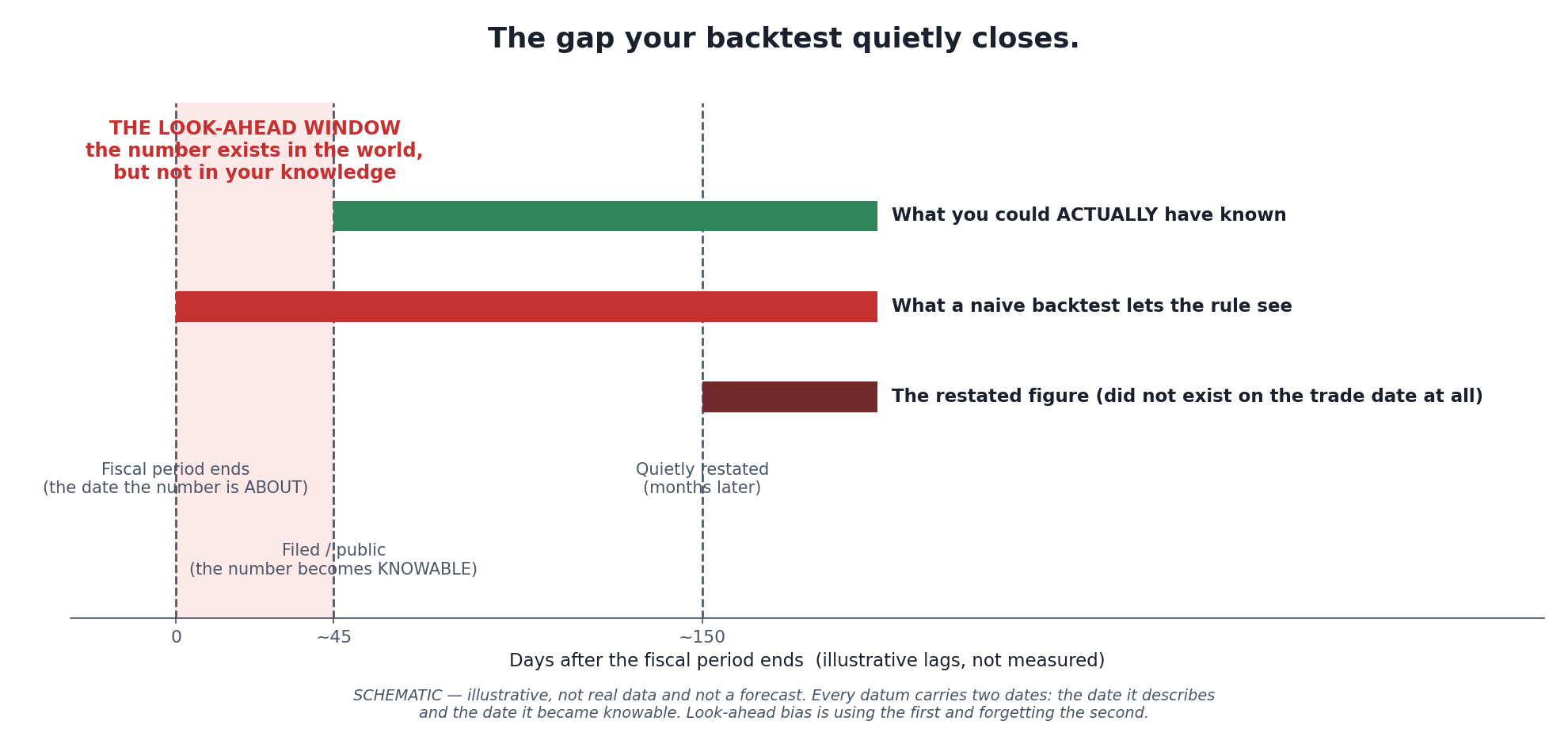
The whole failure in one picture. Financial data carries two dates: the date it is about, and the date it became knowable. Look-ahead bias is what happens when your backtest uses the first and forgets the second — schematic illustration, not measured data.
Overfitting is the failure people talk about. Look-ahead bias is the failure that ships. It is the quietest of the four ways a backtest lies, because it never announces itself: your logic is sound, your out-of-sample window is honest, your costs are in — and your rule still made a decision using a number that did not exist yet on the day it made it.
This is a trading-systems article, and the silo’s non-negotiable rule governs every line: past backtest performance does not predict future results. The figures below are published measurements of a data-handling problem, not returns anyone earned or will earn.
What Look-Ahead Bias Actually Is
Look-ahead bias occurs when a backtest uses information that would not have been available at the moment the simulated decision was made [source: pfolio academy, “Look-ahead bias in backtesting”; AnalystPrep, CFA Level II study notes on backtesting problems — both web-verified 2026-07-12].
The precise mechanism is a timestamp error. Almost every piece of market and fundamental data carries two different dates, and they are not the same date:
- The as-of date — the period the number describes. “Revenue for the quarter ending March 31.”
- The knowable date — the moment the number became public. The filing, the print, the release.
Between those two dates sits a gap, and in that gap the number exists in the world but not in your knowledge. A backtest that joins its data on the as-of date has silently deleted the gap. Your simulated self, standing on April 3rd, is now making a decision using the quarter’s earnings — which nobody outside the company will see for another six weeks.
That is the whole bug. It is one line of a join, and it can manufacture an edge out of nothing.
Where It Hides
Look-ahead bias is not one mistake; it is a family of them. These are the places it actually shows up.
1. Fundamentals joined on the period, not the filing. The textbook case. A company’s fiscal quarter ends, and the results are filed weeks later. If your value or quality screen ranks stocks on “the most recent quarter’s earnings” and the join key is the quarter, every stock is being ranked on numbers that were not yet public.
2. Restated data. This one is nastier, because it survives even a correct filing-date join. Companies revise. A figure reported in July gets quietly restated in September. If your database stores only the final, cleaned version of history — as most convenient databases do — then even a rule that waits for the original filing date is reading the corrected number, a correction that would not exist for months. This is not a hypothetical: research comparing as-reported with restated financial data finds that backtests run on restated data systematically outperform the identical strategy run on as-reported data, with a quality-factor gap of roughly +100 basis points a year in a US equity sample [source: as summarized in the point-in-time literature, attributed to Asness, Frazzini & Pedersen (2019) and related work; via pfolio academy and Compustat Point-In-Time documentation — web-verified 2026-07-12]. A full percentage point a year, from a strategy that looks entirely legitimate.
3. The close-price trap. The most common retail version, and the easiest to commit. Your signal is computed from today’s closing price — and your backtest fills the order at today’s close. You could not have done that. At the instant the close is knowable, the close has already happened. The fill has to be at the next available price. A surprising number of homemade backtests earn most of their return from this single half-bar of impossible timing, and mean-reversion strategies are the worst offenders: buying a big down-close at that close is exactly the trade you could never get.
4. Index membership applied backwards. Membership changes, and the change is announced before it takes effect and recorded in databases as though it always were. Testing “the S&P 500” using today’s constituent list on historical dates is not only survivorship bias — it is also look-ahead, because your rule is being told, in 2015, which companies would be worthy of the index in 2026.
5. Whole-sample statistics. Anything computed over the entire dataset and then applied to every day of it. A volatility normalization that divides by the full-period standard deviation. A “top decile” cutoff computed once across all history. A z-score against the whole sample’s mean. Each of these leaks the future into the past, everywhere, evenly, and none of them look like a bug.
6. Corporate-action adjustments. Split- and dividend-adjusted price series are adjusted retroactively. If your rule triggers on a price level or a moving-average crossover computed from an adjusted series, some of those levels are numbers that never printed on any screen on the day in question.
How Big Is the Damage?
Two published anchors, and they bracket the range.
| Source | Estimated inflation of annual return |
|---|---|
| Restated vs. as-reported fundamentals (quality factor, US equities) | roughly +1.0 percentage point per year |
| Bailey & López de Prado, on backtest hazards in poorly-constructed strategies | +1 to +5 percentage points per year |
[sources: Asness, Frazzini & Pedersen (2019) and related as-reported/restated comparisons, as summarized in the point-in-time literature; Bailey & López de Prado’s work on backtest hazards (2013–2014), as summarized by pfolio academy — both web-verified 2026-07-12.]
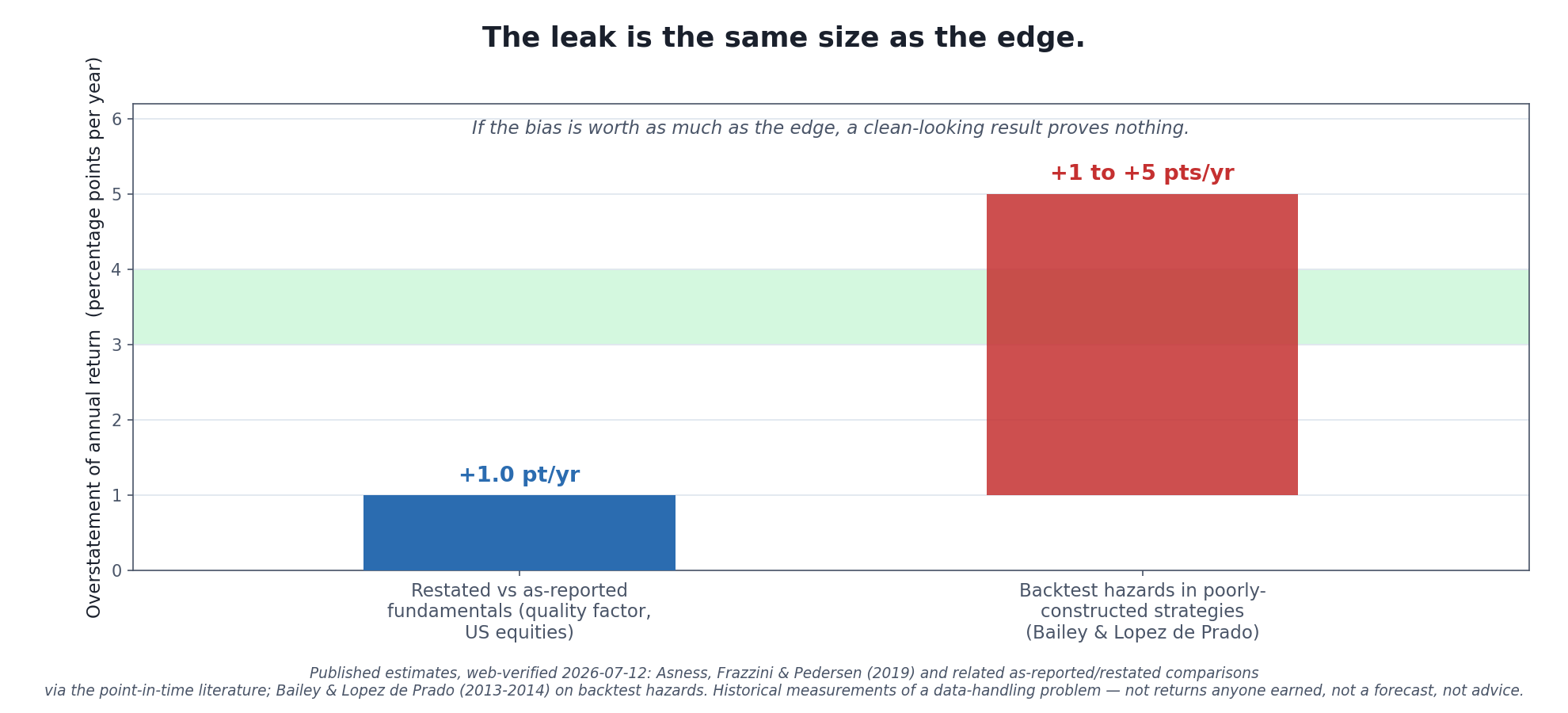
Why this is a fatal flaw and not a rounding error: the range of the bias overlaps the range of a real edge almost exactly. Published estimates; the “good edge” band is an editorial reference, not a measured figure.
Hold that next to what a real edge looks like. A systematic equity strategy that genuinely beats its benchmark by three or four points a year is a good strategy. The range above is the same size as the entire edge. This is why look-ahead bias deserves to be treated as a fatal flaw rather than a rounding error: it does not shave a bit off your honesty. It can be the whole result.
And the close-price trap is worse still than these numbers suggest, because its magnitude scales with how often you trade. A daily strategy that steals half a bar of future information does it every single day. There is no published average for that, because it is not a subtle statistical bias — it is simply a backtest of a trade you cannot place.
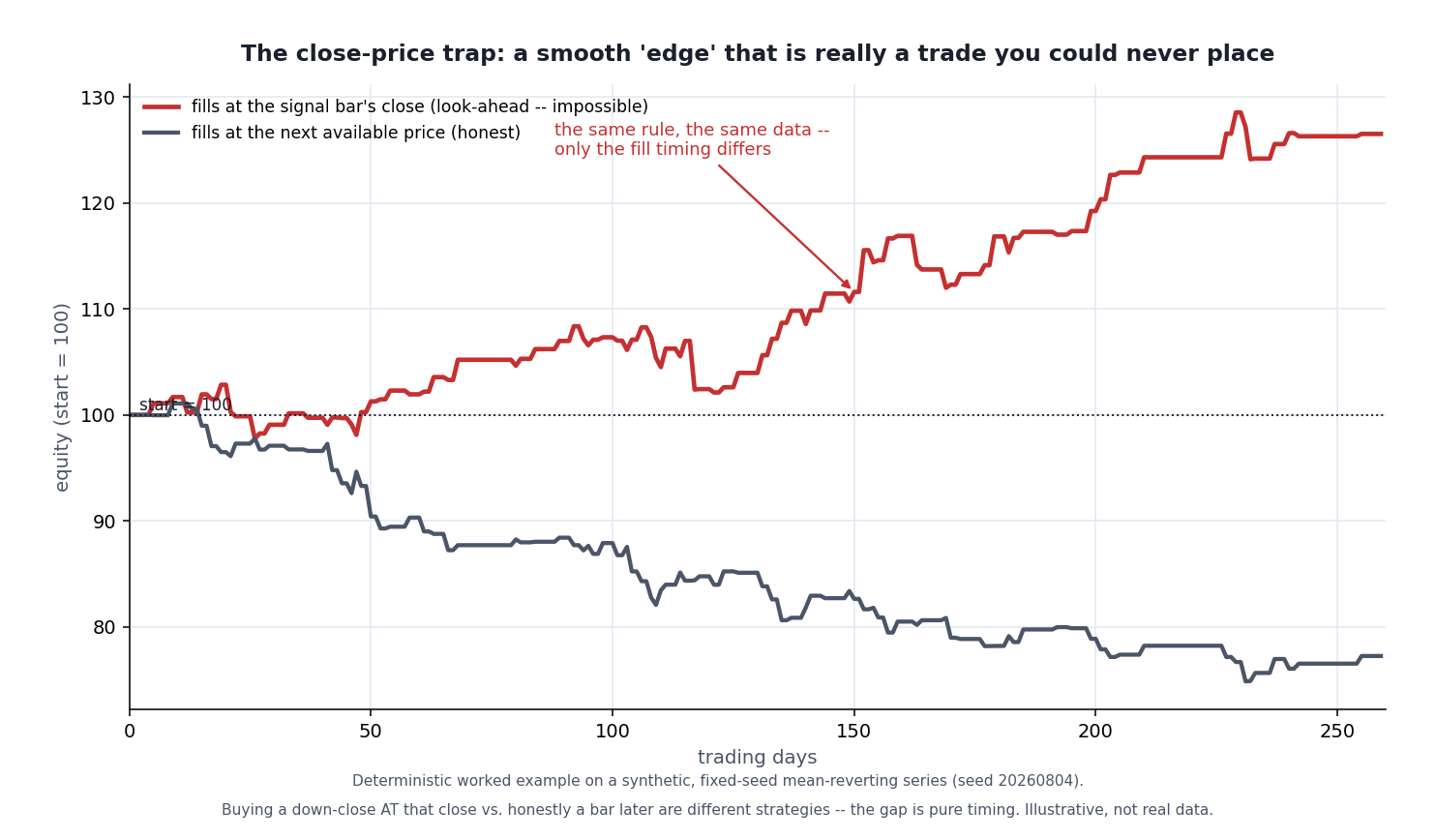
The close-price trap made concrete. Buying a down-close at that close and buying it honestly one bar later are not the same strategy that lost a little to slippage — they are different strategies, and the difference is the whole result. One is a tidy rising edge; the other, the one you could actually have traded, bleeds money. Deterministic synthetic example, not real data.
Why It’s So Easy to Commit
Because the convenient version of every dataset is the biased version. This is the uncomfortable structural fact.
Clean, tidy, single-value-per-date data is what data vendors, spreadsheets, and free APIs give you, because clean history is what almost every other use case wants. If you are writing a report about what happened, you want the restated number and the adjusted price. Point-in-time data — history recorded as it appeared at each moment, revisions and all, with membership dates attached — is bulkier, uglier, more expensive, and less available. The correct data is the inconvenient data.
So look-ahead bias is the default state of a backtest. Avoiding it is an act of deliberate effort, not the natural consequence of being careful.
There is a moment most system-builders eventually have, and it has a particular flavor. Something works. Not spectacularly — nothing suspicious — just steadily, sensibly, the way you’d hope. Then one evening, reading their own code for an unrelated reason, they notice that the signal is computed on bar t and the fill is priced on bar t. They fix the one line. They re-run. The curve goes flat. Nothing about the idea was wrong; nothing about the discipline was lazy. The strategy had simply been buying at prices that were only knowable after the buy. The strange part is not the disappointment — it’s how ordinary the bug looked, sitting there in plain sight, for weeks.
The Timestamp Audit
There is no clever fix. There is a boring, mechanical audit, and it works.
Ask one question of every input: “On the simulated decision date, what exactly did I know, and how do I know I knew it?”
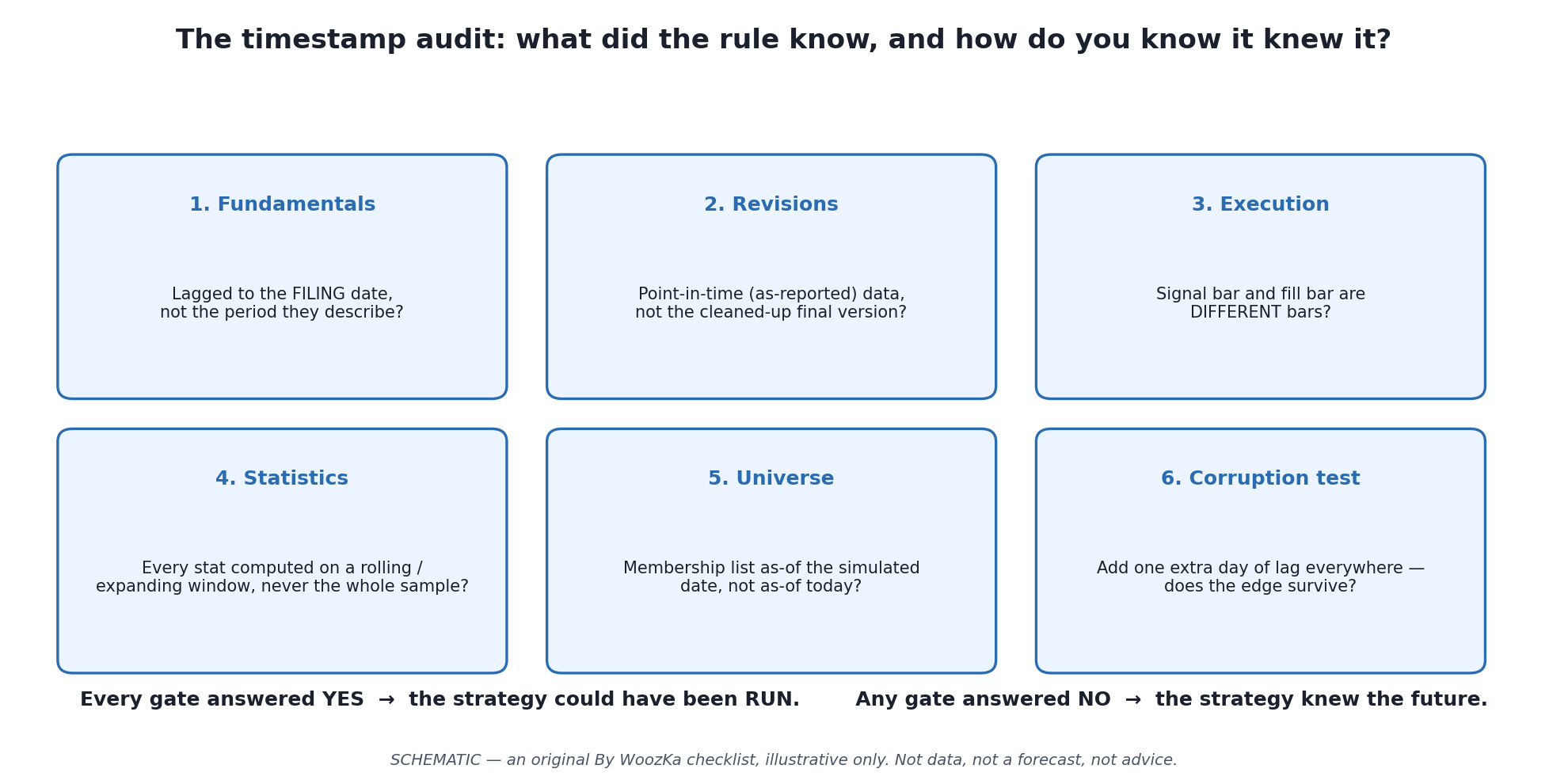
The audit, in full. It is not clever and it is not quick — but every gate it closes is a door the future was walking through. Schematic checklist, not data.
Run that question through the checklist:
1. Lag every fundamental to its filing date, not its period. If you don’t have filing dates, apply a conservative lag as a stand-in — but understand you are patching, not fixing, and say so.
2. Use as-reported (point-in-time) data where you can. A point-in-time database stores each figure as it appeared at each moment, including the versions that were later revised away. This is the actual fix for the restatement problem, and — as with survivorship bias — it is one of the few things a serious backtester should be willing to pay for.
3. Separate the signal bar from the execution bar. Always. If the signal uses the close of bar t, the fill happens no earlier than the open of bar t+1. Make this a structural rule of your backtest engine, not a thing you remember to do. The single most valuable line in a backtester is the one that makes it impossible to fill on the bar that generated the signal.
4. Compute every statistic on an expanding or rolling window. Never on the whole sample. If a number is used on day d, it must have been computable from data up to day d only. This one rule kills the entire “whole-sample statistics” family at a stroke.
5. Ask where your universe list came from, and as of when. Same question as survivorship bias — the two failures share a data source and frequently travel together.
6. Run the deliberate-corruption test. This is the sharpest diagnostic there is, and almost nobody does it. Add an extra day of lag to every input — one more day than you think you need — and re-run. If the result collapses, your edge was living in the timing, not in the idea. A real edge degrades gracefully as you make it more pessimistic. A look-ahead artifact falls off a cliff, because the thing you removed was the edge.
The six gates. Every gate answered yes means the strategy could have been run. Any gate answered no means it knew the future.
| Gate | The question |
|---|---|
| 1. Fundamentals | Lagged to the filing date, not the period they describe? |
| 2. Revisions | Point-in-time as-reported data, not the cleaned-up final version? |
| 3. Execution | Are the signal bar and the fill bar different bars? |
| 4. Statistics | Is every statistic computed on a rolling or expanding window, never the whole sample? |
| 5. Universe | Is the membership list as of the simulated date rather than as of today? |
| 6. Corruption test | Add one extra day of lag everywhere — does the edge survive? |
The Honest Summary
Overfitting is a failure of your judgment — you searched too hard. Survivorship bias is a failure of your data — the losers were deleted before you arrived. Look-ahead bias is a failure of your plumbing, and that is precisely why it is so dangerous: plumbing does not feel like a place where a strategy’s returns come from.
But it is. A join key, a fill price, a z-score computed once over the whole file — any one of them can hand your rule a small piece of the future, and a small piece of the future is worth more than any edge you are likely to find. The test is not whether your strategy is clever. The test is whether it could have been run, in real time, by someone who did not yet know how the story ended.
Keep Going
- How to Backtest a Trading Strategy the Right Way — the pillar. Look-ahead bias is one of four ways a backtest lies; this is the honest process that guards against all of them.
- Survivorship Bias in Backtesting — the sibling data failure. The two share a root cause: a dataset assembled with hindsight.
- What Is Overfitting in Backtesting (And How to Avoid It) — the failure of searching too hard, rather than of knowing too much too early.
- Walk-Forward Analysis: Testing a Strategy Like a Quant — and note the same limitation as with survivorship bias: a walk-forward split does not remove look-ahead bias, because the leak is inside both halves of the data.
- What Makes a Trading System Robust? A Checklist — where the timestamp audit belongs on the checklist, next to data provenance and cost realism.
If you want the plain-English, rigor-first read on building and judging trading systems — the version where every result arrives with the ways it might be fake attached — that’s what the newsletter is for. Subscribe below.
Disclaimer: This article is educational content, not financial advice. I am not a licensed financial advisor, and nothing here is a recommendation to buy or sell any security or asset. Investing and trading involve risk, including the possible loss of the money you invest. Do your own research and consider consulting a licensed financial professional before making investment decisions. Read the full Disclaimer.
Historical and backtested results are hypothetical, carry inherent limitations, and do not guarantee future results. Figures were accurate to the best of my knowledge as of this article’s last-updated date and may have changed.
