Day Trading, Honestly: The Session You Trade and the Spread You Pay Are Both Working Against You
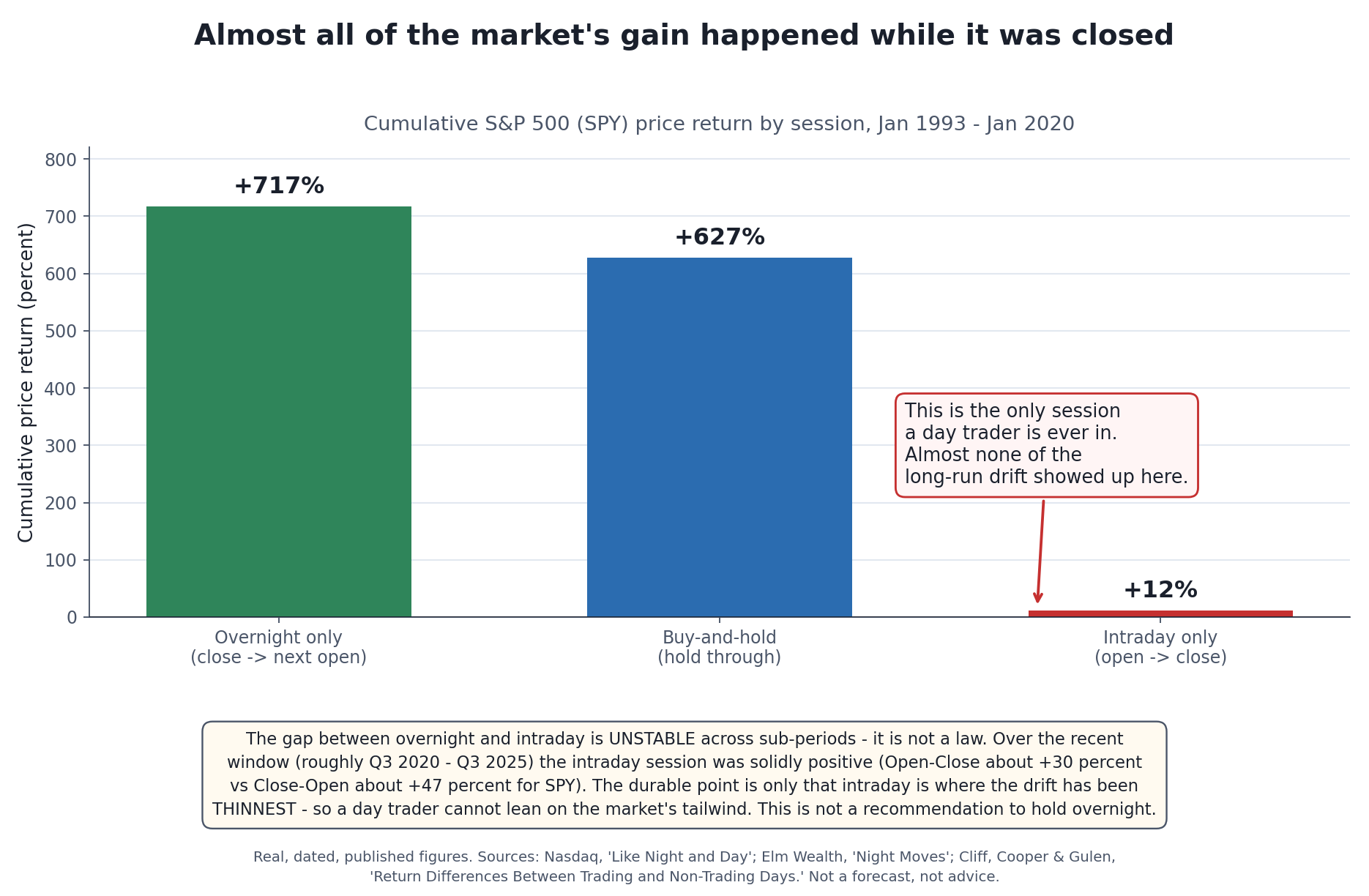
The single most uncomfortable fact about day trading, and it has nothing to do with your ability. Over 27 years, essentially all of the S&P 500’s price gain accrued while the market was closed — between the previous close and the next open. The open-to-close session, which is the only session a day trader is ever in, delivered a rounding error. A day trader has volunteered to compete for the flat bar.
There is an evidence-first version of the day-trading conversation, and this site already has it: Day Trading — What the Evidence Actually Says walks through the large administrative-data studies that counted what happened to entire national populations of retail day traders, and the answer was consistent and brutal across countries and decades. That article asks what happened. This one asks something different and, I think, more useful for anyone still drawn to the style: why is the game structured the way it is? Not “do people lose” but “what, mechanically, is stacked against them before skill even enters the picture?”
The honest answer is that two features of market structure are working against a day trader from the first click, and neither is about being smart or disciplined. You are trading in the half of the day that has historically carried almost none of the market’s return, and you are, by construction, the least-informed participant in nearly every fill you get. This article is about those two headwinds — and, because an honest style piece has to, about who the style still genuinely suits despite them.
This is a trading-systems article, so the silo’s non-negotiable rule governs every line: past performance does not predict future results. Nothing here is a recommendation to trade or not to trade. The point is to describe a mechanism accurately, so that anyone who does choose this style is choosing it with the structure in plain view.
Headwind One: You Chose the Low-Drift Half of the Day
Start with the definition, because the definition is the trap. A day trade is any position opened and closed within the same session — the defining constraint is that you are flat by the close. No overnight risk. That is the feature the style is sold on: you sleep in cash, immune to the gap that guts a swing trader when bad news breaks at 2 a.m.
But “flat by the close” has a cost that almost nobody prices, and the featured chart above is it. Decompose the S&P 500’s history into two non-overlapping sessions — the overnight move (from each day’s close to the next day’s open) and the intraday move (from each open to that day’s close) — and the two could not look more different. From January 1993 to January 2020, the overnight-only return was roughly +717%, comfortably beating even buy-and-hold’s +627%, while the intraday-only return was about +12% — barely off the floor [sources: Nasdaq, “Like Night and Day”; Elm Wealth, “Night Moves: Is the Overnight Drift the Grandmother of All Market Anomalies?”; academic treatment in Cliff, Cooper & Gulen, “Return Differences Between Trading and Non-Trading Days” — web-verified 2026-07-21]. Nearly the entire long-run gain of the U.S. stock market happened while the market was shut.
Sit with what that means for the style. A day trader is, by the rules of the game they have chosen, structurally absent for the part of the day that has historically paid, and structurally present for the part that hasn’t. The buy-and-hold investor collects the overnight drift by doing nothing — they are simply holding through the close. The day trader has deliberately opted out of it in exchange for control. That is a real trade, and control has real value. But it is a trade, and the thing being given up is most of the historical return.
Two honest caveats, because this is exactly the kind of striking statistic that gets abused:
First, the effect is unstable, and it may be fading. The overnight-versus-intraday gap is not a smooth, reliable law; it varies a great deal across sub-periods, and over the most recent five years (roughly Q3 2020 to Q3 2025) the intraday session was actually solidly positive — a Close→Open of about +47% against an Open→Close of about +30% for SPY — so “intraday always loses” is false and I am not claiming it [source: recent SPY session decompositions, web-verified 2026-07-21]. More pointedly, the narrower, best-documented slice of the overnight premium — a single early-morning window in equity-index futures — has, per the New York Fed’s own researchers, averaged close to zero since 2021 [source: “The Disappearing Overnight Drift,” Federal Reserve Bank of New York, Liberty Street Economics, July 1, 2026 — as covered in this site’s swing-trading piece]. So this is not “hold overnight, free money” — that free lunch has its own problems, covered elsewhere.
Second, and this is the point that survives the caveats: the argument here is not that overnight is a guaranteed winner. It is that the intraday session is where the long-run drift has been thinnest, so a day trader cannot lean on the market’s natural upward tendency to bail out a mediocre entry the way a buy-and-hold investor can. Time is not on your side inside the session the way it is across the years. You have to earn your entire return from timing, in the window where the tailwind is weakest. Whatever your edge is, it is doing all the work alone.
Headwind Two: You Are the Uninformed Side of Every Trade
The second headwind is subtler and, once you see it, harder to un-see. It lives inside the bid-ask spread — the small gap between the price you can buy at and the price you can sell at, which you pay every single round trip.
Most people think of the spread as a fee, like a toll. It isn’t, and the difference matters enormously. The spread is compensation for adverse selection — it is the price a market maker charges to protect themselves against the possibility that whoever is trading with them right now knows something they don’t [foundational sources: Glosten & Milgrom, “Bid, Ask and Transaction Prices in a Specialist Market” (JFE, 1985); Kyle, “Continuous Auctions and Insider Trading” (Econometrica, 1985) — the two papers that formalized the spread as an information cost]. A market maker quotes a price to the whole world. Some of the people who hit that quote are uninformed (they are rebalancing, hedging, or just guessing). Some are informed (they know the next tick). The market maker cannot tell them apart in the moment, and they systematically lose to the informed ones — so they widen the spread on everyone to break even on average. The spread exists because someone in the room knows more than the market maker, and the maker is charging admission against that person.
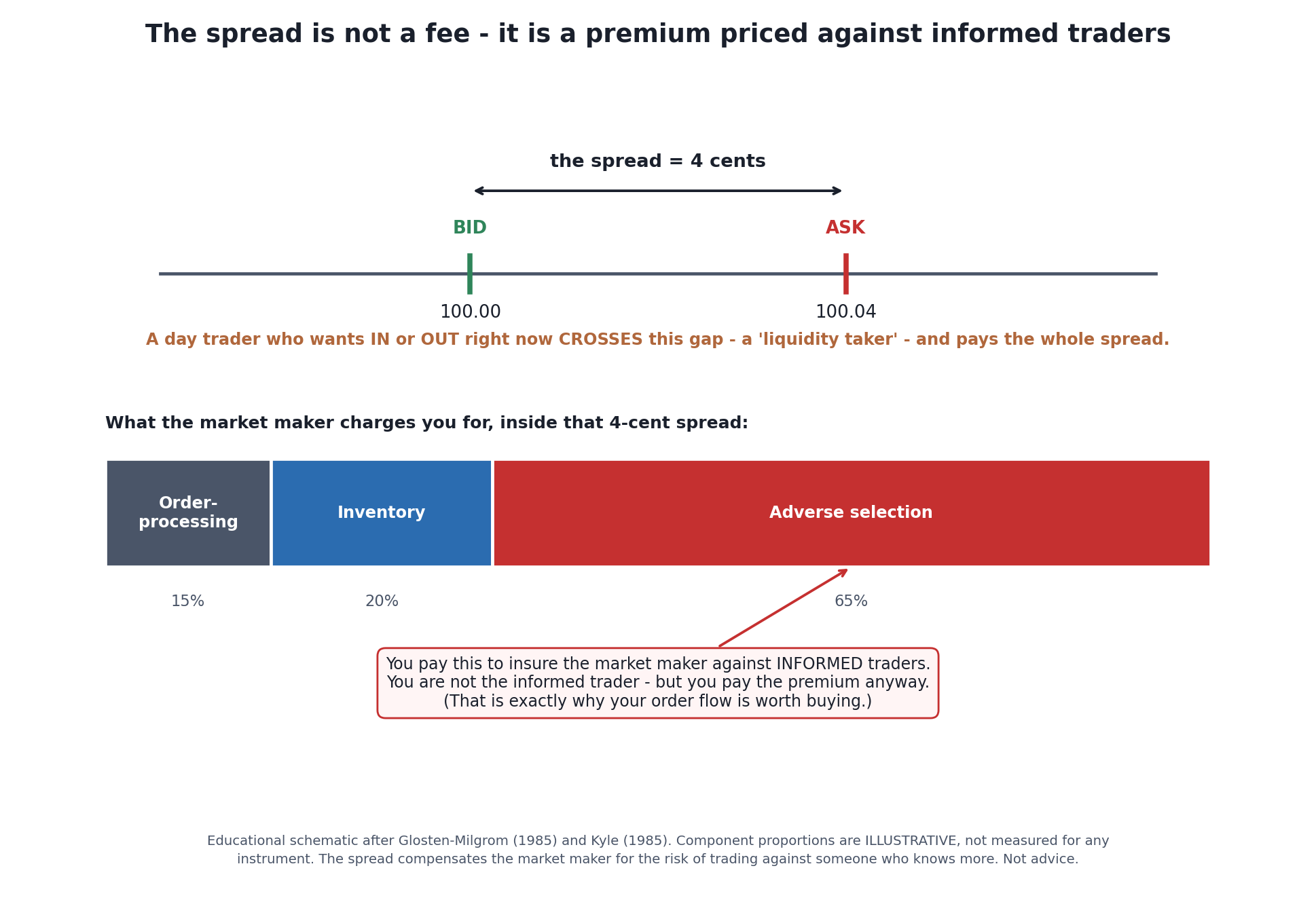
Why the spread is a structural tax on the retail day trader specifically. The adverse-selection slice is insurance the market maker buys against being picked off by someone who knows more. As a retail trader crossing the spread for a quick fill, you pay that insurance premium on every round trip — while being, almost by definition, the person the premium is protecting your counterparty against, not the one profiting from superior information.
Here is why that is a headwind aimed squarely at retail day traders. When you place a market order to get in right now — which is what impatience and short holding periods push you toward — you are a liquidity taker. You cross the spread; you pay it. And you pay the full spread, including the adverse-selection premium, even though you are, statistically, not the informed party that premium exists to guard against. In fact, the entire economics of modern commission-free trading rests on this: wholesalers pay your broker for the right to fill your orders precisely because retail order flow is, in the aggregate, uninformed and therefore safe to trade against — “less toxic than institutional flow,” in the literature’s phrasing [sources: SEC DERA working paper, “How Does Payment for Order Flow Influence Markets?” (2025); Federal Reserve, “Who Is Minding the Store? Order Routing and Competition in Retail Trade Execution,” FEDS 2024-080]. Your order is valuable to a professional counterparty specifically because it does not carry information. That is not an insult; it is the market’s structural assessment of the average retail order, and it is why the flow gets bought and sold at all.
So the second headwind, stated plainly: the spread is a premium priced against informed traders, and as a retail liquidity-taker you pay it in full while being the group the premium is defined against. The more often you cross it — and frequency is the essence of day trading — the more of this structural tax you pay. This is a different, deeper point than the raw “costs scale with frequency” arithmetic in the evidence article; that piece shows the toll grows with how often you trade, and it does. This one shows why the toll exists at all, and why its very existence is a statement about your structural position in the trade.
Putting the Two Together: Your Real Hurdle Is Not Zero
Combine the headwinds and you get the mistake at the center of most day-trading ambition: imagining that the bar to clear is zero — that as long as you don’t actively lose, you’re fine.
You aren’t, because your true benchmark is not “flat.” It is what the same capital and effort would have done in a hands-off index position — the return you gave up to be in cash overnight and active all day. To beat that benchmark, your intraday timing has to generate, through skill alone, the drift you opted out of plus the spread you cross on every trade. The zero-hurdle intuition is off by the sum of two things you cannot see on your P&L screen.
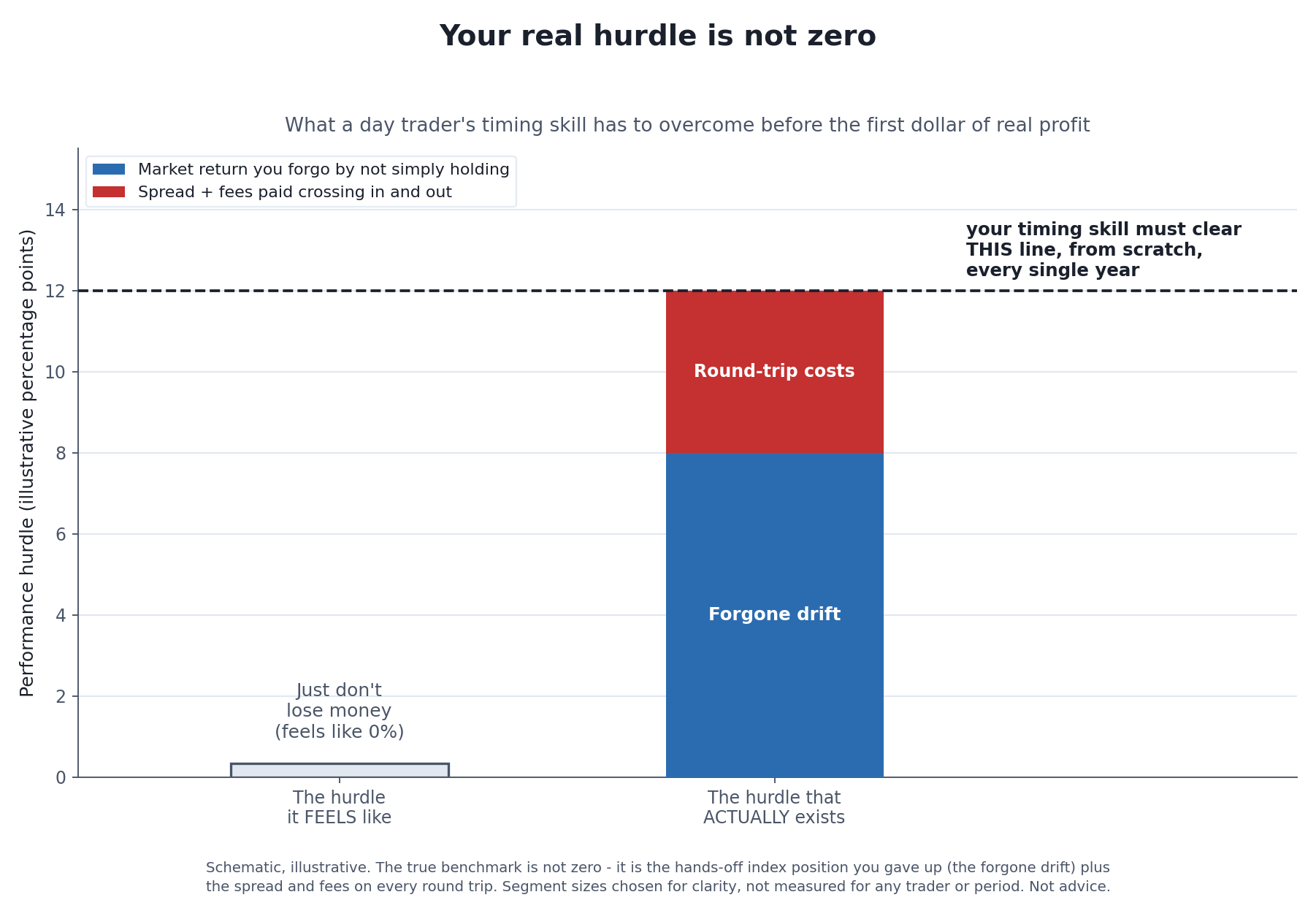
The reframing that changes the whole calculation. A day trader instinctively measures success against zero — did I end the day green? But the honest benchmark is the index position they abandoned. Their timing has to first rebuild the market’s own drift (Headwind One) and then pay the spread on every entry and exit (Headwind Two) before any of the profit is genuinely theirs. The bar is not at the floor. It is well above it, and it resets every year.
This is why “I was profitable last month” is such a weak signal, and why it feels so much stronger than it is. Beating zero is easy in a rising tape. Beating the position you gave up, net of the spread you paid to be active, over a sample long enough to rule out luck — that is the actual test, and almost nothing in the day trader’s daily experience is measuring it.
The Failure Mode: The Brake Came Off in 2019
Every honest style piece has to name the failure mode — the specific way the style hurts people who adopt it — and for day trading in the 2020s the failure mode is not a chart pattern. It is that the one thing that used to physically restrain overtrading has been removed, while everything above stayed exactly the same.
For decades, every trade carried a visible commission — a number that appeared on your screen and stung. That sting was, accidentally, a brake. It made you hesitate before the marginal trade, because the cost of frequency was staring at you. In late 2019, the major U.S. brokers eliminated commissions, and trading apps rebuilt themselves around zero-commission, frictionless, gamified execution [source: the late-2019 shift to commission-free retail trading, funded by payment for order flow — SEC DERA (2025); Wharton WIFPR, “Payment for Order Flow and the Retail Trading Experience”]. The felt cost of one more trade dropped to nothing.
But the real cost did not drop to nothing. It moved. Commission-free trading is paid for by selling your order flow to wholesalers, and the wholesaler’s revenue comes out of the same bid-ask spread we just dissected — payment for order flow and your price improvement are both bounded by that spread, competing for the same pennies [source: SEC DERA (2025); Federal Reserve FEDS 2024-080]. So the spread, and the adverse-selection premium buried in it, is still there on every round trip. What disappeared was not the cost. What disappeared was the part of the cost you could see — the brake.
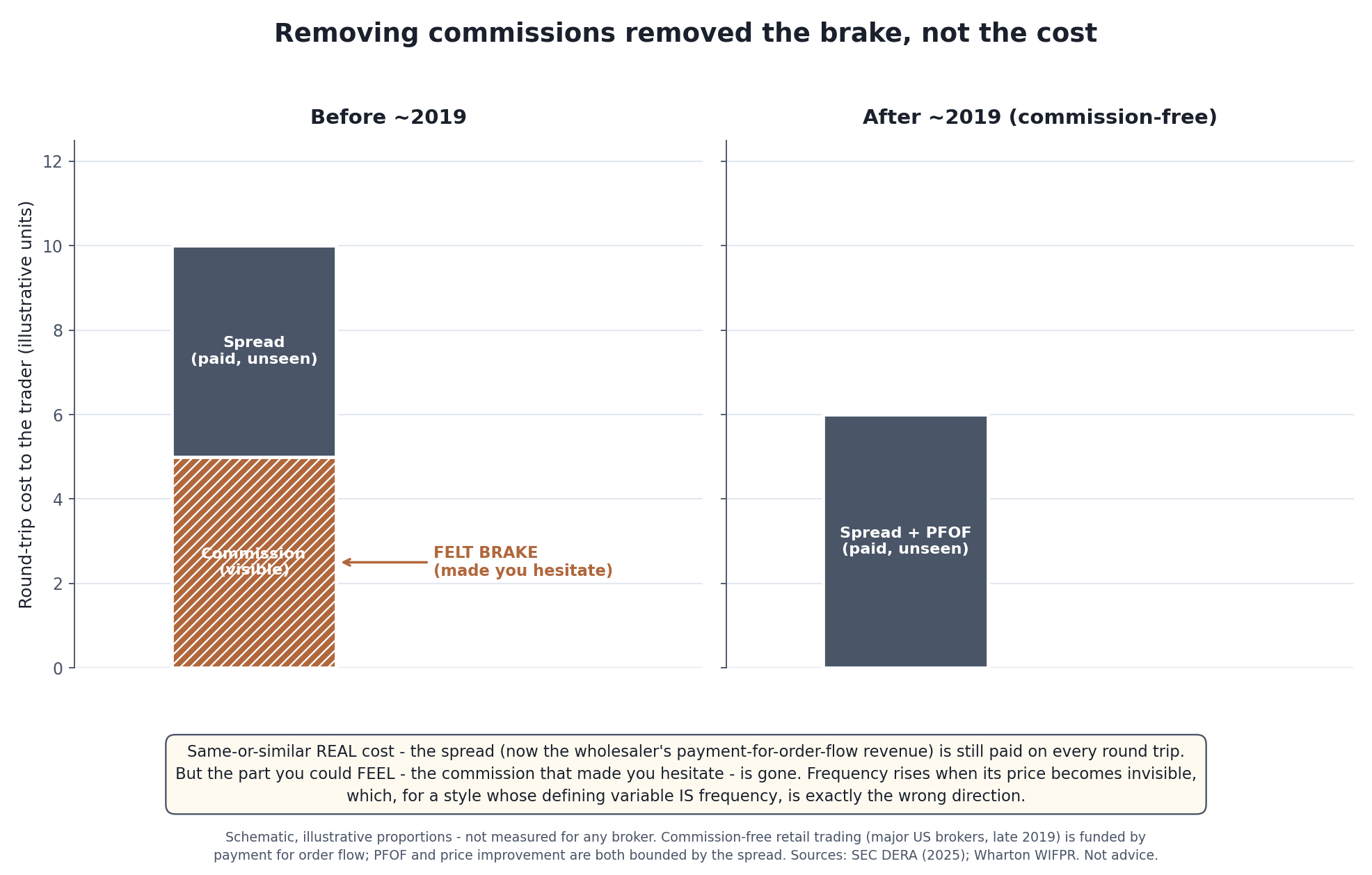
The failure mode, in one comparison. Removing commissions did not remove the cost of trading — it removed the only part of the cost you could feel. The spread is still there, quietly, on every entry and exit. When the price of an activity becomes invisible, people do more of it — which, for an activity whose defining variable is frequency and whose structure is already tilted against you, is precisely the wrong direction. The 2019 change made a structurally losing activity easier to do more often.
That is the mechanism behind the modern surge in retail day trading, and it is why the timing matters. Nothing in the two headwinds changed in 2019. The intraday session is still the low-drift session. The spread is still an adverse-selection premium you pay as the uninformed side. What changed is that the friction which used to make you think twice was quietly deleted, and replaced with an interface engineered to make the next trade feel free and frictionless. The failure mode of day trading today is doing more of a structurally disadvantaged activity, faster, with the one natural brake removed.
And in 2026 a second brake came off — this one deliberately, and by the regulator. For twenty-five years a US account flagged as a “pattern day trader” had to hold a minimum equity of $25,000 on any day it day-traded. The SEC approved FINRA’s amendments to Rule 4210 on April 14, 2026; they took effect June 4, 2026, eliminating both the trade-counting test and the $25,000 minimum and replacing them with intraday margin standards that measure a customer’s actual exposure through the trading day, with firms permitted to phase in until October 20, 2027 [source: FINRA Regulatory Notice 26-10, “FINRA Adopts New Intraday Margin Standards to Replace the Day Trading Margin Requirements,” April 20, 2026]. That threshold was never designed as a filter on who should day-trade, but it worked as one. Neither brake was ever the reason this style is hard. Both were, for a while, reasons that fewer people had to find out.
Who the Style Genuinely Suits — Honestly
A style piece that only stacked up the case against would be dishonest in the other direction, so here is the other side, stated as plainly as the headwinds.
The headwinds are structural, not universal. They describe the average retail day trader crossing the spread for immediacy in a low-drift session. There are real people for whom the picture is different, and they are worth naming precisely:
- Liquidity providers, not takers. If you consistently post resting orders and get filled when others cross to you — genuinely providing liquidity rather than demanding it — then you are, at least sometimes, on the earning side of the spread rather than the paying side. This is hard, capital- and technology-intensive, and not what a phone app encourages, but it inverts Headwind Two rather than suffering it.
- Someone with a genuine, identified informational or structural edge — speed, a specialized data set, a market-making or hedging function, an execution advantage — who has measured it against the spread they actually pay and found it larger. That person exists. They are not guessing that they have an edge; they have quantified one and checked it clears the toll.
- Someone trading capital whose total loss would not damage their life, who has pre-committed to a risk framework they cannot revoke in the moment, and who is honest that the intraday session gives them no help from drift.
Who it does not suit is the mirror image, and it is most people the marketing targets: someone attracted by the frequency itself — the action, the screen time, the feeling of doing something — crossing the spread for immediacy, in a session with no tailwind, now that the brake is gone. If the appeal of the style is precisely the thing that removed your brake and put you on the paying side of the spread, the structure has found you before your skill ever gets a turn.
Notice that this is the same conclusion the evidence article reaches from the outside, via the survival statistics. The two articles meet in the middle: the studies show that the outcomes are brutal; the market structure shows why they would be, even for people who are not doing anything obviously wrong. A structural disadvantage does not mean nobody clears it. It means the bar is higher than it looks, and it is higher for reasons that have nothing to do with how hard you are willing to work.
The version most active traders will recognize goes like this. For a stretch, it works — the account is green more days than not, and the natural conclusion is that you have found something. What is actually happening is harder to see: the tape is drifting up underneath you, so even mediocre entries resolve in your favor often enough to feel like skill, and the spread you pay on each trade is small enough per-trade to disappear into the noise. Then the tape stops helping — a flat or choppy stretch arrives, the kind that removes the drift you were unknowingly borrowing — and the same trading that felt sharp last quarter now bleeds, slowly, a few ticks at a time. The uncomfortable realization is not a big loss. It is the discovery, on totting it all up, that a year of intense daily effort roughly matched, or trailed, the index position you could have held while asleep — and that the difference was sitting in the spread the whole time, invisible, being collected by someone on the other side who was very happy to have your uninformed flow.
The Summary
Day trading is hard for reasons that sit underneath skill, in the structure of the market itself:
- You trade the low-drift half of the day. Historically almost all of the market’s return has accrued overnight, in the session a day trader is required to sit out. Your timing has to generate the whole return alone, without the market’s natural tailwind — and the effect is unstable enough that you cannot count on the reverse, either.
- You are the uninformed side of every fill. The spread is not a fee; it is an adverse-selection premium, and as a retail liquidity-taker you pay it in full while being the very group it is priced against — which is exactly why your order flow is worth buying.
- Your real hurdle is not zero. It is the market return you forgo plus the spread you cross, and your timing skill must clear that stack from scratch before any profit is genuinely yours.
- The one natural brake is gone. Commission-free trading removed the visible cost that used to make you hesitate, without removing the actual cost — so the structurally disadvantaged activity became easier to do more of.
None of this says nobody can day trade profitably. A small, real, identifiable group can, and this piece names them. It says the game is tilted before you sit down, for reasons that have nothing to do with how clever or disciplined you are — and that anyone choosing the style should choose it seeing the tilt, not in spite of not knowing it is there.
The style, in one line: day trading asks your timing skill to overcome the market’s own structure — the session that doesn’t pay and the spread that assumes you don’t know anything — and it recently removed the one thing that used to slow you down while you tried.
Keep Going
- Day Trading — What the Evidence Actually Says — the companion piece: what actually happened to entire populations of retail day traders, and why experience doesn’t seem to repair it.
- Swing Trading, Honestly — the mirror-image style, which holds overnight to collect the very drift a day trader forgoes — and why that compensation has recently gone quiet too.
- How to Backtest a Trading Strategy the Right Way — why a backtest that ignores the real spread and the forgone drift is testing a game you’ll never actually play.
- Trade Expectancy Explained — the formula that tells you whether a high-frequency style can actually clear its own costs.
- Risk of Ruin: Why a Winning System Can Still Blow Up — why survival, not edge, is decided by size, which matters most in the styles that trade most.
If you want the plain-English, evidence-first read on trading systems — including the parts that cost you something — that’s what the newsletter is for. Subscribe below.
Disclaimer: This article is educational content, not financial advice. I am not a licensed financial advisor, and nothing here is a recommendation to buy or sell any security or asset. Investing and trading involve risk, including the possible loss of the money you invest. Do your own research and consider consulting a licensed financial professional before making investment decisions. Read the full Disclaimer.
Historical and backtested results are hypothetical, carry inherent limitations, and do not guarantee future results. Figures were accurate to the best of my knowledge as of this article’s last-updated date and may have changed.
