Day Trading and Taxes: The Third Headwind Nobody Prices In
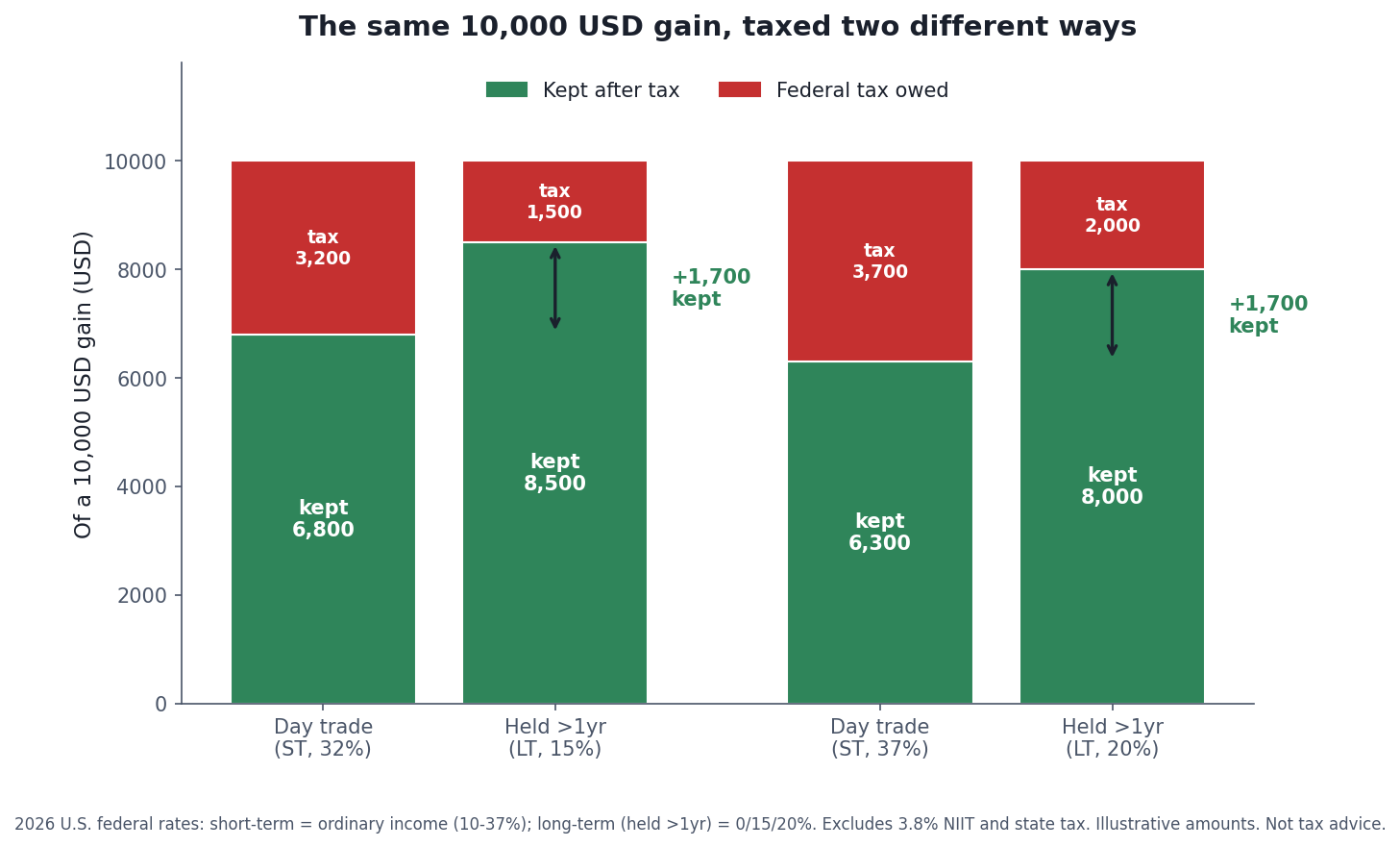 The single cleanest way to see the tax headwind. Two people make the exact same $10,000 profit on the exact same stock. One held it for thirteen months and pays the long-term rate; the other closed it the same afternoon, forty times over the year, and pays the ordinary-income rate on every one. The day trader is not on the expensive side by accident or by bad luck — the style’s defining constraint, closing every position fast, puts them there on every single trade.
This site already has two honest pieces on why day trading is hard, and neither one is about taxes. Day Trading, Honestly is about market structure — the low-drift intraday session and the adverse-selection spread you cross on every fill. Day Trading — What the Evidence Actually Says is about outcomes — the large administrative-data studies, and the arithmetic where your total transaction cost scales with how often you trade. Read those first if you haven’t; this piece assumes them.
What this one adds is a third cost, and it is the one day traders price in least, because it doesn’t show up on the trading screen at all. It shows up in April. The tax code treats a day trader and a buy-and-hold investor as two entirely different kinds of taxpayer, and almost every one of those differences runs against the day trader. You can beat the spread. You can beat the transaction toll. You can end the year genuinely ahead on your P&L — and still keep meaningfully less of it than someone who bought an index fund and forgot the password, for reasons that have nothing to do with how good your trading was.
This is a trading-systems article, so the silo’s non-negotiable rule governs every line: past performance does not predict future results, and nothing here is a recommendation to trade, not to trade, or to adopt any tax position. I am not a tax advisor, the rules below are the U.S. federal rules as of mid-2026, they change, and your own situation can differ in ways only a qualified professional can address. The point is to describe a mechanism accurately, so anyone drawn to the style sees the whole bill.
Headwind One: Every Day-Trade Gain Is Short-Term — and Short-Term Is the Expensive Rate
Start with the rule that does the most damage, because it is both the simplest and the least escapable.
The U.S. tax code splits investment gains into two buckets by how long you held the asset. Hold more than one year and a profit is a long-term capital gain, taxed at a preferential rate of 0%, 15%, or 20% depending on your income. Hold one year or less and it is a short-term capital gain, taxed at your ordinary-income rate — the same schedule as your salary, running 10%, 12%, 22%, 24%, 32%, 35%, up to 37% at the top [source: IRS 2026 capital-gains rules; 2026 ordinary-income brackets — NerdWallet and Tax Foundation 2026 tables, web-verified 2026-07-30].
Now apply the definition of the style. A day trade is opened and closed the same session. Its holding period is measured in minutes or hours. That means a day trader can never, structurally, earn a long-term gain. Every dollar of trading profit lands in the expensive bucket, at the ordinary rate, by the very rule that defines what a day trade is. The preferential long-term rate — the single biggest tax break available to a long-term investor — is not something the day trader is failing to optimize. It is something the style makes categorically impossible to reach.
The featured chart above shows what that costs on a single $10,000 gain: a trader in the 32% bracket keeps $6,800 as a day trader versus $8,500 as a one-year holder, a $1,700 difference on an identical profit — and the gap is the same $1,700 at the very top, 37% against 20%. That is before you add the 3.8% net investment income tax that can apply to higher earners, or any state income tax — both of which also hit short-term gains at the higher, ordinary-income-linked treatment. The chart understates the gap; it does not overstate it.
None of this makes long-term investing “better” in some universal sense — a long-term holder is taking a completely different kind of risk, sitting through drawdowns a day trader never holds through. The point is narrower and it is about net, not gross. Two strategies that produce the identical pre-tax dollar do not produce the identical after-tax dollar, and the day-trading style is on the losing side of that split by construction, every time.
Headwind Two: You Give Up Tax Deferral — and Deferral Is Where Compounding Lives
The rate is the obvious cost. The second one is quieter and, over time, often larger: when you realize a gain, you owe the tax now — and money paid in tax this year can never compound for you again.
A buy-and-hold investor who never sells owes nothing in the meantime. Their gains are unrealized; the tax is deferred, sometimes for decades, and the entire pre-tax balance keeps compounding. A day trader, by contrast, realizes everything, constantly — every position is closed, every gain is booked, and a slice of it is handed to the tax authority every single year. The trader is not just paying a higher rate; they are paying it earlier, and “earlier” is expensive in a way that is easy to miss.
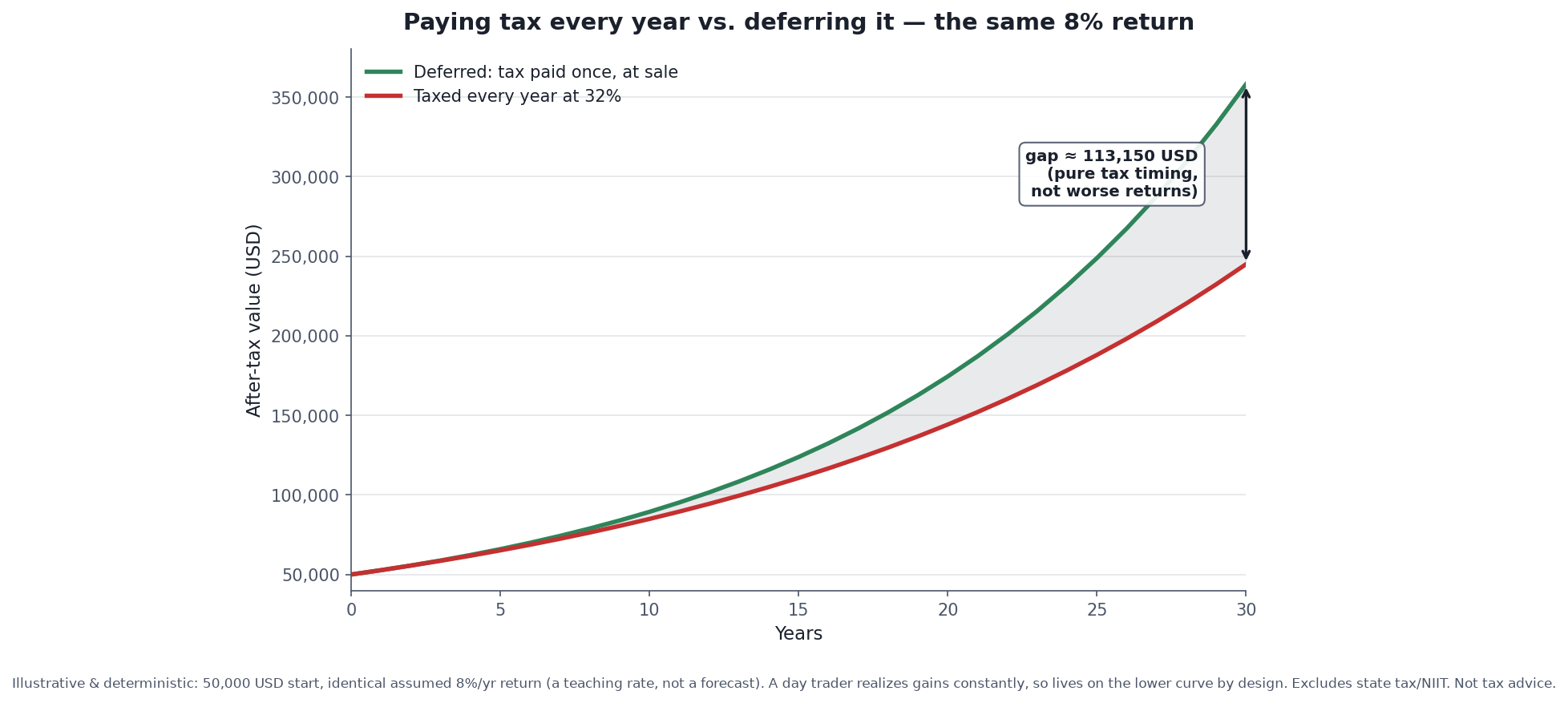 Two investors, same return, same rate — the only difference is when the tax is paid. Paying 32% on each year’s gain as it is booked leaves a smaller base to compound, and the shortfall snowballs. Over 30 years at an assumed 8%, the annually-taxed path ends well behind the deferred one, and every dollar of the gap is tax timing, not trading. A day trader realizes gains constantly, so they live on the lower curve by design — even in the years the trading itself goes well.
The chart makes the mechanism concrete: two identical 8% returns on the same starting capital, one taxed only at the very end, one taxed 32% every year as gains are booked. The annually-taxed path compounds on a smaller base each year, and the gap widens the whole way. That gap is not a difference in returns or skill — both earn exactly 8% — it is purely the cost of paying tax early instead of late.
A day trader lives on the lower curve permanently, because realizing gains fast is not a choice they can defer; it is what the style is. Even a day trader with a real, positive edge is compounding their capital on a base that the tax code shrinks every year — while the passive holder compounds on the full amount and settles up once, later, at a lower rate. This is the part of the tax headwind that survives even if you are good: skill raises the return, but it does not buy back the deferral you gave up by closing every position the same day.
Headwind Three: The Wash-Sale Rule Turns Your Losses Into a Trap
The first two headwinds are about gains. The third is about losses — and it is the one that catches active traders by surprise, because it makes losses you genuinely suffered temporarily disappear from your tax return.
The wash-sale rule says that if you sell a security at a loss and buy the same (or a “substantially identical”) security within 30 days before or after that sale, you cannot deduct the loss on that sale. The disallowed loss isn’t gone forever — it gets added to the cost basis of the shares you rebought, so you recover it later, when you finally sell the replacement without rebuying [source: Internal Revenue Code §1091; IRS Publication 550, “Investment Income and Expenses” — the rule is longstanding U.S. tax law]. The intent is to stop people from selling purely to harvest a tax loss while staying in the position. But look at who it hits hardest.
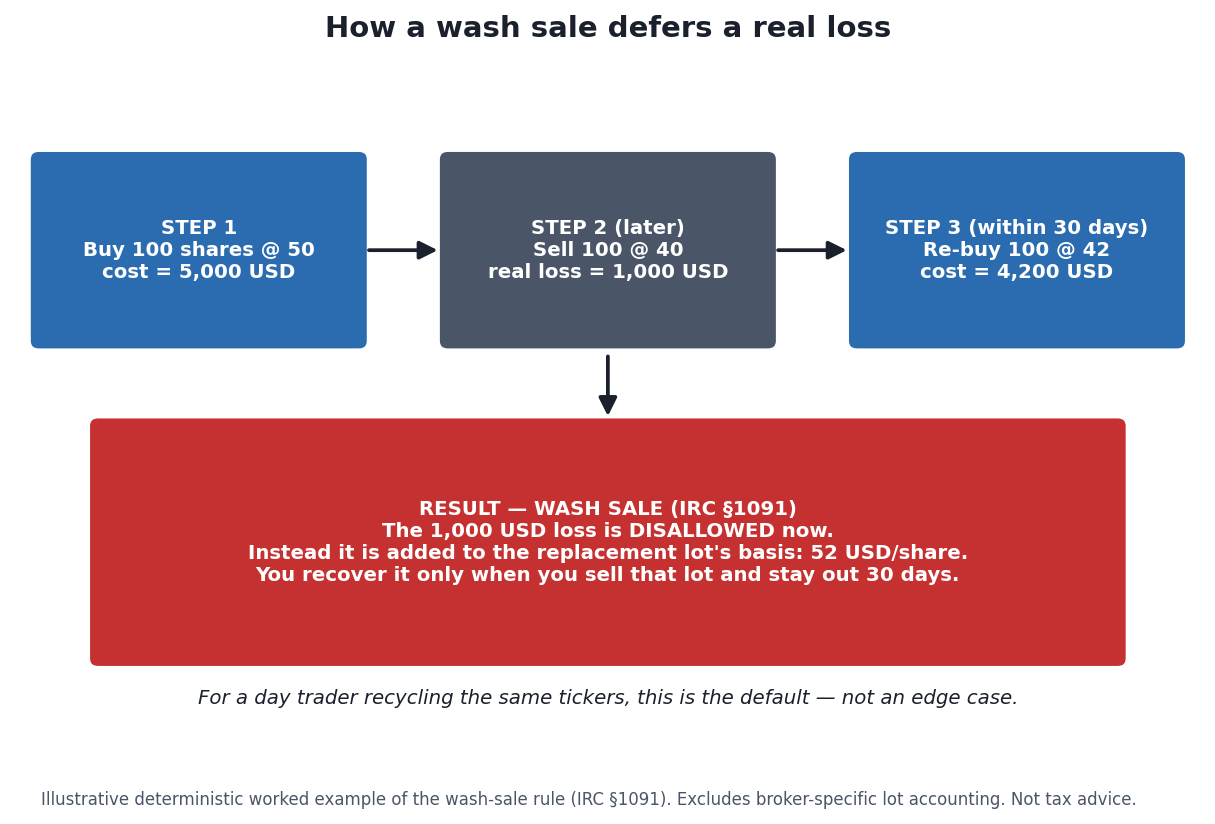 The wash-sale rule in one trade. The $1,000 loss is real — the cash left the account — but the deduction is disallowed the moment you rebuy the same ticker inside the 30-day window, and it is parked in the basis of the new shares instead. For a buy-and-hold investor who rarely sells, this almost never comes up. For a day trader cycling the same handful of tickers day after day, wash sales are not an edge case — they are the default, and they can leave you reporting net taxable gains that are larger than the money you actually made, especially when a loss gets stranded across December 31.
For a long-term investor who owns a fund and rarely sells, the wash-sale rule is a footnote they may never trigger. For a day trader who trades the same few tickers over and over, it is a constant companion — because rebuying a symbol you sold at a loss earlier the same week is not an unusual event, it is the normal texture of the style. The practical consequences are ugly: losses you truly incurred get deferred into the basis of later lots, your reported taxable gain can end up higher than your actual economic gain, and if a big disallowed loss lands right before year-end while the offsetting recovery falls in January, you can owe real tax in April on a year that was, in cash terms, roughly flat. The paperwork alone is punishing, and getting it wrong is expensive.
Headwind Four: If You Lose, the $3,000 Wall Is Waiting
There’s a comforting story day traders tell themselves about the downside: “if I lose, at least I can write it off against my income.” Mostly, you can’t — not at the scale a blown-up trading account produces.
If your capital losses for the year exceed your capital gains, you can deduct the net loss against your ordinary income — but only up to $3,000 per year ($1,500 if married filing separately). Anything beyond that carries forward to future years, $3,000 at a time, until it’s used up [source: IRS rules on capital losses; the $3,000 net-capital-loss limit against ordinary income — web-verified via 2026 tax guidance, 2026-07-30]. The limit is not indexed to inflation and hasn’t moved in decades.
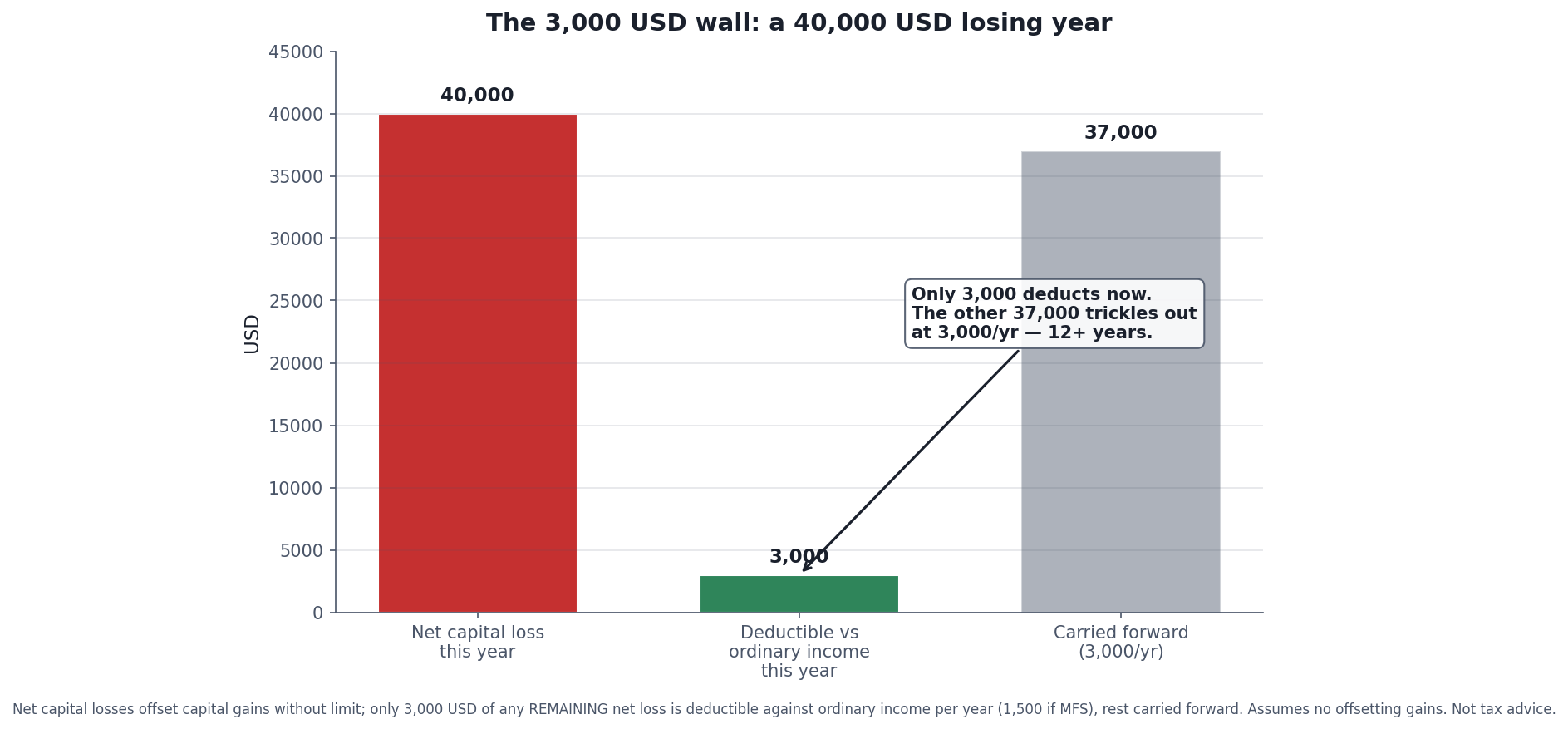 The asymmetry the downside story ignores. Capital losses fully offset capital gains — so in a year with big gains, losses help. But a genuinely losing year, with a net loss and little to offset, runs straight into the $3,000 annual wall: on a $40,000 net loss you deduct $3,000 this year and carry forward $37,000, then chip at it $3,000 a year. Gains are taxed in full and immediately; net losses are recognized in a slow trickle. The tax code is not symmetric about your P&L, and the asymmetry favors the taxman.
Put the asymmetry plainly: your gains are taxed in full, at the higher rate, the year you make them. Your net losses are recognized in a slow $3,000-a-year trickle. Capital losses do fully offset capital gains, so within a winning-and-losing mix they net out — but a truly losing year, where losses swamp gains, does not hand you a matching write-off. It hands you a $3,000 deduction and a carryforward you may spend a decade working through, if you’re still trading and still have gains to apply it against. The downside is not cushioned the way the reassuring version claims.
The Honest Other Side: Trader Tax Status and Sheltered Accounts
A one-sided tax scare would be its own kind of dishonesty, so here is the genuine counter-case — narrow, but real.
Trader Tax Status and the mark-to-market election. A trader whose activity is substantial, frequent, continuous, and regular enough to count as a business — a high and genuinely contested bar, aimed at full-time traders, not people with day jobs and a brokerage app — may qualify for Trader Tax Status, and can elect mark-to-market treatment under Internal Revenue Code §475(f). That election changes the picture in two big ways: trading gains and losses become ordinary, which means the wash-sale rule no longer applies to the trading activity, and the $3,000 capital-loss cap disappears — business losses can offset ordinary income without the wall [source: IRC §475(f); IRS guidance on trader vs. investor status]. For a qualifying full-time trader, that removes Headwinds Three and Four almost entirely, and lets them deduct genuine business expenses too.
But read the fine print, because it is not a free upgrade. Electing §475 means permanently giving up any chance of long-term capital-gain rates on that activity (you were never getting them as a day trader anyway, so this costs you little — but it’s real). Qualifying for the status is hard, fact-specific, and frequently challenged by the IRS; many people who assume they qualify do not. And it does nothing about Headwind Two — you’re still realizing and being taxed every year, still living on the lower compounding curve. So §475 is a real tool for a real, narrow group. It is not a loophole that makes the casual day trader’s tax problem go away.
Tax-sheltered accounts. Trading inside a traditional or Roth IRA sidesteps the annual capital-gains tax entirely — no yearly bill, no wash-sale bookkeeping across the account in the usual sense. But it comes with its own hard limits: you cannot deduct losses in an IRA at all (a losing year is just gone), you can’t trade on margin the way a taxable account allows, contribution caps are small relative to a trading account, and the structural and evidence-based headwinds from the companion pieces are completely unchanged inside the wrapper. Sheltering the taxes does nothing about the edge.
Putting It Together: The After-Tax Number Is the Only Real One
Here is the reframe the whole article is built toward. A day trader watches a P&L screen all day, and that screen shows a pre-tax, pre-cost number. The real figure — the one that determines whether the year was worth it — is what’s left after the spread (Headwind, structural piece), after the transaction toll that scales with frequency (Headwind, evidence piece), and after the tax code takes its cut at the ordinary rate, with no deferral, with losses trapped by wash sales and capped at $3,000.
Stack those and the honest benchmark gets brutal. The day trader’s timing skill has to generate the market’s forgone drift, plus the spread, plus the transaction costs, plus enough extra to make up the gap between paying ordinary rates every year and paying preferential rates once, later — before the first dollar is genuinely theirs to keep. The buy-and-hold investor clears none of those hurdles because they never take them on: they hold, they defer, and when they finally sell they pay the lower rate. That is not a moral point about which investor is more virtuous. It is arithmetic about who keeps more of the same gain, and the tax code has already decided.
The version many active traders eventually recognize goes like this. The year feels good — more green days than red, the account is up, the screen has been kind. Then the consolidated tax form arrives, and two things land at once: the gains are all short-term, taxed like extra salary at a rate that erases a chunk you’d mentally already spent, and the losses you were counting on to soften the bill turn out to be riddled with wash-sale adjustments that pushed your reported gain above what you thought you made. The uncomfortable realization isn’t a single big number. It’s the discovery that the figure you’d been optimizing all year — the one glowing on the screen — was never the figure that mattered, and that the same money, left alone in an index position, would have quietly compounded untaxed and cost you the lower rate only once, years from now, if ever.
The Summary
Beyond the spread and the transaction toll, a day trader carries a third cost the trading screen never shows:
- Every gain is short-term, taxed at your ordinary-income rate (up to 37%) rather than the preferential long-term rate (0/15/20%) — a difference the style makes categorically unavoidable.
- You forfeit tax deferral, realizing and paying every year instead of letting the full pre-tax balance compound — a drag that widens over time and survives even a real edge.
- The wash-sale rule traps your losses, disallowing deductions when you rebuy the same tickers inside 30 days — routine for a day trader, and capable of leaving your taxable gain larger than your actual gain.
- The $3,000 wall caps losing years, so “I’ll write it off” mostly isn’t true at trading scale.
- The escape hatches are narrow: §475 mark-to-market helps a qualifying full-time trader with losses and wash sales but not with deferral, and sheltered accounts remove the tax but not the edge problem — and forbid deducting losses at all.
None of this says day trading can’t be done, and none of it is the reason most day traders lose — the evidence piece covers that. It says the bar is higher than the screen shows, and the tax code raises it specifically for this style, quietly, every April.
The style, in one line: a day trader is taxed like a worker on every gain, denied the deferral that makes compounding cheap, and handed a loss rulebook written to slow their write-offs down — so the after-tax edge has to be bigger than the pre-tax one you were watching all year.
Keep Going
- Day Trading, Honestly — the first headwind: the low-drift intraday session and the adverse-selection spread you pay on every fill.
- Day Trading — What the Evidence Actually Says — the outcomes, the c×N transaction-cost arithmetic, why experience doesn’t fix it, and the June 2026 end of the $25,000 rule.
- Trade Expectancy Explained — the formula that tells you whether a high-frequency style can clear its own costs; run it on after-tax numbers, not pre-tax ones.
- Risk of Ruin: Why a Winning System Can Still Blow Up — why survival is decided by size, which matters most in the styles that trade most.
- How to Backtest a Trading Strategy the Right Way — why a pre-tax, pre-cost backtest is scoring a game you don’t get to keep the winnings from.
If you want the plain-English, evidence-first read on trading systems — including the costs that don’t show up on the screen — that’s what the newsletter is for. Subscribe below.
The headwind, compounded: $50,000 growing at 10% for twenty years is $336,375 if nothing is taken out along the way. Run the same money at a net 6.5% because gains are realized and taxed each year, and it is $176,182. The difference is $160,193 — more than three times the original stake, from a 3.5-point drag. Frequency is what converts a rate difference into that gap. The Compound Growth Calculator shows the spread for any pair of rates.
Disclaimer: This article is educational content, not financial advice. I am not a licensed financial advisor, and nothing here is a recommendation to buy or sell any security or asset. Investing and trading involve risk, including the possible loss of the money you invest. Do your own research and consider consulting a licensed financial professional before making investment decisions. Read the full Disclaimer.
Historical and backtested results are hypothetical, carry inherent limitations, and do not guarantee future results. Figures were accurate to the best of my knowledge as of this article’s last-updated date and may have changed.
