Institutional Investing, Honestly: Size Is an Edge That Charges Rent
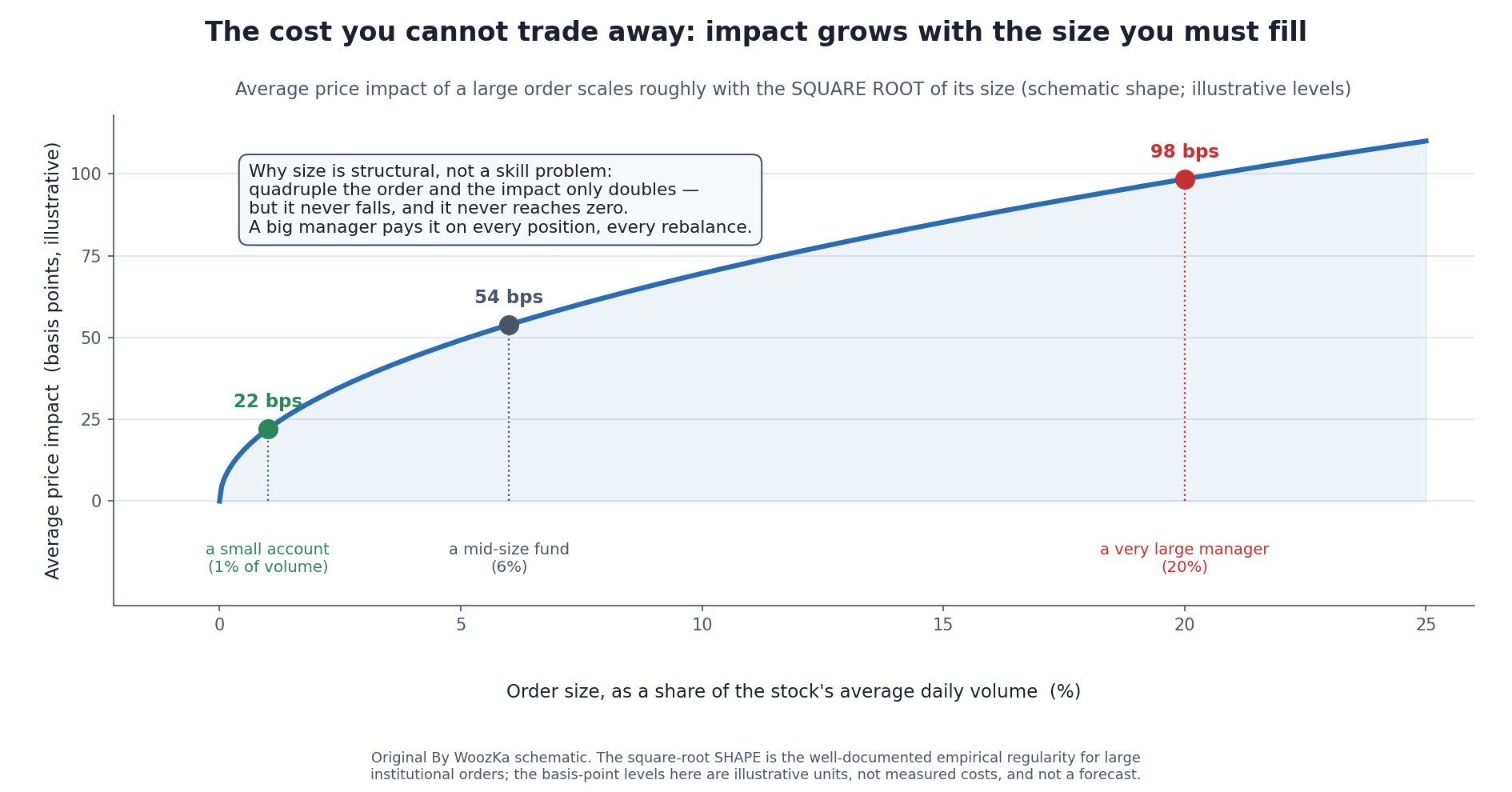
The single fact this article is built on: when you are big, buying the thing moves the price of the thing. The impact grows more slowly than the order does — but it never goes away, and a large manager pays it on every position, every rebalance, forever. Illustrative levels; the shape is the sourced part.
Retail investors tend to imagine institutional investing as the same game they play, with better equipment. Faster data, smarter people, cheaper access, and — the implication is always there — better results. Some of that picture is true. Institutions really do get things you cannot get, and it is worth knowing exactly what.
But the part that never makes it into the picture is the bill. Institutional investing is a style, in the same sense that value investing and swing trading are styles: a coherent approach with a real logic and a real, structural cost attached. Its defining feature is size. And size is not a free advantage — it is an advantage that charges rent, in the form of a cost that no amount of skill, technology, or negotiating power can remove.
This article is about that trade. It is not a case that institutions are smarter than you, or that they are dumber than you — both of those are lazy stories. It is an attempt to describe the style the way someone inside it would: what the advantages actually are, what they cost, and — the part most useful to a small investor — what your own smallness gets you for free.
What “Institutional” Actually Means
An institutional investor is any organization investing pooled money on someone else’s behalf: pension funds, insurers, endowments, sovereign wealth funds, mutual funds, hedge funds, asset managers. The unit of analysis is not a person with an account — it is a mandate, with a benchmark, a governance structure, and a set of constraints written down before anyone trades anything.
That structure produces genuine advantages, and it is worth being specific rather than vague about them:
- Cost of access. Institutional share classes carry lower expense ratios; large orders get institutional commission rates; big managers can borrow securities to short at rates a retail account never sees.
- Information infrastructure. Not secret information — that would be illegal — but depth: dedicated analysts, direct access to company management on scheduled calls, expensive datasets, and the time to actually read the filings.
- Access to whole asset classes. Private credit, direct real estate, infrastructure, private equity, and the better hedge funds are largely closed to individuals, either legally or by minimum size.
- Process. Written mandates, risk limits, and committee oversight impose a discipline that most individuals simply never build. That is not glamorous, but it is probably the largest real edge on this list.
None of that is fake. If someone tells you professional investing offers no advantages at all, they are overcorrecting. The honest question is what those advantages have to be weighed against.
The Tax: Your Own Order Moves the Price
Here is the thing a retail investor almost never has to think about, and an institution can never stop thinking about: when your order is large relative to what the market normally trades, the act of executing it moves the price against you.
The mechanism is not mysterious. At any moment there is only so much stock offered for sale near the current price. If you need more than that, you have to keep lifting higher offers, and the price rises as you buy. Other participants notice sustained one-way pressure and adjust their quotes. By the time your last share is filled, you have paid a meaningfully worse average price than the one you saw when you decided to buy — and then you get to do the whole thing again in reverse when you sell.
The relationship between order size and impact has been studied intensively, and the finding is remarkably robust across equities, futures, options, and even crypto: the average price impact of a large order scales roughly with the square root of its size [source: extensive empirical literature on the square-root law of market impact; see Bouchaud and co-authors, and Zarinelli et al., “Beyond the square root,” 2015, for the ongoing debate over the exact functional form].
Read the featured chart at the top again with that in mind, because it contains both halves of the story. The square-root shape is merciful: quadruple your order and the impact only doubles, so costs do not explode as fast as size does. But the curve never comes back down. Every increment of size buys you a permanently worse execution than the increment before it, and there is no cleverness that repeals this. It is arithmetic about liquidity, not a skill deficiency.
The Paper Portfolio and the Real One
Impact is only one leak. In 1988 André Perold gave the whole family of leaks a name that has stuck: the implementation shortfall — the gap between the return of a hypothetical “paper portfolio,” in which every position is filled instantly at the price prevailing when the decision was made, and the return the portfolio actually delivers [source: André F. Perold, “The Implementation Shortfall: Paper versus Reality,” Journal of Portfolio Management, Spring 1988].
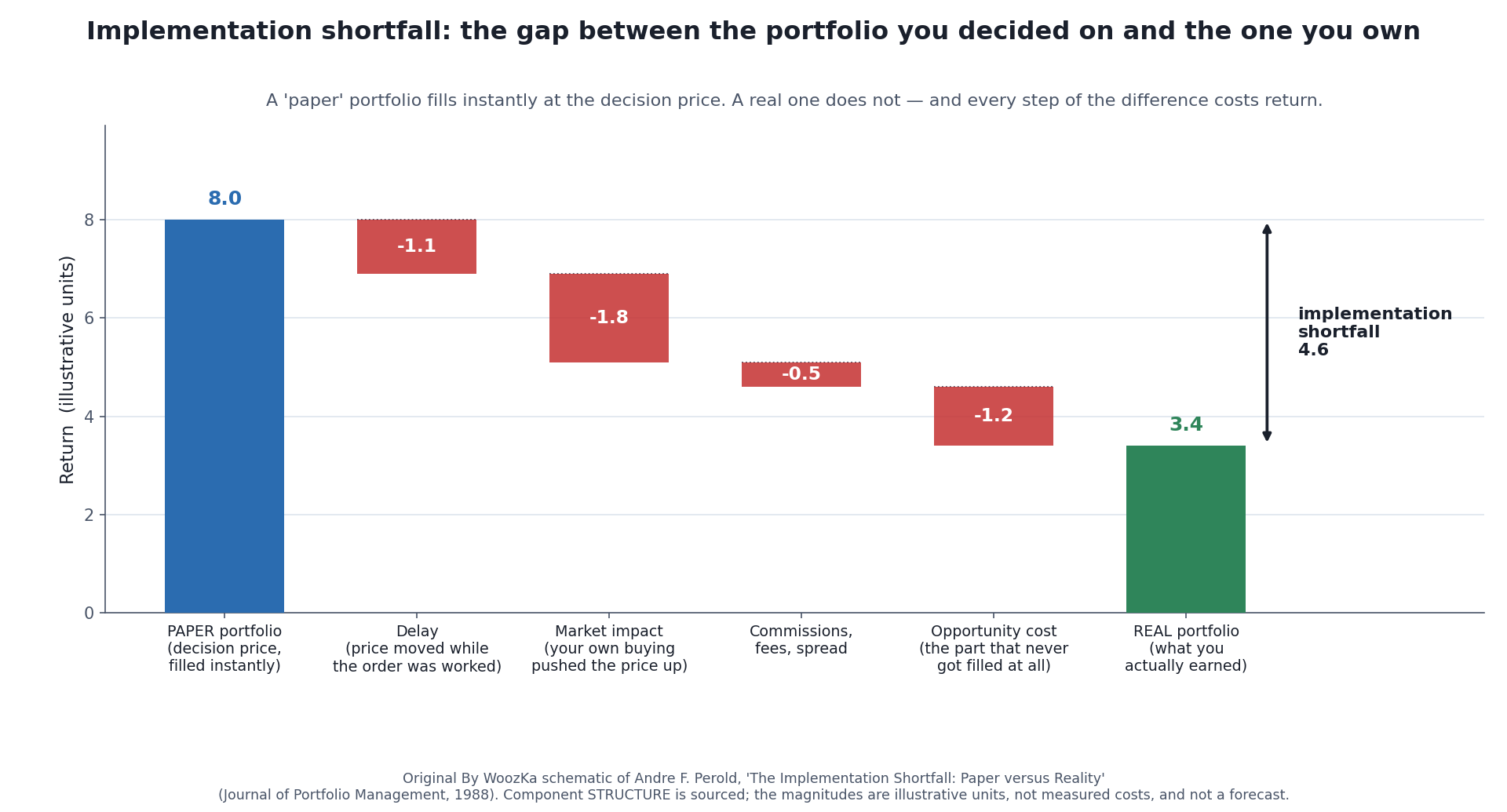
Four separate leaks sit between “we should own this” and “we own this.” Notice the last one: the part of the order that never got filled at all still costs you, because the idea you liked went up without you. Illustrative magnitudes; the structure is the sourced part.
Look closely at that fourth bar, because it is the one people forget. If a manager decides to buy a position, works the order patiently to avoid impact, and the stock runs away before the order completes, the unfilled portion is a real cost — the return on an idea that was right and that the portfolio never got to own. Trading patiently reduces impact and increases opportunity cost. Trading aggressively does the reverse. There is no setting that eliminates both, which is why execution is a genuine discipline with its own specialists rather than an afterthought.
For a retail investor buying a hundred shares of a liquid ETF, essentially all of this collapses to the spread and the commission. That is not a small difference in degree. It is a different problem.
Why Success Is Self-Limiting
Now the deepest version of the size problem, and the one that should change how you read fund marketing forever.
Suppose a manager is genuinely skilled — not lucky, actually skilled. Good results attract money. More money means larger positions, which means more impact, which means the strategy has to be deployed in bigger, less liquid, less attractive chunks. The edge per dollar shrinks as the dollars grow. Jonathan Berk and Richard Green built this into a model of the whole industry in 2004, and it produces a conclusion that is uncomfortable in a specific and clarifying way [source: Jonathan B. Berk and Richard C. Green, “Mutual Fund Flows and Performance in Rational Markets,” Journal of Political Economy 112(6), 2004].
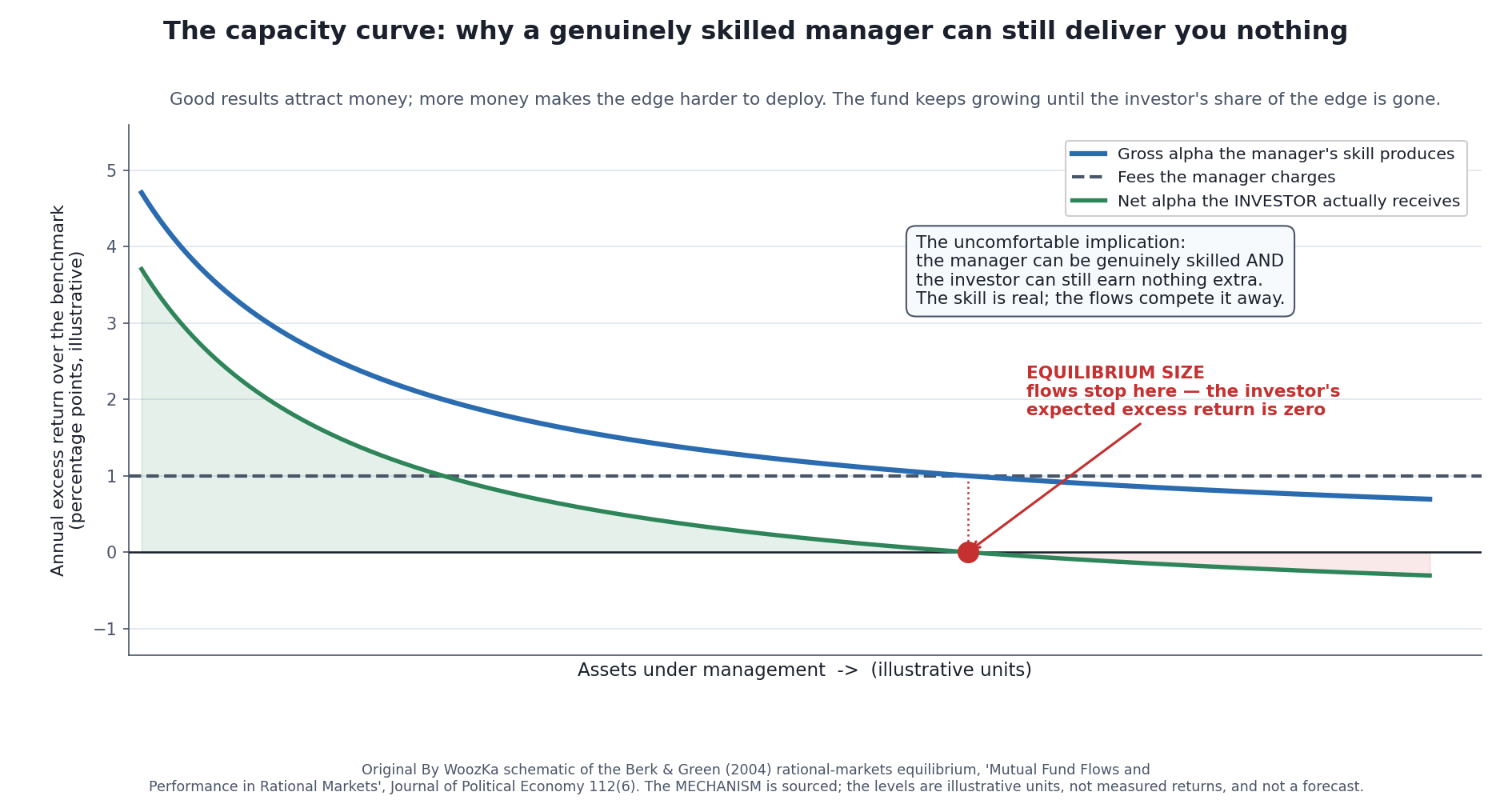
The chart that reframes the whole active-management debate. In this model, skill is real — the blue line starts well above zero. The investor still ends up with nothing extra, because money keeps flowing in until the green line hits zero. The skill accrues to the manager as fees, not to you as returns.
In equilibrium, money flows into a skilled fund until the expected excess return to the investor, after fees is competed down to zero. The manager captures the value of their skill in fee income. The investor gets the benchmark.
This is worth sitting with, because it dissolves a false choice. The usual argument runs “active managers underperform, therefore skill does not exist.” Berk and Green show you can accept that skill absolutely does exist and still predict exactly what we observe: no persistent net outperformance, and strong flows chasing past performance anyway. The finding is not that professionals are fools. It is that the market for their services works — and works to their benefit, not yours.
What This Style Costs You
Every style on this blog gets an honest accounting of its failure mode, and institutional investing has a distinctive one. It is not that professionals are bad at investing. It is that the structure they operate inside imposes costs that have nothing to do with skill:
- The capacity tax, permanently. Everything above. The better the fund does, the more money it attracts, and the harder its own strategy becomes to run. Success is self-undermining in a way that almost no other style has to contend with.
- Forced diversification. A fund with billions to deploy cannot hold twenty positions; it would own too much of each company and could never exit. So it holds hundreds, and the average holding drifts toward the index whether the manager wants that or not.
- Career risk shapes the portfolio. This one is rarely said out loud. A manager who deviates sharply from the benchmark and is wrong gets fired; a manager who tracks the benchmark and is mildly wrong keeps the mandate. The rational response is to hug the benchmark — which caps the upside of skill while collecting fees that assume it. That is an agency problem, not an investing problem, and you pay for it.
- Liquidity constraints you did not choose. Institutions can be forced sellers for reasons unrelated to value: a redemption wave, a risk limit breach, a mandate change, a rebalancing rule. Being compelled to sell into weakness is a structural handicap.
- Time horizons that are shorter than they claim. A pension fund may have a thirty-year liability, but its manager is reviewed quarterly. The horizon that governs behavior is the review cycle, not the liability.
Now turn it around, because this is the practical payoff for a reader with a small account. Every one of those costs is one you do not pay. You can hold a concentrated position. You can do nothing for five years. You can buy an unloved small company without moving its price. You will never face a redemption. Nobody reviews you in March. Your size — the thing that feels like the disadvantage — is a genuine, underrated structural edge.
The honest caveat attached to that flattering sentence: an edge you do not use is worth nothing, and most individuals systematically fail to use exactly this one. The freedom to be patient is only valuable to someone who is patient. The freedom to concentrate is dangerous to someone who concentrates badly. Structural advantages do not convert into returns automatically — and, unlike the institution, you also lack the written mandate and committee that would stop you from doing something stupid at the wrong moment.
The Correction: Nobody Even Agreed What Trading Costs
One more finding, both because intellectual honesty demands it and because it lands directly on the core skill this silo teaches.
Everything above might suggest institutional trading costs are enormous. For years, the academic literature said something like that — a whole body of work argued that many published market anomalies would be wiped out by the cost of trading them at scale. Then a group of researchers did something the earlier work could not: instead of modeling costs from public quote and volume data, they measured them, using roughly USD 1.7 trillion of live executions by a large institutional manager over 19 years across 21 developed equity markets and nearly 10,000 stocks. Real fills, not simulated ones [source: Andrea Frazzini, Ronen Israel and Tobias J. Moskowitz, “Trading Costs,” AQR working paper, SSRN 3229719].
Their headline result: actual trading costs were less than a tenth of what the earlier studies had estimated — implying the practical capacity of these strategies is more than an order of magnitude larger than the literature assumed.
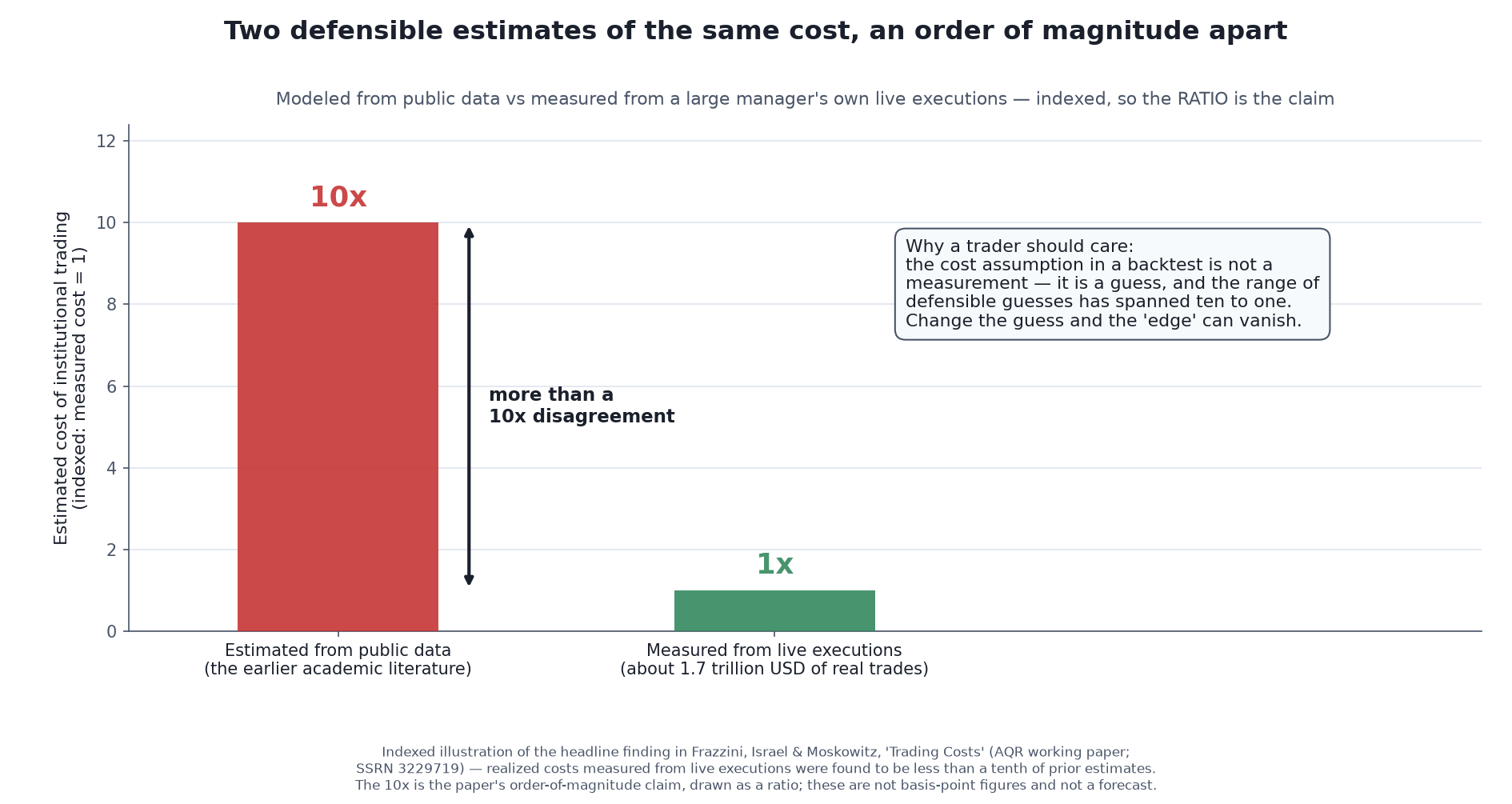
The most useful chart here for anyone who backtests. Two careful, published, defensible estimates of the same quantity sat a factor of ten apart until someone measured it directly. Your backtest’s cost assumption is a number in that range — and which number you pick can decide whether your strategy “works.”
Note carefully what this does and does not overturn. It does not mean impact is free; the square-root curve is still there and still rising. It means the level of the cost was badly overestimated by models built on public data — which is precisely why the researchers had to go get real fills to find out.
And that is the lesson that belongs to every reader of this silo, whether or not they will ever manage institutional money. A backtest’s transaction-cost assumption is not a measurement. It is a guess, and the range of defensible guesses has historically spanned an order of magnitude. Ignoring costs entirely is the fourth of the four ways a backtest lies to you; assuming a cost number you cannot justify is the subtler version of the same error. If your strategy’s edge survives at one cost assumption and dies at another, you have not found an edge — you have found a number you are attached to. Run it across the whole plausible range and see what is left.
The Bill, Tabulated
Three of the headings above promise a cost, and none of them prints one. That is partly deliberate — the charts say “illustrative levels; the shape is the sourced part” — but a shape can be tabulated, and once it is, three things fall out of arithmetic this article has already committed to.
What “Quadruple the Order, Double the Impact” Leaves Out
The square-root law gives one number above: quadruple the order and the price impact only doubles. That is a statement about impact per share. Multiply it back by the number of shares and the total dollars paid for impact grow as size to the power 1.5 — faster than the order, not slower.
| Size × | Impact per share × | Total impact cost × |
|---|---|---|
| 0.25 | 0.50 | 0.125 |
| 0.5 | 0.7071 | 0.3536 |
| 1 | 1.00 | 1.00 |
| 2 | 1.4142 | 2.8284 |
| 4 | 2.00 | 8.00 |
| 9 | 3.00 | 27.00 |
| 16 | 4.00 | 64.00 |
| 100 | 10.00 | 1,000.00 |
Read the two right-hand columns against each other. The “merciful” curve is the middle one; the bill is the right one. Quadrupling the order doubles the impact per share and multiplies the total paid for it by eight. A hundred times the order pays a thousand times the impact. And it runs the other way with the same asymmetry: halving an order trims per-share impact only to 70.71%, not to half — the sub-linearity that flatters a growing manager is exactly what fails to help one trying to shrink.
How Far Success Can Run
The self-limiting section describes the Berk–Green mechanism in words — more money, larger orders, more impact, edge per dollar shrinking toward zero — and the square-root law lets you put a horizon on it. If impact consumes some fraction of a strategy’s gross edge at today’s size, quadrupling the size doubles that fraction, and the edge is entirely eaten at the square of the headroom: a strategy giving up 10% of its edge to impact can grow one hundred times before the edge is gone; one giving up 25% can grow sixteen times; one giving up half can grow four.
| Edge eaten today | At 4× size | Half gone at | Fully gone at |
|---|---|---|---|
| 5% | 10% | 100× | 400× |
| 10% | 20% | 25× | 100× |
| 20% | 40% | 6.25× | 25× |
| 25% | 50% | 4× | 16× |
| 50% | 100% | 1× | 4× |
Two things in that table are identities rather than examples. Half the edge is always gone at exactly one quarter of full capacity, whatever the starting fraction. And halving the fraction eaten today quadruples capacity — so how much impact a strategy pays now matters far more than the linear intuition suggests. That is the arithmetic behind “success is self-undermining”: the first doublings of assets are nearly free, and the last ones are where the whole edge goes.
What a Factor of Ten Does to a Backtest
The correction section reports that measured trading costs came in at less than a tenth of what the models had said, and leaves the consequence for a backtest as advice: run it across the plausible range. Here is what the range does. Hold a round-trip cost assumption fixed and vary the gross edge; a strategy survives if its edge clears the cost, so the break-even edge is the cost. The two cost levels below are illustrative; the factor of ten between them is the sourced part.
| Gross edge | Net, modeled 2.00% | Verdict | Net, measured 0.20% | Verdict |
|---|---|---|---|---|
| 0.10% | −1.90% | dead | −0.10% | dead |
| 0.20% | −1.80% | dead | 0.00% | break-even |
| 0.50% | −1.50% | dead | +0.30% | live |
| 1.00% | −1.00% | dead | +0.80% | live |
| 2.00% | 0.00% | break-even | +1.80% | live |
| 3.00% | +1.00% | live | +2.80% | live |
Every strategy whose gross edge sits between the two cost levels — between 0.20% and 2.00% here — is dead under one defensible assumption and alive under the other, and the band is exactly ten times wide because the cost estimates were. Nothing about the strategy changes between the two columns. That is the precise sense in which a cost assumption you cannot justify is “a number you are attached to”: for any edge inside the band, it is the assumption, not the strategy, that decides the verdict.
What these cost figures are built from, and how far they can be pushed. None of the site’s calculators computes market impact, so nothing here comes from a shipped tool; every figure is arithmetic on two relationships this article already states and sources — impact per share proportional to the square root of order size, and measured cost at a tenth of modeled cost — and the code behind the tables verifies every value, including the article’s own “quadruple, double,” before reporting. The size multiples, the fractions of edge eaten today, and the 2.00% and 0.20% cost levels are illustrative scaffolding in the same sense as the charts above; the exponents and the factor of ten are the sourced part. The square-root law is an empirical regularity with a live debate about its exact form, as the source note says, and the capacity table assumes the fraction of edge lost to impact scales with size and nothing else — no change in strategy, universe, or execution. It describes a mechanism; it does not measure any fund, and it is not a claim about any strategy of yours.
Does Any of This Fit You?
You cannot really “adopt” institutional investing as a private individual; you do not have the mandate, the capital, or the committee. What you can do is decide how to relate to it, and there are three defensible answers.
You can hire it — buy funds and accept the arithmetic honestly, which means choosing on cost and mandate clarity rather than on last year’s returns, since the capacity curve predicts that chasing past performance is precisely how the edge gets competed away before you arrive. You can borrow the process — the written rules, the risk limits, the review discipline — which is the part of the institutional advantage that scales down to any account size and costs nothing. Or you can deliberately play the game they cannot — small, patient, concentrated where you have genuine conviction, in places too small for a large manager to bother with — which is a real edge and also the one most likely to go wrong if you overestimate your own discipline.
What is not defensible is the mental model most people carry: that professionals have a magic the rest of us lack, and that proximity to it is worth paying for. They have real advantages, a real and permanent structural tax, and an incentive structure that is not aligned with yours. Knowing which is which is the whole point.
Where to Go Next
- How to Backtest a Trading Strategy the Right Way — the section pillar, including the four ways a backtest lies to you. Costs are the fourth.
- How Institutions Manage Risk — the risk-control side of the same desk: limits, ladders, and what actually scales down to a personal account.
- What Is Overfitting in Backtesting? — the companion failure mode, and why a strategy that only survives one cost assumption was never robust.
- The Difference Between Trading and Investing (And Why It Matters) — if the style question is still open for you.
If you want the plain-English, evidence-first read on how markets actually work — explained honestly, with the costs shown, never hyped — that’s what the newsletter is for. Subscribe below.
Disclaimer: This article is educational content, not financial advice. I am not a licensed financial advisor, and nothing here is a recommendation to buy or sell any security or asset. Investing and trading involve risk, including the possible loss of the money you invest. Do your own research and consider consulting a licensed financial professional before making investment decisions. Read the full Disclaimer.
Historical and backtested results are hypothetical, carry inherent limitations, and do not guarantee future results. Figures were accurate to the best of my knowledge as of this article’s last-updated date and may have changed.
