Emergency Fund Math: How Many Months of Expenses Do You Actually Need?
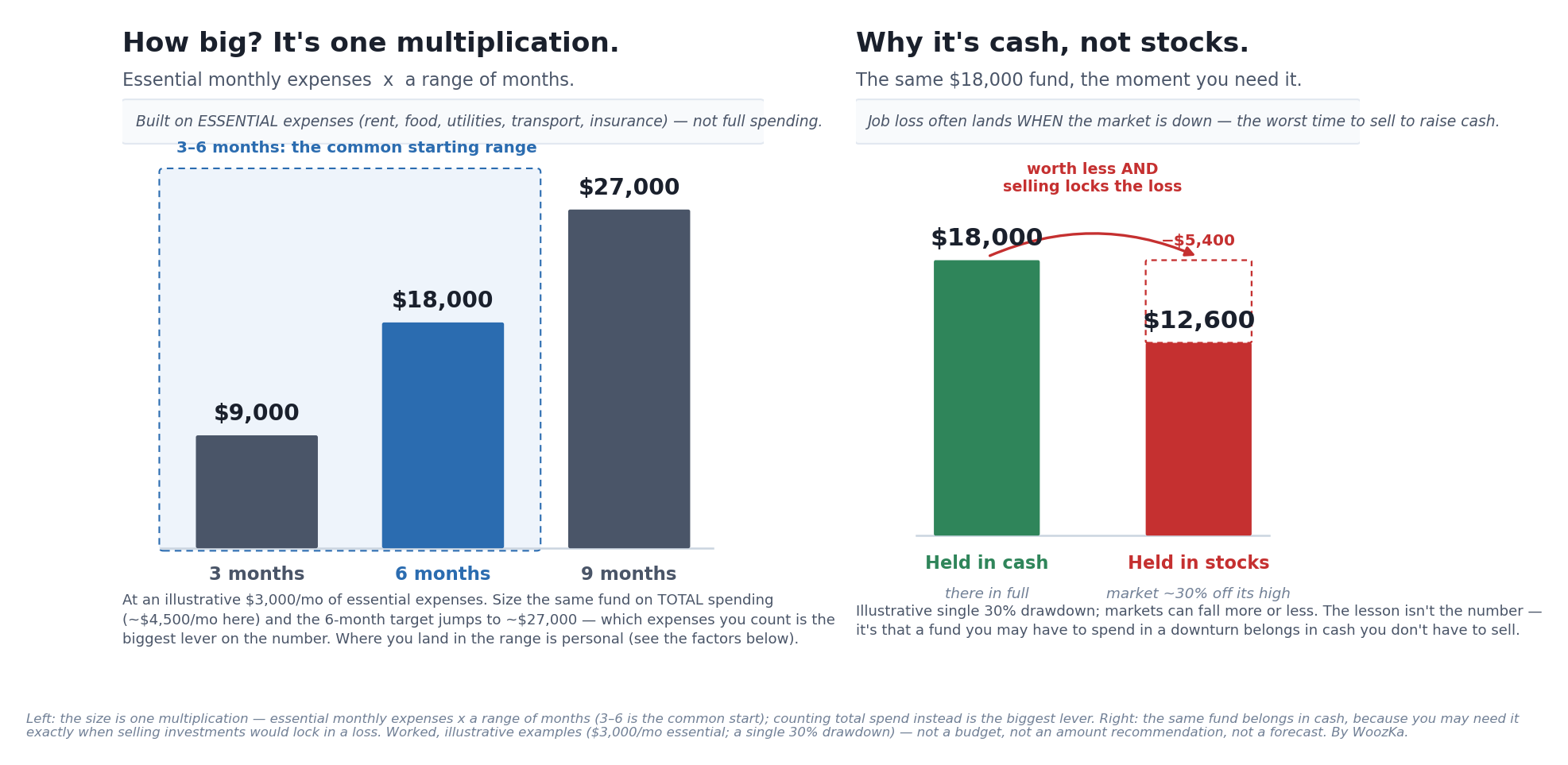 Left: sizing an emergency fund is one multiplication — essential monthly expenses times a range of months. On an illustrative $3,000/month of essentials, 3–6 months is $9,000–$18,000; where you land in the range is personal. Right: the same $18,000 fund belongs in cash, because the moment you need it often coincides with a market drop, and an “invested” emergency fund can force you to sell at a loss. Both panels are illustrative examples built from the figures below — not your budget, and not a recommendation of any specific amount.
“How much emergency fund do I need?” has a frustrating real answer: it depends, but the math is simple. The sizing is one multiplication. The two decisions that change your number — which expenses you count, and where you keep the money — are where almost everyone gets it slightly wrong. This is foundational money literacy, not personal financial planning: it hands you the arithmetic so you can run your own.
The One-Sentence Version
An emergency fund is a pile of cash equal to your essential monthly expenses multiplied by a number of months — commonly 3 to 6 — kept somewhere you can reach it instantly, so an unexpected expense or income gap doesn’t force you into debt or into selling investments at a loss.
What an Emergency Fund Actually Is (and Isn’t)
An emergency fund is self-insurance: its job is to be available and stable at the moment things go wrong. So it is not an investment (cash won’t be down 30% on the Tuesday you get laid off, though inflation erodes it over years, dealt with below), and it is not your long-term savings or your down-payment fund. On your personal balance sheet it is a liquid asset that protects your other plans (see Assets vs Liabilities).
Step 1: Build It on Essential Expenses, Not Total Spending
The single biggest lever on your number isn’t the number of months — it’s which expenses you’re counting. The fund covers what you’d still have to pay if your income stopped: rent or mortgage, groceries, utilities, transportation, insurance, minimum debt payments and essential medical costs, the “essential” expenses the Consumer Financial Protection Bureau frames the target around [source: Consumer Financial Protection Bureau, “An essential guide to building an emergency fund,” 2026 — consumerfinance.gov]. With illustrative total spending of about $4,500 a month and essential spending of about $3,000, a six-month fund is $18,000 built on essentials versus $27,000 built on total spending [author’s own calculation; illustrative]. That’s a $9,000 difference, and the $18,000 version is the more correct target, because it genuinely covers six months of the bills you couldn’t skip.
Step 2: Pick Your Range — and Why “3 to 6 Months” Is a Range, Not a Rule
What the range costs in time, which the advice rarely mentions: take essential expenses of $3,000 a month, so a three-month fund is $9,000 and a six-month fund is $18,000. Saving $400 a month into an account paying 4%, the three-month fund is full at month 22 — a little under two years. The six-month fund is not twice that; it lands at month 42, about three and a half years. That is the real decision hiding inside “three to six months”: not how much cash you want, but how many years you are willing to spend accumulating it while the rest of your plan waits. Run your own essentials and savings rate through the Compound Growth Calculator before picking a number off a rule of thumb.
The classic guidance is three to six months of essential expenses, which the CFPB presents as a range tied to your circumstances [source: Consumer Financial Protection Bureau, 2026]. On $3,000 a month of essentials, that’s roughly $9,000 to $18,000. Variable or single income, dependents, a slow-to-replace job, or high fixed obligations push toward the higher end; two stable incomes, an in-demand skill set and low fixed costs can justify the lower end. Only you can set your own number; this article gives you the inputs, not the answer.
What the Data Says About Who Actually Has One
In the Federal Reserve’s Survey of Household Economics and Decisionmaking (SHED) 2025 report, released May 13, 2026, 63% of adults said they could cover a hypothetical $400 emergency expense entirely with cash or its equivalent, unchanged from the previous three years and down from 68% in 2021, so roughly 37% could not [source: Federal Reserve, “Economic Well-Being of U.S. Households in 2025,” released May 13, 2026; the 13th annual SHED, surveying nearly 13,000 adults in October 2025 — federalreserve.gov; confirm the current year’s figures, they’re updated every May]. And 55% of adults said they had set aside three months of expenses in an emergency or “rainy day” fund, down from a 59% high in 2021 [source: Federal Reserve SHED 2025, released May 2026 — confirm current; this comes from the same annual survey as the figure above]. A little under half did not have even a three-month cushion.
Why the Fund Is Cash, Not Investments
A job loss frequently happens during a downturn, which is when the stock market tends to be down too. If an emergency hits when the market is roughly 30% off its high, an invested $18,000 fund is worth about $12,600 — a $5,400 shortfall — and spending it locks in that drawdown [author’s own calculation; illustrative single 30% drawdown; markets can fall more or less]. Held in cash, the same $18,000 is simply there. That is the fund’s real job: it is what you spend so your long-term portfolio isn’t sold at the bottom (see Should You Invest More in a Bear Market? and, for why job loss and market drops cluster, Recession Indicators). It belongs in a savings or money-market account or similar cash-equivalent, not in stocks.
The Honest Counterweight: Inflation
Idle cash loses purchasing power to inflation over time. Hold $18,000 for a year at 0.40% while inflation runs 3% and its real value falls to about $17,546, roughly $454 of lost purchasing power [author’s own calculation; illustrative]. At a competitive 4% APY against the same 3% inflation, its real value is about $18,175 [author’s own calculation; illustrative]. So a competitive yield on your cash matters (this is where APR vs APY pays off, and both rates move with the Fed: see Why Interest Rates Move Markets), and size the fund as enough, not maximized. For the mechanics of that erosion, see What Is Inflation, Really?.
The Arithmetic Behind the Range
There is a sentence a few sections above that deserves more than the two numbers it arrives with: the real decision inside “three to six months” is not how much cash you want, it is how long you are prepared to spend accumulating it. Priced in dollars the range looks like a choice between $9,000 and $18,000. Priced in time it looks like something else entirely. Every figure below runs this article’s own illustrative numbers — $3,000 a month of essentials, $400 a month saved, 4% on the account — and the build times come from the Compound Growth Calculator this article already links, so you can reproduce every row of them.
What Each Target Costs in Time
Same essentials, same monthly saving, same rate. Only the target moves.
| Months of cover | Fund size | Months to fill |
|---|---|---|
| 3 | $9,000 | 22 |
| 4 | $12,000 | 29 |
| 5 | $15,000 | 36 |
| 6 | $18,000 | 42 |
| 9 | $27,000 | 61 |
Read the last column as a ladder and something quietly encouraging falls out: each block of three months costs less time than the block before it. The first three months of cover take 22 months of saving. The next three take 20. The three after that take 19. The reason is that by the end the balance is doing part of the work: reaching $18,000 takes $16,800 of your own money and $1,201 of interest. That is also the precise answer to why the six-month fund “is not twice” the three-month fund — it is 1.91 times the build time, not two, and compounding is the whole of the difference.
The Same Six Months, Counted Two Ways
The section above calls counting essentials rather than total spending the single biggest lever, and prices it at $9,000. Priced in time, on the same $400 a month, it looks like this — $3,000 of essentials against $4,500 of total spending.
| Counted on | Target | Months to fill | Months it covers |
|---|---|---|---|
| Essentials | $18,000 | 42 | 6.0 |
| Total spending | $27,000 | 61 | 9.0 |
That extra $9,000 is 19 extra months of saving — more than a year and a half. But the last column is the part worth sitting with. Because $4,500 is exactly one and a half times $3,000, six months of total spending is exactly nine months of essentials: $27,000 either way, the same number reached by two different routes. So the saver who sizes on total spending is not building a six-month fund that is merely too big. They are building a nine-month fund, spending 19 extra months to do it, and calling it six. Whatever number of months you decide you want, the expense figure you multiply is what determines whether you actually get it.
The Target Moves While You Save
This article works out a 42-month build time in one place and a 3% inflation drag in another, and never puts the two together. Doing so is uncomfortable. If essential expenses rise at that same 3% — and essentials are prices, so assuming they do is the natural reading — then over 3.5 years $3,000 a month of essentials becomes $3,326.99 a month, and six months of them costs $19,961.94. Here is where three savers stand in month 42, having done everything right.
| APY on the fund | Balance | Months it covers |
|---|---|---|
| 0.40% | $16,915 | 5.1 |
| 3.00% | $17,690 | 5.3 |
| 4.00% | $18,001 | 5.4 |
The saver at 4% hit $18,000 exactly on schedule, on time and in full, and owns 5.41 months of cover rather than six — $1,961.22 short of what six months now costs. Nothing went wrong; the target moved. And the rate on the account turns out to govern the schedule as well as the erosion, which this article treats purely as an inflation question: $18,000 arrives at month 42 at 4%, month 43 at 3%, and not until month 45 at 0.40%. In month 42 the 0.40% saver is still $1,084.69 short of the nominal number, before the moving target is counted at all.
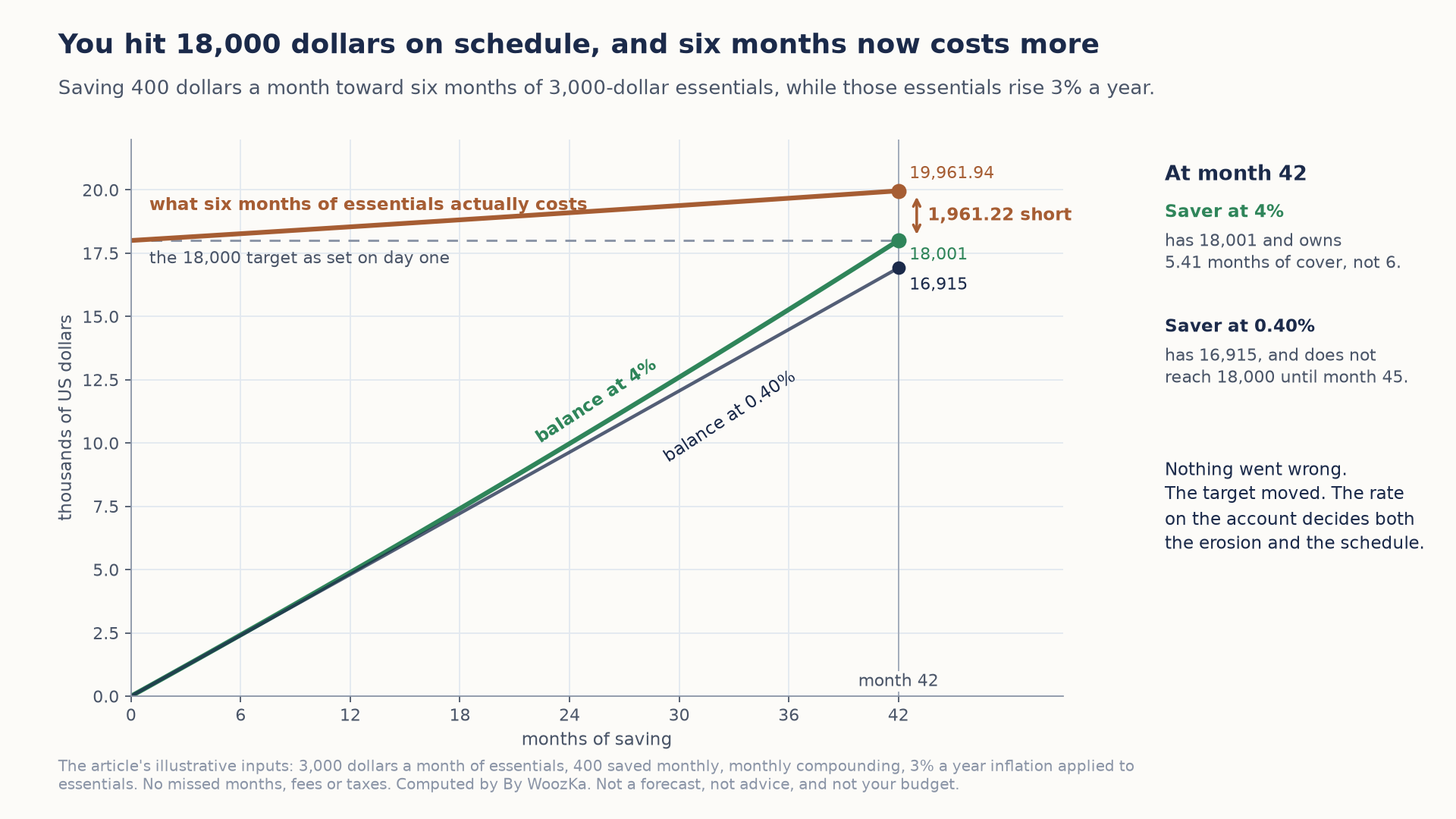 The saver at 4% reaches 18,000 dollars exactly on time, but if essentials rise 3% a year, six months of them now costs 19,961.94. The target is set in today’s dollars and aimed at a cost that keeps moving while you save.
None of that is an argument for a bigger number, and it is emphatically not a reason to reach for returns with money whose whole job is to be there. It is an argument for reading the target as what it is: a figure in today’s dollars, aimed at a cost that will have moved by the time you arrive. The two levers this article already names are exactly the two that answer it — the expense figure you multiply, and the yield on the account — and both of them are visible in the tables above.
Assumptions, sources and limits for the three tables above. Every input is this article’s own illustrative figure — $3,000 of essentials, $4,500 of total spending, $400 saved monthly, 4% and 0.40% account rates, 3% inflation — and none of them is a recommendation or a claim about your budget. Build times come from computeCompound, the function behind the Compound Growth Calculator linked above, at monthly compounding, so every row is reproducible in your browser; “months to fill” is the first whole month the balance reaches the target. One extension is made explicit: the third table applies the 3% inflation figure to essential expenses as well as to the cash, whereas the article applies it only to the cash. Constant contributions, no fees, no taxes and no missed months are assumed, and no investment return is assumed anywhere. The code behind these tables reports every figure above; it also re-derives this article’s own published numbers from scratch — month 22 and month 42, the $9,000 lever, $17,545.63 and $18,174.76 of real value, the $454.37 of lost purchasing power, and the $5,400 invested-fund shortfall — and checks that each one matches before reporting anything.
How to Actually Build It
Pick a target from Steps 1 and 2, then automate recurring transfers into a separate liquid account, as the CFPB recommends [source: Consumer Financial Protection Bureau, 2026]; money you don’t see is money you don’t accidentally spend. A common approach is a small starter cushion first, then the full target over time. And if you carry a balance at a ~20%+ APR, paying it down is a certain saving at that rate, which competes with how fast you grow the fund (see The Real Cost of Carrying Credit Card Debt). That sequencing decision is yours.
A 4-Question Checklist
Whenever you’re sizing or sanity-checking an emergency fund, four questions do most of the work:
- What are my essential monthly expenses? The bills that would still arrive if my paycheck stopped — not my full spending. This is the number I multiply.
- How many months, given my life? Start at the 3–6 range, then move up for variable/single income, dependents, or a slow-to-replace job.
- Where is it kept? Genuinely liquid and stable — a savings or money-market account, reachable instantly — never invested in stocks I might have to sell at a loss.
- Is it earning a competitive yield, and is it finite? A decent APY slows inflation’s erosion; a sensible cap keeps me from over-holding cash that could be working elsewhere.
Answer those four and you’ve done the actual math — and made the two decisions (which expenses, where you keep it) that matter more than the exact month count.
The Bottom Line
An emergency fund’s size is essential monthly expenses times a number of months, with three to six the common starting range. The two decisions that matter most are counting essential expenses rather than total spending, and keeping the money in stable cash so a shock during a downturn doesn’t force you to sell at a loss. Hold enough and not more, at a competitive yield. The economic machine will keep throwing surprises; this is how you meet them without selling the future to pay for the present.
Disclaimer: This article is educational content, not financial advice. I am not a licensed financial advisor, and nothing here is a recommendation to buy or sell any security or asset. Investing and trading involve risk, including the possible loss of the money you invest. Do your own research and consider consulting a licensed financial professional before making investment decisions. Read the full Disclaimer. Historical and backtested results are hypothetical, carry inherent limitations, and do not guarantee future results. Figures were accurate to the best of my knowledge as of this article’s last-updated date and may have changed.
This is the second piece in the money-terminology cluster, after APR vs APY: once you can read a rate, the next foundation is knowing how much cash to keep between you and a bad month. Still ahead in this cluster: how credit scores actually work, and the full cost of a carried card balance. For the weekly market read this blog uses to apply the fear-and-greed rules from the Autopilot Plan — the discipline an emergency fund makes possible — subscribe to the newsletter below and grab the money-foundations checklist.
