DRIP: How Dividend Reinvestment Compounds — and When It Actually Helps
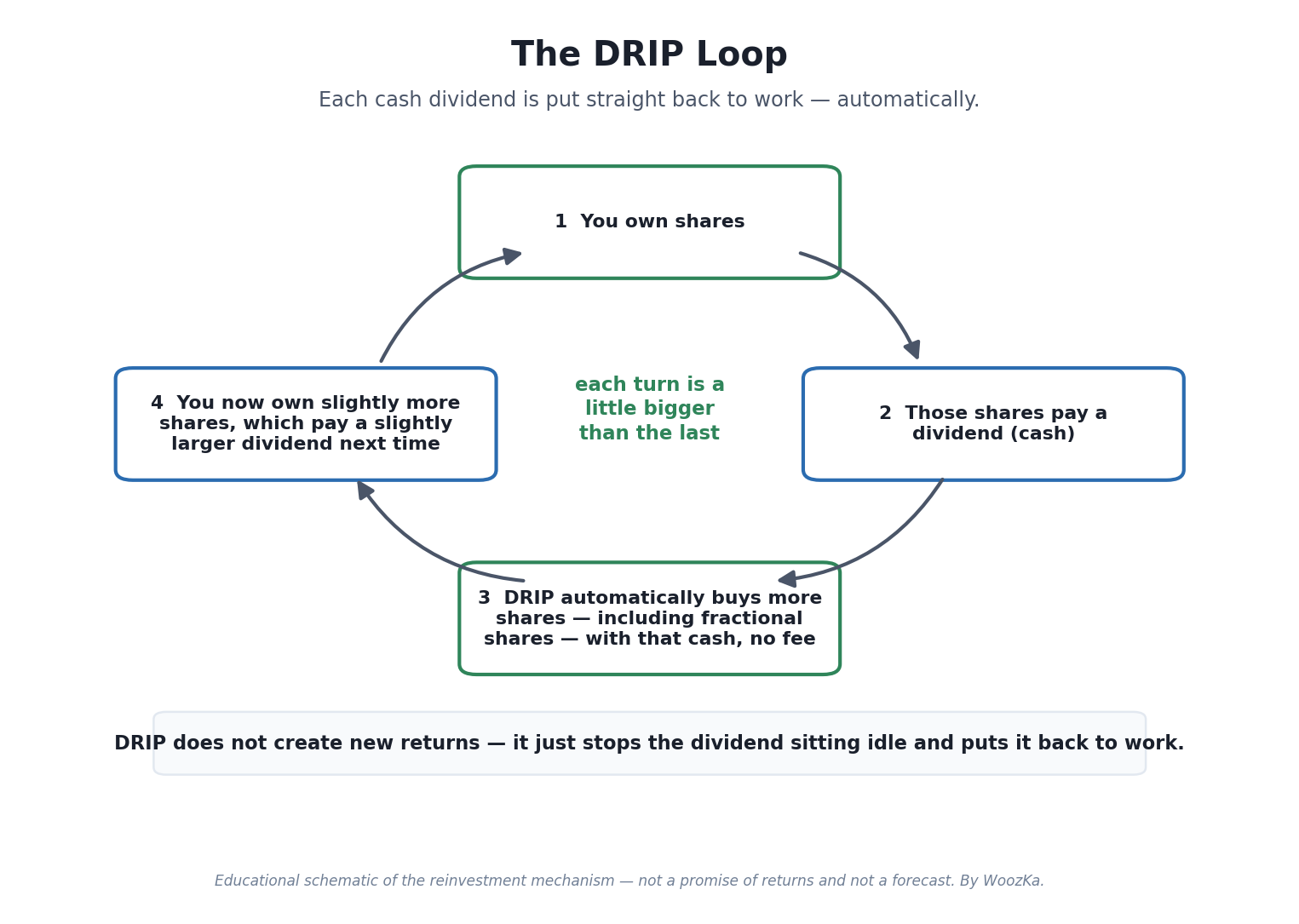
DRIP is one of the simplest ideas in investing and one of the most over-promised. All it does is take the cash a dividend pays you and automatically buy more shares with it, so the payout is not left sitting idle. That creates a small compounding loop — more shares, a slightly larger dividend, more shares again. Useful and quietly powerful over long periods, but not magic, and not free of catches. Illustrative schematic, not advice.
If you own a dividend stock or ETF, sooner or later your broker will ask whether you want to reinvest dividends or take them as cash. That toggle is a DRIP — a Dividend ReInvestment Plan — and it is one of those small settings that does very little this quarter and quite a lot over a decade. This guide explains what DRIP actually does, why the compounding takes time to matter, and the two catches (tax and diversification) worth understanding before you flip the switch.
Naming how a feature works is not telling you to use it; whether DRIP suits you depends on your goals and account type. If dividends themselves are still fuzzy, read Dividend Investing 101 first — this piece assumes you know what a dividend and a yield are. And the mechanism that makes modern DRIP work down to the cent, fractional shares, has its own explainer.
What a DRIP Actually Does
Without DRIP, a dividend lands in your account as cash. It sits there until you decide to do something with it — spend it, or manually buy more of something. Many people let it pile up and forget about it, which quietly turns a stock investment into a part-cash one.
With DRIP switched on, the broker automatically uses that dividend to buy more shares of the same fund or stock, usually commission-free and usually including fractional shares so every cent is put to work rather than rounded down [source: standard brokerage DRIP mechanics; see fractional-shares explainer]. So a $40 dividend does not wait for you to have enough for a whole share — it buys whatever fraction of a share $40 covers, immediately.
That is the whole feature. It does not find better investments, time the market, or add a secret return. It simply removes the friction and the delay between receiving a dividend and reinvesting it. The value is behavioral and mechanical: money that would have drifted as idle cash goes straight back into the position, automatically and on schedule.
Why It Compounds — and Why That Takes Time
Here is the loop, in plain terms. You own shares. They pay a dividend. DRIP buys more shares with it. Now you own slightly more shares, so the next dividend is slightly larger, which buys slightly more shares again. Each turn of the wheel is a little bigger than the last. That is compounding: growth feeding on its own output.
The honest part is the timescale. In year one, the effect is tiny — reinvesting a low-single-digit yield adds a low-single-digit sliver of extra shares, and a sliver of a sliver the next year. Compounding is unremarkable early and only becomes striking after many years, because it depends on many repetitions and, for a dividend-growth holding, on the payout itself rising over time. Anyone showing you a dramatic DRIP chart is showing you the tail of a long process, and usually assuming a steady or rising dividend and a rising share price the whole way — assumptions that do not always hold. Dividends can be cut, and share prices can fall, in which case reinvesting simply buys more of a declining asset.
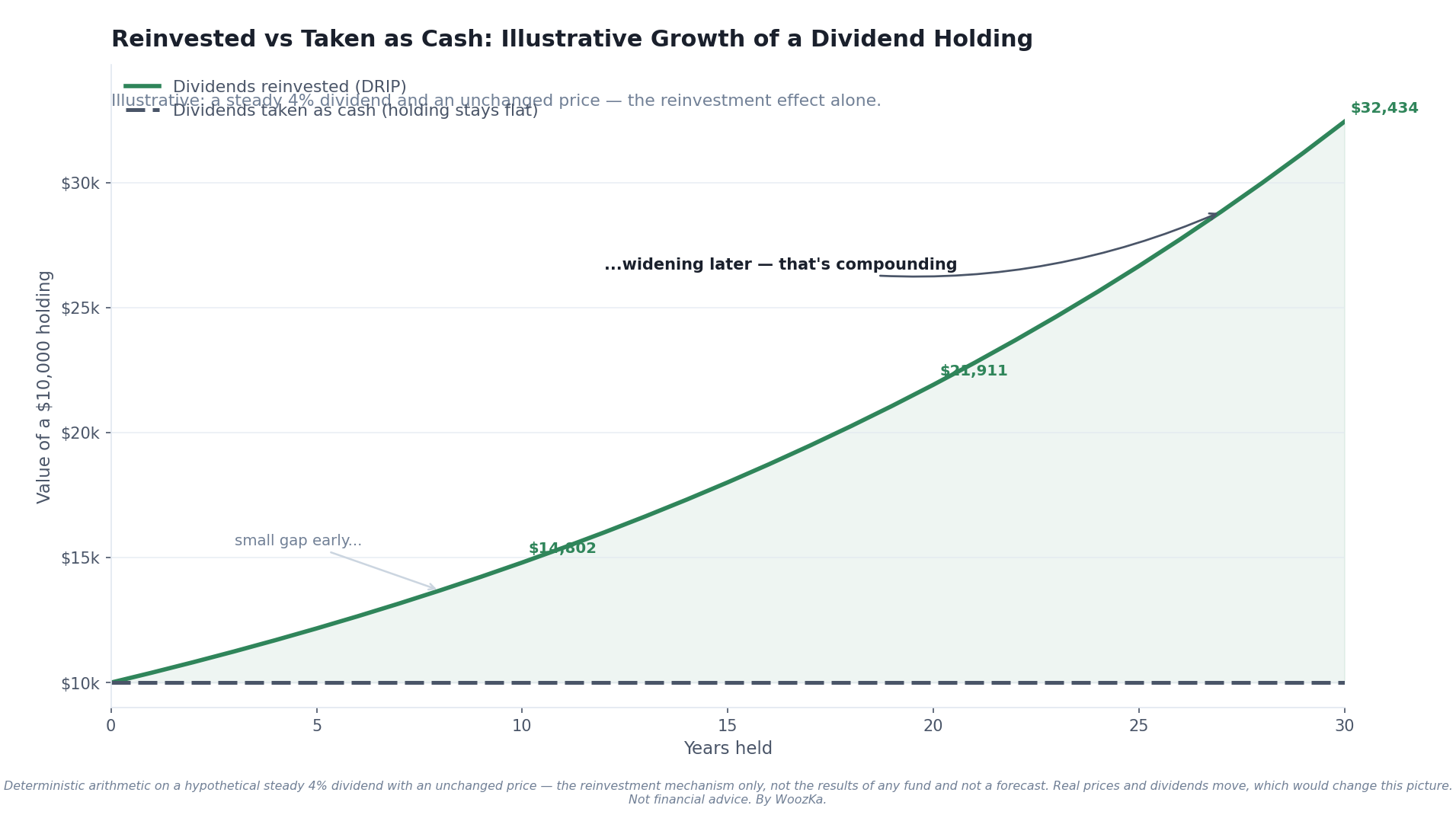
This is the single most useful thing to internalise about DRIP: the payoff is back-loaded. The reinvested line and the cash line sit almost on top of each other for years before the gap becomes obvious, which is exactly why DRIP rewards patience and does very little for a short holding period. The lines are a simplified illustration of the mechanism assuming a steady dividend — real dividends and prices move, so treat the shape as the lesson, not the numbers.
Two Catches Worth Knowing First
DRIP is simple, but “switch it on and forget it” skips two things that matter.
Tax (in a taxable account). In a regular taxable brokerage account, a reinvested dividend is generally still taxable in the year it is paid, even though you never saw the cash — you owe tax on a dividend you immediately turned back into shares [source: general dividend-taxation principle; consult your jurisdiction’s rules]. This is not individualised tax advice, and it varies by country and account type: in many tax-sheltered accounts the issue does not arise. Reinvesting also creates lots of small purchase lots at different prices, which is worth knowing for record-keeping. The point is simply that “I didn’t take the cash” does not mean “no tax event.”
Diversification drift. DRIP always buys more of the thing that paid — the same stock or fund. Over years, faithfully reinvesting into a single holding quietly concentrates your portfolio in it. For a broad, diversified ETF that is usually fine and even desirable. For an individual stock, automatic reinvestment can leave you far more exposed to one company than you intended, without ever making a conscious decision to bet bigger on it. Some investors deliberately take dividends as cash and reinvest them where they choose — into whatever is underweight — precisely to keep control of the mix.
So Should You Use It?
This is a framework, not a recommendation. DRIP tends to suit an investor who is accumulating for the long run, wants automation, and holds broad, diversified funds — the combination where compounding has time to work and concentration is not a worry. It suits less well someone who needs the income to spend now (that is the whole point of taking dividends as cash), someone who wants to actively steer where new money goes, or someone holding a concentrated single stock who does not want to keep adding to it automatically.
The mechanism is genuinely elegant and, over long horizons, quietly effective — but it is a tool, not a strategy, and it does not turn a poor holding into a good one. The prior decision, what you are reinvesting into, matters far more than the toggle itself. Once you have chosen a holding you are comfortable owning more of, DRIP is a low-effort way to keep the dividend working instead of drifting.
For the decisions that sit around this one, see Dividend Investing 101 for the vocabulary, Dividend Growth vs High Yield for what kind of payout you are reinvesting, and What Are Fractional Shares for the mechanism that lets DRIP put every cent to work. The weekly newsletter below ties these together over time.
Disclaimer: This article is educational content, not financial advice. I am not a licensed financial advisor, and nothing here is a recommendation to buy or sell any security or asset. Investing and trading involve risk, including the possible loss of the money you invest. Do your own research and consider consulting a licensed financial professional before making investment decisions. Read the full Disclaimer.
Historical and backtested results are hypothetical, carry inherent limitations, and do not guarantee future results. Figures were accurate to the best of my knowledge as of this article’s last-updated date and may have changed.
