What Are Fractional Shares? How to Invest When You Can’t Afford a Full Share
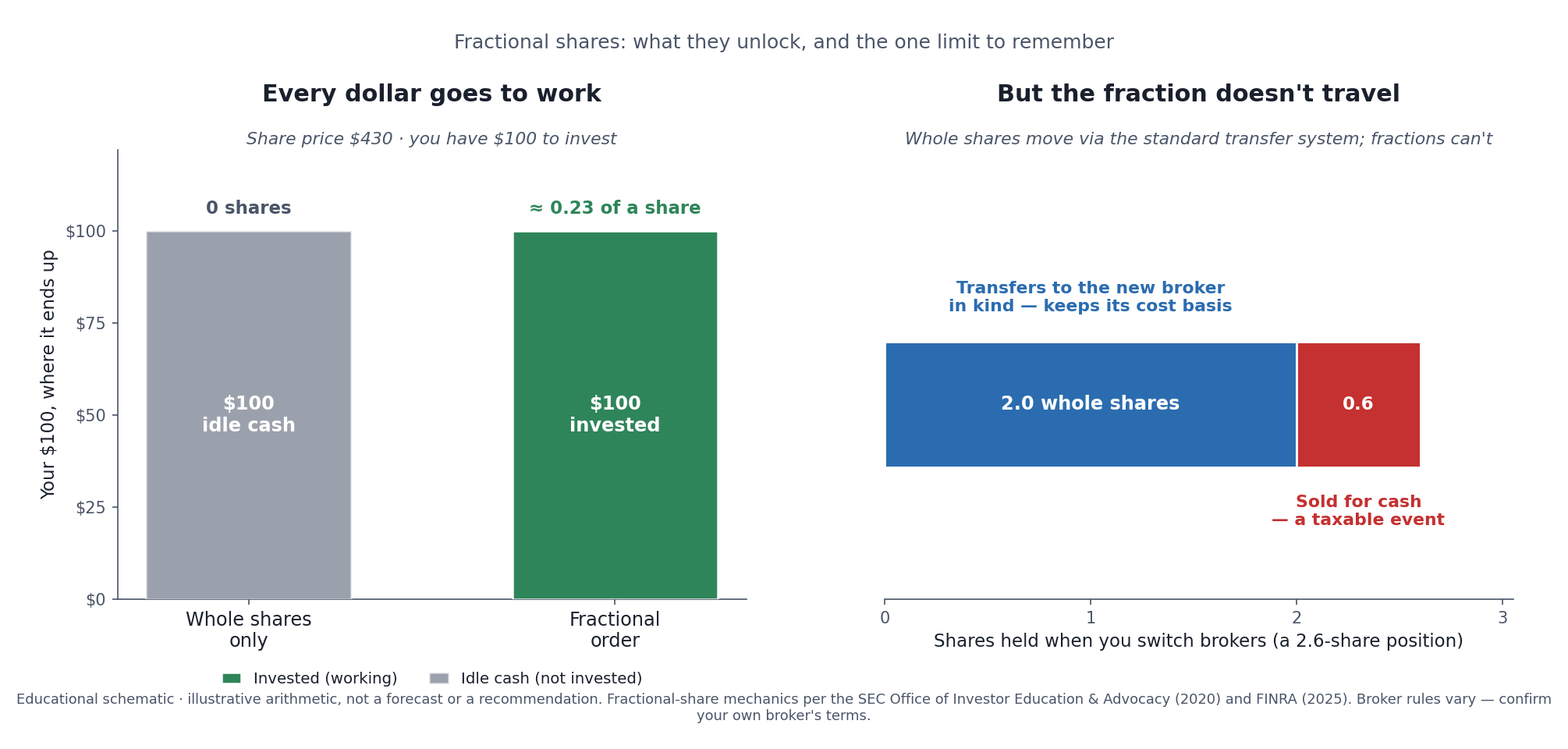 Left: with a share priced at $430, a whole-shares-only order leaves your entire $100 uninvested, while a fractional order puts all of it to work as roughly 0.23 of a share. Right: if you later switch brokers, whole shares transfer in kind but the fractional piece is typically sold for cash — a taxable event. Sources: fractional-share mechanics and the transfer limitation per the SEC Office of Investor Education and Advocacy and FINRA (see citations below). Figures are illustrative arithmetic; confirm your broker’s specific rules.
If you’ve read The Autopilot Plan — the beginner strategy at the center of this blog — you’ve seen the claim that you can invest “exactly $10, regardless of the share price.” The thing that makes that possible is a feature called fractional shares. Without it, a single share of a popular index fund or a high-priced stock can cost hundreds of dollars, which would put the whole “start small and automate it” idea out of reach for most beginners.
This article explains what a fractional share actually is, how brokers handle them, and — just as importantly — the specific limitations that regulators want you to understand before you rely on them. Fractional shares are a genuinely useful access tool. They are not magic, they don’t change what a stock is worth, and they come with a handful of trade-offs that are easy to miss. Nothing here is a recommendation to buy any particular security or use any particular broker; the goal is to explain the mechanics so you can make your own informed decision.
What a Fractional Share Actually Is
A fractional share is simply ownership of less than one whole share of a stock or fund. As the SEC’s Office of Investor Education and Advocacy puts it, “a fractional share is when you own less than one full share of a stock or other security” [source: SEC Investor.gov, “Fractional Share Investing – Buying a Slice Instead of the Whole Share,” Nov. 9, 2020]. FINRA describes it the same way: “a fractional share represents ownership of less than a full share of stock” [source: FINRA, “Investing in Fractional Shares,” June 26, 2025].
The idea is easiest to see with a number. Suppose a stock trades at $1,000 a share but you only have $100 to invest. Fractional-share investing lets you buy one-tenth of a share — 0.1 shares — for your $100 [source: SEC Investor.gov, 2020]. You own a real, proportional claim on that company; it’s just a slice rather than a whole unit.
Crucially, you can usually place the order in one of two ways: by dollar amount (“invest $100”) or by share amount (“buy 0.1 shares”) [source: SEC Investor.gov, 2020]. For a beginner, the dollar-based option is the one that matters most — it lets you decide how much money to invest and lets the broker work out the fraction, instead of forcing you to reverse-engineer how many whole shares your budget will stretch to.
Fractional shares aren’t brand new, either. For decades, dividend reinvestment plans (DRIPs) produced them quietly: because a dividend payment rarely divides evenly into the share price, reinvesting it often bought a fraction of a share rather than a whole one [source: FINRA, 2025]. What’s changed in recent years is that many brokerages now offer fractional trading directly, as part of what’s often called micro-investing [source: FINRA, 2025].
Why They Matter for a Beginner
For someone just starting out, fractional shares remove the single most practical barrier to investing: the price tag on one share.
They let every dollar go to work. If you buy only whole shares, you’ll often have cash left over — the amount that wasn’t quite enough to buy another full share. FINRA lists this “full use of funds” directly as a feature: buying fractional shares lets you “put those extra funds to work rather than leaving them uninvested” [source: FINRA, 2025]. That’s the mechanic behind the Autopilot Plan’s promise that you can invest a flat $10 or $50 on a schedule no matter what a share costs — the whole amount goes in, with nothing stranded as idle cash.
They open up higher-priced securities. Some individual stocks and even some funds trade at hundreds or thousands of dollars per share. Fractional investing gives you “access to higher-priced stocks or ETFs without the financial commitment of purchasing full shares,” in FINRA’s words [source: FINRA, 2025]. A broad-market fund you couldn’t otherwise afford in whole-share form becomes reachable with whatever amount you actually have.
They make small-dollar diversification possible. If you’re working with a small account, FINRA notes that fractional shares let you “invest in a wider range of securities than you otherwise could,” which can help build a more diversified portfolio [source: FINRA, 2025]. Instead of sinking your whole $50 into one share of one company, you can spread it.
They make dollar-based, automatic investing clean. Because you can buy in exact dollar amounts, fractional shares are what let a plain dollar-cost-averaging routine run on autopilot — the same fixed amount every week, fully invested, without rounding. That precision also helps when you want to rebalance by a specific dollar amount rather than a whole share [source: FINRA, 2025].
None of this changes what you’re actually buying. A fractional share of a fund rises and falls with that fund exactly in proportion to the slice you own. Fractional investing is a way to access an investment with less money — not a different or better-performing investment.
How much cash does the whole-share rule actually strand?
That leftover is the whole argument, and it is worth a number rather than a description — because it is not an estimate. Given what you put in and what one share costs, the amount that fails to get invested is plain integer arithmetic: you buy as many whole shares as fit, and whatever will not stretch to one more share stays in cash.
This is not a forecast and no return is assumed anywhere. No market data is involved, and the prices below are simply a range of inputs, not claims about what any particular company costs. The table says only this: of the money you set aside, how much of it buys something.
| If one share costs | $50 a month | $100 a month | $250 a month | $1000 a month |
|---|---|---|---|---|
| $45 | 1 share, 10% idle | 2 shares, 10% idle | 5 shares, 10% idle | 22 shares, 1% idle |
| $120 | 0 shares, 100% idle | 0 shares, 100% idle | 2 shares, 4% idle | 8 shares, 4% idle |
| $300 | 0 shares, 100% idle | 0 shares, 100% idle | 0 shares, 100% idle | 3 shares, 10% idle |
| $700 | 0 shares, 100% idle | 0 shares, 100% idle | 0 shares, 100% idle | 1 share, 30% idle |
| $1,500 | 0 shares, 100% idle | 0 shares, 100% idle | 0 shares, 100% idle | 0 shares, 100% idle |
| $3,200 | 0 shares, 100% idle | 0 shares, 100% idle | 0 shares, 100% idle | 0 shares, 100% idle |
The wall of 100% is the part worth sitting with. It is not that a small investor gets poor value from a high-priced share — it is that nothing happens at all. A $100 monthly contribution aimed at a $700 share buys zero shares in month one, zero in month two, and keeps accumulating as cash until it clears $700. That is the barrier the post opened with, expressed as the number of months you spend not being invested.
Notice too that the drag has nothing to do with how much you invest and everything to do with the price tag. Averaged across contribution sizes, the leftover is spread evenly between zero and one share’s worth, so the cash left stranded averages half the share price — the same $150 whether you are putting in $50 or $1,000 against a $300 share.
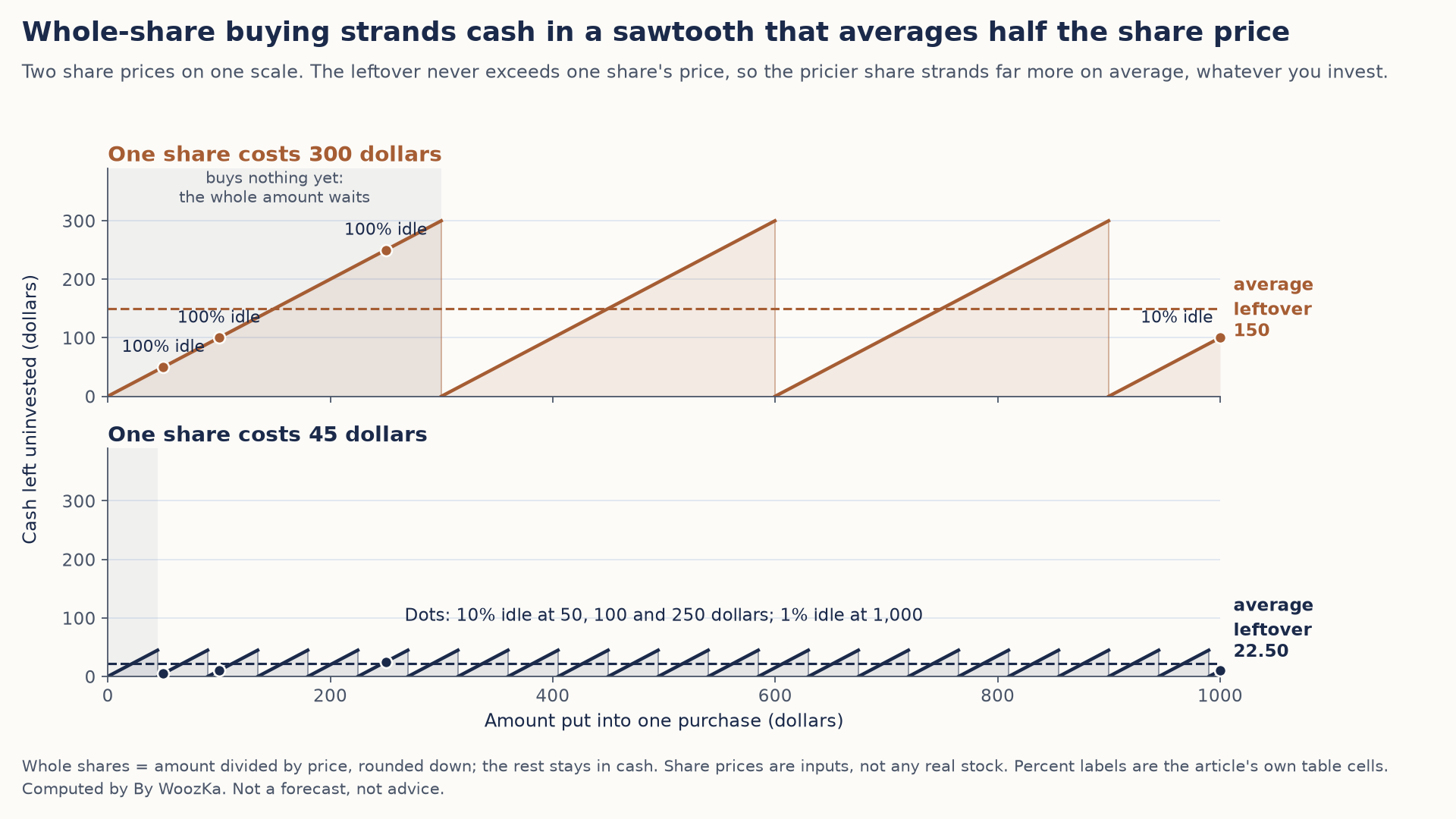 Under a whole-shares-only rule, the leftover cash never exceeds one share’s price and averages half of it. So the share price, not the amount you invest, sets how much sits idle.
The size a purchase has to reach before it stops mattering
Turn that around and you can ask how large a single purchase must be before the stranded cash becomes a rounding error:
| If one share costs | Average cash stranded | To keep it under 5% | To keep it under 1% | To keep it under 0.1% |
|---|---|---|---|---|
| $45 | $22.50 | $450 | $2,250 | $22,500 |
| $120 | $60.00 | $1,200 | $6,000 | $60,000 |
| $300 | $150.00 | $3,000 | $15,000 | $150,000 |
| $700 | $350.00 | $7,000 | $35,000 | $350,000 |
| $1,500 | $750.00 | $15,000 | $75,000 | $750,000 |
| $3,200 | $1,600.00 | $32,000 | $160,000 | $1,600,000 |
To hold the wasted cash under 1% of what you invest in a $700 share, each purchase has to be about $35,000. Under a tenth of a percent, roughly $350,000. Those are not beginner numbers, and that is the point: the whole-share constraint is regressive. It costs a large buyer almost nothing and a small buyer either a meaningful slice of every contribution or the entire thing.
Which is the honest case for fractional investing, and it is narrower than the marketing. It does not improve the investment, change what you own, or alter what the position returns. It removes one specific inefficiency — money sitting in cash because of an indivisibility — and the size of that inefficiency is set by the share price, not by you.
Method, so it can be checked rather than taken on trust: whole shares are floor(contribution ÷ price), cash deployed is that count times the price, and everything else is stranded. The script asserts that the leftover always lands in [0, price), that deployed plus stranded equals the contribution exactly, and it verifies the half-the-share-price average by direct summation rather than asserting it. The leftover figures above are the code’s own output, not hand transcriptions.
How Brokers Actually Handle Them
Here’s a detail most beginners never think to ask about: what happens behind the scenes when you place a fractional order. It varies by broker, and it can affect the price you get.
Some firms execute fractional orders in real time, just like whole-share orders. Others aggregate them — they collect customers’ fractional orders through the day and then fill them together as larger whole-share trades. As the SEC explains, “the process your brokerage firm uses to handle buying and selling of fractional shares may impact the price you pay or receive for a fractional share order” [source: SEC Investor.gov, 2020; corroborated by FINRA, 2025]. For a long-term investor putting in small amounts on a schedule, this is usually a minor effect — but it’s worth knowing your order may not fill at the exact instant you press the button.
Availability itself also varies. Not every brokerage offers fractional investing, and even those that do may not offer it to every customer or on every security [source: SEC Investor.gov, 2020]. Some firms allow fractional trading only in a limited universe — for example, only large-cap stocks or only ETFs, and in some cases only S&P 500 names [source: SEC Investor.gov, 2020; FINRA, 2025]. Before assuming you can buy a fraction of a specific fund, it’s worth confirming that your broker supports it for that security.
As of 2026, several large brokerages support dollar-based fractional investing with very low minimums. Fidelity’s “Stocks by the Slice,” for instance, lets you start a fractional order for as little as $1, with fractional quantities entered to three decimal places, at zero commission on online U.S. stock and most ETF trades [source: Fidelity, “Fractional Shares,” 2026]. Charles Schwab’s “Stock Slices” similarly lets you buy fractions of most U.S.-listed stocks and ETFs from $1 — and, per Schwab’s current terms, a basket of multiple names in a single order [source: Charles Schwab, “Fractional Shares — Stock Slices,” 2026]. These specifics — minimums, eligible securities, and fees — change over time and differ by firm, so treat them as a snapshot and confirm the current terms on the broker’s own site before acting. The head-to-head brokerage comparison lives in a separate post; this article is about the mechanics, not a ranking.
The Limitations to Know Before You Rely on Them
This is the part the marketing rarely leads with, and it’s the part regulators emphasize most. Fractional shares are convenient, but they carry real constraints. Here are the ones that matter.
You generally can’t transfer a fractional share to another broker. This is the big one. The industry’s standard account-transfer system moves whole shares between firms; it does not handle fractional units. So if you decide to move your account to a different brokerage, “you may have to sell any fractional shares in your account” [source: SEC Investor.gov, 2020]. FINRA is blunter: “you can’t transfer fractional shares to another brokerage firm… you’ll have to sell them first, potentially incurring taxes and fees” [source: FINRA, 2025]. In a taxable account, that forced sale can be a taxable event — the right-hand panel of the chart above shows exactly this: your whole shares move over in kind, while the fraction is liquidated to cash. It’s not a reason to avoid fractional shares, but it is a reason not to be surprised at transfer time, and a reason to consider a tax professional before moving an account [source: FINRA, 2025].
Trading is often limited to regular market hours and to market orders. Many firms don’t let you trade fractional shares outside regular hours (9:30 a.m. to 4:00 p.m. ET) — so no pre-market or after-hours fractional trades [source: FINRA, 2025]. Some firms also restrict which order types you can use, in some cases allowing only market orders for fractional shares, and may impose minimum order sizes or route fractional orders only through their mobile app [source: SEC Investor.gov, 2020]. For a buy-and-hold beginner these limits rarely bite, but they’re real.
You may not get voting rights. Common-stock investors normally get one vote per share. As a fractional owner, “you might not have shareholder voting rights”; some brokers allow proxy voting for fractional holders and some don’t [source: FINRA, 2025; SEC Investor.gov, 2020]. If voting matters to you, ask your firm how it handles it.
Liquidity isn’t guaranteed by every firm. The SEC notes that some brokerages “do not guarantee the liquidity of fractional shares, even if full shares of the stock are liquid,” which means you could have difficulty selling a fraction in certain conditions [source: SEC Investor.gov, 2020]. And some firms may charge fees on fractional transactions, so it’s worth asking [source: SEC Investor.gov, 2020].
The common thread across all of these: the SEC’s own repeated advice is to ask your brokerage firm and read your account agreement about how it handles each of these situations [source: SEC Investor.gov, 2020]. Fractional-share programs are not standardized across the industry, so the details genuinely depend on where you hold the account.
Dividends and Corporate Actions: You Still Share In Them
One reassuring point: owning a fraction doesn’t cut you out of dividends or stock splits. You participate in those “based on the percentage of a whole share that you own,” and the SEC gives the plain example: if you own 0.75 shares of a stock that pays a $10.00-per-share dividend, you receive $7.50 [source: SEC Investor.gov, 2020]. Splits and reverse splits work proportionally too [source: SEC Investor.gov, 2020]. Your slice is a real, proportional ownership stake — it simply scales everything down to the size you hold.
Do Fractional Shares Change Your Returns?
Worth being concrete about what this solves. If a share costs $100 and I have $42, fractional investing means I buy $42 of it. That is the whole appeal, and for a small account it is a real one.
The part that took me longer to notice is that commission-free is not the same as cost-free. Commissions on US stock trades have gone to zero almost everywhere, but the spread — the gap between what you pay to buy and what you receive to sell — did not go anywhere, and it is widest on exactly the thin, low-volume names a small account tends to browse. My own experience of investing this way on Robinhood is that “free” describes the commission line rather than the total cost of getting in and back out. A broker is a business; if it is not charging a commission, it is worth asking what part of the spread is doing that job instead. None of that is a reason to avoid fractional shares. It is a reason to understand that the cost moved rather than disappeared — and to care about it much more on an illiquid ticker than on a heavily traded one.
What the spread costs, next to what rounding strands
That point can be made exact, and it is worth doing because the two costs scale in opposite directions.
The spread is a round trip. You buy at the ask and sell at the bid, so per share you give up the spread itself; on the whole position that is the spread divided by the price — the relative spread. Which means the cost is proportional to how much you invest and has nothing to do with the share price.
The whole-share rule is the mirror image. The cash it strands averages half the share price, as the tables further up establish, so as a share of your money it is proportional to the share price and shrinks the more you put in.
Set the two equal and you get a break-even spread: below it, rounding is the bigger cost; above it, the spread is. No return is assumed anywhere below — stranded cash is only ever counted as cash, never as a loss, and the spread levels are inputs spanning a plausible range rather than measurements of any real stock.
| Share price | $100 invested | $250 invested | $1,000 invested | $5,000 invested |
|---|---|---|---|---|
| $45 | 22.50% | 9.00% | 2.25% | 0.45% |
| $120 | buys no shares | 24.00% | 6.00% | 1.20% |
| $300 | buys no shares | buys no shares | 15.00% | 3.00% |
| $700 | buys no shares | buys no shares | 35.00% | 7.00% |
| $1,500 | buys no shares | buys no shares | buys no shares | 15.00% |
| $3,200 | buys no shares | buys no shares | buys no shares | 32.00% |
And for scale, what a round trip actually costs in dollars:
| Relative spread | $100 invested | $250 invested | $1,000 invested | $5,000 invested |
|---|---|---|---|---|
| 0.01% | $0.01 | $0.03 | $0.10 | $0.50 |
| 0.05% | $0.05 | $0.12 | $0.50 | $2.50 |
| 0.10% | $0.10 | $0.25 | $1.00 | $5.00 |
| 0.50% | $0.50 | $1.25 | $5.00 | $25.00 |
| 1.00% | $1.00 | $2.50 | $10.00 | $50.00 |
Every row of that second table is a flat percentage of the amount. The share price never enters it — which is the cleanest way to see that the spread and the whole-share problem are genuinely different animals.
Three things follow. First, every break-even in the first table sits far above what a heavily traded stock’s spread actually is. On a liquid large-cap, rounding is the bigger cost nearly everywhere in the grid — and rounding is the cost fractional investing removes outright.
Second, the spread overtakes it in the opposite corner: larger sums into cheaper shares. Put $5,000 into a $45 share and the break-even is just 0.45%; put in $1,000 and it is 2.25%. A thin, low-volume name can exceed those. That is precisely the distinction drawn just above — the cost bites on the illiquid ticker, not on the heavily traded one — and the table says where the line falls.
Third, and most relevant to anyone reading this article for the reason it was written: below one share price the comparison collapses altogether. Whole shares buy nothing, rounding strands the entire contribution, and no spread on earth competes with that. Those are the buys no shares cells, and they are the ordinary situation for someone putting $100 or $250 into a stock that trades in the hundreds or thousands. It is the whole case for the product, and it is the one case where the answer is not close.
One limit that changes the reading: a round trip is two crossings of the spread. An investor who buys and does not sell pays only one of them, so for a genuine buy-and-hold holder the spread figures above should be halved — while the rounding cost is paid in full at every single purchase.
Method, so it can be checked rather than taken on trust: the break-even is the average stranded cash divided by the amount invested, and the script verifies it by round-tripping — confirming that at the break-even spread a round trip costs exactly what rounding strands. The half-the-share-price average is not assumed either; it is re-derived by direct summation over a fine grid, independently of the earlier script that first established it. The script also asserts the two directions that carry the argument: that the break-even rises with the share price and falls as the amount grows. The break-even figures above come directly from that code.
It’s worth being direct about this, because the accessibility of fractional investing sometimes gets oversold. Fractional shares do not improve an investment’s return, reduce its risk, or make a bad investment good. A fraction of a fund behaves exactly like that fund, scaled to your slice — up and down, proportionally. What fractional investing changes is access: it lets you put a small, exact amount of money into an investment you might otherwise not be able to buy, and it keeps your cash from sitting idle.
For a beginner, that access is valuable precisely because it removes an excuse to wait. But the thing that actually drives long-term outcomes isn’t whether you bought a whole share or a slice — it’s the boring stuff: keeping costs low, staying diversified, and above all continuing to invest consistently over years. Fractional shares are a tool that makes the consistent part easier to start. They are not a shortcut, and no amount of investing math should be read as a promise about how any investment will perform.
The Practical Takeaway
If you’re setting up a small, automatic investing routine — a fixed amount into a broad-market fund on a schedule — fractional shares are the feature that makes it work cleanly: the full amount goes in, nothing is stranded, and you never have to wait until you’ve saved up the price of a whole share. Before you lean on them, confirm three things with your broker: that fractional trading is available to you for the specific fund or stock you want, what it will cost, and how the firm handles a future account transfer.
If you’re brand new to this, the fractional-versus-whole-share question can feel like one more thing to get right before you’re allowed to start — but it’s genuinely one of the smaller decisions in front of you. The mechanics above are worth understanding once; after that, the more useful move is simply to begin, in whatever amount you actually have.
The Bottom Line
A fractional share is a real, proportional slice of a stock or fund that you can buy by the dollar instead of by the whole share. It’s what lets a beginner put an exact $10 or $50 to work no matter what a share costs, keeps spare cash from sitting idle, and still pays you dividends in proportion to what you own. The trade-offs are worth remembering — fractional pieces generally can’t be transferred between brokers and get sold (a possible taxable event) if you move, trading is often limited to market hours and market orders, voting rights may not apply, and the rules differ from firm to firm. Understand those once, confirm the specifics with your broker, and fractional shares become exactly what they should be: a simple on-ramp, not a gimmick.
Once you know how to buy in any amount, the next questions are what to hold and how often to buy. This blog’s take on the “what” is in VTI vs VOO: Which Benchmark ETF Should You Hold for Life?, and the “how often” is the subject of Dollar-Cost Averaging: The Evidence, the Math, and the Limits. The full step-by-step setup lives in The Autopilot Plan; for a side-by-side of the brokerages that support fractional, automatic investing, see the brokerage comparison. For the weekly market read this blog uses, subscribe to the newsletter below.
What equal-dollar buys do to your cost: put $100 into the same stock at $250, then at $200, then at $400. You end up with 1.15 shares for $300 — a blended cost of $260.87, not the $283.33 simple average of the three prices. Buying by dollar amount rather than share count is what pulls the average below the average price, and fractional shares are what make it possible at those prices at all. The Stock Average / Average-Down Calculator works it out for any set of buys.
Disclaimer: This article is educational content, not financial advice. I am not a licensed financial advisor, and nothing here is a recommendation to buy or sell any security or asset. Investing and trading involve risk, including the possible loss of the money you invest. Do your own research and consider consulting a licensed financial professional before making investment decisions. Read the full Disclaimer.
