Stock Splits Explained: Do They Actually Change Anything?
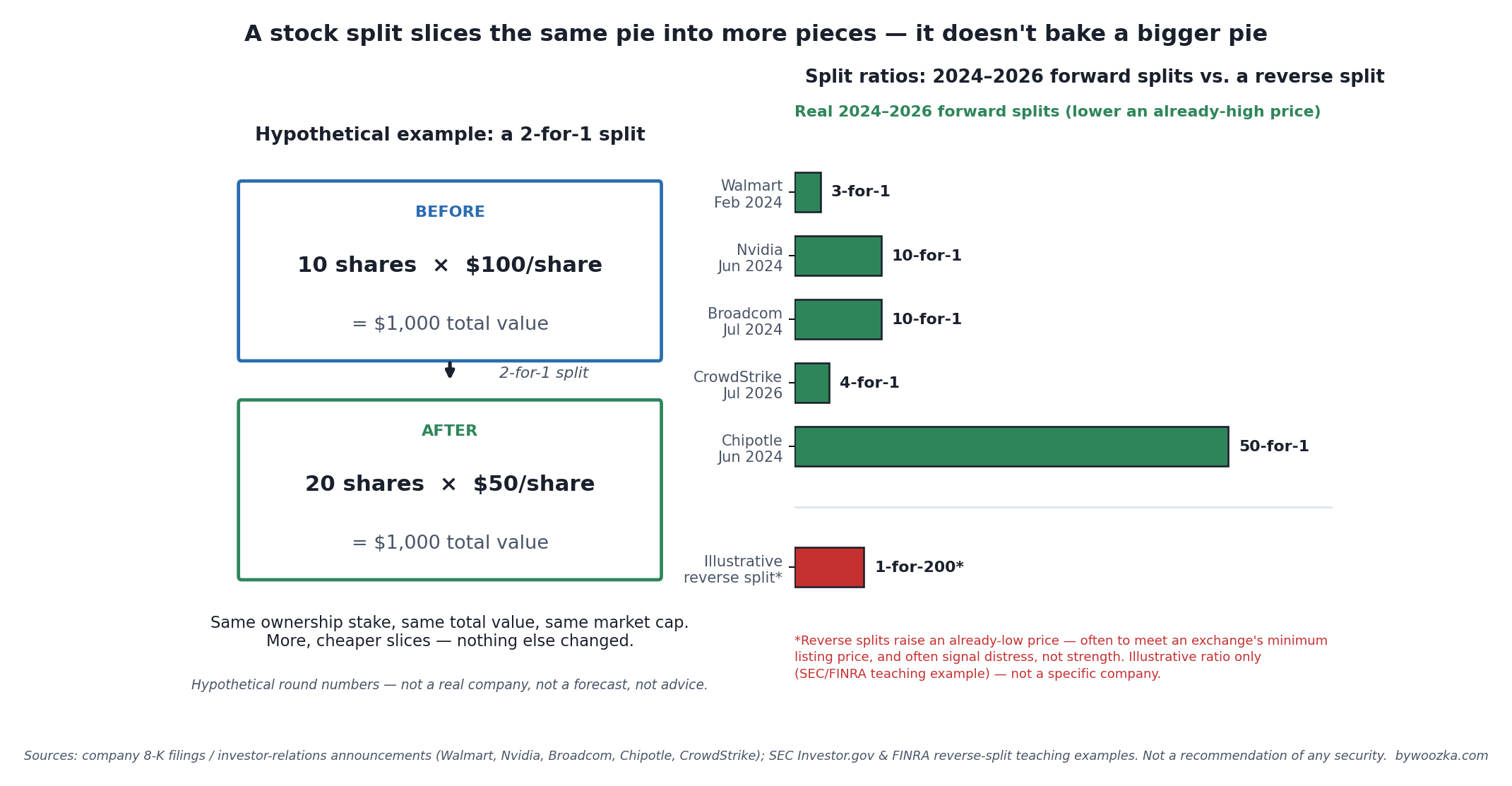
Left: a hypothetical 2-for-1 split — the number of shares doubles, the price per share halves, and the total value is identical before and after. Right: real, sourced split ratios from 2024-2026, plus one illustrative reverse-split example for contrast. Sources: company 8-K filings/investor-relations announcements; SEC Investor.gov and FINRA. Not a recommendation of any broker or security.
If you’ve ever watched a stock’s price chart and seen it suddenly drop by 90% overnight with no bad news anywhere in sight, you’ve probably witnessed a stock split. It looks dramatic. It usually isn’t. A stock split is one of the most misunderstood events in investing precisely because it looks like something big just happened to a company’s value, when in almost every case, nothing did.
This article explains exactly what a stock split changes, what it leaves untouched, how a reverse split is a different animal entirely, and why “the stock just split” is not, on its own, a reason to buy anything. Nothing here is a recommendation to buy or sell any particular security — the goal is to make sure you understand the mechanics before you see the next headline.
What a Stock Split Actually Is
The U.S. Securities and Exchange Commission’s Investor.gov defines a stock split plainly: it’s “an increase in the number of shares of a corporation’s stock without a change in the shareholders’ equity” [source: SEC Investor.gov, “Stock Split,” Glossary]. Companies do this to make their shares more affordable to investors, and — critically — a split does not dilute the ownership interest of existing shareholders [source: SEC Investor.gov, Glossary].
The SEC’s own worked example: if you own 100 shares of a company trading at $100 per share and the company declares a two-for-one split, you’ll own 200 shares at $50 per share immediately afterward. If the company pays a dividend, the dividend paid per share also falls proportionately, so the total dollar amount you receive is unchanged [source: SEC Investor.gov, Glossary].
FINRA’s explanation adds the part that matters most for a beginner to internalize: “the total value of those shares is the same as it was before the split,” and while the number of shares outstanding increases, the company’s “market capitalization… remains the same, too” [source: FINRA, “Stock Splits”]. A stock split is a decision made by a company’s board of directors to increase the number of outstanding shares in a set proportion — most commonly 2-for-1, 3-for-2, or 3-for-1, though ratios can be far larger [source: FINRA, “Stock Splits”].
Put simply: a stock split cuts the same pie into more slices. It does not bake a bigger pie.
A Worked Example
Say you own 10 shares of a company trading at $100 each — a $1,000 position. The board announces a 2-for-1 split. The next trading day, you own 20 shares, each now priced around $50. Your position is still worth $1,000. Nothing about the company — its revenue, its factories, its cash on hand, its debt, its competitive position — changed overnight. Only the number of slices your ownership is divided into changed, and the price tag on each individual slice changed to match.
This is also, per the SEC, true of dividends and other corporate actions: they scale down proportionally with the split rather than disappearing or doubling [source: SEC Investor.gov, Glossary].
The invariant, shown rather than asserted
The claim that a split leaves you exactly where you were is not a reassurance — it is an identity, and it can be checked. Take a 40-share position at $250.00 and run it through several splits:
| Split | Shares | Price | Position value |
|---|---|---|---|
| 2-for-1 | 80 | $125.00 | $10,000.00 |
| 3-for-1 | 120 | $83.33 | $10,000.00 |
| 4-for-1 | 160 | $62.50 | $10,000.00 |
| 10-for-1 | 400 | $25.00 | $10,000.00 |
| 1-for-10 | 4 | $2,500.00 | $10,000.00 |
The last column never moves. Shares multiply by exactly the ratio, price divides by exactly the same ratio, and the product is untouched — which is what “the pizza is cut into more slices” means once you write it down. The final row is a reverse split running the identical arithmetic backwards, and it is equally neutral: apply a 1-for-10 and then a 10-for-1 and you land precisely where you began.
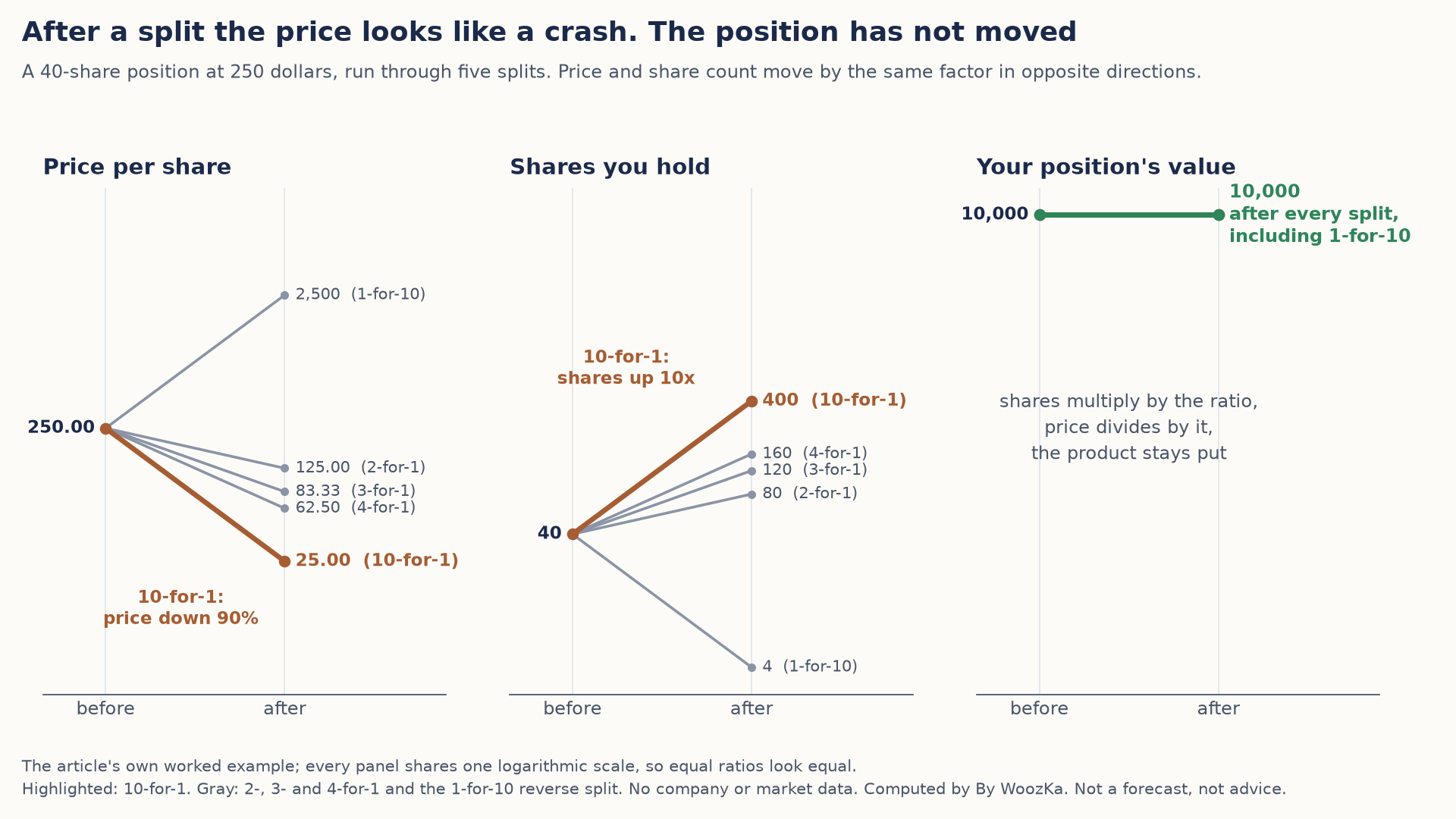
A split moves the price and the share count by the same factor in opposite directions, so the value of your position does not change. Check the total, not the per-share price.
This is not a forecast and names no company. The position above is an input; no market data is involved.
So what does move?
“Nothing changes” is a slight overstatement, and the exceptions are worth separating from the invariants:
| Quantity | Effect of a split |
|---|---|
| Number of shares you hold | changes |
| Price per share | changes |
| Total value of your position | unchanged |
| Your percentage ownership | unchanged |
| The company’s market capitalization | unchanged |
| Total dividend income (the per-share amount adjusts) | unchanged |
| Cost basis per share (the total basis splits too) | changes |
| Smallest amount you can buy without fractional shares | changes |
Everything in the unchanged column is unchanged as a matter of arithmetic, not as a matter of usually. The two that genuinely move are bookkeeping (your per-share basis is divided along with the price) and accessibility — which is the honest version of the reason companies do it. A lower share price lowers the smallest whole-share purchase, and that is a real effect on who can buy a round lot, even though it is not an effect on what the company is worth.
Method: shares become shares × ratio and price becomes price ÷ ratio. The code asserts the position value is invariant under every split shown, that a 2-for-1 exactly doubles shares and halves price, that a reverse split followed by its inverse round-trips exactly, and that the ownership fraction is invariant at any company share count.
What a Split Does to a Round Lot Now That Lots Come in Tiers
The section above names the one effect of a split that is real: “A lower share price lowers the smallest whole-share purchase, and that is a real effect on who can buy a round lot.” It assumes a round lot is 100 shares; since November 3, 2025, that is not always so. Regulation NMS now sets a stock’s round lot by its average closing price: 100 shares at $250.00 or less, 40 shares from $250.01 to $1,000.00, 10 shares from $1,000.01 to $10,000.00, and 1 share above that. The average is taken over March or September, and the result “shall be operative” from the first business day of May “and continue through the last business day of October,” or from November through April. Nothing in the definition reassigns a stock when it splits, so a split moves the price at once and the round lot only at the next assignment.
The cost of one round lot, with shares in the lot in parentheses:
| Illustrative split | Before | Until reassigned | After |
|---|---|---|---|
| $200 → $100, 2-for-1 | $20,000 (100) | $10,000 (100) | $10,000 (100) |
| $800 → $200, 4-for-1 | $32,000 (40) | $8,000 (40) | $20,000 (100) |
| $300 → $150, 2-for-1 | $12,000 (40) | $6,000 (40) | $15,000 (100) |
| $1,200 → $600, 2-for-1 | $12,000 (10) | $6,000 (10) | $24,000 (40) |
Until the next assignment, every split cuts the cost of a round lot by exactly its ratio; then the lot catches up, and only the first row ends where the old 100-share rule would put it. Across a tier the lasting cut is smaller: the 4-for-1 row falls 37.5%, not 75%. And a split can leave a round lot dearer. The $300 stock’s lot ends 25% more expensive and the $1,200 stock’s doubles, because stepping down a tier multiplies the lot by 2.5 or 4, more than a 2-for-1 split divides the price.
CrowdStrike, listed below, is a real case. Nasdaq’s round-lot file puts its March 2026 average close at $413.17 and assigns it 40 shares from May 1 through October 30, 2026, spanning its July 2 split. At the July 1 pre-split close of $772.74, those 40 shares cost $30,909.60; at the July 2 close of $193.98, $7,759.20.
One qualification to “who can buy”: an order smaller than a round lot is simply an odd lot. The round lot sets how quote sizes are shown, in shares rounded down to a multiple of it.
Method and limits, so this can be checked rather than taken on trust. The tiers and periods are the text of amended Rule 600(b)(93) [source: SEC, Release No. 34-101070, September 18, 2024], with the November 2025 start confirmed in [source: SEC, Release No. 34-104172, October 31, 2025] and the quote-size change in [source: CTA, Round Lots Enhancements FAQ, October 28, 2025]. CrowdStrike’s assignment and closes are from Nasdaq’s round-lot file and price history, retrieved September 24, 2026. That history is split-adjusted, so the July 1 close was multiplied by four; four times the adjusted March average reproduces Nasdaq’s $413.17 exactly. The illustrative rows assume a flat evaluation month; CrowdStrike’s November assignment is not estimated, because September is not complete. The arithmetic was computed in code that confirms every published figure. Nothing here recommends trading around any split.
Why Companies Actually Do This
If a split doesn’t change what a company is worth, why bother? FINRA’s answer centers on psychology and access, not fundamentals: “a psychological barrier might occur with trading high-priced shares. A very high stock price can intimidate investors who fear there is little room for growth” [source: FINRA, “Stock Splits”]. Splitting lowers the sticker price, which can make a stock feel more approachable to a wider pool of retail investors — even though, mechanically, nothing about the investment itself changed.
There’s a second, more practical reason that’s grown more relevant since fractional-share trading became widespread: a lower per-share price makes a stock easier to trade in round lots and can improve day-to-day liquidity, since more investors can afford a whole share without needing to buy fractions. (If fractional shares are new to you, see What Are Fractional Shares? — a split and a fractional share solve a similar “high price tag” problem from two different directions.)
Real Splits from 2024–2026
Stock splits aren’t a historical curiosity — they’ve been common in recent years, especially among large, high-flying growth and AI-adjacent names as their prices climbed. Some real, dated examples, each confirmed against the company’s own announcement or SEC filing:
- Walmart completed a 3-for-1 stock split, distributed February 23, 2024.
- Nvidia executed a 10-for-1 stock split effective June 7, 2024.
- Chipotle Mexican Grill completed its first-ever stock split, a 50-for-1 split, on June 25, 2024 [source: Chipotle Mexican Grill, Form 8-K, 2024].
- Broadcom executed a 10-for-1 stock split effective July 15, 2024.
- CrowdStrike completed a 4-for-1 forward split effective July 2, 2026, reducing its share price from roughly $770 to roughly $195.
Zoom out, though, and the broader trend is worth knowing too. Corporate boards authorized 76 traditional forward splits in 2024 and 62 in 2025, and 37 in 2026 through June 8 [source: Wall Street Horizon, “Split Decisions: What Stock Splits Reveal About Corporations in H1 2026,” 2026]. Wall Street Horizon describes that as a sharp cooling, but the 2026 count covers only about five months, so it is not comparable with the two full-year totals beside it. Put all three on a per-month basis and 2026 was running at about 7.1 splits a month, against 6.3 in 2024 and 5.2 in 2025, so the partial year does not yet show a slowdown. None of that tells you anything about where any individual stock is headed — it’s simply useful context for understanding how common (or uncommon) the mechanic is in the market you’re actually investing in right now.
Reverse Splits: The Same Mechanic, the Opposite Signal
Everything above describes a forward split — more shares, lower price. A reverse split runs in the other direction: existing shares are consolidated into fewer, higher-priced shares. The SEC’s example: in a one-for-ten reverse split, every ten shares you own become one share. If you owned 10,000 shares before, you’d own 1,000 after [source: SEC Investor.gov, “Reverse Stock Splits,” Glossary].
The reasons companies do this are almost the mirror image of why they do forward splits — and they’re worth taking seriously. Per the SEC, “a company may declare a reverse stock split in an effort to increase the trading price of its shares — for example, when it believes the trading price is too low to attract investors… or in an attempt to regain compliance with minimum bid price requirements of an exchange on which its shares trade” [source: SEC Investor.gov, “Reverse Stock Splits,” Glossary]. FINRA is more direct still: “a reverse stock split tends to occur with small companies that believe their stock price is too low to attract investors,” it’s more common among stocks trading over-the-counter rather than on major exchanges, and “if a reverse split is announced and actually occurs, proceed with caution” — especially when the post-split price is many multiples of the pre-split price [source: FINRA, “Stock Splits”].
That caution is well earned. A reverse split doesn’t fix a struggling business any more than a forward split makes a healthy one healthier — in both directions, “the amount of money you have invested doesn’t change, just the number of shares you own” [source: FINRA, “Stock Splits”]. But a reverse split is frequently a symptom of a company in trouble (a share price that’s fallen so far it risks delisting), where a forward split is frequently a symptom of a company whose price has risen enough that management wants to make it feel more accessible. Same mechanic, very different context.
Does a Split Change Your Taxes?
No. The IRS treats a stock split as a non-event for tax purposes: “you don’t report income until you sell the stock” [source: IRS, “Stocks (options, splits, traders),” FAQ]. What does change is your cost basis per share — your total basis stays the same, but it’s reallocated across your new, larger number of shares. Using the IRS’s own illustration: if you own 100 shares with a $15-per-share basis ($1,500 total) and the stock does a 2-for-1 split, you now own 200 shares, but your total basis is still $1,500 — meaning your basis per share is now $7.50 [source: IRS, FAQ]. For shares purchased at different times and prices, this reallocation happens lot by lot. Most brokers track this automatically for “covered” securities purchased after cost-basis reporting rules took effect, but it’s still worth understanding what your statement is actually showing you.
What the Evidence Actually Says (and Doesn’t Say)
Here’s where it’s easy to overreach, so it’s worth being precise. Academic researchers have studied stock splits for decades, and one of the most cited studies — Ikenberry, Rankine, and Stice, published in the Journal of Financial and Quantitative Analysis in 1996 — examined 1,275 two-for-one stock splits and found an average announcement-period return of 3.38%, followed by additional excess returns of 7.93% over the following year and 12.15% over the following three years, relative to comparable non-splitting firms [source: Ikenberry, Rankine & Stice, “What Do Stock Splits Really Signal?,” Journal of Financial and Quantitative Analysis, Vol. 31, No. 3, Sept. 1996, pp. 357–375]. The researchers’ own interpretation is a signaling story, not a mechanical one: companies tend to split their stock when management is optimistic about continued performance, so a split can function as a costly, credible signal — and the market, on average, appears to initially underreact to that signal [source: Ikenberry, Rankine & Stice, 1996].
Three things matter enormously here, and this blog is not going to let the headline statistic stand without them:
- This is a decades-old average across a large sample (largely from the 1970s-1990s), not a rule about any specific stock today. An average post-announcement drift across 1,275 splits tells you nothing certain about what happens to the next individual company that splits its shares.
- The likely direction of causation runs backward from how it’s often repeated online. The split doesn’t cause the good performance — under the signaling theory, a company’s board tends to schedule a split because it already expects continued strong performance. The stock isn’t doing well because it split; it split, at least in part, because insiders already believed it was going to keep doing well. Treating “it just split” as a buy signal inverts the researchers’ own explanation.
- A statistic from one academic sample is not a promise about any investment’s future. Historical and backtested results like these are hypothetical relative to any position you might take today, carry real limitations, and do not guarantee anything going forward.
The honest, useful takeaway is narrower than “splits make stocks go up”: a split is, at most, a small piece of circumstantial evidence about how confident management felt at one moment — not a mechanism that creates value, and not a reason by itself to buy, sell, or hold anything.
The Moment Most Investors Have Felt
There’s a particular kind of investor whiplash that a stock split triggers reliably: you check your portfolio the morning after a split, see your share count jump and the price per share collapse, and for one disorienting second your brain reads it as a crash before the math catches up. It happens to disciplined, experienced investors and brand-new ones alike — a split’s optics are simply built to look alarming to a system tuned to associate “price fell 90%” with “something is very wrong.” The fix is always the same: check the total value of the position, not the per-share price, before reacting to anything.
The Practical Takeaway
When you see a stock split headline, run through the same short checklist every time: the total value of the company (its market capitalization) is unchanged; your position’s total value is unchanged; only the share count and the per-share price move, in opposite directions, to cancel out; there’s no new tax event, only a basis reallocation you should let your broker track; and the split itself tells you essentially nothing new about whether the business is a good investment going forward. If it’s a reverse split instead, treat it as a flag worth investigating rather than ignoring — it’s frequently, though not always, a sign of a company under real pressure.
None of this is a reason to chase a stock because it recently split, and it’s equally not a reason to avoid one. The split is cosmetic. The business underneath it is what actually matters, and that requires the same research — reading the actual financials, understanding what the company does, and sizing any position sensibly — that any other investment decision does. For a first look at that kind of research, see How to Analyze a Company Before You Buy the Stock.
The Bottom Line
A stock split increases the number of a company’s shares and lowers the price per share in exact proportion, leaving total shareholder value, market capitalization, and ownership percentage completely unchanged. Companies mostly do it to make a high share price feel more approachable, not because anything about the underlying business shifted. A reverse split runs the opposite direction and often shows up around real financial or listing-compliance pressure, so it deserves a more skeptical read. There’s no new tax bill from a split — only a basis reallocation across more shares. And while researchers have found splits are, on average, associated with modestly positive subsequent returns in some historical samples, the leading explanation is that management schedules splits when it’s already optimistic — not that splitting causes anything. A split is a fact about share count. It is never, by itself, an investment thesis.
If you’re building the literacy to evaluate what actually does matter about a company before you buy its stock, the next steps are What Is a P/E Ratio and How Do You Actually Use It? and How to Read an Earnings Report Without an MBA. If you haven’t opened a brokerage account yet, start with How to Open Your First Brokerage Account. For the weekly market read this blog uses, subscribe to the newsletter below.
Disclaimer: This article is educational content, not financial advice. I am not a licensed financial advisor, and nothing here is a recommendation to buy or sell any security or asset. Investing and trading involve risk, including the possible loss of the money you invest. Do your own research and consider consulting a licensed financial professional before making investment decisions. Read the full Disclaimer.
Historical and backtested results are hypothetical, carry inherent limitations, and do not guarantee future results. Figures were accurate to the best of my knowledge as of this article’s last-updated date and may have changed.
