Stablecoins Explained: How They (Try To) Hold Their Peg
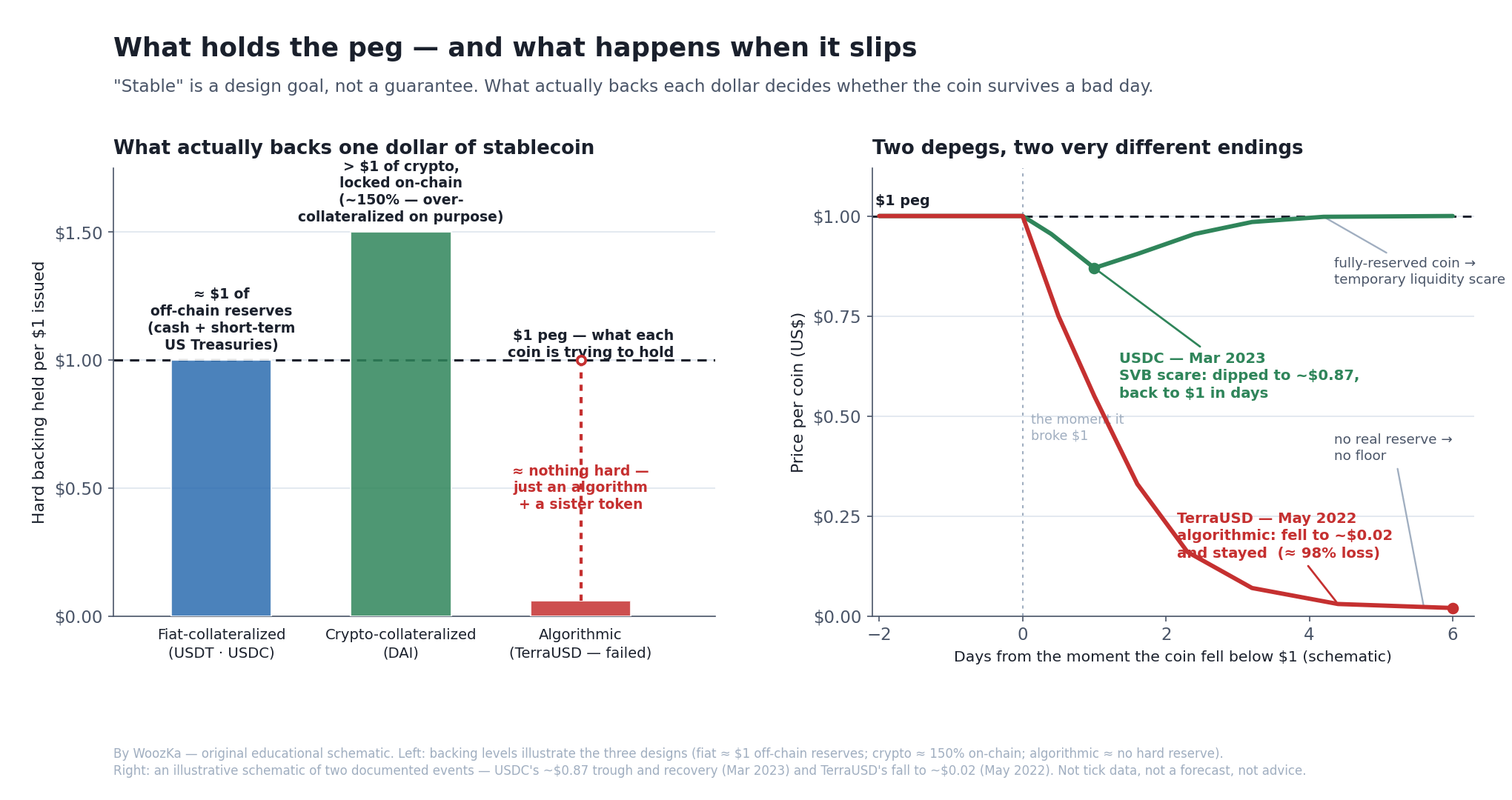
The whole article in one picture. Left: “backed” means completely different things across the three designs — and the differences are exactly what decide whether a coin survives a bad day. Right: two coins both broke a dollar; one came back in a weekend, one never came back at all. Knowing which kind you’re holding is the entire point.
If you’ve read the pillar on buying your first Bitcoin safely, you know this silo’s rule: risk management first, price speculation last. Stablecoins are where a lot of beginners quietly break that rule — because the name does the lying for them. “Stablecoin” sounds like the safe corner of crypto, the digital-dollar you park money in between trades and never think about again. Most of the time, for the big ones, that’s roughly how it behaves. But “stable” is a design goal, not a law of nature, and the goal has failed — spectacularly, to near zero, wiping out tens of billions of dollars — inside the last few years.
One thing up front, because it frames everything below: a stablecoin is not a dollar in a bank, and it is not free of risk. A US bank deposit is insured up to $250,000 by the FDIC; a stablecoin is not, no matter how “stable” the marketing sounds [source: FDIC deposit insurance basics; stablecoins are not FDIC-insured — a point regulators and the issuers’ own disclosures make repeatedly]. The U.S. Securities and Exchange Commission’s blanket caution about crypto still applies here — “the only money you should put at risk with any speculative investment is money you can afford to lose entirely” — and the U.K.’s Financial Conduct Authority is blunter still: “if you invest in crypto, be prepared to lose all your money” [source: SEC / Investor.gov, “Exercise Caution with Crypto Asset Securities,” Mar. 23, 2023; FCA, “Investing in crypto,” 2021]. This article makes no price prediction and no recommendation — not which coin to hold, not whether to hold any. It explains how the peg is supposed to work, the three very different ways issuers attempt it, and where each one can break. That knowledge is the safety equipment; it is not a green light.
What a Stablecoin Actually Is
A stablecoin is a cryptocurrency token engineered to hold a steady value — almost always one US dollar — instead of swinging around the way Bitcoin or Ether do [source: general definition; J.P. Morgan Private Bank, “Demystifying Stablecoins”]. The goal is a crypto asset you can send on a blockchain, at blockchain speed, that is still worth about a dollar tomorrow.
They exist because volatility makes ordinary crypto clumsy for a lot of jobs. If you want to step out of a falling market at 2 a.m. on a Sunday without wiring money back to a bank, move funds between exchanges in minutes, price a trade against something that isn’t itself lurching 5% an hour, or send value across a border, a token pinned to the dollar is far more convenient than one that isn’t. That utility is real, and it’s why the category has grown large: as of mid-2026 the total value of all stablecoins was roughly $290 billion, after briefly topping $321 billion earlier in the year [source: DefiLlama / stablecoin market-cap trackers, July 2026 — these totals move daily, so read them as a July 2026 snapshot rather than a live figure]. Two coins dominate almost entirely — Tether (USDT) at around $184 billion and Circle’s USD Coin (USDC) at around $73 billion, together roughly 89% of the whole market [source: stablecoin market-cap reporting, July 2026].
Here’s the catch that the rest of the article unpacks: a stablecoin holds its value only as long as the mechanism behind it holds. The dollar peg isn’t stamped into the token; it’s the result of whatever the issuer does to defend it. Understand the mechanism and you understand the risk. Ignore it and you’re trusting a label.
The Three Ways to Hold a Peg (and How Well Each Works)
There are three main designs, and they are not variations on a theme — they’re genuinely different promises with genuinely different failure modes.
| Design | Examples | What backs each $1 | Main risk |
|---|---|---|---|
| Fiat-collateralized | USDT, USDC | Real off-chain reserves (cash + short-term US Treasuries) held by a company | You’re trusting the company: are the reserves real, liquid, and redeemable? |
| Crypto-collateralized | DAI | More than $1 of volatile crypto, locked in on-chain smart contracts | A fast crash in the collateral can outrun the buffer; complex, still crypto-exposed |
| Algorithmic | TerraUSD (collapsed) | Essentially nothing hard — an algorithm and a paired token | Death spiral: confidence breaks, the mechanism accelerates the fall |
Fiat-collateralized is the simplest idea and the biggest by far. A company promises that for every token it issues, it holds one dollar of safe, liquid reserves — cash and short-dated US Treasury bills — that it will hand back on redemption [source: USDT/USDC reserve disclosures; the fiat-collateralized model]. USDT and USDC both work this way. The peg holds because, in principle, arbitragers can always redeem a token for a real dollar, so the market price gets dragged back to $1. The whole thing rests on one word: trust. Are the reserves actually there, actually worth a dollar, and actually redeemable when everyone wants out at once? We’ll come back to that, because it’s the crux.
Crypto-collateralized stablecoins try to remove the company. DAI, issued by the Sky protocol (formerly MakerDAO), is the leading example: no firm holds reserves. Instead, users lock crypto — ETH and others — into on-chain smart contracts called vaults and mint DAI against it, but only up to a fraction of the collateral’s value. Because crypto is volatile, the system deliberately demands more than a dollar of collateral for every dollar of DAI — typically a collateralization ratio around 150–175%, so roughly $150 of ETH backs about $100 of DAI [source: Sky/MakerDAO documentation; DAI overcollateralization and vault mechanics, 2026]. That excess is a shock absorber; if collateral falls too far, the protocol automatically liquidates it to keep every DAI backed. It’s more transparent (you can inspect the collateral on-chain) but also more complex, and it never stops being exposed to crypto’s own swings.
Algorithmic stablecoins are the design that gives the whole category its scariest chapter. They hold no meaningful hard reserve at all. Instead, an algorithm mints and burns a second, free-floating “sister” token to push the price back to a dollar — market incentives standing in for collateral. When confidence is high, it can look like it works. When confidence breaks, the same mechanism can accelerate the collapse instead of stopping it. That is not hypothetical. It is exactly what happened in May 2022.
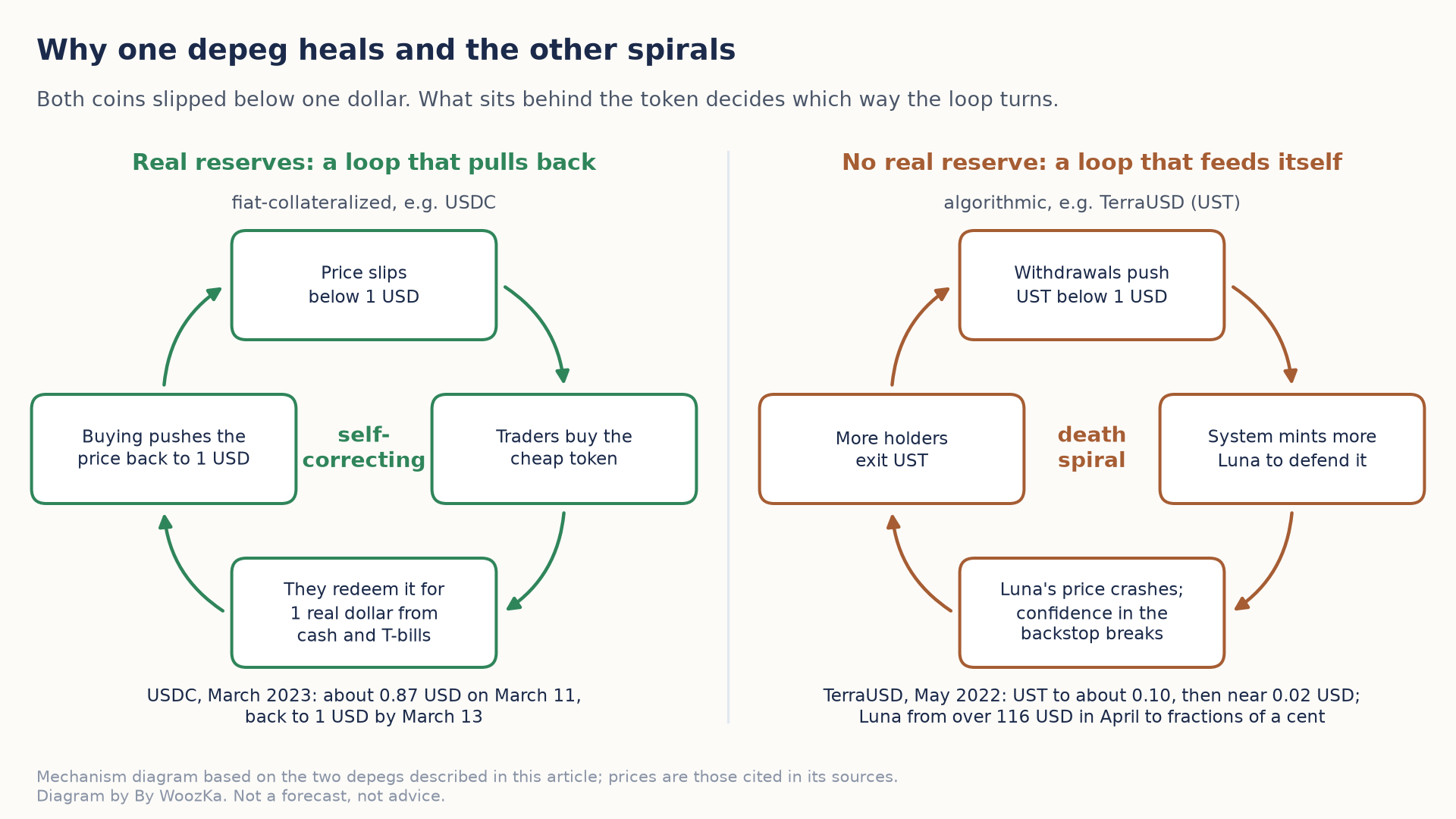
With real reserves, a slip below a dollar invites buyers who can redeem for a real dollar, which pulls the price back up. With no reserve, defending the peg means minting more of the sister token, and each turn of that loop makes the next one worse.
The Peg Is a Promise, Not a Law: Two Depegs
The single most useful thing a beginner can learn about stablecoins is that a “depeg” — the price slipping below a dollar — is not one event with one meaning. It can be a temporary scare that fully heals, or a terminal collapse. The two most famous examples are the two panels on the right of the chart above, and the difference between them is everything.
TerraUSD, May 2022 — the collapse to near zero
TerraUSD (UST) was the flagship algorithmic stablecoin. It held its dollar peg through a mint-and-burn link to a sister token, Luna — no real reserves standing behind it [source: Corporate Finance Institute, “What Happened to Terra”; Harvard Law / MIT Sloan CFI, “Anatomy of a Run: The Terra Luna Crash,” 2023]. In early May 2022, large withdrawals knocked UST below a dollar. The mechanism responded by minting huge amounts of Luna, which crashed Luna’s price, which destroyed confidence in the backstop, which drove more people out of UST — minting still more Luna. That feedback loop is the death spiral algorithmic designs are prone to. Within days, UST fell to around $0.10 and then near $0.02 — a roughly 98% loss for holders — and Luna went from over $116 in April to fractions of a cent, essentially worthless [source: reporting and academic analysis of the Terra/Luna crash, May 2022; CFI; MIT Sloan]. Somewhere around $50 billion of UST and Luna value evaporated, and the shock helped trigger an estimated $400 billion of losses across the broader crypto market [source: Terra/Luna collapse post-mortems, 2022]. The SEC later won a fraud case against Terraform Labs and its founder Do Kwon, with a settlement of about $4.5 billion [source: SEC v. Terraform Labs / Do Kwon; ~$4.5B judgment reported June 2024]. There was no reserve to redeem against. When the confidence went, there was nothing underneath.
USDC, March 2023 — the scare that fully recovered
Now the other kind. USDC is fiat-collateralized — real reserves, held by Circle. In March 2023, Silicon Valley Bank failed, and Circle disclosed that $3.3 billion of USDC’s cash reserves — about 8% of its backing — was stuck at the collapsed bank [source: CNBC and CoinDesk, “Circle confirms $3.3B of USDC’s cash reserves stuck at failed Silicon Valley Bank,” Mar. 11, 2023]. Traders panicked that USDC might not be fully redeemable, and it depegged, falling to about $0.87 at its trough on March 11 [source: CNBC; Federal Reserve FEDS Notes, “In the Shadow of Bank Runs,” 2025]. But this was a fundamentally different situation from Terra: the reserves existed; the only question was whether that 8% slice was recoverable. When US regulators announced that all SVB depositors would be made whole, USDC regained its dollar peg within days, by March 13 [source: CoinDesk, “USDC Stablecoin Regains Dollar Peg,” Mar. 13, 2023].
Put the two side by side and the lesson writes itself. Both coins broke a dollar. One was a liquidity scare on a fully-reserved coin and healed in a weekend; the other was a structurally uncollateralized coin whose fall had no floor. “It depegged once and recovered” and “it depegged once and went to zero” describe the same word attached to two completely different risks. The design is what tells them apart — which is why the boring question (“what actually backs this?”) is the one that matters.
The two depegs side by side. Same word, two entirely different risks — every figure below is from the sources cited in this section.
| TerraUSD — May 2022 | USDC — March 2023 | |
|---|---|---|
| Design | Algorithmic: a mint-and-burn link to Luna, no hard reserves | Fiat-collateralized: cash and short-dated US Treasuries held by Circle |
| Trough price | About $0.10, then near $0.02 | About $0.87, on March 11 |
| Loss at the trough | Roughly 98% | Roughly 13% |
| What actually broke | Large withdrawals triggered the death spiral; Luna fell from over $116 in April to fractions of a cent | $3.3 billion — about 8% of backing — was stranded at the failed Silicon Valley Bank |
| Did it recover? | No. There was no reserve to redeem against | Yes — within two days, repegged by March 13 |
| What ended it | Nothing. The mechanism accelerated the fall rather than arresting it | Regulators announced all SVB depositors would be made whole |
| Wider cost | About $50B of UST and Luna value; helped trigger an estimated $400B of losses across crypto; SEC v. Terraform Labs, roughly $4.5B judgment reported June 2024 | None to holders who waited |
“Backed” Is Doing a Lot of Work: What’s Actually in the Reserves
For the fiat-collateralized giants, the entire peg rests on reserves being real, safe, and redeemable. So it’s worth knowing that “backed by reserves” is a phrase, not a guarantee — and that the two market leaders sit at different points on a transparency spectrum.
Tether (USDT) is the largest stablecoin and also the most historically contested. Its reserves today are dominated by US Treasuries — the company reported exposure of roughly $135 billion in US Treasuries in a 2025 attestation, alongside gold (around $12.9 billion) and Bitcoin (around $9.9 billion) and smaller buckets of secured loans and other assets [source: Tether Q3 2025 attestation; reserve-composition reporting, 2025–2026]. Notice something there: not all of the backing is dollars or Treasuries. Gold and Bitcoin are themselves volatile, which means a slice of the thing meant to hold a steady dollar is backed by assets that don’t. Just as important is how we know: Tether publishes quarterly attestations by the firm BDO — but an attestation is a point-in-time snapshot, not a full audit of systems and controls over time [source: reporting on Tether’s BDO attestations; the attestation-vs-audit distinction]. Update, September 2026: that picture changed on August 13, 2026, when Tether announced that KPMG U.S. had completed a full audit of its financial statements for the year ended December 31, 2025 and issued an unqualified opinion — which the company describes as its inaugural financial audit [source: Tether, “Tether Completes the Largest Inaugural Financial Audit in History,” August 13, 2026]. The audit covers one fiscal year’s statements; the quarterly reports in between remain attestations, so the distinction above still describes most of what gets published. And the history matters: in 2021, Tether and the exchange Bitfinex settled with the New York Attorney General for $18.5 million over an inquiry into whether they had covered up the loss of $850 million in funds; they admitted no wrongdoing, and the current quarterly-attestation regime was in part a settlement requirement, not purely a voluntary gesture [source: NY Attorney General settlement, Feb. 2021; CoinDesk].
USDC (Circle) has generally positioned itself as the more transparent, more regulated of the two, with reserves concentrated in cash and short-term Treasuries and monthly reserve reporting — and, as we’ll see, it has leaned into the new regulatory frameworks rather than away from them [source: Circle USDC reserve disclosures; MiCA authorization reporting].
None of this is a verdict on any coin. The point for a beginner is narrower and more durable: the word “backed” hides a spectrum — from fully liquid, frequently and transparently reported dollars to a mix that includes volatile assets, disclosed in periodic snapshots by a firm with a contested past. When someone tells you a stablecoin is “backed 1:1,” the right reflex is to ask backed by what, held where, verified how, and redeemable by whom — not to nod at the number.
How Much Work “Backed” Is Doing, Measured
The section above notices that a slice of the largest stablecoin’s backing is gold and Bitcoin, which do not hold steady, and leaves it as an observation. It is also a question with an arithmetic answer: how far would that slice have to fall before the reserves stopped covering the tokens, and how bad could it get if it fell all the way? The same report that supplies the three figures above also states total reserves and total liabilities, and those two numbers are all the question needs. Everything below is one dated snapshot — September 30, 2025 — and nothing in it is a forecast or a statement about where any issuer stands today.
The Cushion and the Slice
“Backed 1:1” describes a floor. What an issuer actually holds above that floor is the cushion, and the cushion is the only part of the reserves that can absorb a loss before a token is worth less than a dollar of assets.
| As of Sept. 30, 2025 | Reported | In proportion |
|---|---|---|
| Reserves | $181.22B | — |
| Liabilities | $174.45B | — |
| Excess reserves | $6.78B | 3.9% of liabilities |
| Gold and Bitcoin | $22.8B | 12.6% of reserves |
The two bottom rows are the whole story in miniature. The cushion is 3.9% of what is owed; the part of the reserves that can move sharply in price is 12.6% of what is held. The volatile slice is about 3.4 times the size of the cushion that exists to absorb its losses. Neither number is alarming alone, and the release reports both without comment. It is the ratio between them that tells you what “backed” depends on, and it is not printed anywhere.
What It Takes to Use Up the Cushion
Divide the cushion by the slice and you get the fall at which excess reserves reach zero — the point where every token is still matched by a dollar of assets, with nothing to spare.
| If this falls | Cushion is gone at |
|---|---|
| Gold and Bitcoin together | 29.7% |
| Gold alone | 52.5% |
| Bitcoin alone | 68.5% |
The last row is the one with history behind it. This site’s article on sizing a crypto position lists Bitcoin’s past bear markets at roughly 77%, 84% and 86%. Every one of them is deeper than the 68.5% that would, with nothing else changing, have used up this cushion. That is a statement about proportions on one date, not a prediction that it will happen: the same release reports more than $10 billion of profit in the first nine months of 2025, earnings can rebuild a cushion as fast as prices erode it, and an issuer can change what it holds from one quarter to the next. But it does put a number on the sentence above it. On that date the margin behind the token was thinner than a single Bitcoin bear market of the kind already on record.
The Floor Under a Bad Day
The same arithmetic run to its end says something less dramatic and at least as useful, because it bounds the damage.
| Scenario | Reserves per $1 | Shortfall |
|---|---|---|
| As reported | 103.9¢ | 0.0% |
| Bitcoin −77% | 99.5¢ | 0.5% |
| Bitcoin −86% | 99.0¢ | 1.0% |
| Both fall 50% | 97.4¢ | 2.6% |
| Both go to zero | 90.8¢ | 9.2% |
A Bitcoin collapse as deep as any this site documents leaves about 99 cents of assets behind every token. Even with gold and Bitcoin both marked to nothing, the reserves would still cover 90.8 cents on the dollar, because seven-eighths of them are not in that slice at all. That is what the “spectrum” described above looks like with a scale on it: the worst case the volatile slice can produce is a shortfall of 9.2%, where the algorithmic design in the table further up lost roughly 98% with nothing underneath. One caution belongs beside that comfort, and the same table supplies it. A shortfall in reserves is not a price. In March 2023 the market marked USDC down roughly 13% when about 8% of its backing was in doubt, so a run can take the price below the arithmetic before the arithmetic reasserts itself.
Method and limits, so this can be checked rather than taken on trust. No calculator on this site works on reserve reports, so nothing above comes from a shipped tool; every figure is arithmetic on the issuer’s own release for the period ended September 30, 2025, read at source, computed in code and checked before publication, with the release’s stated excess reproduced to the dollar from its reserves and liabilities, and this page’s own 98% and 13% trough losses recomputed from the prices beside them. Four limits are real. It is one snapshot, now a year old, and composition changes every quarter. Gold and Bitcoin are given only to the nearest tenth of a billion; both ends of that rounding were run and move the 29.7% by less than a quarter of a point and the 90.8 cents by less than a tenth of a cent. The scenarios hold everything else still — no earnings, no redemptions, no change in holdings, and gold and Bitcoin moving only as each row says — which is how you isolate a proportion and not how a real quarter unfolds. And a report prepared by the issuer is the only source for these figures; the full audit of the 2025 year-end statements announced in August 2026 put excess reserves at $6.814 billion, within about half a percent of the figure used here, but its release does not break out gold or Bitcoin. Nothing here is a verdict on any coin or a reason to hold or avoid one.
You’re Lending the Issuer Your Dollars — Usually for Free
Here’s a piece most beginners miss. When you hold a fiat-collateralized stablecoin, you’ve effectively handed the issuer a dollar, and the issuer parks that dollar in Treasury bills and keeps the interest. You get a token that’s worth a dollar; they get the yield on a very large pile of very safe assets — which is exactly why issuing stablecoins is so profitable. In the US, the GENIUS Act now prohibits stablecoin issuers from paying interest or yield to holders just for holding the coin, so the “your dollars work for free” arrangement is written into the law, not just the business model [source: GENIUS Act (P.L. 119-27), 2025; Congressional Research Service, “The Stablecoin Yield Debate”].
That reframes the “stablecoin savings account” pitch you’ll see on some platforms. If a service is paying you attractive “yield” on a stablecoin, that yield is not coming from the coin itself — it’s coming from what the platform does with your coins (lending them out, deploying them in DeFi), which reintroduces exactly the credit and counterparty risk the stablecoin was supposed to sidestep. “Stable” plus “yield” is not a free lunch; it’s a second risk bolted onto the first.
Two more real risks belong here, briefly. Counterparty and freeze risk: centralized issuers can, and do, freeze or blacklist specific tokens and addresses to comply with law enforcement or sanctions — a USDT or USDC balance is not as unstoppable as “crypto” branding implies [source: Tether/Circle freeze-and-blacklist policies; on-chain freeze events]. And fee and spread costs apply here just as they do everywhere in crypto (covered in the pillar): moving in and out of stablecoins repeatedly still pays spreads and fees, so treating them as friction-free cash is a mistake.
The Rules Are Changing Fast: GENIUS Act and MiCA
Stablecoins spent most of their history in a regulatory gray zone. That changed sharply in 2024–2025, and the direction of travel matters for anyone holding them.
In the United States, the GENIUS Act was signed into law on July 18, 2025, after passing the House 308–122 and the Senate 68–30 — the first federal framework for payment stablecoins [source: The White House, “Fact Sheet: President Signs GENIUS Act into Law,” July 18, 2025; Congress.gov, S.1582]. In broad strokes it requires issuers to hold 100% reserves in liquid assets (cash, short-term Treasuries, and similar), to publish monthly reserve disclosures, and — as noted — bars them from paying holders interest [source: GENIUS Act text and summaries; Richmond Fed, “Stablecoins and the GENIUS Act,” 2025]. By demanding full, high-quality reserves, the law effectively rules out the uncollateralized algorithmic model that failed in 2022.
In the European Union, the Markets in Crypto-Assets Regulation (MiCA) got there first. Its stablecoin rules took effect June 30, 2024, requiring issuers to be licensed, fully backed by high-quality liquid reserves, and externally audited [source: MiCA, Regulation (EU) 2023/1114; ESMA]. The consequences were immediate and concrete: because Tether did not seek MiCA authorization, USDC’s rival USDT was delisted from EU-regulated exchanges (Coinbase, Kraken, Binance’s EEA platform, Crypto.com) across late 2024 and early 2025, while Circle’s MiCA-authorized USDC and euro-pegged EURC were positioned to fill the gap [source: MiCA delisting reporting, 2024–2025].
Regulation is a real improvement — full-reserve rules and disclosure make the fiat-collateralized model meaningfully safer than the Wild-West version that produced Terra. But “safer” is not “safe.” Rules reduce the odds of a Terra-style implosion for regulated coins; they do not repeal bank-run dynamics, reserve-quality questions, freeze risk, or the plain fact that a stablecoin is still not an insured bank deposit. Read new “fully regulated” marketing the same way you’d read any other — as a reason to check the details, not to skip them.
What This Means for You
If you use stablecoins at all — and most people who touch crypto eventually do — a few beginner-level disciplines carry almost all the value:
- Treat “stable” as a goal, not a guarantee. The name describes what the coin is trying to do. Terra was called a stablecoin right up until it wasn’t. Ask what design you’re holding — fiat-collateralized, crypto-collateralized, or algorithmic — because that answer, not the label, tells you how it can break.
- A stablecoin is not a savings account. It isn’t FDIC-insured, it usually pays you nothing, and any “yield” on it comes from someone taking a further risk with your money. Parking cash in a stablecoin is a convenience for staying inside crypto, not a place to store money you can’t afford to lose.
- “Backed 1:1” is a question, not an answer. Prefer transparency you can actually check — frequent, detailed reserve reporting held in genuinely liquid assets — over a reassuring number. Know that attestations are snapshots, not full audits.
- Depegs happen; the design decides the ending. A brief slip on a fully-reserved coin that recovers in days (USDC, 2023) and a terminal collapse with nothing underneath (Terra, 2022) are not the same risk. Don’t let one word blur them.
- Size it like the rest of your crypto. Everything in this silo comes back to the same discipline: decide amounts when you’re calm, and size any position — stablecoins included — so that a bad outcome is survivable.
Stablecoins are a genuinely useful tool: they make crypto easier to move, trade, and hold without cashing out to a bank. Used with clear eyes, that’s a real convenience. Just don’t let the calmest-sounding word in the whole asset class talk you into forgetting it’s still part of the asset class.
Where to Go Next
Stablecoins are the “cash” corner of crypto; these build out the rest of the safety picture around them:
- How to Buy Your First Bitcoin Safely: A Step-by-Step Guide — the pillar: the risk-first walkthrough everything in this silo plugs into.
- Crypto Wallets Explained: Hot vs Cold Storage for Beginners — where your stablecoins (and everything else) actually live, and the custody tradeoffs that decide who can freeze or lose them.
- Crypto Position Sizing: How Much of Your Portfolio Should Be Crypto? — the discipline that keeps any single position, stablecoins included, from doing real damage.
If you want markets explained plainly — risk-first, never hyped, no price targets — that’s what the newsletter is for. Subscribe below.
Disclaimer: This article is educational content, not financial advice. I am not a licensed financial advisor, and nothing here is a recommendation to buy or sell any security or asset. Investing and trading involve risk, including the possible loss of the money you invest. Do your own research and consider consulting a licensed financial professional before making investment decisions. Read the full Disclaimer.
Historical and backtested results are hypothetical, carry inherent limitations, and do not guarantee future results. Figures were accurate to the best of my knowledge as of this article’s last-updated date and may have changed.
