The Dividend Tax Nobody Reads About: Qualified vs Ordinary, and Where You Hold It
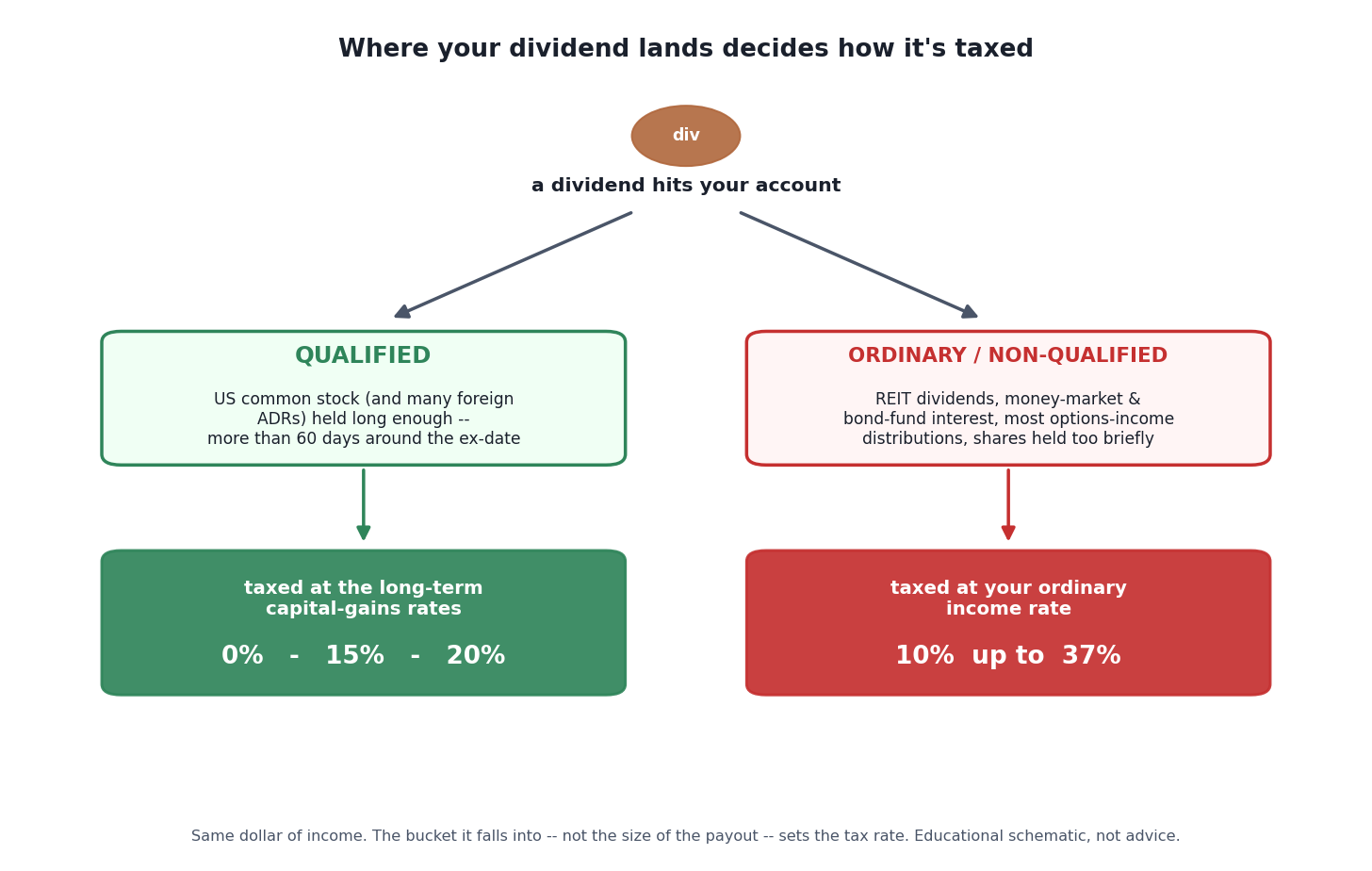
Before you compare two dividend funds by yield, look at the fork above. The single biggest thing separating what two investors actually keep from the same payout isn’t the fund — it’s which of these two buckets the income falls into, and that’s set by tax law, not by the size of the check. This piece is about reading that fork on purpose. Illustrative schematic, not advice.
Most dividend writing stops at the yield. It tells you SCHD pays about this, VYM pays about that, and leaves you to imagine the money arriving intact. It doesn’t. Between the company’s payout and your bank balance sits a step almost nobody teaches: the tax code sorts every dividend into one of two buckets, and the two are taxed on completely different schedules. Get this wrong and a “higher-yield” fund can leave you with less spendable income than a lower-yield one. Get it right — and, just as importantly, hold each fund in the right account — and you keep more of the same payout without picking a single different ticker.
This is the tax-aware corner of dividend investing. It’s a real style, with real advantages, and — like every style this site covers — a real way it goes wrong, which I’ll get to. If you’re new to the whole idea of living on dividends, start with Dividend Investing 101; if you’re weighing which kind of dividend fund to own, Dividend Growth vs High Yield is the companion to this one. Everything below is education on how the numbers are defined and calculated, not advice on your specific return — and I’m not a tax advisor, so the moment real dollars are on the line, a CPA earns their fee.
The One Distinction That Runs the Whole Thing
Here’s the sentence the rest of the article unpacks: a qualified dividend is taxed at the long-term capital-gains rates — 0%, 15%, or 20% — while an ordinary (non-qualified) dividend is taxed at your regular income rate, which for 2026 runs as high as 37%.
That gap is not small. For a lot of middle-income households the qualified rate is 15% and the ordinary rate on the same dollar would be 22% or 24% — so the identical dividend keeps roughly a tenth more of itself just by being sorted into the right bucket. The catch is that you mostly don’t choose the bucket dividend by dividend. It’s decided by what kind of security paid it and how long you held the shares. Understanding those two levers is the whole game.
I’ll be honest about where I landed on this after years of watching people (myself included) obsess over yield: the tax bucket and the account you hold a fund in are the most reliable edge in dividend investing, precisely because they don’t depend on predicting anything. You can’t know which fund will out-yield the other next year. You can know, today, that a REIT throws off ordinary income and belongs somewhere sheltered. One is forecasting; the other is just reading the rules.
What Makes a Dividend “Qualified”
To be a qualified dividend — the good bucket — a payout generally has to clear two tests [source: IRS, “Topic No. 404 Dividends”; Fidelity, “What are qualified dividends and how are they taxed?”, 2026]:
- It has to come from a US corporation, or a qualifying foreign one (typically a company in a country with a US tax treaty, or one whose shares trade on a US exchange as ADRs). Ordinary corporate common and preferred stock usually qualify on this test.
- You have to have held the shares long enough. The rule: you must hold the stock for more than 60 days during the 121-day window that starts 60 days before the ex-dividend date [source: IRS Topic No. 404; Fidelity, 2026]. The 61+ days don’t have to be consecutive, but they must fall inside that window. Buy a stock the day before it goes ex-dividend, pocket the payout, and sell the next week, and that dividend is not qualified — you flunked the holding test. (Certain preferred-stock dividends tied to periods over 366 days use a stricter 91-day / 181-day version of the test.)
Clear both and the dividend is taxed at the capital-gains schedule. Fail either — usually the holding period — and it drops into the ordinary bucket regardless of how “blue-chip” the company is.
Some income never qualifies, no matter how long you hold it, because of what’s paying it:
- REIT dividends are generally taxed as ordinary income. A real estate investment trust doesn’t pay corporate tax on the income it distributes, so that income was never taxed at the company level the way a normal corporation’s was — and the code makes up for it by taxing the payout at your ordinary rate [source: IRS, REIT taxation; Wikipedia, “Qualified dividend”]. (A slice of REIT distributions can be return of capital or capital gain, and through the Section 199A pass-through deduction a portion of the ordinary REIT dividend may get a deduction — but the headline is: REIT income is ordinary, not qualified.)
- Interest dressed up as a “dividend.” The “dividend” a money-market fund or a bond fund pays is really interest, and it’s taxed as ordinary income.
- Most options-income / covered-call fund distributions (the JEPI/JEPQ family) are largely ordinary, because the option premium that powers the yield isn’t a qualified dividend.
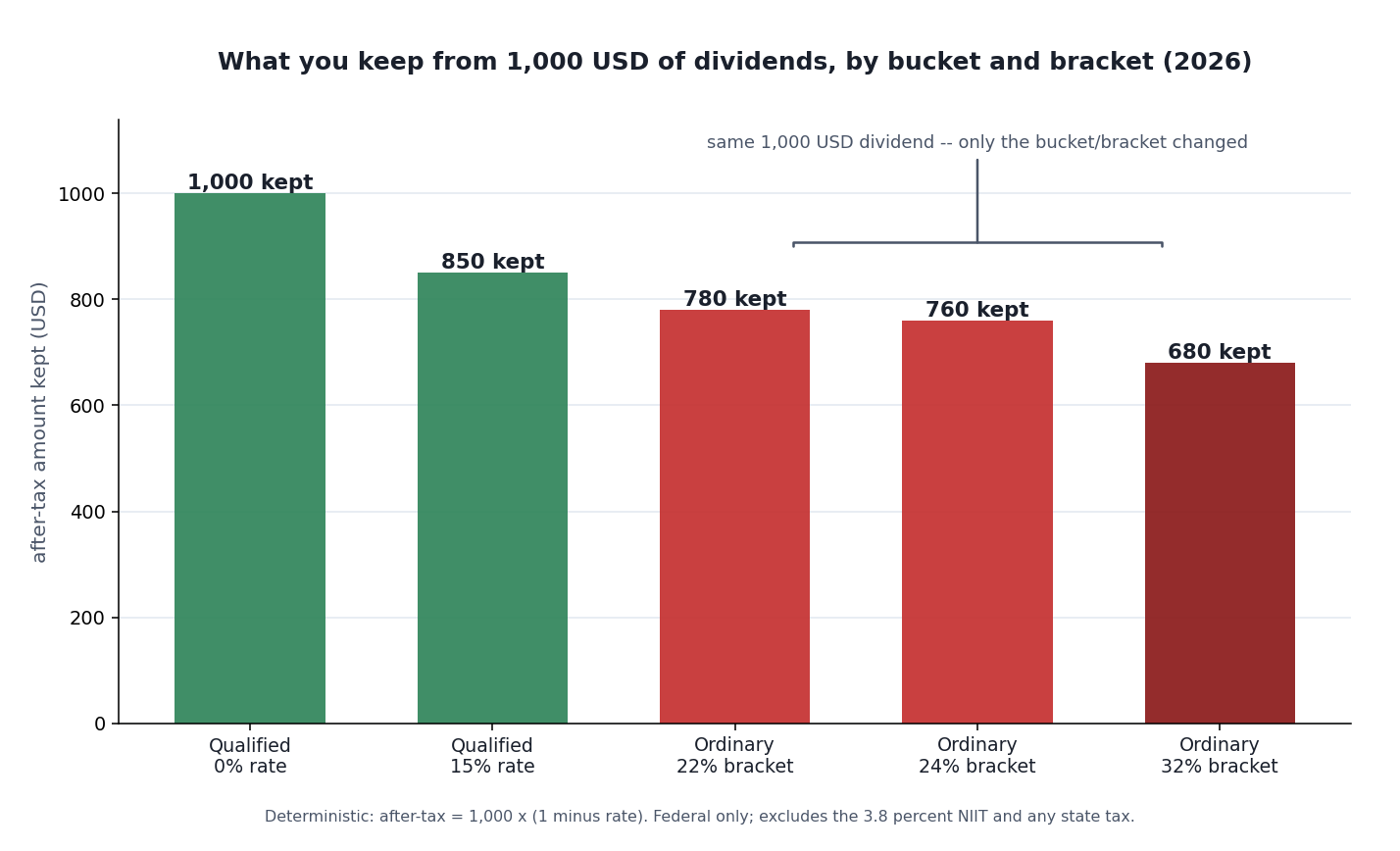
This is the whole argument in one picture. The payout is identical — $1,000 — in every bar. The only thing that moves is which bucket the income lands in and, for the ordinary bars, your tax bracket. A qualified dividend at 15% keeps $850; the same dollar as ordinary income at 24% keeps $760. Deterministic arithmetic, federal only. State tax and the 3.8% surtax below would widen the gap further.
The holding-period rule, drawn as a calendar
That rule is the one people misread, and the reason is that it is stated as a window rather than as a deadline. “More than 60 days inside a 121-day period” does not tell you what you actually need to know, which is: given when I bought, how much longer do I have to hold? That question has an exact answer, because it is arithmetic on days.
No tax rule is introduced below. Both windows are the ones stated and sourced above; nothing here computes a liability, and none of it is advice about when to trade. It is the same rule, rearranged into the form you would actually use.
| You bought this long before the ex-dividend date | Common stock — must still hold | Certain preferred — must still hold |
|---|---|---|
| 1 day | 60 days | 90 days |
| 7 days | 54 days | 84 days |
| 15 days | 46 days | 76 days |
| 30 days | 31 days | 61 days |
| 45 days | 16 days | 46 days |
| 60 days | 1 day | 31 days |
| 90 days | 1 day | 1 day |
Read the top row first, because it is the one that catches people. Buy a share one day before it goes ex-dividend and you have to keep holding it for 60 days afterwards — two full months — before that payout counts as qualified. For the preferred shares that fall under the stricter test, it is 90 days, or roughly three months.
Read down the column and the rule turns friendly. Every day you owned the share before the ex-dividend date is a day you do not have to serve afterwards, until at 60 days the requirement collapses to almost nothing. Buying earlier than that adds no further credit, because the window itself only opens 60 days before the ex-dividend date — holding from the year before is worth exactly the same as holding from the window’s first day.
Why buying for the dividend rarely works the way people expect
The article’s own example above — buy the day before, pocket the payout, sell the next week — is worth following all the way through, because the gap is not marginal:
| Total time held | Days that count | Days needed | Result |
|---|---|---|---|
| 3 days | 3 | more than 60 | not qualified |
| 7 days | 7 | more than 60 | not qualified |
| 14 days | 14 | more than 60 | not qualified |
| 30 days | 30 | more than 60 | not qualified |
| 61 days | 61 | more than 60 | qualified |
| 75 days | 61 | more than 60 | qualified |
Holding for a week gets you 7 of the more than 60 days required. Even a full month leaves you at 30 — still less than halfway. The threshold is not one you drift across by holding “a while”; on this timing it takes 61 days to clear, and every day before that produces a dividend taxed in the ordinary bucket rather than the favorable one.
Notice also that the last row stops improving. Once the window closes, extra holding earns no more qualifying days — the count is capped at what fits inside the 121 days. Holding longer may be sensible for every other reason, but it cannot rescue a dividend whose window has already passed.
Method, so it can be checked rather than taken on trust: each figure is the days of holding that fall inside the stated window, split into those before the ex-dividend date and those after it, with holding earlier than the window’s opening contributing nothing. The script verifies every entry twice — once from the formula and once by walking the window one day at a time and counting — and separately asserts that exactly enough holding passes while one day less fails, at every purchase date. Day counting is whole days of holding; the exact treatment of the purchase and sale days themselves shifts these figures by at most a day and is worth confirming with a tax professional, as is anything here that touches your own return. It lives in the site’s repository as qualified_dividend_calendar.py; the figures above are printed by it, not transcribed by hand.
The 2026 Numbers, So You Can Place Yourself
The qualified-dividend rates aren’t a single number — they’re a three-step schedule that tracks the long-term capital-gains brackets, and the thresholds are set each year. For 2026 (IRS Rev. Proc. 2025-32, released October 2025), the qualified-dividend / long-term-gains breakpoints are [source: IRS Rev. Proc. 2025-32; SmartAsset, “Dividend Tax Rate for 2025 and 2026”, 2026]:
- 0% on qualified dividends while your taxable income sits below $49,450 (single) / $98,900 (married filing jointly).
- 15% from there up to $545,500 (single) / $613,700 (MFJ).
- 20% above those levels.
Two things people miss. First, this stacks: your wages and ordinary income fill the brackets first, and your qualified dividends pile on top — so a retiree with modest ordinary income can genuinely pay 0% on a chunk of qualified dividends, while a high earner pays 20% on the same dividend. Second, above certain income levels a separate 3.8% Net Investment Income Tax (NIIT) rides on top of investment income, including dividends, once your modified AGI clears $200,000 (single) / $250,000 (MFJ) [source: IRS, NIIT / Form 8960; Fidelity, 2026]. Those NIIT thresholds are not indexed to inflation and haven’t moved since 2013 — so each year a few more households drift into paying it without a single rule changing. A “20% qualified” dividend for a high earner is really 23.8% once the surtax lands, and an ordinary dividend at the top can hit 40.8% federal before any state tax.
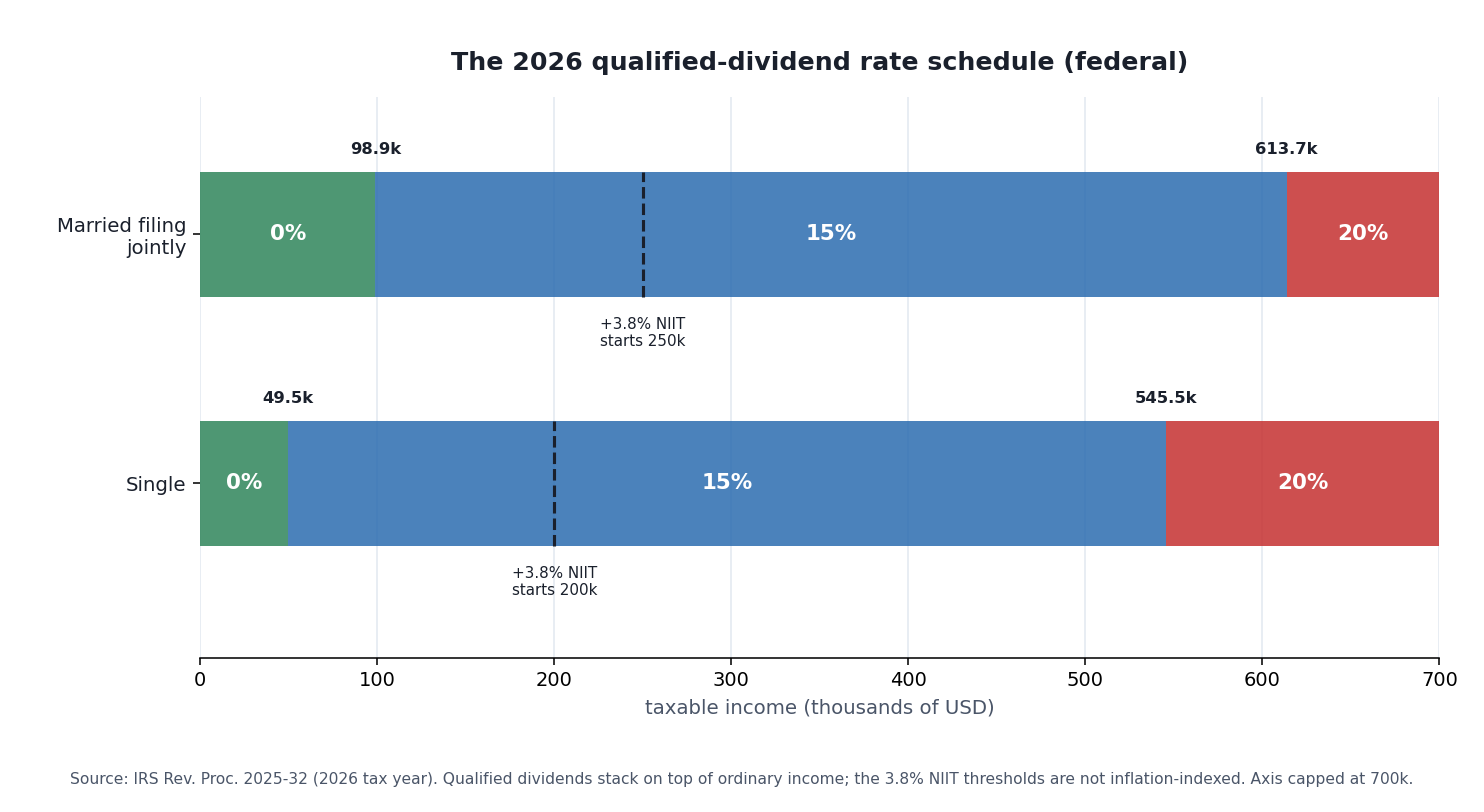
Real, dated figures for the 2026 tax year. Find your filing status, run your taxable income across the bar, and you can see which qualified-dividend rate applies — and where the 3.8% surtax starts stacking on top. Because the payout piles on top of your ordinary income, the exact same dividend can be taxed at 0%, 15%, 20%, or 23.8% depending entirely on the rest of your return.
Where You Hold It Can Matter As Much As What You Hold
Now the part that turns this from trivia into a repeatable edge: asset location — deciding which account holds which asset. You have, roughly, three kinds of accounts, and they tax income differently:
- A taxable brokerage account taxes dividends every year as they’re paid — qualified ones gently, ordinary ones at your full rate.
- A traditional IRA/401(k) defers all of it: nothing is taxed as it’s earned, and you pay ordinary rates on withdrawals later.
- A Roth IRA taxes none of the growth or qualified withdrawals at all.
Put those next to the two buckets and a simple pattern falls out. Tax-inefficient income — the ordinary bucket — is the income you most want to shelter. A REIT, a high-yield bond fund, a covered-call fund: all throw off ordinary income that would be taxed at your full rate every year in a taxable account. Held inside an IRA or Roth, that same income compounds untaxed. Meanwhile the tax-efficient holdings — broad qualified-dividend stock funds, or a total-market index that barely distributes — are the ones that hurt least in a taxable account, because they’re already taxed gently (or deferred as unrealized gains). The general shape most tax-aware investors follow: ordinary-income generators inside tax-advantaged accounts; qualified, low-turnover holdings fine in taxable.
That’s a decision you make once, when you set the accounts up, and it quietly pays every year afterward with zero forecasting. It is the closest thing dividend investing has to the APR-vs-APY insight from the money cluster: not a prediction, just reading which rule applies. (For the borrowing-side version of “the same number is quoted two ways,” see What Is APR vs APY?.)
The Foreign-Dividend Trap Almost Nobody Flags
There’s one more bucket-and-account interaction worth its own section, because it’s a genuine, avoidable leak. When you own foreign dividend-payers — directly, or through an international fund — the foreign country usually withholds tax at source before the dividend reaches you, commonly 15% under a US tax treaty [source: IRS, Foreign Tax Credit / Publication 514; Schwab, “Claiming Foreign Taxes: Credit or Deduction?”, 2026].
Here’s the trap. In a taxable account, that foreign withholding isn’t lost — you can generally claim it back as a foreign tax credit on your US return, roughly a dollar-for-dollar offset against your US tax. But in an IRA or other retirement account, there’s no US tax on that income to offset, so the foreign tax credit isn’t available — the withheld 15% is simply gone, permanently [source: IRS Pub. 514; Schwab, 2026]. It’s the one spot where the usual “shelter your income in the IRA” instinct backfires: a foreign-heavy dividend fund can quietly bleed a slice of its yield inside a tax-advantaged account that it wouldn’t lose in a taxable one, where the credit is recoverable.
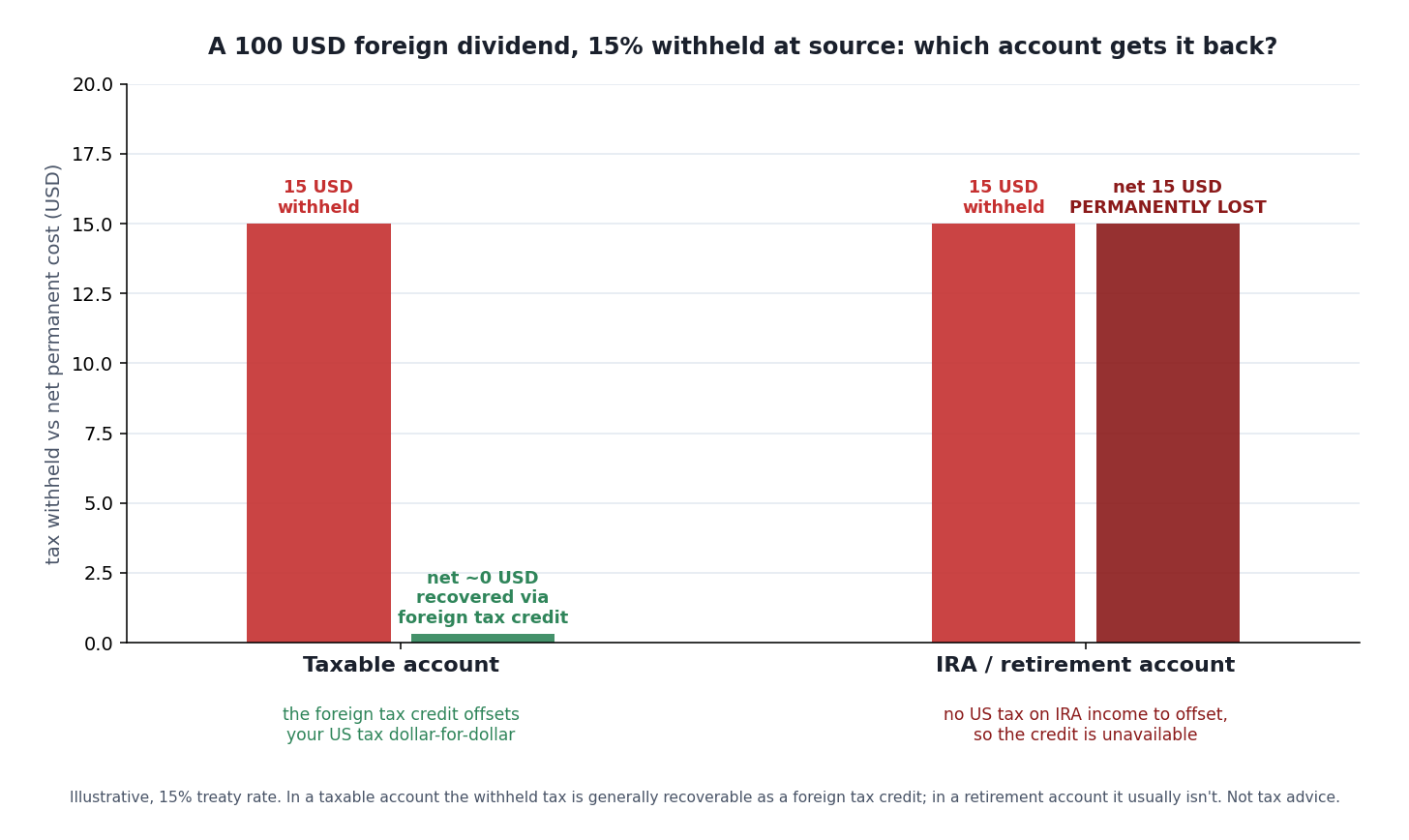
The counter-intuitive one. The instinct is to shelter income-heavy holdings in an IRA — but foreign withholding is the exception. In a taxable account the 15% withheld abroad is generally recoverable as a foreign tax credit; inside an IRA there’s no US tax for the credit to offset, so it’s a permanent leak. Illustrative at a 15% treaty rate; the actual rate and recoverability depend on the country, the treaty, and your return.
Teaching the Style Honestly: Where Tax-Aware Dividend Investing Goes Wrong
Every style this site covers gets the same treatment, including the one I clearly like: here’s how it fails.
Failure mode 1 — the tax tail wagging the investment dog. The whole point of a portfolio is total return net of tax, not minimized tax. It is entirely possible to build a worse portfolio in pursuit of a better tax bucket — reaching for qualified-dividend payers you’d never otherwise own, or crowding your IRA with high-yield junk because it’s tax-inefficient, and ending up concentrated, under-diversified, or lower-returning. A dividend taxed at 24% that you actually earned beats a qualified one at 15% on a stock that lagged. Tax efficiency is a tiebreaker between otherwise-good choices, not a reason to make a bad one.
Failure mode 2 — the rules move, and not in your favor. Every number in this article is a 2026 figure. Brackets get re-indexed yearly; the NIIT thresholds are frozen and quietly catch more people each year; and Congress can and does rewrite the qualified-dividend regime outright. A plan that only works at today’s rates is fragile. Building around durable ideas — shelter ordinary income, keep turnover low, don’t chase yield — survives a rule change; building around a specific 15% number does not.
Failure mode 3 — complexity you won’t maintain. Asset location, tax-loss harvesting, tracking qualified vs ordinary across accounts: it compounds into a system you have to actually keep up. For many people a simpler, slightly-less-optimized setup they’ll stick with beats an intricate one they abandon in year three. Honest tax-aware investing knows when to stop optimizing.
None of that makes the tax bucket unimportant — it’s real money, every year, for zero forecasting. It just means the tax rules are a lens you apply to a sound plan, never the plan itself. Who does this style suit? Someone with meaningful taxable and tax-advantaged accounts, enough income that the bucket difference is real dollars, and the temperament to set it up once and leave it. If all your investing is inside a single Roth, most of this is moot by design — which is itself a kind of answer.
The Bottom Line
Two investors can earn the identical dividend and keep very different amounts of it. A qualified dividend — US common stock held past the 60-day-plus window — is taxed at the capital-gains rates of 0%, 15%, or 20%; an ordinary dividend — REITs, cash and bond interest, options-income distributions, or shares held too briefly — is taxed at your regular rate, up to 37% in 2026, plus a possible 3.8% surtax. Where you hold each fund can matter as much as which fund it is: shelter the ordinary-income generators, leave the qualified low-turnover holdings in taxable, and watch the one exception — foreign withholding, which is recoverable in a taxable account but a permanent leak in an IRA. Do that once and you keep more of the same payout forever, without predicting a thing. Just don’t let the tax tail wag the dog, and don’t build a plan that only survives at this year’s rates.
Disclaimer: This article is educational content, not financial advice. I am not a licensed financial advisor, and nothing here is a recommendation to buy or sell any security or asset. Investing and trading involve risk, including the possible loss of the money you invest. Do your own research and consider consulting a licensed financial professional before making investment decisions. Read the full Disclaimer. Historical and backtested results are hypothetical, carry inherent limitations, and do not guarantee future results. Figures were accurate to the best of my knowledge as of this article’s last-updated date and may have changed.
This is the tax lens on the simplest-wealth-building cluster: once you can read which bucket a dividend falls into and which account should hold it, the yield number finally means what you think it means. For the foundations, see Dividend Investing 101; for the fund choice, Dividend Growth vs High Yield. Subscribe below for the money-foundations checklist this cluster builds on.
