Two Kinds of Growth Investing: Quality Compounders vs. Profitless Promises
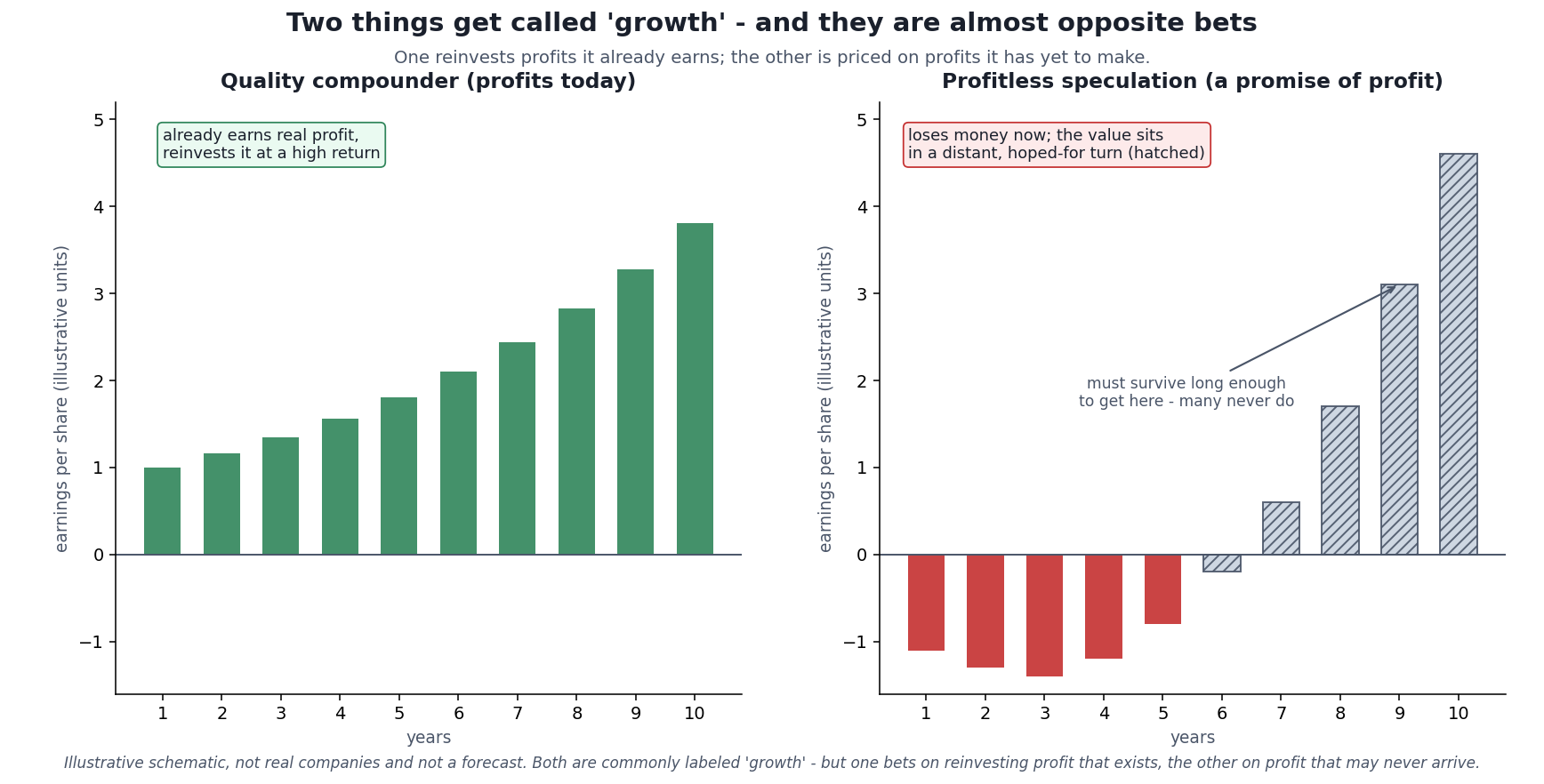 Both of these get called “growth stocks,” and they are almost opposite bets. One reinvests profit it already earns. The other is priced on profit it has not made yet — and may never make. Illustrative schematic, not a forecast.
“Growth investing” sounds like one thing. It isn’t. The label covers two disciplines that share a word and share almost nothing else, and confusing them is how people talk themselves into the riskiest corner of the market believing they’re doing what Peter Lynch did. This site already has the two hardest truths about the style covered from other angles: why rising rates punish your fastest stocks worst, and why a great company can still be a terrible stock once its price already assumes the greatness. This piece is about a split inside the style that comes before either of those problems — the difference between the two things you might actually be buying.
The first is a quality compounder: a company that already earns real profit and grows by plowing that profit back into the business at a high rate of return. The second is profitless speculation: a company losing money now, whose entire value rests on a promise that it will be hugely profitable someday. Both go up when the story is good. But one is compounding something real, and the other is a bet on a future that hasn’t arrived — and the base rates for that future are worse than the excitement suggests.
This is a stocks article about growth as a style, and it takes no position that growth beats value or that either kind of growth beats a plain index fund. The duration piece already lays out the style’s real, painful costs, and for most beginners a total-market index fund remains a perfectly defensible default. What follows assumes you’ve decided you want to own growth stocks and are asking the sharper question: which kind, and what actually has to go right for it to pay?
The Two Bets Behind One Word
Look again at the opening chart, because it’s the whole article in one picture. On the left, the quality compounder is already in the black in year one. Its growth is funded — every year it earns a profit, keeps most of it, and reinvests it into more of whatever is working. The bet you’re making is that it can keep finding places to put that profit at a high return for a long time.
On the right is the other animal entirely. It loses money for years. There’s nothing to reinvest yet; the company is spending investors’ capital to chase a market it hasn’t captured. Its stock isn’t worth much today on any earnings basis — it has no earnings — so its price is built almost entirely on a forecast of profits far out in the future. Buy it and you are not buying a compounding machine; you are buying a lottery ticket on a business model, priced as if the ticket has already won.
Neither bet is illegitimate. Some of the best-performing stocks in history spent their early years deeply unprofitable, and a disciplined investor can own speculative growth with eyes open. The mistake is not knowing which one you’re holding — treating a profitless promise as though it were a proven compounder, and sizing it, and trusting it, accordingly.
Why the Return on Capital — Not the Growth Rate — Decides Everything
Here’s the idea that separates a real compounder from a company that’s merely getting bigger: growth only creates value if the money reinvested earns more than it costs. A company can grow revenue and earnings for years and still make its owners nothing, if it’s funding that growth with capital that earns a poor return.
The engine of a compounder is a simple identity: the rate at which its intrinsic value grows is roughly its return on invested capital multiplied by the share of profit it reinvests. A business that reinvests everything at a 20% return on capital compounds its worth at about 20% a year. A business that reinvests everything at an 8% return compounds at about 8% — and if its cost of capital is around 9%, that “growth” is actually destroying value with every dollar it reinvests, however fast the top line climbs.
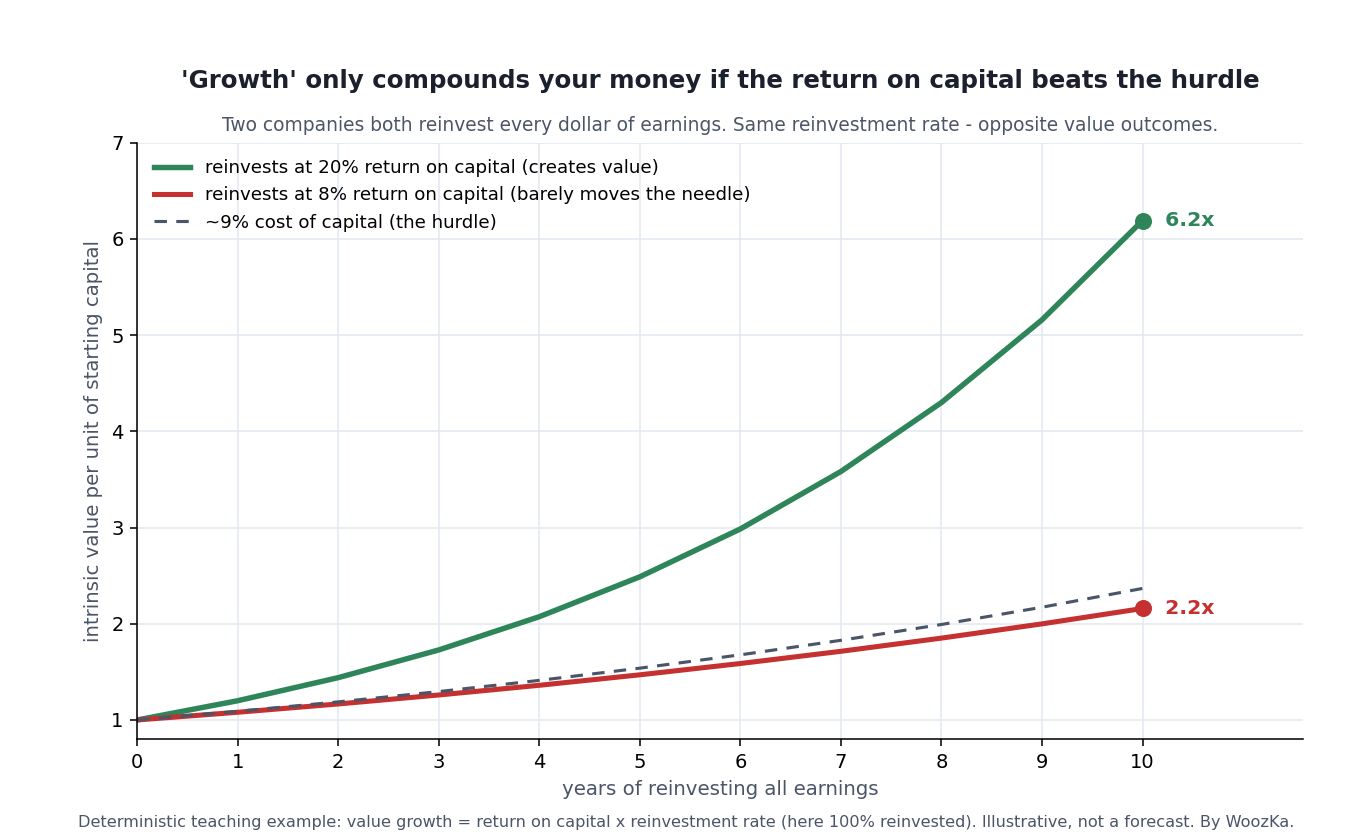 The quiet distinction most growth investors skip. Both companies “grow” by reinvesting all their earnings — but only the one earning a high return on that capital actually compounds your money. Growth funded at a return below the cost of capital is expansion, not value creation. Deterministic illustration, not a forecast.
This is why serious growth investors obsess over return on capital, reinvestment runway, and competitive advantage rather than the growth rate on its own. A high growth rate is the headline; the return on capital is whether the headline means anything. It’s also the cleanest way to tell a genuine compounder from a company that’s just spending a lot to look like one: the compounder earns a high return on what it reinvests and has somewhere to keep reinvesting; the pretender is growing by pouring capital into projects that barely earn their keep.
And it draws the honest line under the quality-growth school: its failure mode isn’t that these companies stop growing. It’s that the return on capital fades — competition arrives, the runway shortens, and a business that compounded at 20% quietly slips toward its cost of capital. When that happens, the “compounder” was really a mid-life grower all along, and you were paying a compounder’s price for it.
The Profitless Bet Has Worse Base Rates Than the Excitement Suggests
Now the other school, and its failure mode is more dramatic. When a company has no profits, there’s nothing to compound and nothing to value on today’s numbers — so the whole case is this will be enormously profitable later. Sometimes it is. Usually it isn’t, and the aggregate record is not close.
The clearest evidence comes from the market for newly public companies, where the profitless-growth bet is most concentrated. Decades of data compiled by University of Florida finance professor Jay Ritter show two things at once. First, the share of companies going public while still losing money is large and, in recent booms, historically so — around 80%+ of US IPOs came from unprofitable companies at the 2021 and 2017 peaks, comparable to the roughly 86% seen at the height of the dot-com bubble in 2000 [source: Jay R. Ritter, IPO statistics, University of Florida — web-verified 2026-07-31]. Second, and more important for you as a buyer: those exciting money-losers, on average, underperform. Ritter’s long-run data shows IPOs of profitable companies have beaten IPOs of unprofitable ones by roughly six percentage points a year over the following three years — a gap that held in the 1980s and 1990s too, not just recently.
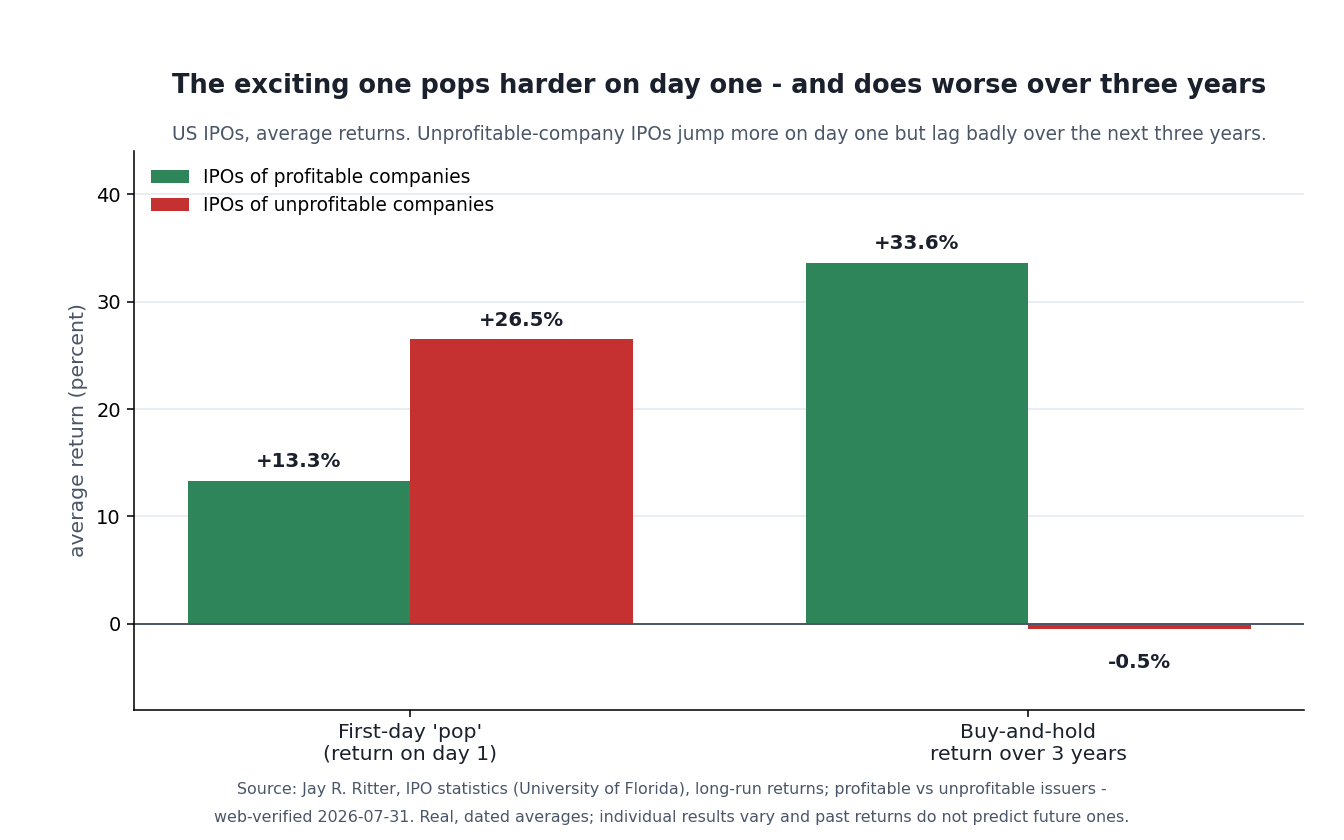 Why the day-one thrill is a trap, in real numbers. The profitless names pop harder when they list — then, on average, go nowhere over the next three years while the profitable ones roughly double the market’s pace. The excitement is real; the returns, on average, are not. Real, dated averages, not a forecast.
Read those two bars together, because the story is in the contrast. The profitless names pop harder on day one — that’s the exciting part, the part that shows up in headlines and group chats. And then, on average, they hand it all back and more over the next three years, while the boring profitable ones quietly compound. The excitement and the return are, if anything, negatively correlated. This is the base rate the enthusiasm hides: you’re not just taking more risk for more reward, you’re on average taking more risk for less.
That’s the honest failure mode of profitless speculation. It isn’t that these companies always fail — a handful become the defining businesses of their era, and that’s genuinely how some fortunes are made. It’s that the average one disappoints, the dispersion is enormous, and the human tendency is to overweight the exciting story precisely when the odds are worst. If you own this kind of growth, own it as what it is: a small basket of lottery tickets where you expect most to fail and a rare one to pay for the rest — not a core holding you can size like a compounder.
Even Great Growth Needs a Reasonable Price
Suppose you’ve done the harder work — you’ve found a genuine quality compounder, high return on capital, real runway, durable advantage. There’s still one way to lose money on it, and it’s the subject of this site’s expectations-treadmill piece: paying too much. A wonderful business bought at a punishing price can be a bad investment even if everything you believed about the business turns out right.
The discipline that guards against this is old enough to have a name — growth at a reasonable price, GARP, most associated with Peter Lynch — and its rough rule of thumb is that the price-to-earnings multiple you pay shouldn’t run too far ahead of the growth rate you’re paying for (a PEG ratio, price-to-earnings divided by growth, somewhere near 1). It is not a precise law, and it breaks in obvious ways at very low growth. But as a discipline it captures something real: your return is the business’s earnings growth times what happens to the multiple you paid, and if you buy at a demanding multiple that later normalizes, the shrinking multiple can eat most of the growth.
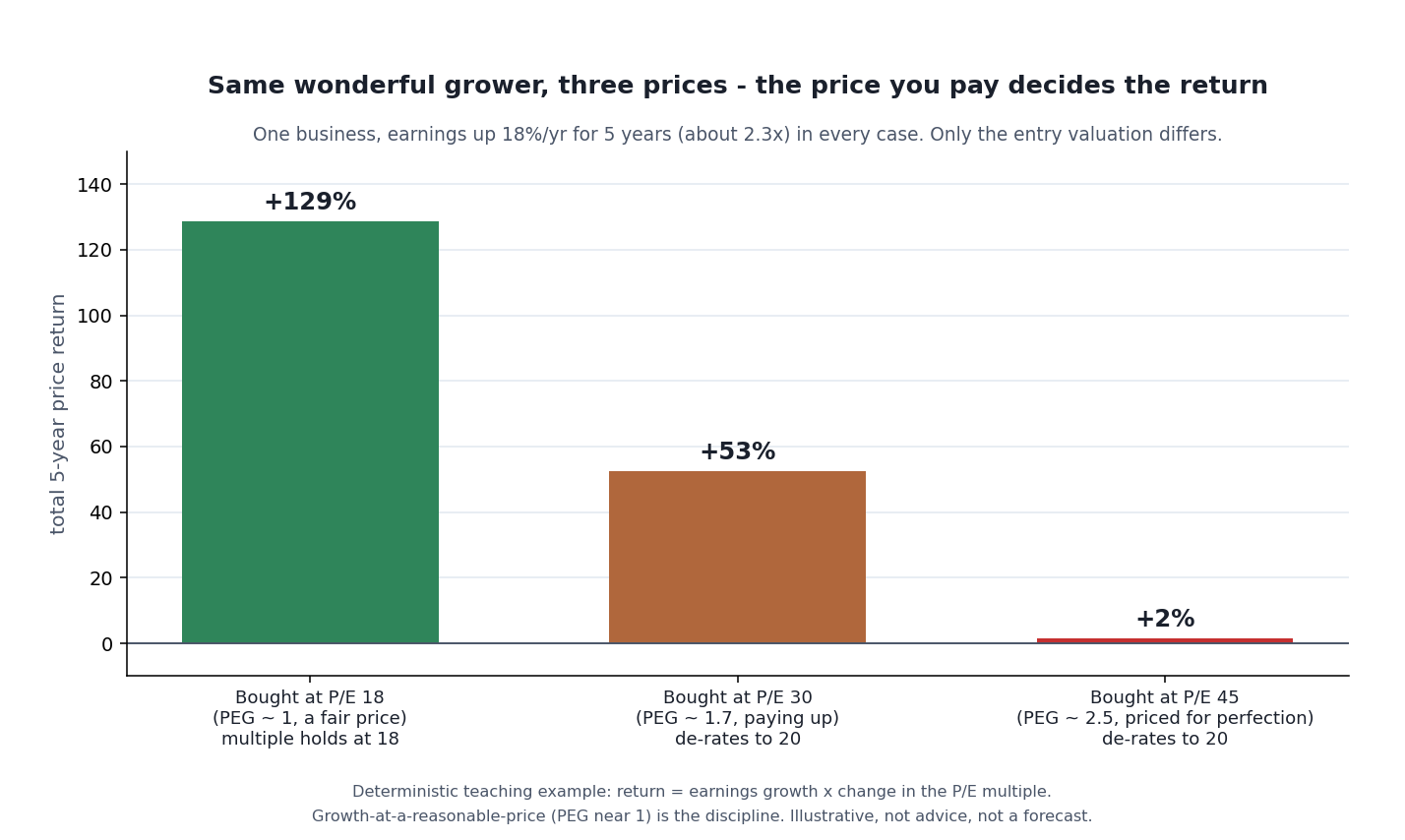 The same great grower, three entry prices, wildly different outcomes. Earnings grow identically in all three; the only variable is what you paid going in. Pay a fair multiple and a good business makes you good money; pay a perfect-world multiple and the same good business barely rewards you at all. Deterministic illustration, not a forecast.
GARP is the bridge between the two great styles — it refuses to buy growth at any price the way a value investor refuses to buy cheapness without quality. It won’t make you buy the profitless lottery tickets, because you can’t compute a sane multiple on nonexistent earnings. And it won’t let you overpay for the real compounders, because it keeps asking whether the price already assumes the growth you’re hoping to be paid for. That’s the same question the treadmill piece answers from the other direction: the defense against a great company being a bad stock is simply refusing to pay the perfect-world price for it.
So Which One Are You Actually Buying?
The point of separating these isn’t to crown a winner — it’s so you know which bet you’ve made on each stock you own, because they need to be held completely differently.
Quality compounders suit an investor who can judge whether a business’s high return on capital will persist — a genuinely hard analytical skill and the place compounder investors most overrate themselves; who has the patience to hold for years while the compounding does the work; and who has the discipline to buy only at a sane price and wait, sometimes a long time, for one. Its characteristic sin is falling in love with a great business and paying anything to own it.
Profitless speculation suits — if it suits anyone — an investor who truly understands they’re buying a basket of lottery tickets, sizes each one so that being wrong (the base case) doesn’t hurt much, expects most to fail, and is honest that the exciting day-one pop is not the return they’ll keep. Its characteristic sin is the opposite of the compounder’s: mistaking a thrilling story for a proven business and betting real money on it as though the future were already here.
Most people who call themselves growth investors are, whether they admit it or not, mixing these two bets in one account — a couple of real compounders alongside a few exciting money-losers — and that’s fine, as long as you know which is which and size them accordingly. The danger is the blur: holding a profitless promise with a compounder’s conviction, or paying a lottery-ticket price for a business that was supposed to be the safe, compounding core. Growth investing isn’t one bet. It’s two, and the discipline that keeps you safe in one is not the discipline that keeps you safe in the other.
Where to Go Next
- Growth Investing Is a Bet on Duration: Why Rising Rates Hit Your Fastest Stocks Hardest — the macro risk that lands hardest on the profitless end of this split, plus the skew that means most growth stocks aren’t the winners.
- Growth Investing Is Priced In: Why a Great Company Can Be a Terrible Stock — the expectations/valuation mechanism that the “reasonable price” discipline above is a defense against.
- Growth vs Value Investing: Which Approach Fits Your Goals? — the side-by-side with the other great style.
- Two Kinds of Value Investing: Cigar Butts, Compounders, and How Much to Buy — the mirror-image split inside value investing, where “compounder” shows up again from the other side.
If you want the plain-English, evidence-first read on investing styles — explained honestly, with the costs and base rates shown, never hyped — that’s what the newsletter is for. Subscribe below.
Why return on capital decides it: $10,000 reinvested at a 20% return on capital for fifteen years is $154,070. The same $10,000 at 8% is $31,722 — same start, same fifteen years, nearly five times the difference. The gap is not the growth rate in the headline; it is the rate at which the business can redeploy what it earns. The Compound Growth Calculator makes that spread concrete before you pay a multiple for it.
Disclaimer: This article is educational content, not financial advice. I am not a licensed financial advisor, and nothing here is a recommendation to buy or sell any security or asset. Investing and trading involve risk, including the possible loss of the money you invest. Do your own research and consider consulting a licensed financial professional before making investment decisions. Read the full Disclaimer.
Historical and backtested results are hypothetical, carry inherent limitations, and do not guarantee future results. Figures were accurate to the best of my knowledge as of this article’s last-updated date and may have changed.
