Growth vs Value Investing: Which Approach Fits Your Goals?
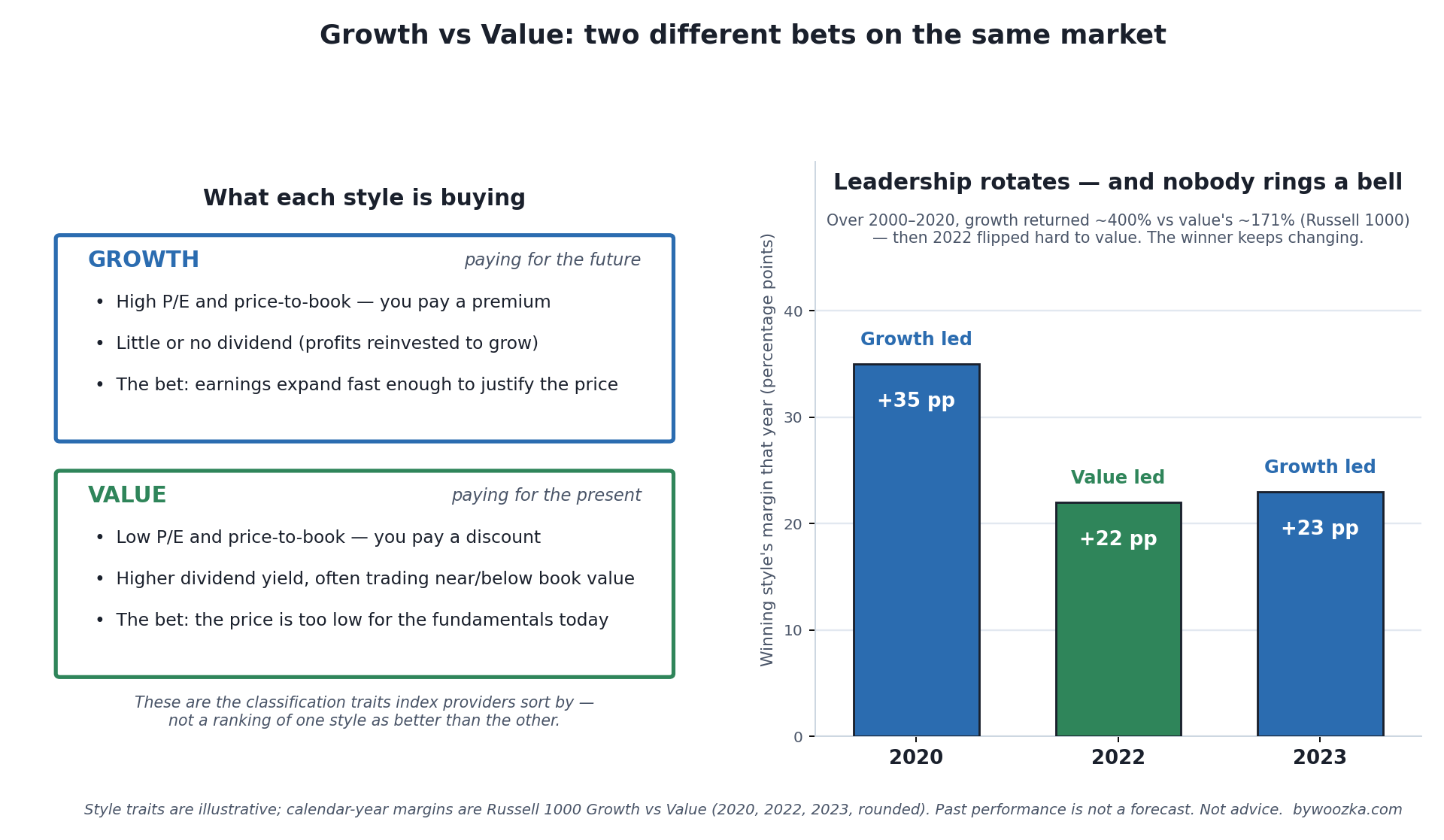
Growth and value aren’t two different markets — they’re two different bets on the same one. Growth pays up today for earnings expected tomorrow; value pays a discount for fundamentals that already exist. Which one “wins” flips from era to era, and nobody reliably calls the turn. Illustrative graphic, not a forecast and not advice.
“Are you a growth investor or a value investor?” is one of the oldest questions in the market, and it’s usually asked as if you have to choose a team and stick with it for life. You don’t. But the labels do describe two genuinely different ways of deciding what a stock is worth and what you’re willing to pay for it — and understanding the difference will make you a sharper reader of financial headlines, fund names, and your own instincts.
This guide explains what growth and value actually mean, the honest case for each, the uncomfortable fact that the “better” style keeps changing, and why the smartest investors treat the whole debate with more nuance than the labels suggest. The goal here isn’t to tell you which one to pick — it’s to give you the map so you can decide what fits your goals, horizon, and temperament. If you haven’t opened an account yet, start with the pillar for this section, How to Open Your First Brokerage Account, because everything below assumes you’re looking at real stocks and funds.
What “Growth” and “Value” Actually Mean
Strip away the jargon and the two styles differ on a single question: what are you paying for?
Value investing means buying stocks that appear underpriced relative to some measure of their fundamentals — earnings, assets, cash flow [source: Wikipedia, “Value investing”]. The style traces directly to Benjamin Graham and David Dodd, who taught it at Columbia Business School starting in 1928 and laid out the framework in their 1934 textbook Security Analysis [source: Wikipedia, “Value investing” and “Security Analysis (book)”]. The classic value signals they looked for — still the markers used today — are a low price-to-earnings (P/E) ratio, a low price-to-book (P/B) ratio, and a relatively high dividend yield, often a company trading at or below its book value [source: Wikipedia, “Value investing”]. The mental model is buying a dollar of established fundamentals for less than a dollar. Graham called the cushion between price and underlying worth the “margin of safety.”
Growth investing means buying companies expected to expand faster than the market average, and being willing to pay a higher P/E or P/B for that expected future expansion — even when current profits are small or nonexistent [source: Wikipedia; J.P. Morgan Asset Management, “Value vs growth investing: A historical overview”]. Where value is backward- and present-looking (what has this business already earned and what does it own?), growth is forward-looking (how big could this business become?). Growth companies typically pay little or no dividend, because they reinvest their earnings back into growing.
Here’s the part most beginners miss: these aren’t fuzzy vibes, they’re measurable, and the index providers who build “growth” and “value” funds sort stocks with explicit rules. FTSE Russell, for example, scores each large U.S. stock using book-to-price to capture value, plus a combination of medium-term earnings-growth forecasts and historical sales-per-share growth to capture growth [source: LSEG / FTSE Russell, “Russell Growth and Value Indexes” methodology]. It then splits the Russell 1000 so that half its total market value lands in growth and half in value; roughly 70% of companies get classified as all-growth or all-value, while about 30% are genuinely mixed and get weighted into both indexes [source: LSEG / FTSE Russell]. That last detail — a single company living in both camps at once — is a preview of why the whole growth-versus-value framing is blurrier than it sounds.
The Case for Value
The intellectual case for value is the older and, historically, the more academically decorated of the two.
The logic is intuitive: if you consistently buy businesses for less than they’re fundamentally worth, the market’s eventual re-pricing works in your favor, and the margin of safety limits how badly you can be hurt if you’re wrong. This is the philosophy behind Warren Buffett’s early career and a whole lineage of investors who studied under or copied Graham.
For decades, the data backed it up. In the academic literature, the value effect is captured by the Fama-French “HML” factor (“high minus low”), which measures the return gap between cheap stocks (high book-to-market) and expensive ones (low book-to-market) [source: Corporate Finance Institute, “Fama-French Three-Factor Model”]. Historically this “value premium” averaged roughly 3% to 5% a year, though it varies enormously depending on the period you measure [source: Alpha Architect, “Is the Value Premium Smaller Than We Thought?”; summary of Fama-French data]. The long-run record was striking: a long-short value strategy compounded to more than 4,000% from 1926 to 2007 [source: Alpha Architect, summarizing the Fama-French HML series]. And it wasn’t just a U.S. quirk — Fama and French’s 1998 study found value beat growth in twelve of thirteen major international markets, with a global spread averaging about 7.6% a year over 1975–1995 [source: Fama & French (1998), “Value versus Growth: The International Evidence”].
That’s a genuinely impressive body of evidence, and it’s why “value investing” carries an aura of rigor. But notice the end date on that 4,000% figure. It stops at 2007 for a reason.
The Case for Growth
The case for growth is less about a statistical premium and more about a simple, powerful idea: a business that keeps compounding its earnings can be worth paying up for, and the price you “overpaid” on day one becomes trivial if the growth actually shows up. A company that grows earnings 20% a year for a decade becomes a very different company; the multiple you paid at the start matters far less than whether the growth materialized.
And for most of the last two decades, growth didn’t just win — it dominated. From 2000 to 2020, the Russell 1000 Growth index returned roughly 400%, more than double the roughly 171% from the Russell 1000 Value index [source: Russell Investments, “Value Has Trailed Growth, But That Won’t Always Be The Case”]. In the decade ending 2021, growth roughly doubled value’s return [source: Russell Investments]. The single most extreme year was 2020, when large-cap growth beat large-cap value by more than 35 percentage points — the widest one-year gap on record between the two [source: Russell Investments]. A generation of investors has now spent its entire adult investing life watching growth beat value, which is exactly why growth feels “obviously” better to many people today.
Why did it happen? The common explanations are a long stretch of very low interest rates (which flatter companies whose payoff is far in the future — see why interest rates move markets) and the rise of a handful of enormous, fast-growing technology companies that came to dominate the market’s returns. Whether those forces persist is precisely the thing nobody can promise.
My own experience of holding growth names is that the thesis was never what gave me trouble — the volatility was. Coming at it from the trading side, buying growth is a bet that something already jumpy moves into an even jumpier phase, and bet is the honest word for it. The valuation work tends to agree: measured the ordinary way, the multiples look impossible to defend, because what’s being bought is a future rather than a present. That gap is uncertainty, and uncertainty shows up later wearing the clothes of risk. The person who does well holding a growth position is the one who buys it and forgets the account exists, and hardly anyone is built that way. So what I’d tell my younger self isn’t “stay away from growth.” It’s narrower: keep it to a slice you could watch fall by half without reaching for the sell button, accept that you don’t yet know how big that slice is for you, and start smaller than your confidence suggests. The confidence is the part that does the damage.
The Catch Nobody Can Solve: Leadership Rotates
Here’s the fact that should make you skeptical of anyone confidently telling you which style to own: the winner changes, and it changes without warning. The featured graphic’s right panel makes this concrete with three recent years.
Growth crushed value in 2020 (+35 points). Then 2022 flipped hard: value beat growth by about 22 percentage points as interest rates rose and expensive growth stocks fell [source: Oakmark Funds, “Value vs. growth: Then and now”; Russell Investments]. Anyone who declared “value is back” got a fast lesson, because 2023 flipped right back: growth beat value by about 23 points, erasing value’s 2022 gains [source: Oakmark Funds]. Two dramatic reversals in two years — after value had spent most of the prior fifteen in the wilderness.
This is the pattern across market history, not an exception to it. Value had its own multi-decade run of dominance; then came what value investors ruefully call the “lost decade,” roughly 2007 through 2020, when the strategy that generated that 4,000% figure stopped working and even went negative [source: Alpha Architect, on the post-2007 reversal of the HML premium]. The honest summary is that style leadership rotates in long, unpredictable regimes, and no one has demonstrated a reliable way to jump between them at the right moment. By the time a style’s outperformance is obvious enough to feel safe, you’re often buying near the end of its run. Chasing whichever style just won is a well-worn way to arrive late to every party — the same behavior gap that the evidence on why investors underperform documents in painful detail.
The rotation is real. Timing it is the part nobody can sell you honestly.
Two Clocks: What the Rotation Costs Against What the Trend Pays
This article measures the growth-versus-value argument on two different clocks and never sets them to the same time. The case for growth is made in twenty-year cumulative returns — roughly 400% against roughly 171%. The rotation is described in single years — 35 points, 22 points, 23 points. Cumulative returns and one-year gaps are not comparable as printed, so the article’s own evidence for a durable style trend is never weighed against its own evidence that the trend flips. Converting the first pair to an annual rate puts both on one clock, and the ordering that falls out is the opposite of the one the sections suggest.
The Twenty-Year Headline, Per Year
The article prints “returned roughly 400%,” which is a 5.00× ending multiple, and confirms that reading itself by calling it “more than double” the 171% (the ratio is 2.34×). Read instead as an ending value the multiples would be 4.00× and 1.71×, so both readings are carried through and the finding holds under either.
| Reading of the printed pair | Growth a year | Value a year | Gap a year |
|---|---|---|---|
| As returns, 5.00× and 2.71× | 8.38% | 5.11% | 3.27 pts |
| As ending values, 4.00× and 1.71× | 7.18% | 2.72% | 4.46 pts |
Two decades that read as a 2.34× rout in cumulative terms are 3.27 to 4.46 percentage points a year. Nothing about the record changed; the unit did. Compounding is what hides the size of the annual edge inside a cumulative headline, and the conversion is reversible in the site’s compound growth calculator — 8.38% for twenty years returns exactly 5.00×, which is how each rate here was checked. Counting 2000 to 2020 as twenty-one calendar years rather than twenty moves the gap by 0.17 points, to 3.10, so the arithmetic does not turn on that choice either.
One Year of Rotation Against One Year of the Trend
With both figures on an annual clock, the three years the rotation section reports can be measured against the trend the growth section describes. The right-hand column is each year’s gap divided by the annual gap above, low reading to high.
| Calendar year | Style that won | Gap a year | Years of the trend it is worth |
|---|---|---|---|
| 2020 | Growth | 35 pts | 7.85× to 10.71× |
| 2022 | Value | 22 pts | 4.93× to 6.73× |
| 2023 | Growth | 23 pts | 5.16× to 7.04× |
Every year listed is worth between about five and eleven years of the twenty-year drift this article calls domination. That is the arithmetic behind “nobody reliably calls the turn”: the year-to-year swing is roughly an order of magnitude larger than the trend it swings around, so a run of years long enough to establish a style’s advantage is short enough for one ordinary year to overwhelm it. The signal operates on a twenty-year clock and the noise on a one-year clock, and only the noise is visible while you are living through it.
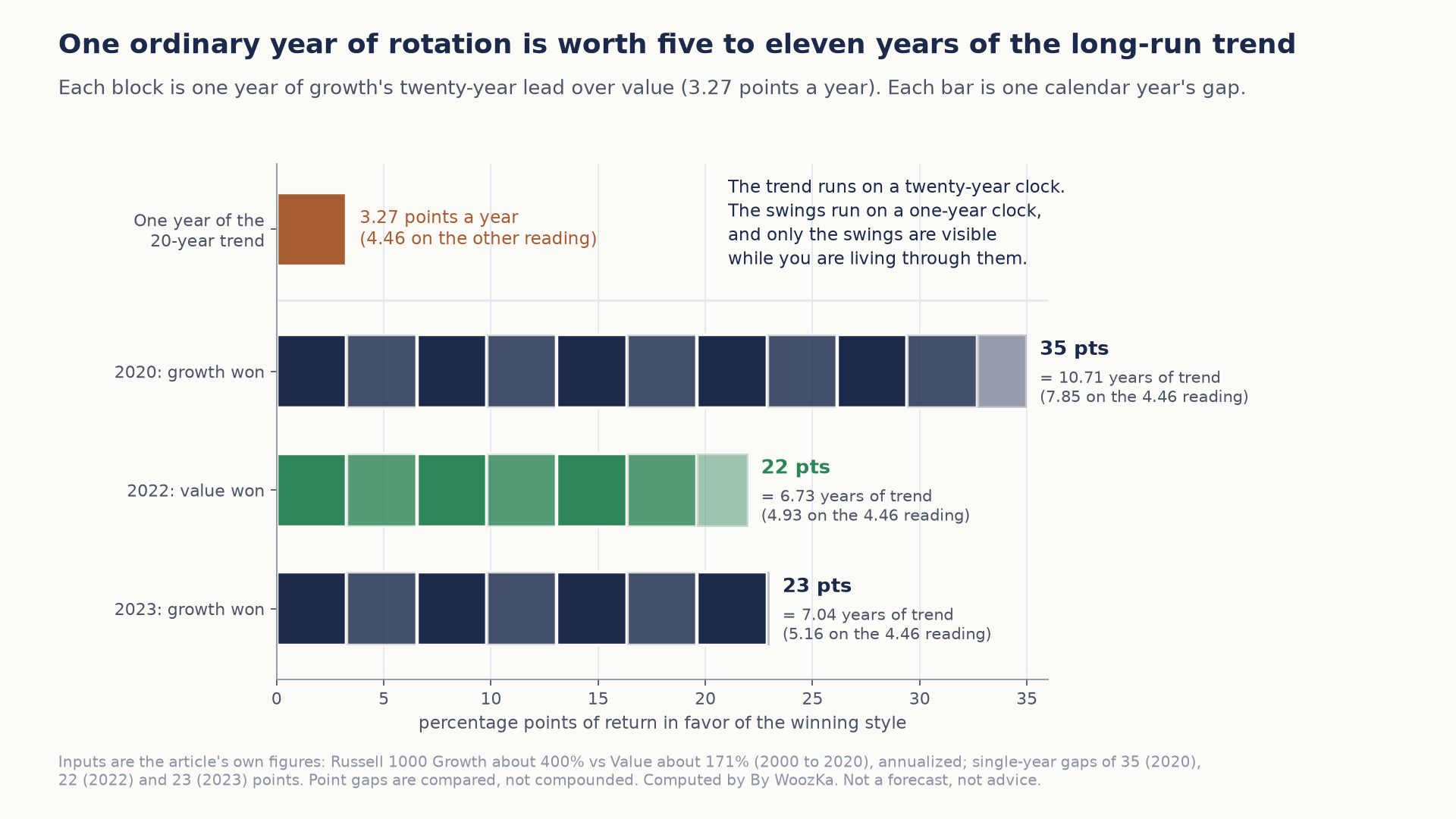
Each block is one year of the twenty-year trend that made growth look dominant. A single ordinary year of rotation stacks up five to eleven of those blocks, which is why a style’s long-run edge is so easy to lose sight of, and so hard to time.
“Hold Last Year’s Winner,” Priced
The article warns that chasing whichever style just won is a way to arrive late, and its own three years fix that rule’s result exactly: after 2020 the chaser holds growth, and after 2022 he holds value. No estimate is needed, because the rule’s choice is the previous row.
| Year held | Style chased | Style that won | Chaser’s result |
|---|---|---|---|
| 2022 | Growth, 2020’s winner | Value | −22 pts |
| 2023 | Value, 2022’s winner | Growth | −23 pts |
| Two years | — | — | −45 pts |
The rule was wrong in both rotations the article documents, and not by a little: 45 points handed back in two years is 10.1 to 13.8 years of the very annual gap the chaser was chasing. Half a career’s worth of the trend, surrendered in two years, by a rule whose only input is last year’s scoreboard. The article’s own default — owning both styles in market proportion — scores zero in every row here by construction, which is the point: it does not need to be right about the rotation, because it never takes a side in one.
The inputs, the script and the limits, set out so the work can be re-run. Every input above is a figure this article already publishes and sources — the 400% and 171% cumulative pair, the 35-, 22- and 23-point single-year gaps, and the sequence in which those years fall. Each rate was also run through the code behind this site’s compound growth calculator and matched to twelve decimal places before it was reported. Three limits are real. Percentage-point gaps are added, not compounded, so the −45 is a sum of annual relative gaps rather than a wealth calculation, and no dollar figure is claimed from it. The chase table covers the only two rotations this article supplies figures for; 2021 is absent from it, so a longer or differently chosen window could give a different answer, and two observations are an illustration of the rule’s mechanics rather than a test of it. And the twenty-year rates depend on the two published cumulative figures being total returns for the same window, which is why both readings are shown rather than one. Nothing above forecasts a return, recommends a style or names an allocation — the arithmetic measures how the article’s own numbers relate to each other, and the conclusion it supports is the one the article already reaches.
The Distinction Is Blurrier Than It Sounds
If the debate feels a little artificial by now, you’re in good company — so did Warren Buffett. In his 1992 letter to Berkshire Hathaway shareholders he wrote that most analysts feel they must choose between value and growth, but that “the two approaches are joined at the hip: Growth is always a component in the calculation of value, constituting a variable whose importance can range from negligible to enormous and whose impact can be negative as well as positive” [source: Berkshire Hathaway, 1992 Chairman’s Letter]. In other words, growth isn’t the opposite of value — it’s one of the inputs that determines what a business is actually worth. A fast-growing company can be a screaming value; a cheap, shrinking one can be a trap.
Practitioners built a whole style around that middle ground: GARP, or “growth at a reasonable price,” most associated with Peter Lynch, who ran Fidelity’s Magellan Fund from 1977 to 1990 [source: Validea, “Buffett vs. Graham vs. Lynch”; Investopedia on GARP]. GARP investors want growth but refuse to pay any price for it — the PEG ratio (P/E divided by growth rate) is the classic GARP tool, and it’s covered in the companion piece on what a P/E ratio is. GARP is a reminder that “growth” and “value” are two ends of a spectrum, not a binary switch.
And remember that ~30% of large companies the index providers can’t cleanly classify — a mega-cap can literally be half in the growth index and half in the value index at the same time, and can migrate from one to the other as its fundamentals and price change [source: LSEG / FTSE Russell methodology]. The labels are useful shorthand. They are not laws of nature.
So Which One Fits Your Goals?
Here’s the honest answer the headline promises — and it isn’t a stock tip.
For most people, especially early on, the right move is not to bet on a style at all. When you own a broad, total-market index fund, you already own both growth and value in their market proportions — you’re not forced to guess which regime is coming next, and you capture whichever style leads without having to time the switch. That’s the logic behind the broad-index default, and it’s why “pick growth or value” is a question a lot of successful investors simply never answer. Owning the whole market is a perfectly legitimate — arguably the default — response to this entire debate.
If you do want to tilt toward one style, it’s worth being honest with yourself about why. A defensible reason is temperament and time horizon: value’s discipline and dividends may suit an investor who wants to hold cheaper, steadier businesses and can stomach long stretches of underperformance; growth may suit an investor with a long horizon and the stomach to ride bigger swings for the chance at faster compounding. A poor reason is “because it’s been winning lately” — that’s performance-chasing, and the rotation section above is exactly why it so often backfires. Whichever you choose, the practical, low-cost way to express a tilt is usually a broad style index fund rather than hand-picking individual stocks — for example, funds tracking the Russell 1000 Growth or Value indexes, or the CRSP large-cap growth/value indexes that some popular ETFs follow (these are examples of how the styles are packaged, not recommendations, and their tickers, fees, and holdings change — confirm current details before buying anything).
Three principles hold no matter which way you lean:
Size the tilt so being wrong is survivable. A modest lean toward a style is a strategy; betting your whole portfolio on one regime continuing is a gamble on something history says you can’t reliably predict.
Keep costs low. Whatever edge a style might offer is small and uncertain; a high fund fee is a large and certain drag that eats it. Cost is one of the few things you actually control.
Don’t expect to out-time the rotation. If professionals with entire research departments can’t reliably jump between growth and value at the right moment, a part-time investor shouldn’t build a plan that depends on doing so.
None of this tells you which style is “better,” because — as the last two decades of reversals show — that isn’t a knowable fact about the future. It’s a question about you.
The Sane Way to Think About It
Growth and value are two honest answers to the same question: what is this business worth, and what should I pay? Value hunts for a discount to what already exists; growth pays up for what might come. Each has enjoyed long stretches of dominance, each has spent long stretches in the doghouse, and the switch between them has humbled far smarter forecasters than anyone quoting a single statistic in a headline.
The liberating takeaway is that you don’t have to win this argument to be a good investor. You can own both by owning the market. You can lean gently toward the style that fits your temperament, keep the bet small and cheap, and stop watching the scoreboard. What you shouldn’t do is treat “growth” or “value” as a magic word that settles the question of what to buy — because the market keeps proving that neither one does.
The natural next steps in this section build directly on this one: what a P/E ratio is and how to use it is the single number this whole debate revolves around, how to analyze a company before you buy the stock gives you the framework that sits underneath both styles, and the difference between trading and investing frames how much any single style label should drive your decisions in the first place. The weekly plain-English newsletter below is where these ideas get connected over time.
Disclaimer: This article is educational content, not financial advice. I am not a licensed financial advisor, and nothing here is a recommendation to buy or sell any security or asset. Investing and trading involve risk, including the possible loss of the money you invest. Do your own research and consider consulting a licensed financial professional before making investment decisions. Read the full Disclaimer.
Historical and backtested results are hypothetical, carry inherent limitations, and do not guarantee future results. Figures were accurate to the best of my knowledge as of this article’s last-updated date and may have changed.
