Two Kinds of Value Investing: Cigar Butts, Compounders, and How Much to Buy
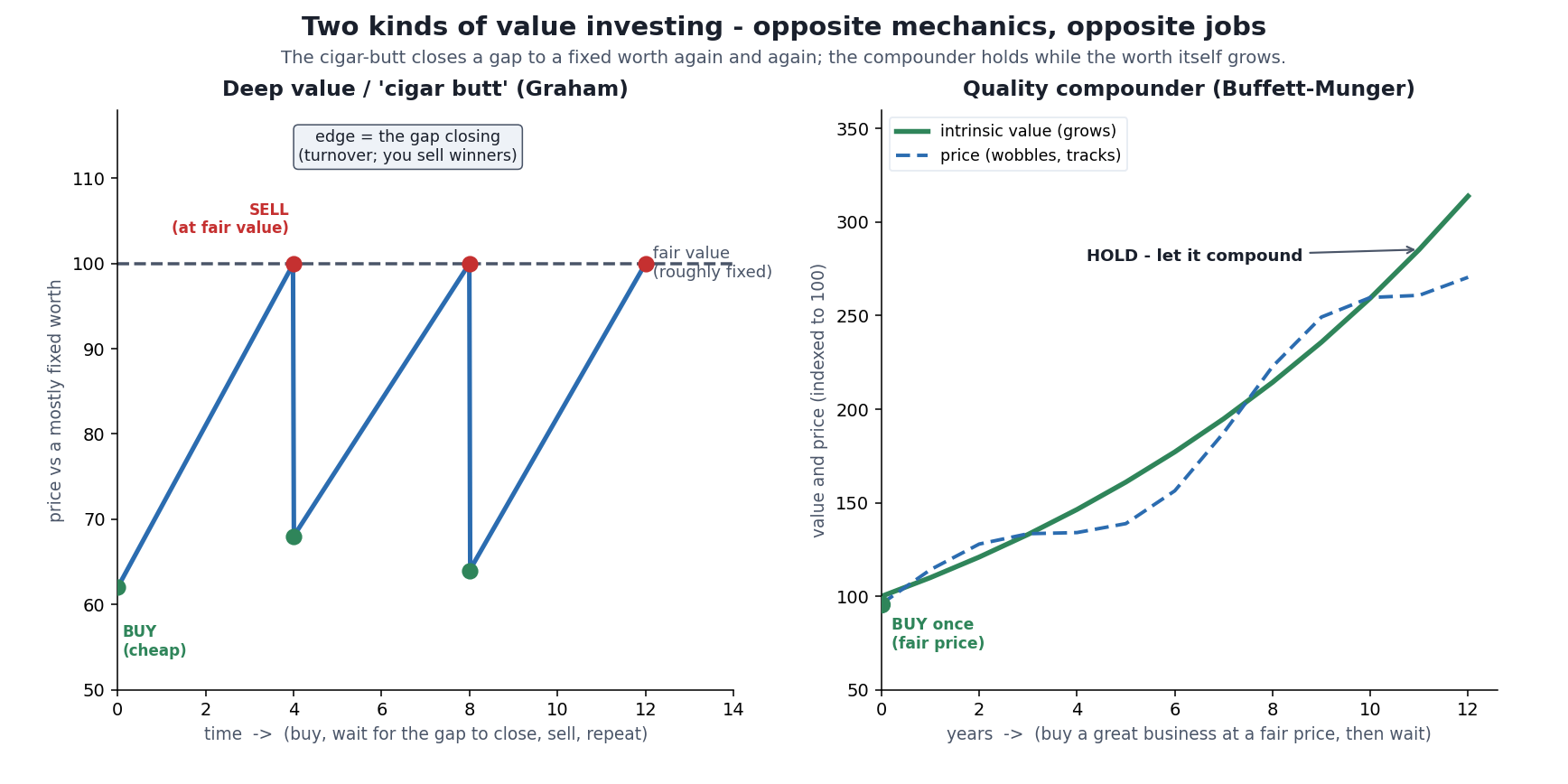 The single most useful thing to understand before you call yourself a value investor: there are two of them, and they are almost opposites. One bets that a cheap price will rise to meet a fixed worth. The other bets that a fair-priced worth will keep growing. Illustrative schematic, not a valuation of anything real.
Most explanations of value investing quietly assume there’s just one thing going on: buy cheap, wait, get paid. The value pillar on this site makes the honest general case for it — the real long-run value premium, and the brutal decade that tested everyone who believed in it. This article is about a split inside the style that trips up almost every beginner, because the word “value” is doing double duty. It covers two disciplines that share a slogan and share almost nothing else.
The first is what Benjamin Graham actually practiced: buy something statistically cheap, regardless of whether it’s any good, because it’s cheap enough that the odds are in your favor. The second is what Warren Buffett drifted toward under Charlie Munger’s influence: buy a genuinely excellent business at a reasonable price and let it compound for years. Both are “value.” Both insist on not overpaying. But they make money in opposite ways, they fail in opposite ways, and they suit opposite temperaments. Confusing them is how people end up holding a cheap, dying business for a decade because they read a book about holding great businesses for a decade.
This is a stocks article about value as a style, and it takes no position that value is superior to any other approach — the pillar already lays out the style’s real, sometimes decade-long cost, and for most beginners a total-market index fund remains a perfectly defensible default. What follows assumes you’ve decided you want to pick value stocks and are asking the next question: which kind, and how much of each name should you actually buy?
The Cigar Butt: You’re Betting on a Gap, Not a Business
Graham’s version of value has a wonderfully unglamorous nickname, and Buffett gave it to us. In his 1989 letter to Berkshire shareholders — the one where he looked back on his own mistakes — he described the approach he’d learned from Graham like this: “a cigar butt found on the street that has only one puff left in it may not offer much of a smoke, but the ‘bargain purchase’ will make that puff all profit” [source: Warren Buffett, Berkshire Hathaway 1989 Chairman’s Letter — web-verified 2026-07-29].
That’s the whole idea, and it’s not an insult. A cigar-butt investor doesn’t care whether the business is good. They care that the price is low enough — trading below the cash on its balance sheet, or below the liquidation value of its assets, or at a P/E so depressed that even a mediocre future beats what’s priced in. The bet is narrow and mechanical: the price is irrationally far below a rough floor of worth, and when it drifts back up toward that floor, you sell and move on to the next one. The worth itself isn’t really going anywhere — the left panel of the chart above shows a roughly flat “fair value” line. Your entire edge is the gap closing.
Because the worth doesn’t grow, the cigar-butt investor is forced to be a seller. Once price reaches your estimate of fair value, the puff is smoked — there’s no reason left to hold, so you take the gain and redeploy into the next cheap thing. That makes deep value a high-turnover style by nature. You are running a portfolio of small, unglamorous bets, harvesting each one as it works, and constantly hunting for replacements.
Graham’s own record says the approach can genuinely work: his “net-net” strategy — buying stocks below net current asset value — has held up in study after study as one of the more durable cheap-stock effects. But notice what kind of edge it is. It’s statistical, not qualitative. You will be wrong on plenty of individual names; the thesis is that the basket is cheap enough that the winners more than pay for the losers. Which means it lives or dies on a discipline that has nothing to do with picking good companies — how much you pay relative to worth, and how much you put in each one.
The Margin of Safety Isn’t Just a Buffer — It Tells You How Much to Buy
The pillar introduces Graham’s margin of safety as protection: you can’t know a business’s worth exactly, so you buy well below a range of reasonable estimates, and the gap is your cushion for being wrong. That’s correct, and it’s the first thing to internalize. But there’s a second job the margin of safety does that beginners almost always miss, and it’s the practical heart of the cigar-butt discipline: the size of the discount is also a signal for the size of the bet.
The logic is simple once you say it out loud. If a stock trades 45% below a conservative estimate of its worth, you have far more room to be wrong before you actually lose money than if it trades 10% below. More room to be wrong is exactly the condition under which a larger position is defensible. So the wider the margin of safety, the bigger the bet you can justify — up to a point.
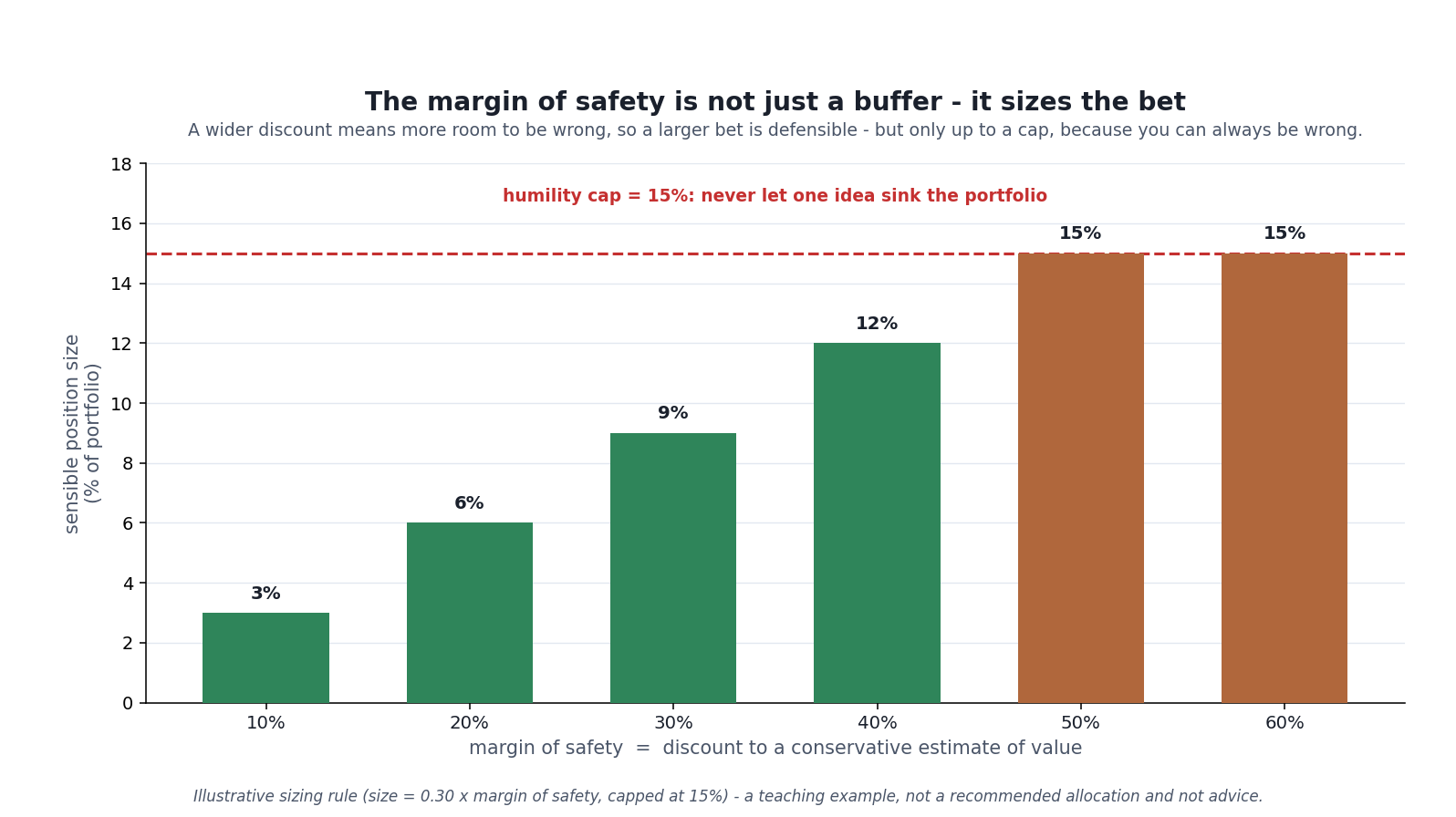 Why the margin of safety governs sizing, not just entry. A wider discount buys more room to be wrong, so it justifies a larger position — but the cap is the whole point of the word “safety.” The chart deliberately flattens at 15%: your estimate of worth is itself a guess, and a guess should never be allowed to sink the portfolio. Illustrative rule, not an allocation.
That cap is not a technicality — it is the humility that makes this “value” rather than “gambling.” Your estimate of worth is a guess dressed up in a spreadsheet. A wide margin of safety means the guess can be fairly far off and you’ll still be fine on that one position; it says nothing about the possibility that your whole method is off, or that you’ve hit a run of value traps. So the sensible version of “bet bigger when it’s cheaper” always carries a ceiling. Press your best mispricings, yes — but never so hard that being wrong once ends the game. Serious deep-value investors argue about where the cap sits and how fast size should rise, but essentially none of them argue that it shouldn’t exist.
The Compounder: You’re Betting on Worth Growing, Not a Gap Closing
Now the other school, and it’s the one Buffett is famous for — though he wasn’t born believing it. In that same 1989 letter he credited the shift to Munger, boiling the new blueprint down to a single line that has since become the most quoted sentence in value investing: “It’s far better to buy a wonderful company at a fair price than a fair company at a wonderful price” [source: Warren Buffett, Berkshire Hathaway 1989 Chairman’s Letter — web-verified 2026-07-29].
Read that carefully, because it inverts the cigar butt on purpose. Graham says: I don’t care if the company is any good, I care that it’s dirt cheap. Buffett-via-Munger says: I care enormously that the company is good — good enough to keep growing its worth for years — and I’ll accept merely a fair price to own it, because the growth in worth, not the discount, is where the money comes from. The right panel of the opening chart is the picture: you buy once, and then the intrinsic-value line climbs, and the price wobbles along behind it. You are not waiting to sell into a fixed ceiling. You are holding while the ceiling rises.
This is why compounder investing is naturally low turnover, the mirror image of the cigar butt. If the business keeps reinvesting its profits at a high rate of return, the best thing you can do is nothing — sitting still lets the compounding run and defers the tax bill. And that tax point isn’t a footnote; it’s a real, mechanical edge that most beginners underrate.
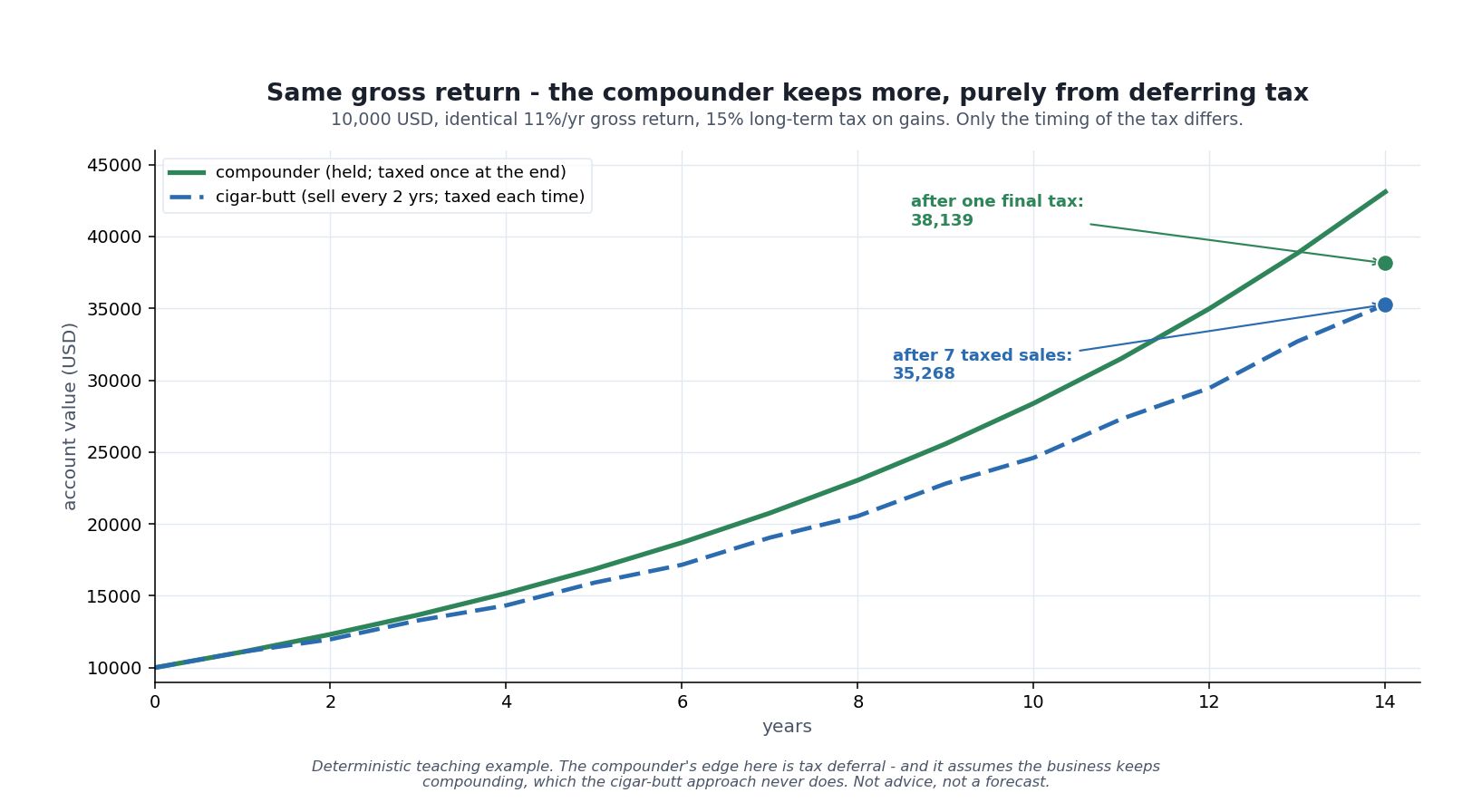 The quiet advantage of sitting still. Every time you sell, you hand the tax collector a slice of the gain and compound what’s left — so realizing gains every couple of years, at the same gross return and same tax rate, leaves you meaningfully behind the investor who paid the tax just once at the end. It’s a modest edge, and it’s conditional: it only exists if the business keeps compounding. Deterministic illustration, not a forecast.
In the United States, that timing gap has real teeth. Long-term capital gains — on assets held more than a year — are taxed at 0%, 15%, or 20% depending on income (with an extra 3.8% net investment income tax above certain thresholds), while gains on anything held a year or less are taxed as ordinary income, at rates up to 37% [source: IRS long-term vs short-term capital gains treatment; 2026 rate thresholds — web-verified 2026-07-29]. A compounder who holds for a decade doesn’t just defer the tax; if they ever do sell, they pay the lower long-term rate. A hyperactive trader can lose the deferral advantage and the rate advantage at the same time. The chart above holds the tax rate constant to isolate just the deferral effect, and even that alone is worth real money.
But — and an honest style piece has to plant the flag here — the compounder’s whole edge rests on an assumption the cigar butt never makes: that the business actually stays wonderful. Which is exactly where this school fails.
The Two Failure Modes Are Opposites Too
Neither school is safer than the other. They just break differently, and knowing how each breaks is most of what separates a disciplined value investor from someone repeating a slogan.
The cigar butt’s failure mode is the value trap — a stock that’s cheap not because the market is wrong but because the business is genuinely dying, so “cheap” keeps getting cheaper all the way down. This site has a whole diagnostic devoted to telling one from the other, and it’s the natural next read for deep-value work: How to Tell ‘Cheap’ From ‘Cheap for a Reason’. The other, subtler cigar-butt cost is the one the tax chart hinted at: constant turnover means constant tax and transaction friction, and the strategy tends to “starve” when markets are expensive and almost nothing screens as genuinely cheap.
The compounder’s failure mode is the exact inverse, and it’s more seductive because it wears a halo: overpaying for quality. Once you’ve accepted that a great business is worth holding, it’s a short and dangerous step to deciding it’s worth holding at any price — that the quality justifies whatever multiple the market is charging. It doesn’t. The price you pay is still part of your return, and for a richly valued stock it can be most of it.
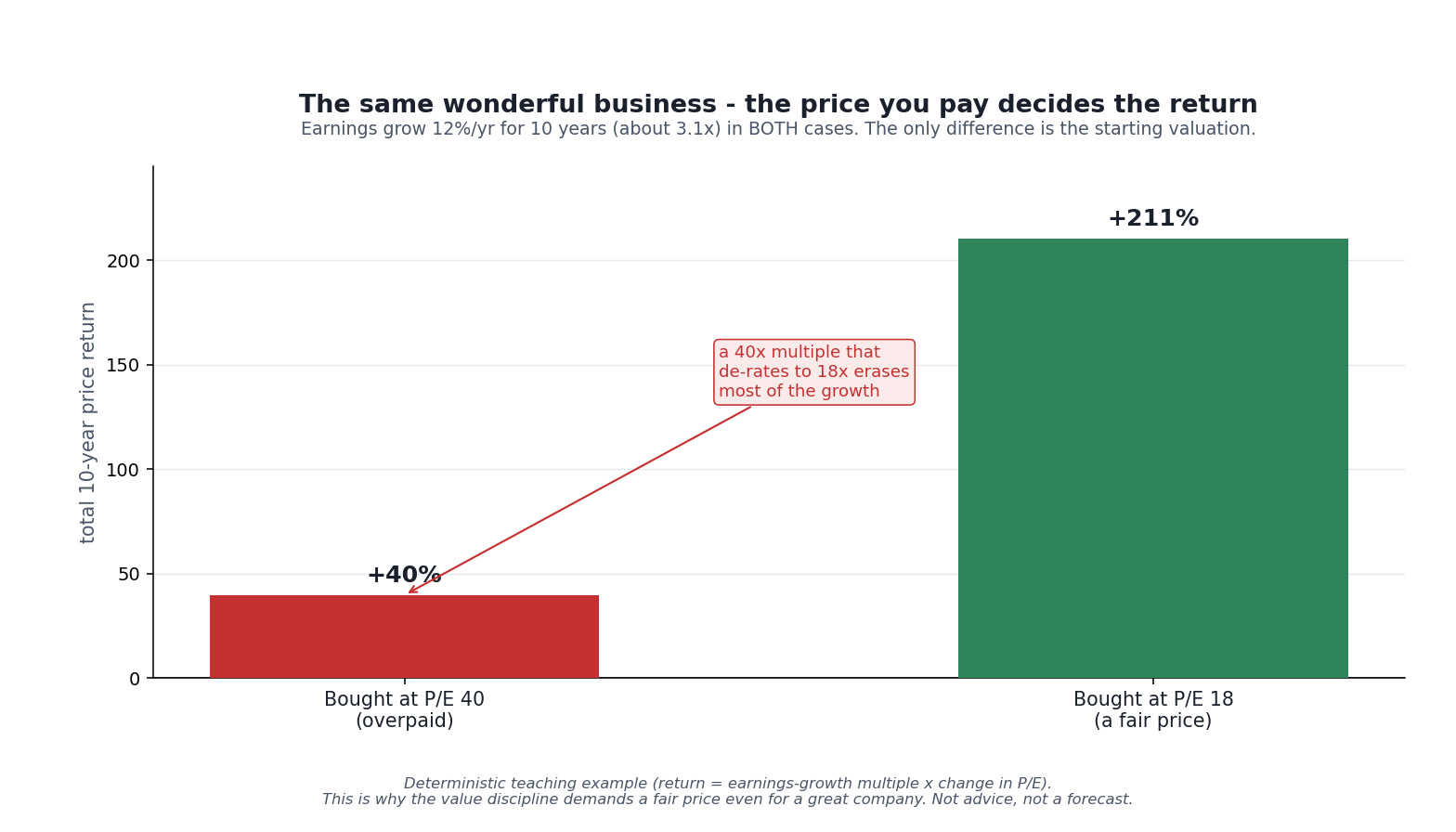 Why “wonderful company” is only half the sentence — the other half is “at a fair price.” Both bars are the identical business with identical earnings growth. The only difference is what you paid going in, and it swings a decade’s return from a disappointing +40% to a strong +211%. Buy quality at a demanding multiple and you can be completely right about the business and still barely make money. Deterministic illustration, not a forecast.
This is the deep reason Munger’s line says “at a fair price” and not “at any price.” Even the compounder school is a value discipline: it demands a margin of safety too, just expressed through the multiple rather than through a discount to liquidation value. Buy a great business when it’s priced for perfection, misjudge the durability of that greatness by even a little, and the de-rating does to you what a value trap does to a cigar-butt investor — you were “right” and still lost. (The mechanism here — high expectations that a great company then has to keep beating — is its own subject, covered from the growth-investor’s side in Growth Investing Is Priced In. The value-investor’s response to that same mechanism is simply: refuse to pay the demanding multiple in the first place.)
So Which One Fits You?
The useful question, as always on this site, isn’t which school is better — both have made and lost people money — but which one matches your temperament, your capital, and your skills. They genuinely suit different people.
Deep value / cigar butts tend to suit an investor who is comfortable owning ugly, unloved businesses they have no emotional attachment to; who has the stomach for a higher hit rate of individual losers offset by the basket working; who is investing a small enough sum that tiny, illiquid, statistically-cheap names are actually available to them (this style has real capacity limits — it works best with modest amounts of money, which is one reason Buffett himself left it behind as Berkshire grew); and who won’t be wrecked by the turnover, the taxes, or the occasional value trap. Its skill is screening and sizing — being cheap-disciplined and unsentimental.
Quality compounders tend to suit an investor who can actually judge whether a business’s advantages will persist for years — a genuinely hard analytical skill, and the place most compounder investors overrate themselves; who has the patience to hold through multi-year stretches where a great business’s stock does nothing or falls; who values the low turnover and tax efficiency; and who has the discipline to not buy the wonderful company when it’s expensive, and to wait, sometimes for years, for a fair price. Its skill is business judgment and patience — and its characteristic sin is falling in love and overpaying.
Most real value investors end up somewhere on the spectrum between these poles rather than at one end, and that’s fine. The point of separating them is not to make you choose a tribe. It’s so that you know which bet you’re actually making on each stock you buy — a gap closing, or a worth growing — because the discipline that keeps you safe is different for each, and the way each one will try to hurt you is different too. Value investing isn’t one promise. It’s two, and they don’t keep each other’s.
Where to Go Next
- Value Investing, Honestly: You’re Getting Paid to Be Patient — the value pillar: what the style is, the real long-run value premium, and the lost decade that tested it.
- The Value Trap: How to Tell ‘Cheap’ From ‘Cheap for a Reason’ — the diagnostic every cigar-butt investor needs, because “cheap” is a question, not a verdict.
- Growth vs Value Investing: Which Approach Fits Your Goals? — the side-by-side with the other great style.
- Growth Investing Is Priced In: Why a Great Company Can Be a Terrible Stock — the expectations mechanism, seen from the growth side, that the compounder’s “fair price” discipline is a defense against.
If you want the plain-English, evidence-first read on investing styles — explained honestly, with the costs shown, never hyped — that’s what the newsletter is for. Subscribe below.
Why the two schools need different clocks: a cigar butt bought at half of fair value pays once — $10,000 becomes $15,000 when the gap closes, and then you have to find another one. A compounder reinvesting at 12% turns the same $10,000 into $54,736 over fifteen years without you finding a single new idea. That is why one school sizes for the gap and the other sizes for the wait. The Compound Growth Calculator shows how quickly the second curve pulls away from the first.
Disclaimer: This article is educational content, not financial advice. I am not a licensed financial advisor, and nothing here is a recommendation to buy or sell any security or asset. Investing and trading involve risk, including the possible loss of the money you invest. Do your own research and consider consulting a licensed financial professional before making investment decisions. Read the full Disclaimer.
Historical and backtested results are hypothetical, carry inherent limitations, and do not guarantee future results. Figures were accurate to the best of my knowledge as of this article’s last-updated date and may have changed.
