Crypto Wallets Explained: Hot vs Cold Storage for Beginners
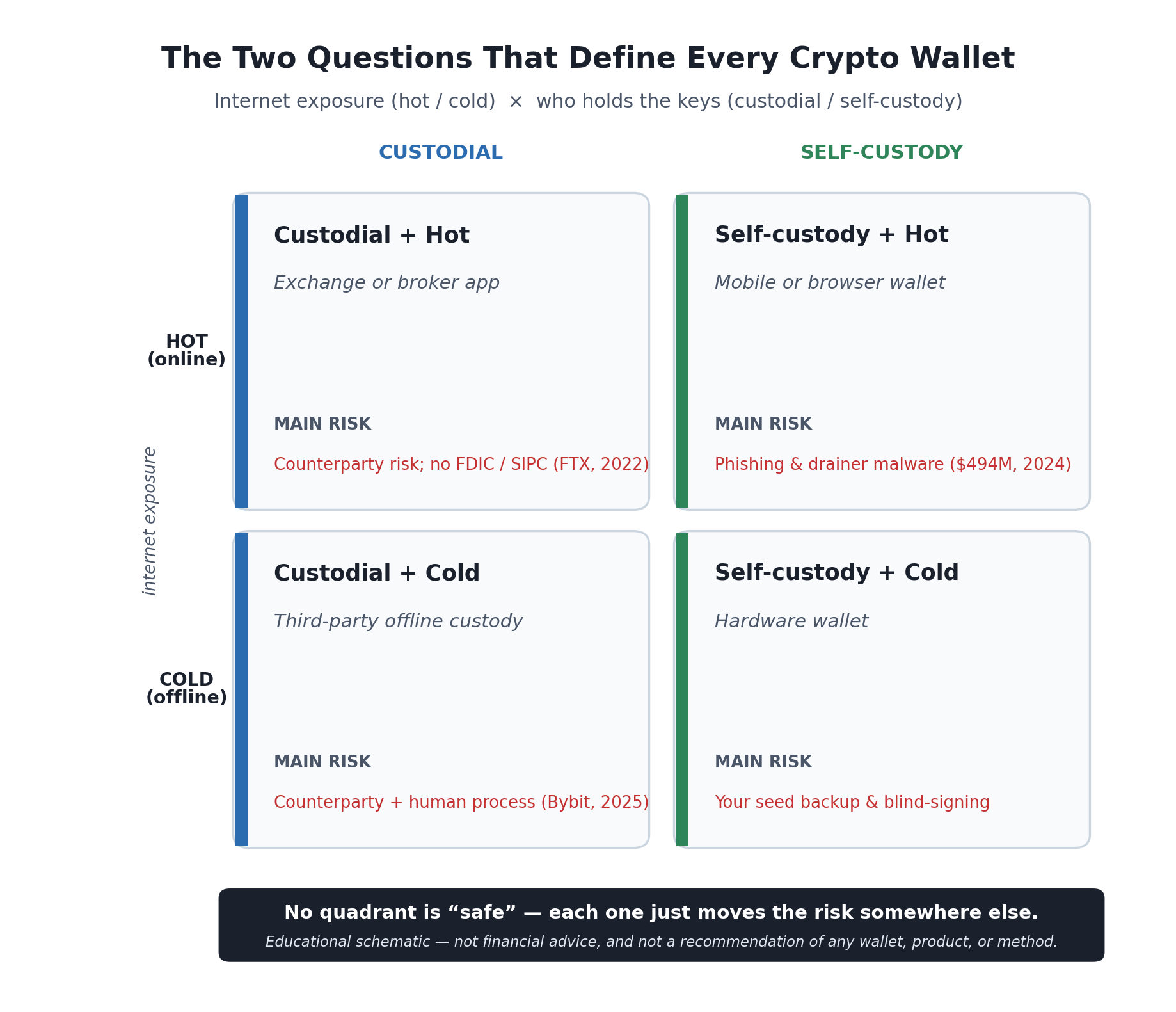
Every “which wallet should I use” question is really two separate questions: is the wallet online or offline, and do you hold the keys or does someone else? The answers trade different risks — none of them removes risk.
If you’ve read the pillar on buying your first Bitcoin safely, you’ve met the idea that the most important safety decision in crypto isn’t which coin but who holds the keys. This article maps that decision — hot versus cold storage, custodial versus self-custody — and the specific ways people lose money at each point on the map.
One thing up front: moving crypto is usually irreversible, and mistakes with wallets and keys generally can’t be undone by a support line, a chargeback, or a court. This is educational content, not advice, and it does not tell you to hold crypto, in what amount, or in which product.
What a Wallet Actually Is (It Doesn’t Hold Your Coins)
A crypto wallet does not store your coins. Coins are entries on a public ledger. A wallet stores your keys: a private key that proves ownership and authorizes spending, and a public address derived from it that others use to send you funds [source: general public-key cryptography as applied to crypto wallets; see e.g. StoneX and BitGo wallet explainers, 2025]. The address is safe to share. The private key, and the recovery phrase that can regenerate it, is the whole ballgame: in crypto, control of the key is ownership, which is why the community repeats “not your keys, not your coins.”
The Two Questions That Define Every Wallet
- Is it online or offline? A hot wallet keeps the keys on an internet-connected device; a cold wallet keeps them offline [source: BitGo, “Cold Wallet vs. Hot Wallet”; Cryptonews Academy, “Hot Wallets vs Cold Wallets,” 2025].
- Who holds the keys? A custodial wallet means a third party (usually an exchange) holds them; a non-custodial or self-custody wallet means you do [source: BitGo custodial vs. non-custodial explainer, 2025].
The axes are independent: an exchange account is custodial and hot, a phone app where you control the keys is self-custody and hot, a hardware wallet is self-custody and cold. No combination is “safe” in the abstract; each relocates the risk.
Hot Wallets: Convenient, and the Attack Surface
A hot wallet’s keys live on something connected to the internet — a mobile app, a browser extension, an exchange account. Because the keys touch the internet, the internet can reach them, through malware, phishing and fake apps [source: BitGo; Cryptonews Academy, 2025]. In 2024, “wallet drainer” attacks stole roughly $494 million across about 332,000 victim addresses, a 67% jump in losses over the prior year [source: Scam Sniffer, “2024 Web3 Phishing Report,” Jan. 2025, as reported by BleepingComputer and Infosecurity Magazine]. Often the thief never sees your keys: a convincing site gets you to approve a transaction or token “permission” that lets them move your funds later, and that confirmation is final. That makes hot wallets a reasonable place for a small, actively used amount and a poor place for a large, long-term holding.
Cold Wallets and Hardware Wallets: Offline, Not Invincible
A cold wallet keeps the keys offline. In a hardware wallet, the private key is generated and stored on the device and, in normal use, never leaves it: the transaction is signed internally on the offline chip, and only the signed transaction — not the key — is broadcast [source: BitGo hardware-wallet explainer, 2025]. But a hardware wallet moves the risk from the network to you and the moment you approve a transaction.
- The approval / “blind signing” trap. Approve without verifying the details on the device’s own screen and compromised software around it can redirect the funds. In February 2025, hackers stole about $1.5 billion from the exchange Bybit, the largest crypto theft on record, by tampering with the interface the signers were looking at, so they approved a cold-wallet transfer that quietly redirected the funds [source: reporting on the Bybit hack, Feb. 2025 — BleepingComputer, CSIS, The Hacker News].
- The physical-and-backup problem. A hardware wallet is only as safe as its recovery phrase and your handling of the device: buy it new from the maker, and never enter the phrase into a website or app “to set it up.”
Custodial vs. Self-Custody: Who Carries the Responsibility
A custodial wallet is the beginner-friendly default: password resets exist and there is no seed phrase to manage. The cost is counterparty risk, and crypto held on an exchange generally is not covered by FDIC or SIPC insurance; in a bankruptcy it can be treated as the exchange’s property rather than yours [source: U.S. SEC, Division of Trading and Markets, “FAQs Relating to Crypto Asset Activities”; Coinbase Help, “How is Coinbase insured?”]. The 2022 failure of FTX made “not your keys, not your coins” concrete. With self-custody, no company can freeze or lose your funds, and every responsibility a custodian carried is now yours, with no reset button. For most beginners the honest answer is a progression, covered below.
The Seed Phrase Is the Whole Game
If you self-custody, your recovery phrase (or seed phrase) outranks everything: typically 12 or 24 ordinary words that can regenerate your entire wallet. It follows a published standard, BIP-39, which maps the wallet’s secret to words drawn from a fixed list of 2,048 (each word encodes 11 bits, since 2 to the 11th power is 2,048), with a built-in checksum so a mistyped phrase is usually caught [source: BIP-39 specification; Webopedia and Bitcoin Wiki “Seed phrase” explainers, 2025]. A 12-word phrase already represents on the order of 10-to-the-39th possible combinations, so its security comes from being impossible to guess — and entirely from being impossible for anyone else to obtain.
- Lose it with no copy → the coins are unrecoverable. Not frozen. Gone.
- Let someone else obtain it → they can drain the wallet, from anywhere, instantly, and irreversibly.
So the rules are about storage and disclosure: write it down and store it physically offline, ideally in more than one place; never type it into a website, app, or “wallet validator,” and never share it with “support” (no legitimate party will ever ask for it); and never photograph it into a cloud-synced camera roll or keep it in a synced notes app or password manager, which quietly turns a cold backup into a hot one. Test the restore on a fresh wallet before moving any real amount in.
Putting Numbers on “Impossible to Guess” and “Usually Caught”
The section above makes two quantitative claims in words — that the phrase is impossible to guess, and that the checksum usually catches a mistyped one. BIP-39’s structure, exactly as described above, fixes both values precisely. The first one also turns out not to be the number the article quotes.
The Headline Count Is Not the Number of Valid Seeds
Twelve words drawn from 2,048 gives 2,048 to the 12th power of combinations, which is 2 to the 132nd — and at 5.4445 times 10 to the 39th, the article’s “on the order of 10-to-the-39th” is right. But BIP-39 spends some of those bits on the checksum rather than on the secret: a 12-word phrase carries 128 bits of entropy plus 4 checksum bits, and a 24-word phrase 256 plus 8. So most word combinations are not seeds at all.
| Phrase length | Word combinations | Actual valid seeds | Only one in |
|---|---|---|---|
| 12 words | 2 to the 132nd | 2 to the 128th | 16 |
| 24 words | 2 to the 264th | 2 to the 256th | 256 |
The correction is a factor of 16, and it points the safe way — a guesser has fewer targets to hit, not more. The second row carries the more surprising fact: doubling the word count does not double the difficulty, it squares it. A 24-word phrase has 2 to the 128th times as many valid seeds as a 12-word one — and that multiplier is the entire 12-word space over again. In decimal the two are 3.4028 times 10 to the 38th and 1.1579 times 10 to the 77th.
“Usually Caught” Has an Exact Value
The checksum bits are what catch a mistyped phrase, so the number of them sets the odds exactly.
| Phrase length | Checksum bits | A wrong phrase slips through | A wrong phrase is caught |
|---|---|---|---|
| 12 words | 4 | 6.250000% | 93.750000% |
| 24 words | 8 | 0.390625% | 99.609375% |
“Usually” is 93.75% on a twelve-word phrase and 99.609% on a twenty-four-word one. The flip side is the part worth internalizing before you rely on the checksum as a safety net: 6.25% of the time a wrong twelve-word phrase is perfectly valid. It will not error. It will quietly open a different wallet, almost certainly an empty one — which looks identical to having lost your own.
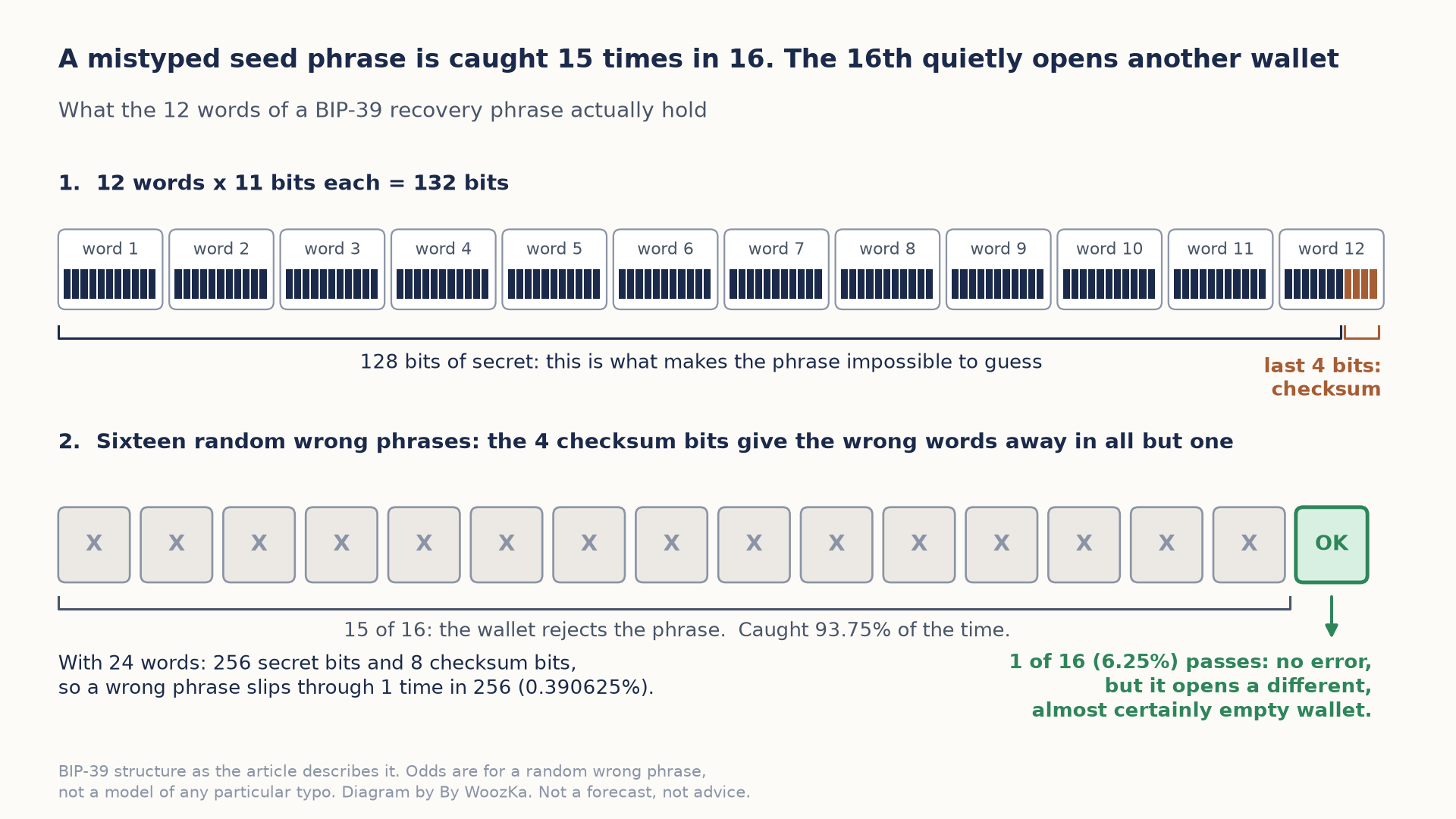
Only 128 of a 12-word phrase’s 132 bits are secret; the last 4 are a checksum, which is why a wrong phrase is rejected 15 times in 16. The 16th time it is accepted without any error and simply opens a different, almost certainly empty wallet.
Where the Money Actually Went
Set that search space against the loss figures this article reports for 2024, divided out.
| Derived from the 2024 drainer figures | Amount |
|---|---|
| Average loss per victim address | $1,488 |
| Implied prior-year losses | $295.8 million |
| Year-over-year increase | $198.2 million |
Here is the whole security model in one comparison. The valid-seed space is 2 to the 128th, about 3.4028 times 10 to the 38th. Not one of those 332,000 drained addresses was reached by searching it. Every one was reached by persuading a person to sign something or hand something over. The phrase’s strength is arithmetic; every real loss came from the part arithmetic does not protect. That is exactly why the rules above are about storage and disclosure rather than about picking a better phrase — there is no better phrase to pick, and the attacker was never going to guess anyway.
Two claims above were turned into arithmetic; here is how, and where it ends. Every input above is a figure this article already publishes — the 2,048-word list, 11 bits per word, the 12- and 24-word lengths, the checksum, the “order of 10-to-the-39th” figure, and the Scam Sniffer totals of roughly $494 million across about 332,000 addresses at a 67% year-over-year jump. Every figure was verified in code before it was published; the article’s own 10-to-the-39th was recomputed at 5.4445 times 10 to the 39th and confirmed before anything was built on it. Three limits are real. The entropy and checksum figures are BIP-39’s specification as the article describes it, not measurements of any wallet. The checksum percentages are the odds that a random wrong phrase passes, not a model of any particular typing mistake. And the loss figures are one firm’s reporting for a single year; the average is a mean over a badly skewed distribution, so most victims lost less than it. No forecast, no product recommendation and no security advice beyond what the article already gives appears above.
The Failure Modes, as Patterns (Not Just Stories)
The specific scams change monthly; the shapes don’t:
- Phishing sites and fake wallet apps built to capture credentials or your recovery phrase. Reach wallets through your own bookmarks and official app stores.
- Malicious approvals / wallet drainers — the $494-million pattern above. Read what you’re approving.
- Address poisoning and clipboard swaps. Verify the full destination address, not just the first and last few characters.
- Blind signing, the individual-scale version of the Bybit failure.
- “Support,” giveaways, and recovery services. Legitimate parties never ask for your phrase, your keys, or remote access.
The unifying tell: urgency, plus a too-good promise, plus a request to sign, connect, or reveal something.
A Sane Default Progression for a Beginner
This is the widely taught progression, not a product recommendation: while learning with a small amount, a reputable custodial exchange account, hardened with a strong unique password and app-based two-factor authentication; as the amount and horizon grow, self-custody, most commonly a hardware wallet. Whichever you use, guard the recovery phrase offline, verify addresses and approvals before you sign, and keep only what you’re actively using in anything hot.
Where to Go Next
- How to Buy Your First Bitcoin Safely: A Step-by-Step Guide — the pillar this piece extends.
- Common Crypto Scams and How to Spot Them Before You Lose Money — the fraud patterns above, in depth.
- Crypto Position Sizing: How Much of Your Portfolio Should Be Crypto? — the “how much” question without a made-up percentage.
- Best Crypto Exchanges Compared: Fees, Security, and Coin Selection — the like-for-like platform breakdown.
If you’d like the plain-English read on crypto and investing — explained, never hyped, and always risk-first — that’s what the newsletter is for. Subscribe below.
Disclaimer: This article is educational content, not financial advice. I am not a licensed financial advisor, and nothing here is a recommendation to buy or sell any security or asset. Investing and trading involve risk, including the possible loss of the money you invest. Do your own research and consider consulting a licensed financial professional before making investment decisions. Read the full Disclaimer.
Historical and backtested results are hypothetical, carry inherent limitations, and do not guarantee future results. Figures were accurate to the best of my knowledge as of this article’s last-updated date and may have changed.
