Crypto Position Sizing: How Much of Your Portfolio Should Be Crypto?
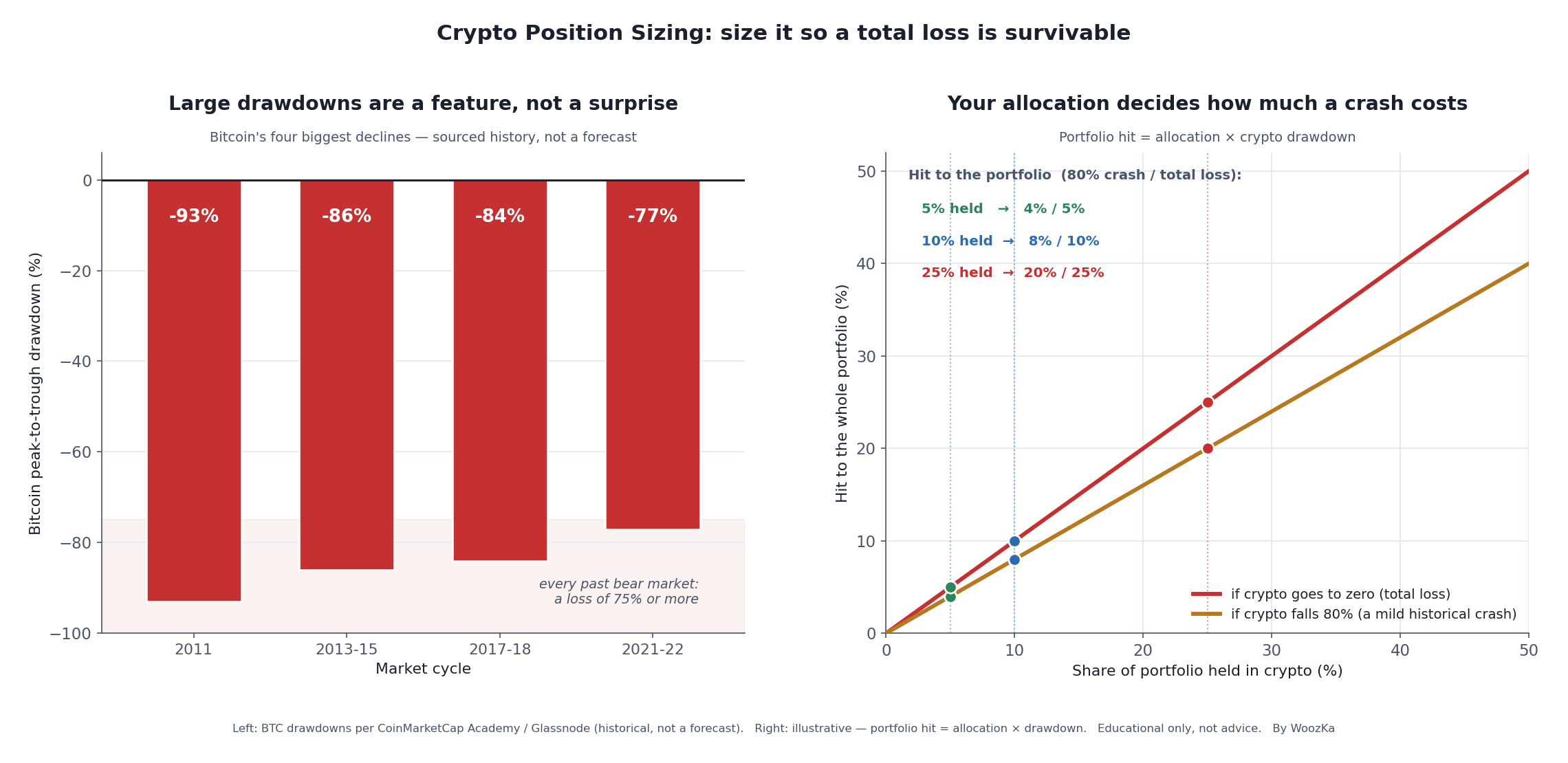 Two ideas in one picture. Left: Bitcoin has lost roughly three-quarters or more of its value in every past bear market — deep drawdowns are ordinary, not freak events. Right: because a crash of that size is on the table, the share you hold is what decides whether it’s a bruise or a catastrophe for your whole portfolio.
If you’ve read the pillar on buying your first Bitcoin safely, you met a promise: the question of how much crypto belongs in a portfolio deserves its own careful treatment, not a throwaway percentage. This is that article. And it opens by refusing to do the one thing most “how much crypto” content does — hand you a number.
There is no correct percentage, and anyone who gives you one without knowing your income, your debts, your timeline, and how you’d actually behave in a crash is guessing on your behalf. What there is is a way to reason about the size — the same way a disciplined trader reasons about a position size in forex: you don’t start from the number you want, you start from the loss you can survive, and the size falls out of that. This article is that reasoning, worked with real historical figures and plain arithmetic.
One thing up front, because it shapes everything below: crypto assets are exceptionally volatile and can lose their entire value. That isn’t a bearish opinion; it’s the explicit position of financial regulators. The U.S. Securities and Exchange Commission tells investors plainly that “the only money you should put at risk with any speculative investment is money you can afford to lose entirely” [source: SEC / Investor.gov, “Exercise Caution with Crypto Asset Securities,” investor alert, Mar. 23, 2023]. The U.K.’s Financial Conduct Authority is blunter still: “if you invest in crypto, be prepared to lose all your money” [source: FCA, “Investing in crypto,” InvestSmart; and FCA public warning, 2021]. Sizing a crypto position is, at its core, the discipline of making sure “all of it” is an amount you can genuinely absorb. This is educational content, not advice, and it does not tell you to hold crypto — in any amount.
Why “Position Sizing” Is the Right Frame for Crypto
In trading, position sizing means deciding how much to put at risk on a single bet so that a loss — which will happen sometimes — doesn’t take you out of the game. A crypto allocation is the same problem wearing different clothes. The “bet” is the slice of your net worth you place in an asset class that history says can fall most of the way to zero, and the discipline is choosing that slice so that even the worst plausible outcome is survivable.
That reframe does something important: it moves the decision away from prediction and toward risk management. You do not need a view on whether Bitcoin goes up or down to size a position — this article deliberately makes none, per this site’s no-price-prediction rule. You only need an honest answer to a different question: if this went to zero, would my financial life be fine? Size is the answer to that question, expressed as a percentage. Everything else is detail.
The Premise, in Historical Numbers
The reason the total-loss framing isn’t hysteria is that crypto’s drawdowns — its peak-to-trough declines — have been enormous and repeated. Looking only at Bitcoin, the largest and longest-lived crypto asset, and describing history rather than predicting anything:
- The 2011 cycle drew down roughly −93%.
- The 2013–2015 cycle drew down roughly −86%.
- The 2017–2018 cycle drew down roughly −84%, falling from a late-2017 peak near $19,783 to about $3,200 by December 2018.
- The 2021–2022 cycle drew down roughly −77%, from an all-time high near $69,000 in November 2021 to about $15,476 in November 2022.
[source: peak-to-trough drawdown figures per CoinMarketCap Academy, “A Comparison of the 2018 Bear Market and 2022 Crypto Market Drawdown,” and Glassnode BTC all-time-high-drawdown data as charted on TradingView; figures describe historical price behavior only and are not a forecast.]
Two honest observations. First, the drawdowns have shrunk over successive cycles — 93% to 86% to 84% to 77% — which some read as a market maturing as it grows larger. Second, and more importantly for sizing: even the “mildest” of these was a loss of more than three-quarters of the asset’s value. A drop of that magnitude is not a tail scenario to wave away; in Bitcoin’s history it is the ordinary shape of a bear market. Whatever you hold, you should assume a decline of that order can happen again — and size as if it will.
The Core Sizing Rule: Survive the Total Loss
Here is the whole method in one sentence: choose an allocation small enough that losing all of it would be a setback you can absorb, not a catastrophe that derails your life. The arithmetic that makes this concrete is simple, because the damage a crypto position can do to your whole portfolio is just the allocation multiplied by the drawdown.
Portfolio hit = crypto allocation × crypto drawdown
Run it at the two levels that matter — an 80% crash (the mild end of Bitcoin’s history) and a 100% loss (the total loss regulators tell you to prepare for) — across a range of allocations:
| Crypto allocation | Portfolio hit if crypto falls 80% | Portfolio hit if crypto goes to zero |
|---|---|---|
| 2% | 1.6% | 2% |
| 5% | 4.0% | 5% |
| 10% | 8.0% | 10% |
| 25% | 20.0% | 25% |
| 50% | 40.0% | 50% |
[Arithmetic: portfolio hit = allocation × drawdown. All figures are plain multiplication and are the right panel of the chart above.]
Make it tangible with a $50,000 portfolio. Hold 5% in crypto — $2,500 — and even a total wipeout costs you $2,500, or 5% of everything; an 80% crash costs $2,000, or 4%. You’d be annoyed, not endangered. Now hold 25% — $12,500 — and that same 80% crash removes $10,000, a 20% hole in your entire net worth, while a total loss removes $12,500. And recall the recovery asymmetry from the leverage and forex position-sizing articles: a 20% portfolio loss needs a 25% gain to undo, and a 40% loss needs a 67% gain. The bigger the allocation, the deeper the hole a normal crypto bear market can dig — and the longer the rest of your portfolio has to work just to climb back out.
This is why the size, not the coin, is the decision that protects you. You cannot control whether crypto crashes. You can control, completely and in advance, how much of your financial life is standing under it when it does.
Two Numbers Decide Your Ceiling: Capacity and Tolerance
“An amount you can absorb” has two independent meanings, and a good allocation respects both. Financial planners separate them as risk capacity and risk tolerance [source: definitions per SmartAsset, “Risk Capacity vs. Risk Tolerance,” and John Hancock Retirement, “Risk Tolerance vs. Risk Capacity”].
- Risk capacity is your ability to absorb loss — an objective fact about your finances. It’s set by your income stability, your time horizon, your existing assets, and how much you depend on this money for near-term goals. Someone with a secure income, a fully funded emergency reserve, no high-interest debt, and thirty years until they need the money has high capacity. Someone who might need the funds next year, or who’d be forced to sell in a downturn, has low capacity — regardless of how they feel.
- Risk tolerance is your willingness to endure loss — a subjective fact about your temperament. It’s how much volatility you can watch without panic-selling at the bottom or lying awake at 3 a.m. checking a price.
The two rarely match, and the rule when they don’t is unforgiving: size to the lower of the two. High capacity but low tolerance means you could afford more than you can emotionally hold — and an allocation you sell in a panic at the worst moment is too big no matter what the spreadsheet says. High tolerance but low capacity is more dangerous still: the thrill-seeker who “isn’t bothered” by volatility but is risking money they’ll need has confused a feeling for a fact. Capacity sets the hard ceiling; tolerance often sets a lower one; you take the smaller number.
Foundation First, Crypto as a Satellite
Position sizing doesn’t happen in a vacuum — it happens on top of a financial base, and the base comes first. The widely taught sequence in personal finance is to secure the foundation before adding anything speculative: an emergency fund of several months’ expenses, high-interest debt paid down (a credit-card balance costing 20%+ is a near-certain drag that no uncertain asset should jump ahead of), and a diversified core of low-cost, broad holdings doing the long-term compounding. Crypto, if it appears at all, sits around that core as a small satellite — the speculative sleeve, not the engine.
That ordering isn’t a moral judgment about crypto; it’s a consequence of the volatility already shown. An asset that can fall 80% is the wrong place for money you might need for rent, and the wrong thing to fund while paying 20% interest elsewhere. Get the foundation solid, and a crypto position becomes what it should be: a small, deliberate bet you can afford to be wrong about. Skip the foundation, and the same position becomes a liability dressed up as an opportunity.
The Diversification You Might Be Counting On May Not Show Up
A common argument for a larger crypto allocation is that it’s “uncorrelated” — that it zigs when stocks zag, lowering overall portfolio risk. Treat that claim with caution, because the data has undercut it. The IMF found that crypto’s correlation with equities rose sharply: through 2020–21 Bitcoin increasingly moved with stocks rather than independently of them. In the IMF’s words, that rising correlation of crypto assets with traditional holdings like stocks “limits their perceived risk diversification benefits and raises the risk of contagion across financial markets” [source: IMF, “Crypto Prices Move More in Sync With Stocks, Posing New Risks,” Jan. 11, 2022; IMF Global Financial Stability Note 2022/01]. The 2022 downturn made the point concretely: crypto and risk-asset equities fell together, not on opposite schedules.
The sizing implication is direct: don’t inflate your allocation on the assumption that crypto will cushion a stock-market fall. It may instead amplify it, dropping hardest exactly when the rest of your portfolio is already down. Size the position on its own standalone risk — the total-loss rule above — and treat any diversification benefit as a bonus you don’t get to spend in advance.
Rebalancing: The Discipline That Enforces Your Number
Suppose you settle on a target — say a small single-digit percentage — and buy it. Volatility guarantees that number won’t stay put. A rally can quietly swell a 5% position into 15% of your portfolio; a crash can shrink it to 1%. Rebalancing is the routine that drags the allocation back to your chosen target: when crypto has run up past your band, you trim it (selling some of what’s now overweight); when it’s fallen well below, you top it back up toward target — but only within the size you already decided was safe, never by throwing in money the plan didn’t allow.
Rebalancing is where the pillar’s most important line becomes operational: decide the number when you’re calm, not while you’re staring at a live price. A predetermined target and a rebalancing band take the decision out of the hands of the version of you that’s euphoric in a rally or terrified in a crash — the version that does the most damage.
Two cautions specific to crypto, both flagged in this silo’s other articles. First, trading costs are real and easy to underestimate: every rebalance pays the exchange fee and the bid-ask spread, and frequent tinkering can quietly erode the position [see the pillar and the exchange comparison for fee and spread mechanics]. Rebalance on a schedule or a wide band, not on every twitch. Second, in many jurisdictions selling crypto is a taxable event — trimming a winner can trigger a tax bill — so factor that in and see Crypto Tax Basics for the general picture and a professional for your situation.
Common Position-Sizing Mistakes
- Copying a percentage off the internet. “Put 5% in Bitcoin” or “everyone should have 10%” ignores the only things that determine your right size — your capacity, your tolerance, and your foundation. A number that’s prudent for one person is reckless for another.
- Sizing by FOMO. Setting the allocation during a rally, when the fear of missing out is loudest, is the crypto version of a trader picking his size by how good the trade feels. The size decided in euphoria is almost always too big for the crash that follows.
- Forgetting that the downside is total. Sizing as if the worst case is a 30% dip, when regulators and history both say to prepare for the whole thing, sets the allocation too high by construction.
- Adding leverage on top. Crypto is already one of the most volatile assets a retail investor can hold; borrowing to buy more, or using leveraged products, stacks risk on risk and can turn a survivable drawdown into a total loss. The whole point of sizing is to cap the damage, not multiply it.
- Letting a winner balloon and calling it “conviction.” Refusing to rebalance a position that’s grown to a quarter of your net worth isn’t discipline — it’s an unplanned bet that got large while you weren’t looking.
- Concentrating in one small coin. A “small allocation” split into a single illiquid altcoin isn’t sized safely; concentration and illiquidity are their own risks on top of the asset-class risk. Sizing is about the money at stake and what it’s in.
- Investing money you’ll need soon. Rent, tuition, next year’s down payment — putting short-horizon money into an 80%-drawdown asset is a capacity error no tolerance can rescue.
The Sizing Rule, Run Backward
This article gives a formula — portfolio hit equals allocation times drawdown — and then only ever runs it forwards, asking what a crash costs if you hold a given percentage. The question in the title runs the other way: given the loss you can absorb, what allocation does that permit? That is the same formula divided instead of multiplied, and it is the version that answers the question a reader actually arrives with. It is worth running, because what it exposes is not the percentage but how much the answer depends on the crash you assume.
| Hit you absorb | -30% | -77% | -93% | Total loss |
|---|---|---|---|---|
| 2% | 6.67% | 2.60% | 2.15% | 2.00% |
| 5% | 16.67% | 6.49% | 5.38% | 5.00% |
| 10% | 33.33% | 12.99% | 10.75% | 10.00% |
| 20% | 66.67% | 25.97% | 21.51% | 20.00% |
Read the last column first, because it contains a small surprise. When you assume a total loss, the allocation the rule permits is exactly the hit you said you could absorb. The two numbers are the same number. That makes the regulators’ sentence — only risk what you can afford to lose entirely — something other than a caution sitting next to the method. At the hundred percent case it is the method, and the whole apparatus collapses into one honest question about a single figure.
Now compare the columns. Assuming a 30% dip rather than a total loss permits 3.3333 times the allocation, and that multiple is identical in every row — it does not depend on how much you can absorb, only on the crash you talked yourself into. So the mistake listed above of sizing as if the worst case were a 30% dip is not a matter of degree: it is a constant 233.3% overshoot, built in before any judgment about your own finances is made. Against that, the choice between assuming the mildest bear in this article’s own history and assuming zero is worth only 1.2987 times, or 29.9% more. The expensive error is not being insufficiently pessimistic about a crash. It is assuming a dip.
The Drift Sentence, Checked
The rebalancing section makes a claim in one breath: that a rally can quietly swell a 5% position into 15% of a portfolio, and that a crash can shrink it to 1%. Both halves are exactly computable. Holding the other 95% of the portfolio flat, so that only crypto moves, here is what each drift actually requires.
| 5% becomes | Crypto must move | Portfolio effect |
|---|---|---|
| 1% | -80.81% | -4.04% |
| 2% | -61.22% | -3.06% |
| 5% | 0.00% | 0.00% |
| 10% | +111.11% | +5.56% |
| 15% | +235.29% | +11.76% |
| 25% | +533.33% | +26.67% |
The sentence’s grammar makes those two halves sound like a matched pair, one in each direction. They are not remotely matched. Shrinking to 1% takes a fall of 80.81%, which three of the four bear markets listed above were deeper than — it is the ordinary shape of a crypto bear. Swelling to 15% takes a rise of 235.29%, a move of more than three and a half times, with no counterpart anywhere in the history this article reports. The drift downward is a thing that has repeatedly happened. The drift upward is a thing that would have to happen.
That asymmetry has a practical edge, because a rebalancing band is usually set as a symmetric distance around a target. A band drawn evenly around 5% is not evenly likely to be hit on its two sides, and the side it gets hit on most is the one where trimming is not the response. The third column is worth keeping too: the portfolio effect works out to a clean identity, one minus the starting weight over one minus the new weight, so the damage a drift represents to the whole portfolio depends only on the weight the position has drifted to, never on the path the price took getting there. A 5% position found at 25% has done 26.67% of good to the portfolio, whatever route it traveled.
What the Discipline Was Worth
Rebalancing is described above as the routine that enforces the number, which is true and is not priced. It can be, using only this article’s own figures: the $50,000 portfolio, the 5% target, the swell to 15%, and the four cycle drawdowns. Start with $2,500 in crypto. Let it run the 235.29% the table above says a 15% weight requires, which takes the portfolio to $55,882.35 with $8,382.35 of crypto in it. One investor leaves it. The other trims back to 5%, to $2,794.12. Then a bear market arrives.
| Then crypto | Left alone | Rebalanced | Difference |
|---|---|---|---|
| -77% | $49,428 | $53,731 | +$4,303 |
| -84% | $48,841 | $53,535 | +$4,694 |
| -86% | $48,674 | $53,479 | +$4,806 |
| -93% | $48,087 | $53,284 | +$5,197 |
| +100% | $64,265 | $58,676 | -$5,588 |
In all four of the bear markets this article itself lists, the investor who did not rebalance finishes below the $50,000 they started with, and the one who did finishes above it. The gap runs from $4,303 to $5,197 — between 8.6% and 10.4% of the entire starting portfolio — and none of it came from being right about anything. Both investors made identical guesses about the market, which is to say none. The only difference was whether the position was allowed to grow past the size that had been chosen for it while calm.
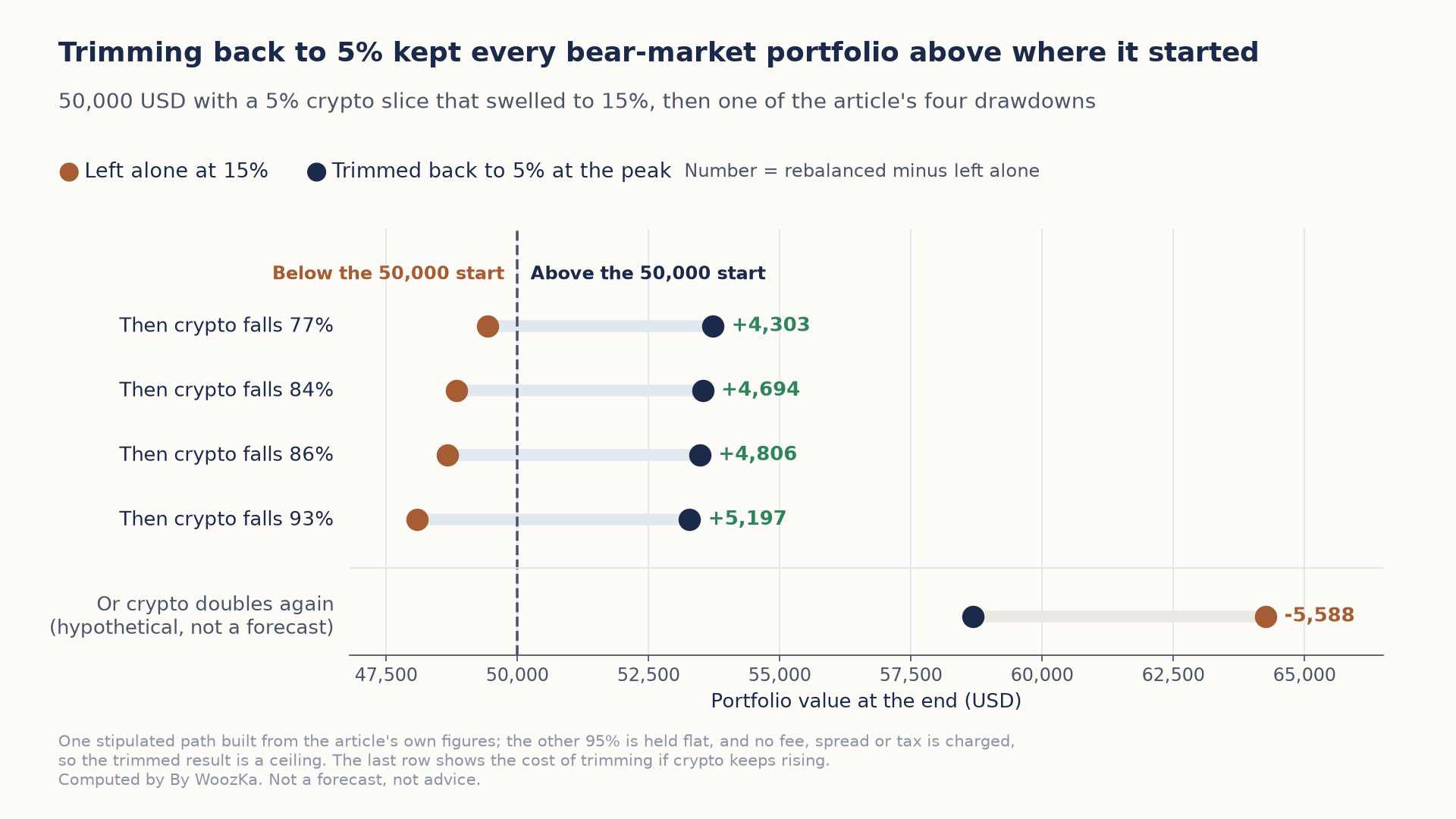 On the article’s own path, trimming back to 5% left the portfolio 4,303 to 5,197 USD better off in each of its four bear markets, and above the starting 50,000 each time. The bottom row is the price of that insurance: if crypto had doubled again instead, the trimmed portfolio would trail by 5,588 USD.
The last row is there because it is the honest half, and it is a hypothetical rather than a forecast: this article makes no price predictions and neither does this. If crypto instead doubles again from that peak, the rebalancer ends $5,588 behind. That is the premium. Trimming a winner is insurance, insurance has a cost, and the cost is the upside you hand back every time the trim turns out to have been early. What the four bear rows establish is not that rebalancing wins — it does not, in the fifth row — but that the discipline is doing real and measurable work rather than merely tidy-looking work, and that the size of that work is on the same scale as the position itself.
Every price move in these three tables was produced by the same code that runs the site’s Crypto Profit Calculator, with fees set to zero, so any row can be reproduced by entering a start price and an end price and reading off the result.
What went into these tables, and why none of them names an allocation. Every input above is this article’s own: the formula, the four cycle drawdowns, the $50,000 portfolio, the 5% target, the 15% and 1% drift figures, the 30% dip from the mistakes list, and the total loss the SEC and FCA both describe. Nothing here recommends an allocation, and no row can be read as one — each is conditional on a number about your own finances that only you can supply. The non-crypto 95% of the portfolio is held flat throughout, which is what isolates drift caused by crypto from drift caused by everything else; if the rest of the portfolio rises too, a given crypto weight needs a larger crypto move to reach, so these are the conservative version. No fee, spread, slippage or tax is charged on any rebalance, and this article is explicit that all four are real, which makes the rebalanced column a ceiling on what the discipline delivers rather than a floor. The third table is one stipulated path and is not evidence about rebalancing in general, which is why the row where it loses is shown rather than omitted. The calculation behind these tables uses exact fractions, checks each figure against the calculator linked above, and confirms that this article’s own published arithmetic — all five rows of its allocation table, the $2,500 and $12,500 worked example, the 25% and 67% recovery figures, and the drawdown from $19,783 to $3,200 — re-derives before it reports anything. One note it raises rather than corrects: the fall from $69,000 to $15,476 is 77.57%, which rounds to 78% rather than the 77% stated, a difference of 0.57 points and comfortably inside the word “roughly” and inside the precision of an approximate peak and trough.
Putting It Together
Position sizing won’t tell you whether to own crypto — that’s a genuinely personal decision this article doesn’t make for you. What it gives you is a way to decide how much, if you decide to hold any, that doesn’t depend on predicting a price. Fix the loss you can survive first; assume the downside is total, because regulators and history both say to; take the lower of your ability and your willingness to bear it; keep it a satellite around a solid foundation; and let a predetermined target plus rebalancing hold the line when your emotions would rather move it.
Done that way, the right size has a recognizable feel: it’s an amount whose complete loss you could describe out loud as “a real setback, but I’d be fine” — no flinch, no rationalizing. If saying that sentence makes you uneasy, the position is too big, whatever the math or the influencer said. The size that lets you sleep through an 80% drawdown without selling at the bottom or reaching for money you need is not a limitation on your returns. It’s the thing that keeps you in a position to have any.
Where to Go Next
Sizing is the risk-management half of everything else in this silo; these build directly on it:
- How to Buy Your First Bitcoin Safely: A Step-by-Step Guide — the pillar: the risk-first walkthrough this sizing decision plugs into.
- Crypto Wallets Explained: Hot vs Cold Storage for Beginners — once you’ve sized a position, where and how you hold it is the next decision.
- Common Crypto Scams and How to Spot Them Before You Lose Money — the fastest way to a 100% loss isn’t a crash, it’s a scam; the patterns to recognize.
- Best Crypto Exchanges Compared: Fees, Security, and Coin Selection — the fee and spread mechanics that make frequent rebalancing costly.
If you want markets explained plainly — risk-first, never hyped — that’s what the newsletter is for. Subscribe below.
Worked example: a $10,000 account risking 2% ($200) on an entry at $60,000 with a stop at $54,000 — a 10% stop — takes 0.0333 BTC. That is $2,000 of exposure against $200 at risk: the position is ten times the amount you can lose, which is the part that catches people out. Run your own entry and stop through the Position Size Calculator.
Disclaimer: This article is educational content, not financial advice. I am not a licensed financial advisor, and nothing here is a recommendation to buy or sell any security or asset. Investing and trading involve risk, including the possible loss of the money you invest. Do your own research and consider consulting a licensed financial professional before making investment decisions. Read the full Disclaimer.
Historical and backtested results are hypothetical, carry inherent limitations, and do not guarantee future results. Figures were accurate to the best of my knowledge as of this article’s last-updated date and may have changed.
