How to Buy Your First Bitcoin Safely: A Step-by-Step Guide
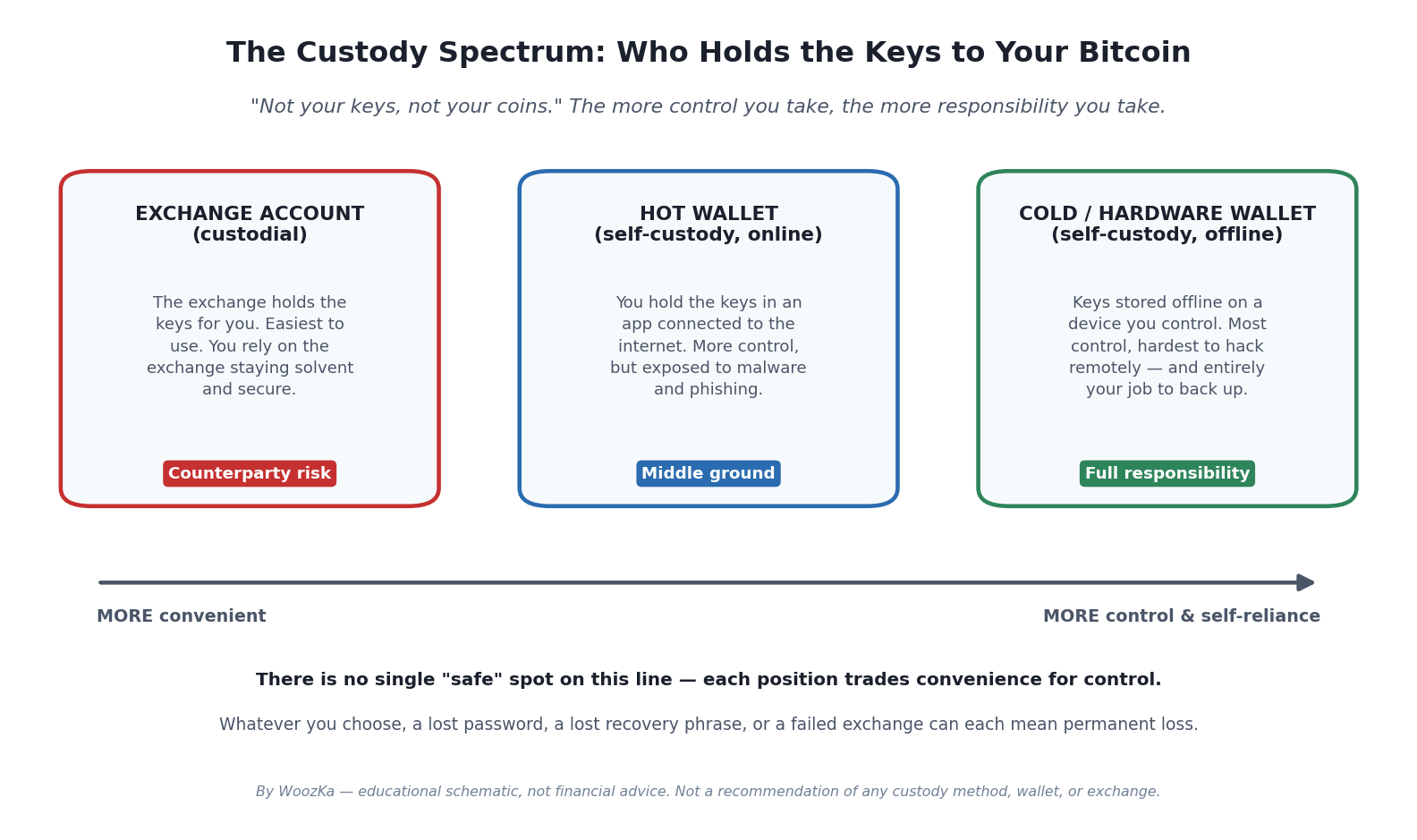 Every choice about where to keep Bitcoin sits somewhere on this line, trading convenience against control. The single most important safety decision you’ll make isn’t which coin to buy — it’s who holds the keys.
Let’s start with the part most “how to buy Bitcoin” guides bury: Bitcoin is extremely volatile and can lose a large portion — or in a worst case, effectively all — of its value, and unlike a bank deposit or a stock in a brokerage account, crypto you hold is generally not backed by any government insurance. That isn’t a reason nobody should ever own it; plenty of thoughtful people hold a small allocation. It is the reason this guide is built the way it is. The mechanics of buying are genuinely a five-minute affair. The safety — not getting scammed, not losing your keys, not misunderstanding what you actually own — is the whole ballgame, and it’s what the rest of the crypto section on this blog is built to teach.
So this pillar is deliberately risk-first and custody-first. It will not tell you Bitcoin is going up, going down, or that now is or isn’t “the time.” Nobody honest can tell you that, and this blog doesn’t pretend to. What it will do is walk you from “I’ve never done this” to “I’ve made a first purchase and I understand how to hold it without becoming one of the cautionary tales.”
If you’re doing this for the first time, here’s what the experience usually feels like: the buying itself is almost anticlimactic — a few taps and you own a fraction of a Bitcoin — and the genuinely nerve-wracking part comes right after, when it lands that the responsibility for keeping it safe is now entirely yours. That ordering is the whole point of this guide. Start with an amount small enough that a mistake is a lesson rather than a disaster, and treat the custody decision below as the real task.
First, What You Actually Own
When you buy Bitcoin, you are not buying a file that sits “in an app.” What you actually control is a private key — a secret string of data that proves ownership of a balance recorded on Bitcoin’s public ledger (the blockchain). Whoever holds that key controls the coins. That single fact drives every safety decision below, so it’s worth sitting with: in crypto, control of the key is ownership. Lose the key with no backup, and the coins are gone — not frozen, not recoverable by a support line, gone. Let someone else learn the key, and they can take everything, irreversibly.
This is why the crypto world repeats the phrase “not your keys, not your coins.” When you leave Bitcoin on an exchange, the exchange holds the keys on your behalf — convenient, but it means you’re trusting that company the way you’d trust a bank, except without the bank’s safety net. When you move it to a wallet you control, you hold the keys yourself — full control, and full responsibility. Neither is automatically “safe.” They trade different risks, which is exactly what the custody spectrum above is showing.
The safety net you’re used to isn’t here
In a U.S. brokerage account, if the firm fails, SIPC insurance can cover missing securities up to certain limits; in a bank, FDIC covers deposits if the bank fails. Crypto held on an exchange generally has neither. The SEC’s own staff have spelled this out plainly: custodially held crypto can be treated as property of the exchange in a bankruptcy, may sit in a single wallet the exchange controls, and is not covered by FDIC or SIPC insurance [source: U.S. SEC, Division of Trading and Markets, “Frequently Asked Questions Relating to Crypto Asset Activities”; SEC Commissioner remarks, crypto roundtable, Apr. 2025]. Major exchanges say the same in their own disclosures — Coinbase, for example, states directly that cryptocurrency is “not insured or guaranteed by or subject to the protections of the FDIC… or SIPC” [source: Coinbase Help, “How is Coinbase insured?”].
The failure of the exchange FTX in November 2022 is the case study nobody in crypto forgets. FTX and more than 100 affiliated entities filed for bankruptcy on November 11, 2022, after a spike in customer withdrawals exposed a roughly $8 billion shortfall; over $10 billion in customer funds were caught in the collapse, in significant part because customer money had been funneled to an affiliated trading firm [source: reporting on the FTX bankruptcy, CFTC statement Aug. 2024; CoinDesk Nov. 2022]. Customers who had left their crypto on the exchange couldn’t get it out. That is precisely the “not your keys, not your coins” risk made real — and it’s why custody is treated here as a first-order decision, not an afterthought.
Step 1 — Decide How Much (Before You Open Anything)
The safest sizing rule in crypto is old and unglamorous: only commit money you could afford to lose entirely without it affecting your life. Given the volatility described above, treat any amount you put into Bitcoin as money that could fall sharply and stay down for a long time. That reframes the first decision away from “how much can I buy” and toward “how much am I genuinely willing to risk” — which for a beginner is often a small, fixed amount, not a number that keeps you up at night.
How much crypto belongs in a broader portfolio — if any — is a genuinely personal question that depends on your goals, timeline, and risk tolerance, and it deserves its own careful treatment rather than a throwaway percentage here. This blog has a dedicated piece on Crypto Position Sizing: How Much of Your Portfolio Should Be Crypto? for exactly that. The one rule that holds for everyone: decide the number before you’re staring at a live price, when you’re calm, not in the middle of a rally when the fear of missing out is loudest.
Step 2 — Choose a Reputable Exchange (What to Compare)
For a first purchase, most people buy through a centralized crypto exchange — an online platform where you fund an account and buy Bitcoin. They are not interchangeable, and for a beginner the differences that matter most are about safety and cost, not flashy features. What to actually compare:
- Security and track record. Has the exchange operated for years without losing customer funds? What are its security practices, and how does it hold customer assets? A boring, long, incident-free history is a feature, not a bore.
- Regulatory standing. Is the exchange registered and operating within the rules of your jurisdiction? Regulation isn’t a guarantee, but an exchange that ignores it is a louder warning than any marketing.
- Costs — and read these carefully (Step 3 below breaks them down). Advertised “fees” are only part of what you pay.
- What it lets you do with your coins — including whether you can withdraw Bitcoin to a wallet you control, which matters the moment you decide to self-custody.
Because fees, supported features, security history, and regulatory status change and differ by platform, treat any specific claim about an exchange as something to verify on that exchange’s own current pages before you rely on it. This blog keeps a separate, regularly updated comparison — “Best Crypto Exchanges Compared: Fees, Security, and Coin Selection” — for readers who want a like-for-like breakdown; that post carries an affiliate disclosure, and it’s the right place for platform-by-platform specifics. This pillar’s job is to make sure you know what the criteria mean before you get there.
Step 3 — Understand the Real Cost of Buying
Crypto trading costs are easy to underestimate, and underestimating them is itself a safety issue — it quietly eats into whatever you put in. Two costs matter:
The trading fee. On the “advanced” or “pro” trading interfaces, retail fees typically run somewhere in the range of about 0.1% to 0.6% per trade, depending on the platform, your volume, and whether you’re a “maker” or “taker.” As of 2026, for example, Kraken’s Pro base tier lists roughly 0.25% maker / 0.40% taker, and Coinbase’s Advanced interface lists roughly 0.40% maker / 0.60% taker at the base tier, both falling at higher volumes [source: Kraken and Coinbase published fee schedules, 2026 — confirm the current schedule for your platform and tier, as these change]. Crucially, the simple one-click “buy” screens on the consumer apps often cost much more than the pro interfaces: Coinbase’s standard app has applied a spread-based cost commonly cited around 0.5%–1.49% per transaction, and Kraken’s Instant Buy has carried a flat 1% fee plus spread [source: exchange fee reporting, 2026 — verify current before trading, as each venue sets and resets its own pricing]. The convenient button is frequently the expensive one.
The bid-ask spread — often the bigger hidden cost. The spread is the gap between the highest price buyers will pay and the lowest price sellers will accept, and you cross it every time you trade. On Bitcoin it’s usually small; on lower-liquidity coins or during volatile moments it can widen and quietly exceed the advertised fee [source: exchange fee/spread comparison reporting, 2026]. And here’s the part that punishes active beginners: a round trip pays these costs twice. Every buy-then-sell pays the spread and the fee on the way in and on the way out. A habit of frequent, small, in-and-out trades inside a narrow price range can bleed your position dry on costs before any price move ever works in your favor. (You may see SEO or affiliate pages claiming “hidden fees eat 30% of profits” — ignore unsourced figures like that; the fee-and-spread mechanics above are what’s actually verifiable, and they’re enough to take seriously.)
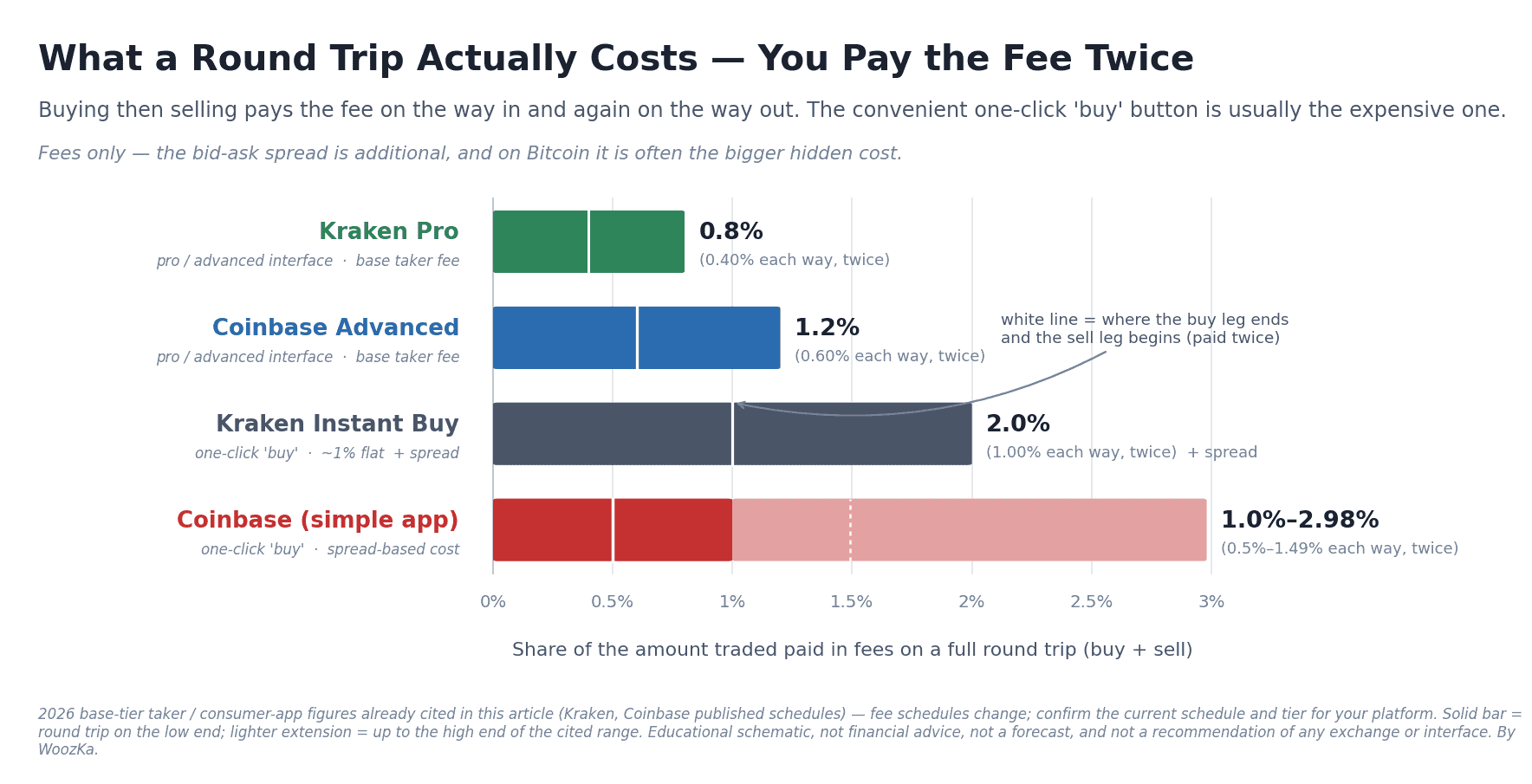 A round trip pays the cost twice — once to buy, once to sell — and the convenient one-click “buy” button is usually the priciest interface. These are trading fees only; the bid-ask spread is additional and often larger. Figures are 2026 base-tier examples — confirm the current schedule and tier for your platform.
The safety takeaway: for a first purchase, a single, deliberate buy on a low-cost interface beats a flurry of clicks on a convenient-but-pricey one.
Step 4 — Secure the Account Before You Fund It
Before money goes in, harden the account itself, because a crypto account is a target the moment it exists:
- Use a strong, unique password you don’t reuse anywhere else — a password manager makes this painless.
- Turn on two-factor authentication (2FA), ideally with an authenticator app rather than SMS text codes, which are more vulnerable to “SIM-swap” attacks where a criminal hijacks your phone number.
- Assume no legitimate exchange or “support agent” will ever ask for your password, your 2FA code, or your wallet’s recovery phrase. Anyone who does is running a scam. Full stop.
None of this is crypto-specific wizardry; it’s basic account hygiene. It just matters far more here, because — as Step 1 established — there’s usually no insurance and no reversibility to bail you out.
Step 5 — Make the Purchase
With a funded, secured account, the buy itself is simple. Two order types cover almost every beginner case:
- A market order buys immediately at the best price currently available — fast, but in a fast-moving market the price you get can differ slightly from the price you saw.
- A limit order buys only at a price you set or better — you trade the certainty of filling right now for control over the price you pay.
For a first, small, long-term-minded purchase, either can be reasonable; a limit order is a good habit for avoiding surprises in a volatile market. Place the order, confirm it, and you own Bitcoin. Which brings you back to the decision that matters most.
Step 6 — Decide Where to Keep It (The Custody Decision)
This is the choice the whole article has been building toward, and the custody spectrum at the top lays out the three broad options:
- Leave it on the exchange (custodial). Easiest, and fine for a small amount you’re actively learning with — but you’re carrying the FTX-style counterparty risk described above. The larger the amount and the longer the horizon, the harder that trade-off gets to justify.
- Move it to a hot wallet (self-custody, online). You hold the keys in an app or browser wallet connected to the internet. More control than an exchange, but the internet connection is also the attack surface — malware and phishing are the real threats here.
- Move it to a cold or hardware wallet (self-custody, offline). Keys are generated and stored on a device kept offline, which makes remote theft dramatically harder. This is the most control — and the most responsibility, because now you are the backup.
If you self-custody, everything hinges on your recovery phrase (also called a seed phrase), typically 12 or 24 words that can regenerate your keys. Anyone who obtains it can drain the wallet, and losing it with no backup makes the coins unrecoverable, so write it down, keep it offline, and never type it into a website or share it with anyone. How wallets work, hot versus cold storage, and how to protect the phrase are covered in Crypto Wallets Explained: Hot vs Cold Storage for Beginners.
A Note on the Regulated Alternative: Spot Bitcoin ETFs
There is now a materially different on-ramp worth knowing about, presented here neutrally — not as better or worse than direct ownership. In January 2024, the SEC approved the first eleven U.S.-listed spot Bitcoin ETFs, which trade on regulated national securities exchanges and let you get Bitcoin price exposure through an ordinary brokerage account, without ever holding keys yourself [source: U.S. SEC omnibus approval order, Jan. 10, 2024]. The trade-offs are real and cut both ways: an ETF means no seed phrases and the familiar guardrails of a brokerage account, but also a management fee, market-hours-only trading, and — importantly — you don’t hold the actual Bitcoin or its keys. Direct ownership means true custody and 24/7 access, but all the responsibility this article describes. This blog covers the mechanics in Bitcoin and Ethereum ETFs Explained; the point for now is simply that “buy Bitcoin” and “get Bitcoin exposure” are not the only synonyms — and the regulated wrapper is a legitimate option for someone who wants exposure without custody.
Before You Buy: The One Scam Rule
Crypto’s irreversibility is exactly what makes it a magnet for fraud: once funds leave, they rarely come back. The FBI’s Internet Crime Complaint Center reported that in 2024, complaints involving cryptocurrency totaled about $9.3 billion in losses, a 66% jump from the prior year [source: FBI IC3 2024 Annual Report; FBI press release, 2024]. For a first-time buyer, one rule covers nearly all of it: urgency plus a promise of guaranteed gains plus a request for your keys, codes, or an upfront payment is the shape of nearly every crypto scam. No legitimate exchange or support agent will ever ask for your recovery phrase. The individual schemes, from romance-investment “pig butchering” to fake support and phishing apps, and how each one works, are laid out in Common Crypto Scams and How to Spot Them Before You Lose Money.
Common Beginner Mistakes to Sidestep
- Confusing “I bought it” with “it’s safe.” Buying is easy; custody is the actual risk. Where you keep it matters more than that you bought it.
- Treating an exchange like an insured bank. It usually isn’t — no FDIC, no SIPC, and FTX showed what that can mean.
- Losing or mishandling the recovery phrase. Photographing it, cloud-storing it, or losing the only copy are all routes to permanent loss.
- Overcommitting. Putting in money you actually need is how volatility turns into a real-life problem instead of a learning experience.
- Trading frequently in and out. Spreads and fees, paid twice per round trip, quietly compound against you.
- Chasing hype. A rising price and a loud crowd are not analysis — and are exactly the conditions scammers exploit.
The Round Trip, Priced
Step 3 publishes the rates and then makes three claims about them: that a round trip pays them twice, that the convenient button is usually the expensive one, and that trading in and out can bleed a position dry before any price move helps. All three are true. None of them is given a number. The Crypto Profit Calculator this article already points to charges the fee on both sides of a trade, which is precisely what a round trip is, so the rates the article already cites can be run through the tool the article already recommends to answer the question the article already asked.
One warning before the arithmetic: every figure here is fees only. The spread is additional, the article is right that it is often the larger of the two, and no Bitcoin spread figure appears anywhere in these pages — so none is assumed here. That makes all of the numbers understatements of what a round trip really costs.
What One Round Trip Costs
Take $1,000, buy, and sell again at the same price. Holding the price still is a construction rather than a forecast: it removes the market from the question so that the only thing left in the answer is cost.
| Interface | Fee a side | Round trip | Break-even move |
|---|---|---|---|
| Kraken Pro, limit | 0.25% | 0.499% | 0.502% |
| Kraken Pro, market | 0.40% | 0.798% | 0.805% |
| Coinbase Adv., market | 0.60% | 1.196% | 1.211% |
| Kraken Instant Buy | 1.00% | 1.990% | 2.030% |
| Coinbase app, high end | 1.49% | 2.958% | 3.048% |
Two things fall out that the phrase “pays these costs twice” does not quite say. The round trip costs slightly less than twice the fee, because the fee on the way out is charged against a balance the fee on the way in has already shrunk. And the price move needed to undo that round trip is slightly more than the round trip cost, for the mirror-image reason: the gain has to be earned on the smaller balance that is left. Neither gap is large at 0.25%, where they differ by three thousandths of a point. At 1.49% the second one is nine hundredths of a point, and both grow with the rate.
The comparison the article draws in words is worth stating as a ratio. The high end of the one-click app charges 5.96 times the fee of a resting limit order on a pro tier, and costs 5.92 times as much per round trip. “The convenient button is frequently the expensive one” is, on the article’s own published rates, a factor of about six.
The Order Type Is Also a Price
Step 5 recommends a limit order, and recommends it purely on price certainty, as protection against a fast-moving quote. That is correct as far as it goes, but it leaves out the other half. A resting limit order is a maker order and a market order is a taker order, and Step 3 already published what that distinction costs. So the habit recommended for one reason happens to be the cheaper one as well, and the article never says so.
| Platform and order | Fee a side | Round trip | Trips to lose half |
|---|---|---|---|
| Kraken Pro, limit | 0.25% | 0.499% | 139 |
| Kraken Pro, market | 0.40% | 0.798% | 87 |
| Coinbase Adv., limit | 0.40% | 0.798% | 87 |
| Coinbase Adv., market | 0.60% | 1.196% | 58 |
On Kraken’s base tier the choice is worth 0.299 of a point per round trip — $2.99 on $1,000 — which sounds like rounding error until it is expressed as runway. The same stake survives 87 round trips of market orders before costs have taken half of it, and 139 round trips of limit orders: fifty-two more trades bought by an order type the article already told you to prefer.
The table also contains a coincidence worth naming, because it cuts against reading any one platform as cheap or dear. A market order on Kraken’s pro tier and a limit order on Coinbase Advanced are the same 0.40% and cost exactly the same. Which venue you pick and how you place the order are two separate decisions, and on these two schedules the second one is as large as the first.
What the Habit Costs When It Repeats
“Bleed your position dry” is the sharpest sentence in this article and the one carrying no number at all. It has an exact answer. Each round trip multiplies what is left by the same factor, so the erosion compounds, and the same $1,000 in the same motionless market ends up in very different places depending only on which screen the trades were placed on.
| Fee a side | After 25 trips | After 50 trips | After 100 trips |
|---|---|---|---|
| 0.25% | $882.36 | $778.56 | $606.15 |
| 0.40% | $818.40 | $669.78 | $448.61 |
| 0.60% | $740.15 | $547.82 | $300.11 |
| 1.00% | $605.01 | $366.03 | $133.98 |
| 1.49% | $472.08 | $222.86 | $49.67 |
A hundred round trips is roughly two a week for a year, which is not an extraordinary amount of activity for someone who has just discovered a price that moves at all hours. At the high end of the one-click app it leaves $49.67 of the original $1,000 — 95.0% of the stake gone. At a limit order on a pro tier it leaves $606.15. Same trader, same trades, same price at the end as at the beginning, and a factor of 12.2 between the two outcomes, produced by nothing except which interface the button was on.
This is what makes cost a safety topic rather than a bookkeeping one, which is the claim Step 3 opens with. Nothing above is an argument for trading often; the arithmetic is an argument against it, and it is strongest for exactly the beginner the article is written for. A single deliberate purchase pays these costs once.
Method and limits: every figure was produced by the shipped code behind the Crypto Profit Calculator, which applies the fee to both sides of the trade, and each result was reproduced independently in separate code that checks against the tool’s own output before reporting. Fees only — the spread is extra and is not modeled. Buying and selling at one price is a device for isolating cost, not a prediction. The rates are the base-tier 2026 examples this article already cites, they fall at higher volumes, and the article is right that you should confirm the current schedule for your own platform and tier before relying on any of it.
Where to Go Next
You’ve made a first purchase and you understand the decision that actually protects it. The next layer is deepening the safety literacy this pillar opened:
- Crypto Wallets Explained: Hot vs Cold Storage for Beginners — a closer look at the custody spectrum above and how to set up self-custody properly.
- Crypto Position Sizing: How Much of Your Portfolio Should Be Crypto? — how to think about the “how much” question without a made-up percentage.
- Common Crypto Scams and How to Spot Them Before You Lose Money — each scheme behind the rule above, one by one.
- Best Crypto Exchanges Compared: Fees, Security, and Coin Selection — the like-for-like platform breakdown, with current fees and security history.
- Bitcoin and Ethereum ETFs Explained — the regulated, custody-free alternative, laid out neutrally.
If you’d like the plain-English read on crypto and investing — explained, never hyped, and always risk-first — that’s what the newsletter is for. Subscribe below.
What the fees actually take: put $1,000 in at $60,000 and sell at $75,000 — a 25% move in the price — and at 1.5% a side you finish with $1,212.78, a 21.3% return. The $33.47 of fees is the gap, and it is charged once on the way in and again on the way out. The Crypto Profit Calculator applies the fee to both sides, so the figure it shows is the one you would actually keep.
Disclaimer: This article is educational content, not financial advice. I am not a licensed financial advisor, and nothing here is a recommendation to buy or sell any security or asset. Investing and trading involve risk, including the possible loss of the money you invest. Do your own research and consider consulting a licensed financial professional before making investment decisions. Read the full Disclaimer.
Historical and backtested results are hypothetical, carry inherent limitations, and do not guarantee future results. Figures were accurate to the best of my knowledge as of this article’s last-updated date and may have changed.
