How Forex Trading Actually Works: A Beginner’s Guide to Currency Pairs
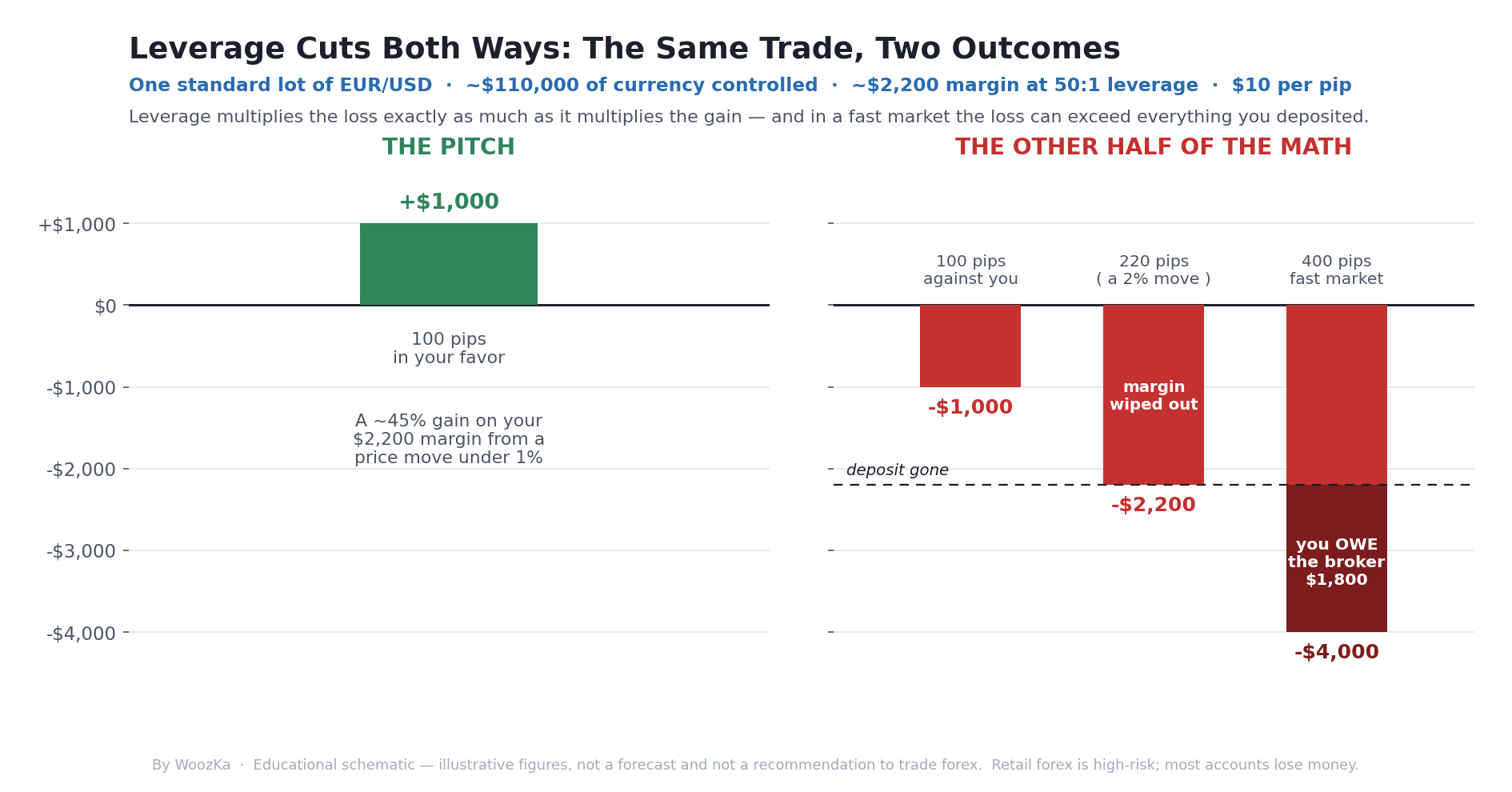
Leverage is the single fact that makes retail forex different from buying a stock. It multiplies losses exactly as much as it multiplies gains — and this pillar spends more time on the left-out half of that sentence than the marketing ever does.
Let’s open with the number most “how forex works” guides leave for the footer: across EU brokers required by regulators to publish it, roughly 74% to 89% of retail CFD accounts lose money [source: ESMA product-intervention measures on CFDs and binary options, 2018 analysis and mandated broker risk-warning disclosures — this range is updated periodically per broker, so read the specific figure on your broker’s own current risk warning]. U.S. retail forex is not meaningfully different: the majority of retail accounts lose money over time. That is not a reason nobody ever trades currencies — but it is the reason this pillar is built mechanics-first and risk-first, and it is the honest baseline any beginner deserves before funding an account.
There is a second fact that belongs up here, not buried: in leveraged forex and futures trading it is possible to lose more than your original deposit and end up owing your broker money. Some regulated brokers offer “negative-balance protection” that caps your loss at what you deposited — the EU mandates it for retail clients — but it is not universal, and U.S. regulators do not require it [source: ESMA negative-balance-protection requirement, in force since Aug 1, 2018; FOREX.com U.S. account disclosures on client liability for deficits, 2026]. You have to confirm whether your specific broker offers it rather than assuming.
So this article will not tell you forex is easy income, a side hustle, or a fast path to wealth — that framing is exactly the promotional pattern this blog exists to counter. What it will do is explain how currency trading actually works — pairs, quotes, pips, lots, leverage, and margin — with the loss side of every equation shown at full weight, so that if you ever do fund an account, you go in understanding the machine instead of the marketing.
If you’ve never done this, here’s the shape of a typical beginning: someone opens an account, is offered leverage that makes small price moves feel enormous, places a first trade on a major pair like EUR/USD, and then watches the position swing far faster than expected — a routine 50-pip move already showing a meaningful gain or loss on the statement. The lesson almost everyone learns early is that the leverage level they chose mattered more than the trade idea itself.
What You’re Actually Trading: Currency Pairs
You never buy a currency in isolation. A currency only has a price in terms of another currency, so forex is always quoted in pairs — you are simultaneously buying one and selling the other. In EUR/USD, the euro is the base currency (the one you’re pricing) and the U.S. dollar is the quote currency (the one it’s priced in). A quote of EUR/USD = 1.1000 means one euro costs 1.1000 U.S. dollars.
When you “go long” EUR/USD, you profit if the euro strengthens against the dollar and lose if it weakens. Go “short,” and it’s the reverse. Because it’s always a pair, there’s no neutral cash to hide in mid-trade — you are always expressing a view on one currency relative to another. Pairs are loosely grouped as majors (the most heavily traded, all involving the U.S. dollar — EUR/USD, USD/JPY, GBP/USD, USD/CHF), minors or crosses (major currencies without the dollar, like EUR/GBP), and exotics (a major currency against a smaller or emerging-market one, like USD/ZAR). Majors tend to have the tightest costs and deepest liquidity; exotics the widest and thinnest — which is why regulators cap leverage lower on the riskier ones, as you’ll see below. Each of those groups gets its own article in this cluster; here, the point is just that a “pair” is two bets in one.
Reading a Quote: The Bid, the Ask, and the Pip
A live quote has two prices: the bid (what the broker will pay you to sell) and the ask (what it will charge you to buy). The ask is always a touch higher than the bid, and the gap between them is the spread — a cost you pay on entry, baked invisibly into the price rather than billed as a separate fee. You’ll meet the spread again in the costs discussion; for now, know that you effectively start every trade slightly “in the red” by the size of the spread.
Price moves in forex are measured in pips. For most pairs, a pip is the fourth decimal place — 0.0001 — so EUR/USD moving from 1.1000 to 1.1001 is a one-pip move. (For yen pairs, quoted to two decimals, a pip is 0.01.) The pip is the unit that turns a price change into a dollar amount, which is the next piece of the machine — and the piece where beginners most often underestimate what they’ve taken on.
Lots and Pip Value: The Money Math
Forex trades in standardized quantities called lots:
- A standard lot is 100,000 units of the base currency.
- A mini lot is 10,000 units (one-tenth).
- A micro lot is 1,000 units (one-hundredth).
[source: standard forex lot conventions — standard/mini/micro = 100,000 / 10,000 / 1,000 units.]
The lot size sets your pip value — how much one pip is worth in money. For a pair quoted in U.S. dollars like EUR/USD, the arithmetic is direct: one pip (0.0001) × 100,000 units = $10 per pip for a standard lot. Scale that down and a mini lot is $1 per pip, a micro lot is $0.10 per pip [source: EUR/USD pip-value convention: $10 / $1 / $0.10 per pip for standard / mini / micro lots].
So on one standard lot of EUR/USD, a 10-pip move — a routine flicker that can happen in minutes — is a $100 swing in your account. A 100-pip day, entirely ordinary in an active market, is $1,000. That number is the same whether the move goes your way or against you. Hold onto it, because leverage is what determines how large that swing is relative to the money you actually put up.
Leverage and Margin: Where the Real Risk Lives
Leverage is the defining feature of retail forex and the reason it deserves more caution than buying a stock outright. Margin is the deposit your broker requires to open a position; leverage is the ratio between the size of the position you control and that deposit. At 50:1 leverage — the U.S. cap for major pairs — $2,000 of margin controls $100,000 of currency [source: CFTC/NFA retail forex leverage limits — 50:1 on major currency pairs, 20:1 on minors and exotics; NFA Forex Regulatory Guide; CFTC retail forex final rule. EU/ESMA caps are lower still: 30:1 on majors, down to 2:1 on the most volatile underlyings].
Here is the full arithmetic — both halves of it — on a single standard lot of EUR/USD at a rate of 1.1000:
- Position size (notional): 100,000 × 1.1000 = $110,000 of currency controlled.
- Margin required at 50:1: $110,000 ÷ 50 = $2,200 put up.
- Pip value: $10 per pip.
Now watch the leverage work in both directions from that same $2,200:
- The euro rises 100 pips in your favor → +100 × $10 = +$1,000, a ~45% gain on your $2,200 margin from a price move of less than 1%. This is the half the marketing shows you.
- The euro falls 100 pips → −$1,000, a ~45% loss on your margin from the same tiny move. Same size, opposite sign.
- The euro falls 220 pips — a 2% move in the underlying — → −220 × $10 = −$2,200, which is your entire margin, gone. At 50:1, a 2% adverse move is a total wipeout of the money backing the trade. This is not an exotic scenario; 2% currency moves happen.
And now the half that even the risk warnings often soften: the loss doesn’t politely stop at zero. In a fast, gapping market, price can jump straight past the level where your position would normally be closed out. Suppose you’d deposited exactly that $2,200 and a sudden move takes EUR/USD 400 pips against you before the position can be closed: the loss is 400 × $10 = $4,000 on a $2,200 account. Your balance is now −$1,800 — and without negative-balance protection, that $1,800 is a debt you owe the broker.
That is not hypothetical. In the January 2015 Swiss franc shock, EUR/CHF collapsed roughly 20% in minutes, and leveraged retail traders on the wrong side were left with negative balances owed to their brokers. The safeguard is negative-balance protection (NBP), which resets an account driven below zero back to zero. It is mandatory for retail clients in the EU and is not mandated in the U.S., so the beginner’s rule is simple: before you deposit a cent, confirm on your broker’s own current terms whether your account has it. How the franc shock unfolded, what a margin call actually does, and where NBP does and doesn’t apply are covered in Margin Calls Explained: How to Avoid Getting Wiped Out. The regulatory leverage caps and what leverage does to an account over many trades are in Leverage in Forex: Why It Cuts Both Ways.
Why Most Retail Accounts Lose: The Honest Mechanics
Put the pieces together and the 74–89% figure stops being mysterious. Three mechanical forces grind against the retail trader:
- Leverage compresses the margin for error. As the math above shows, a 2% move can end a 50:1 position. High leverage doesn’t create opportunity so much as it shortens the distance between “open” and “wiped out.”
- Costs are paid on every trade, in both directions. The spread is a cost on entry, and a round trip — open and close — pays it twice, plus any commission and any overnight financing on positions held past the day. Frequent trading multiplies these costs against you before any price view has a chance to be right.
- Behavior does the rest. Fear and greed — the recurring theme across this blog — are amplified by leverage. Doubling down on a loser, moving a stop “just this once,” or over-sizing after a win are how a survivable position becomes a fatal one.
None of that means a disciplined person can never trade currencies. It does mean the realistic expectation for a beginner is losses while learning, that the money at stake should be money you can afford to lose entirely, and that anyone selling forex as reliable income is selling the one thing the data most clearly contradicts.
The habit that separates traders who survive from those who don’t is almost always position sizing, not prediction. Using far less leverage than the broker offers, capping the loss on any single trade to a small percentage of the account, and setting a stop before entering rather than after it starts to hurt — these unglamorous rules are what keep one bad trade from being the last one. The margin-call math above is precisely what those habits are built to keep you away from.
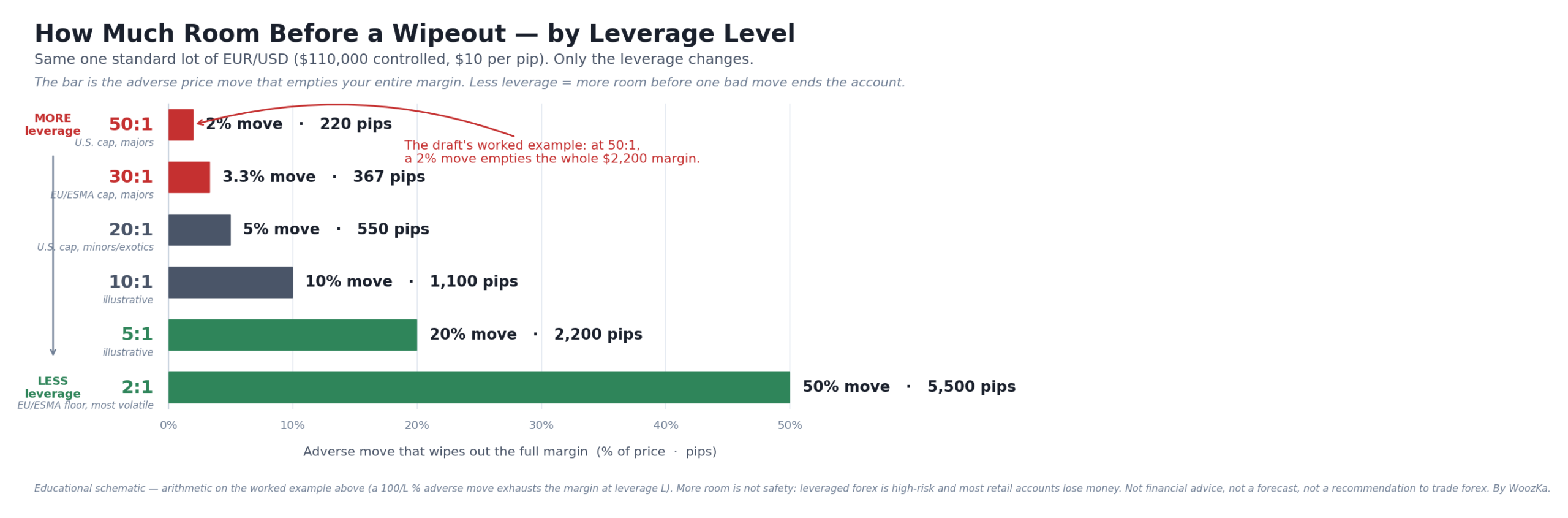
This is the position-sizing lesson as a picture. The trade is identical in every bar — one standard lot of EUR/USD — and only the leverage changes. At the 50:1 maximum, a 2% move against you empties the account; drop to 5:1 and it takes a 20% move to do the same damage. Choosing far less leverage than the broker offers is the single mechanical decision that buys room to be wrong and still survive. More room is not safety, and no setting makes forex low-risk — but it is exactly why disciplined traders almost never use the maximum on offer.
Choosing a Broker: What Actually Matters
When you’re ready to look at brokers, lead with regulation, not spreads or bonuses:
- Regulatory status. In the U.S., a legitimate retail forex broker is registered with the CFTC and a member of the NFA; other jurisdictions have their own regulators (FCA in the UK, ASIC in Australia, CySEC in the EU). Verify the specific license or registration number on the regulator’s own database — this is a claim to check, never to take from the broker’s marketing [source: NFA Forex Regulatory Guide; CFTC registration requirements].
- Negative-balance protection — as above, confirm it explicitly.
- All-in costs: the typical spread on the pairs you’ll trade, any commission, and overnight financing (swap) rates.
- Execution quality and platform, and whether withdrawals are straightforward.
Because fees, execution, and even regulatory status differ by broker and change over time, this pillar deliberately doesn’t rank specific brokers — the like-for-like, date-stamped comparison lives in Best Forex Brokers for Beginners: Fees, Regulation, and Execution Compared, which carries an affiliate disclosure. This article’s job is to make sure you know what the criteria mean — especially the regulation and NBP checks — before you get there.
Common Beginner Mistakes to Sidestep
- Treating leverage as free buying power. It’s borrowed exposure that magnifies losses first and fastest. The available maximum is a ceiling, not a target.
- Assuming losses stop at your deposit. Without NBP, they don’t — the franc shock proved it.
- Ignoring the spread and swap. Small per-trade costs, paid twice per round trip and daily on held positions, quietly compound against you.
- Over-sizing the position. Position sizing is the discipline that keeps one bad trade from being the last one — covered in Position Sizing in Forex: The Math That Keeps You in the Game.
- Trading money you can’t afford to lose. With a majority-lose base rate, forex is not the place for rent or emergency funds.
- Believing the “income” pitch. The regulator-mandated loss disclosures exist precisely because that pitch so reliably fails.
What “The Money Math” Leaves Out
The pip-value section above gives you one number — $10 per pip on a standard lot — and calls the arithmetic direct. It is direct, and for EUR/USD it is correct. The catch is that it is correct for EUR/USD, and the section never says so. This site’s own Forex Position Size & Pip Calculator offers 29 pairs. On exactly four of them is the answer $10.
| Kind of pair | Pairs | Pip value | Needs a rate |
|---|---|---|---|
| Quoted in USD | 4 | $10.00 | No |
| Gold (XAU/USD) | 1 | $1.00 | No |
| Rises with the rate | 6 | Varies | Yes |
| Falls with the rate | 18 | Varies | Yes |
Four of twenty-nine is 13.8%. The other twenty-four cannot be answered at all without knowing the current exchange rate, because a pip is worth a fixed amount of the quote currency, and that has to be converted into dollars before it means anything to a U.S. account. Look back at the four majors this article named earlier — EUR/USD, USD/JPY, GBP/USD, USD/CHF — and exactly two of them are the $10 case. The other two sit in the bottom row of that table.
How Far “Varies” Actually Varies
“Varies” is easy to skim past, so here is the size of it. Each row runs one pair through the same calculator across a band of rates. These bands are illustrative inputs chosen to show how the arithmetic behaves — exactly the way this article already uses 1.1000 for EUR/USD — and not quotes for any date.
| Pair | Rate band | Pip value | Spread |
|---|---|---|---|
| USD/JPY | 130 – 170 | $7.69 to $5.88 | 30.77% |
| USD/CHF | 0.80 – 0.95 | $12.50 to $10.53 | 18.75% |
| USD/CAD | 1.30 – 1.45 | $7.69 to $6.90 | 11.54% |
| EUR/GBP | 1.20 – 1.35 | $12.00 to $13.50 | 12.50% |
USD/JPY is the row to sit with: the same pair, the same standard lot, and a pip worth anywhere from $7.69 to $5.88 depending only on where the rate happens to be. That is a 30.77% difference in what every pip is worth to you, and nothing about your trade changed. The relationship is not merely loose, either — it is exactly reciprocal. Raise USD/JPY by 10% and pip value is multiplied by exactly 1/1.1: the calculator returns $6.6667 at 150 and $6.0606 at 165, a ratio of 0.9090909090909091, which matches 1/1.1 to the last digit a computer can hold. Note also that the last row moves the opposite way. On EUR/GBP the conversion multiplies by the rate instead of dividing, so there a rising rate makes each pip worth more, not less. Six of the twenty-four rate-dependent pairs behave that way and eighteen behave like USD/JPY.
Why “220 Pips” Is Not a Forex Fact
The leverage section above works out that at 50:1, a 220-pip move against one standard lot of EUR/USD consumes the entire $2,200 of margin. That arithmetic is right, and it is worth following one step further, because a beginner is very likely to carry the 220 around as a rule of thumb. Here is the same construction — the adverse move that eats exactly the posted margin — run across other pairs.
| Pair | Rate | Margin | Wipeout | Move |
|---|---|---|---|---|
| EUR/USD | 1.1000 | $2,200 | 220 pips | 2.00% |
| GBP/USD | 1.2500 | $2,500 | 250 pips | 2.00% |
| USD/JPY | 150.00 | $2,000 | 300 pips | 2.00% |
| USD/CHF | 0.9000 | $2,000 | 180 pips | 2.00% |
| AUD/USD | 0.6500 | $1,300 | 130 pips | 2.00% |
Read the last two columns together. The pip count runs from 130 to 300, a 2.31x spread, while the move that produces it is 2.00% in every single row — because at 50:1 the move that empties your margin is always one-fiftieth of the price, whatever the price is. The pips are not measuring the same thing from row to row. The percentage is. So someone who remembers “220 pips is the wipeout distance” is holding a fact about EUR/USD at 1.1000, and on AUD/USD at 0.6500 that rule under-estimates the danger by 40.9%: the account is gone at 130 pips, not 220. This is the strongest practical argument for the habit this article has already pressed twice — think in percent of the account, never in pips.
The same distortion runs in reverse when you size a position. Hold the risk fixed at $100 with a 20-pip stop, and the calculator’s sizing function returns 0.50 lots for EUR/USD, 0.75 for USD/JPY and 0.45 for USD/CHF — a 1.67x spread in position size for identical risk. That is not an inconsistency to iron out; it is the sizer doing its job, because the lot size has to move precisely to the extent the pip value does. Turn it around and the cost of ignoring it is clear: fix the lot size at 0.50 across all three and the risk you actually took drifts from $66.67 to $111.11 on a stop you thought was worth $100 either way. That is 67% more money at stake on one pair than another, from a decision you never made.
The provenance of these pip values, and the limits on them. Every figure above comes from forexPipValuePerLot and forexPositionSize, the two functions behind the Forex Position Size & Pip Calculator this section links, so every row can be reproduced in your browser; the 29-pair list is that calculator’s own. Exchange rates are inputs here, not claims — no rate above is a quote, a forecast, or a statement about any market on any date, and the results that matter survive whatever rate you substitute, since they are about which pairs are fixed, which direction each one drifts, and the fact that the wipeout percentage is identical while the pip count is not. One modeling choice is made explicit: “wipeout” means the adverse move that consumes exactly the posted margin, ignoring the margin call that would normally close the position first, which is this article’s own construction and is how it gets its 220 pips. Spread, commission, swap and slippage are not modeled anywhere above; this article treats those separately. The calculation behind these tables reports every figure above and confirms that this article’s own published numbers — the $10, $1 and $0.10 pip values, the $100 and $1,000 swings, the $110,000 notional, the $2,200 margin, the ~45% move, the 220-pip wipeout, the $4,000 loss and the resulting -$1,800 balance — all re-derive exactly before it reports anything. They do.
Where to Go Next
You now understand the machine: pairs, pips, lots, and the leverage-and-margin math that makes this the second-highest-risk corner of the whole blog after crypto. The next layer digs into each piece:
- Leverage in Forex: Why It Cuts Both Ways — the full loss-side treatment of the mechanic introduced above.
- Position Sizing in Forex: The Math That Keeps You in the Game — how to size a trade so a single loss can’t end you.
- What Moves Currency Prices? Interest Rates, Inflation, and Central Banks — the macro forces behind the numbers.
- Margin Calls Explained: How to Avoid Getting Wiped Out — margin mechanics, negative-balance risk, and which brokers protect against it.
- Best Forex Brokers for Beginners: Fees, Regulation, and Execution Compared — the date-stamped, like-for-like broker breakdown.
If you’d like currencies and markets explained plainly, risk-first and never hyped, that’s what the newsletter is for. Subscribe below.
Disclaimer: This article is educational content, not financial advice. I am not a licensed financial advisor, and nothing here is a recommendation to buy or sell any security or asset. Investing and trading involve risk, including the possible loss of the money you invest. Do your own research and consider consulting a licensed financial professional before making investment decisions. Read the full Disclaimer.
Historical and backtested results are hypothetical, carry inherent limitations, and do not guarantee future results. Figures were accurate to the best of my knowledge as of this article’s last-updated date and may have changed.
