Futures Contracts 101: What They Are and Who Trades Them
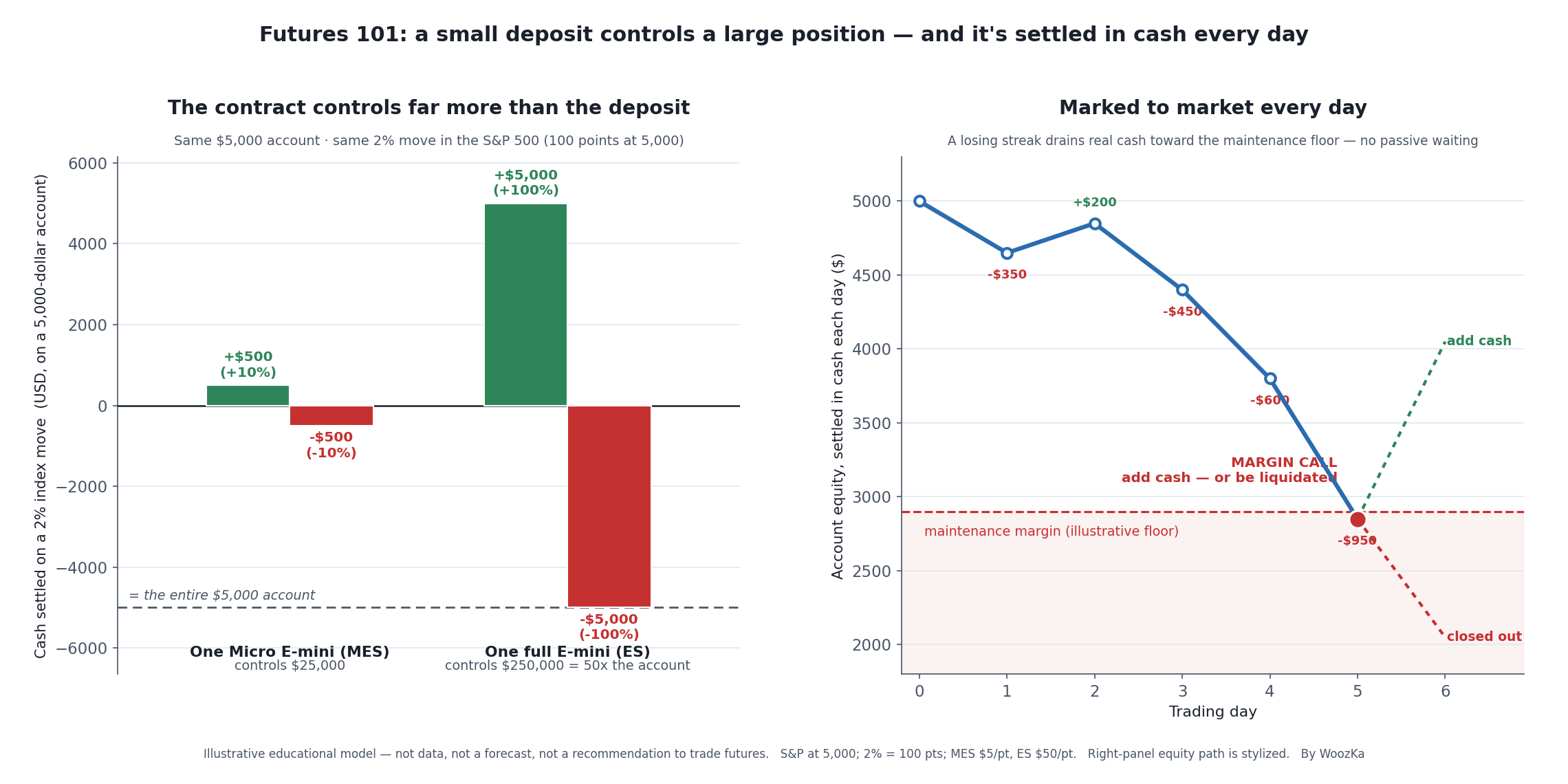
The whole article in one picture: a futures contract controls far more value than the deposit behind it (left), which is where the leverage — and the danger — comes from; and unlike a stock you buy and forget, a futures position is settled in cash every single day, so a losing streak drains real money out of your account until a margin call forces a decision (right).
A futures contract is one of the oldest ideas in finance and one of the most misunderstood by beginners. Stripped to its core, a futures contract is a standardized, legally binding agreement to buy or sell a specific asset at a price agreed today, for delivery on a set date in the future [source: CFTC Futures Glossary; CME Group, “Definition of a Futures Contract”]. That’s it. The buyer is obligated to buy at expiration; the seller is obligated to deliver — unless, as almost every trader does, they close the position before then.
Two facts belong at the top, not buried in a footnote. First, futures are leveraged: you control a large amount of an asset by depositing a small fraction of its value, so both gains and losses are magnified. Second — and this is the one beginners underestimate — in futures trading it is possible to lose more than the money you deposited and end up owing your broker the difference, because a fast market can push your account below zero before anyone can close the position [source: Charles Schwab, “How Futures Margin Works”; Robinhood, “Futures deficits and margin calls”]. Some brokers offer “negative-balance protection” that caps your loss at your deposit, but it is not universal, and you have to confirm whether your broker offers it rather than assuming.
This is not an “easy income” or “quick money” article — that framing is exactly the promotional pattern this blog exists to counter. It’s a plain explanation of what these contracts are, how the leverage and daily settlement actually work, who trades them and why, and where the real risk sits. If you haven’t read the silo’s foundation, How Forex Trading Actually Works: A Beginner’s Guide to Currency Pairs covers pips, lots, leverage, and margin in the same risk-first spirit, and much of the leverage intuition carries straight over.
What a Futures Contract Actually Is
Picture an agreement between two people who don’t know each other, made through an exchange rather than face to face. One agrees to buy 5,000 bushels of corn at $4.50 a bushel next December; the other agrees to sell it at that price. Neither pays for the corn today. They’ve simply locked in a price for a transaction that will happen later. That agreement — standardized so that any buyer and any seller can trade it interchangeably — is a futures contract.
What makes it a futures contract rather than a private handshake deal is standardization and the exchange. Every contract of a given type specifies the same quantity, the same quality, and the same delivery months and locations, so the only thing left to negotiate is the price [source: CFTC, “Basics of Futures Trading”; CME Group, “Definition of a Futures Contract”]. This is the key difference from a forward contract, which is a similar buy-later/sell-later agreement but customized and traded privately (over-the-counter) between two specific parties. Futures are standardized and trade on a regulated exchange; forwards are bespoke and trade off-exchange [source: CFTC Futures Glossary; standard futures-vs-forward distinction].
Standardization is what makes futures liquid. Because every March corn contract is identical, an enormous number of buyers and sellers can trade the same instrument, and you can almost always exit a position by taking the opposite trade rather than waiting for delivery. That’s also why the vast majority of futures positions never result in anyone hauling physical corn anywhere: most traders close out before expiration.
The Standardized Contract, in Plain Numbers
The abstraction gets concrete fast once you look at real contract specifications. Each contract controls a fixed quantity of the underlying, and each one-unit move in the price is therefore worth a fixed dollar amount. A few widely traded examples, current as of 2026 (always confirm the current spec on the exchange before trading — sizes and settlement details are occasionally revised):
| Contract | Controls | Value of a move | Settlement |
|---|---|---|---|
| E-mini S&P 500 (ES) | $50 × the S&P 500 index | $50 per index point ($12.50 per 0.25 tick) | Cash |
| Micro E-mini S&P 500 (MES) | $5 × the S&P 500 index | $5 per index point ($1.25 per 0.25 tick) | Cash |
| WTI Crude Oil (CL) | 1,000 barrels of crude | $1,000 per $1.00 move | Physical delivery |
| Corn (ZC) | 5,000 bushels | $50 per 1-cent move | Physical delivery |
[source: CME Group contract specifications for E-mini and Micro E-mini S&P 500, WTI Crude Oil, and CBOT Corn futures; NinjaTrader/CME contract-spec pages, 2026.]
Read one row slowly. With the S&P 500 index at 5,000, one E-mini S&P 500 contract controls $50 × 5,000 = $250,000 of index exposure. A quarter-million dollars of the U.S. stock market, in a single contract. The Micro version (MES), launched by CME in May 2019 to give smaller accounts a right-sized tool, is exactly one-tenth of that: $5 × 5,000 = $25,000 controlled per contract, and ten Micros behave like one E-mini [source: CME Group, “Micro E-mini Equity Index futures products overview,” Micro E-minis launched May 5, 2019]. Notice you don’t pay $250,000 or $25,000 to hold these. You post a much smaller deposit — which is the whole story of the next section.
Who Actually Trades Futures (and Why)
Futures markets exist for a reason older than speculation: hedging. The two big groups in every futures market are hedgers and speculators, and they need each other [source: CFTC, “Basics of Futures Trading”; CFTC, “Economic Purpose of Futures Markets”].
A hedger uses futures to reduce an existing price risk. The classic example is a corn farmer. In the spring, a farmer knows roughly how much corn will be harvested in the fall but has no idea what the price will be. A price crash between planting and harvest could wipe out the season’s profit. So the farmer sells December corn futures now, locking in a selling price. If the cash price of corn falls by harvest, the loss on the physical crop is offset by a gain on the short futures position — the farmer effectively locked in the earlier price [source: CME/CBOT corn hedging examples; the mechanics of a short hedge]. An airline does the mirror-image thing with jet fuel, and a cereal company does it with grain. Hedgers aren’t trying to profit from the futures trade; they’re paying to transfer a risk they don’t want.
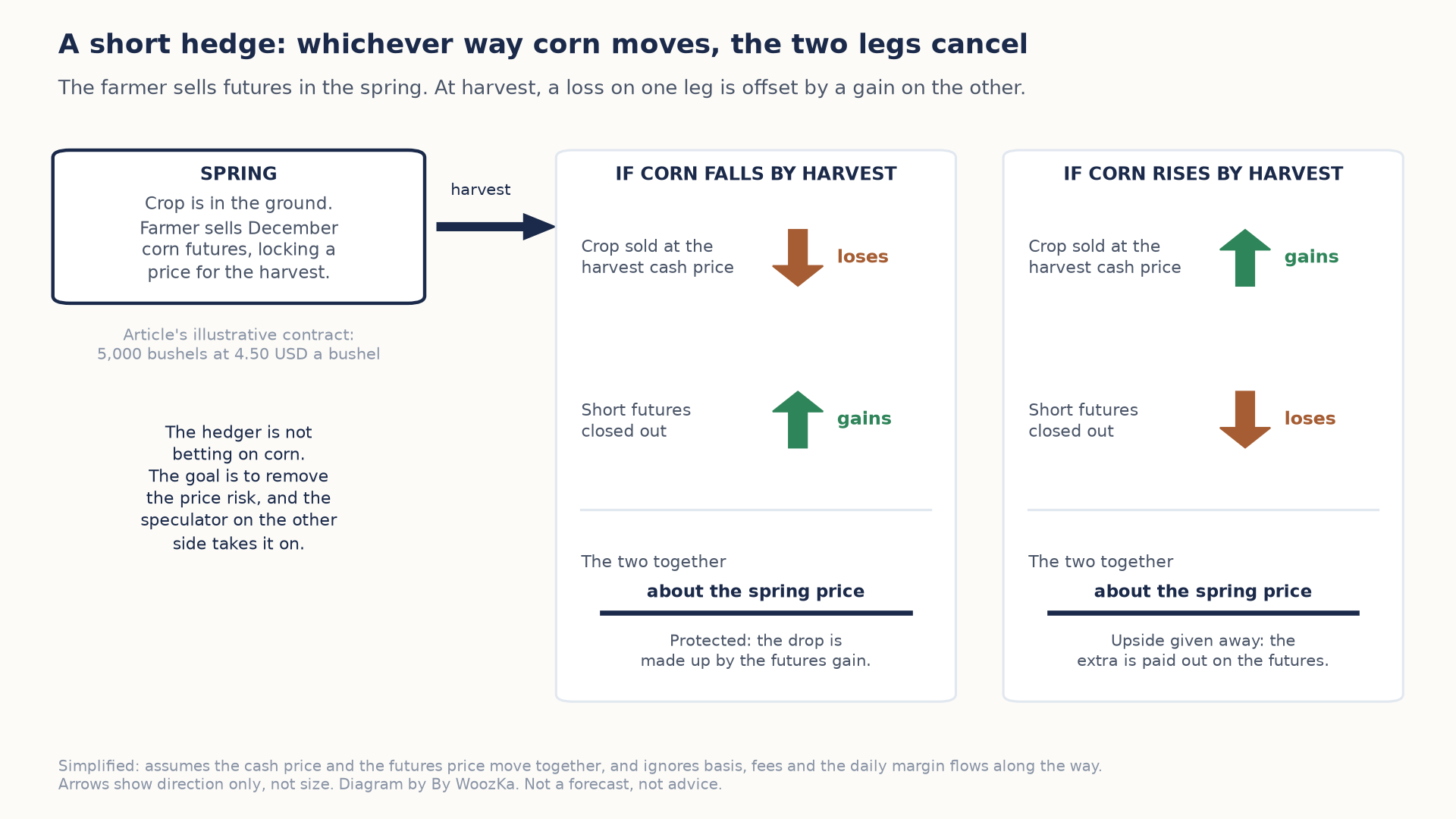
The farmer isn’t betting on corn. Whichever way the price goes, one leg loses what the other gains, so the harvest nets out near the price locked in during the spring. The cost is giving up the upside if corn rallies.
A speculator does the opposite: they take on price risk they didn’t previously have, hoping to profit from a move in either direction. Speculators are often cast as the villains, but the market needs them — they take the other side of the hedgers’ trades and provide the liquidity that lets a farmer or an airline hedge at all [source: CFTC, remarks on the role of hedgers and speculators; speculators supply liquidity and absorb transferred risk]. Between them, hedgers and speculators give futures markets their two core economic functions: transferring risk from those who want to shed it to those willing to bear it, and price discovery — continuously aggregating everyone’s information into a public price for the underlying asset [source: CFTC, on risk transfer and price discovery as the two primary functions of futures markets].
For an individual beginner, the honest framing is this: you would be entering as a speculator, taking the risk side of the trade, in a market built and dominated by well-capitalized commercial hedgers and professionals. That’s not a reason never to learn how it works — but it is a reason to understand the mechanics and the risk cold before funding anything.
Where the Leverage Comes From: Margin Is a Performance Bond
Here’s the concept that trips up everyone coming from stock investing. When you buy stock “on margin,” you’re borrowing money from your broker to pay for shares, and you owe interest on the loan. Futures margin is not a loan and not a down payment. It’s a performance bond — a good-faith deposit that shows you can cover the day’s potential losses [source: CME Group, “Performance Bonds/Margins”; CME describes futures margin as a performance bond]. You’re not buying the asset and financing the rest; you’re posting collateral against an obligation.
There are two levels of it. Initial margin is what you must deposit to open a position. Maintenance margin is the lower floor your account must stay above to keep the position open; drop below it and you get a margin call — a demand to add cash or have the position closed [source: CME Group, “Margin: Know What’s Needed”; initial vs. maintenance margin]. The exchange sets these amounts using a risk model (CME’s is called SPAN) designed to cover roughly 99% of a typical one-day move, and it raises them when markets get volatile [source: CME Group performance-bond/SPAN methodology]. Because the required deposit is only a small fraction of the contract’s full value, a little money controls a lot of exposure. That fraction — and the leverage it implies — changes with volatility, so treat any specific dollar figure as something to confirm with your broker and the exchange on the day, not a fixed number.
The cleanest way to see your real risk is to ignore the margin number for a moment and compare the contract’s full notional value to the cash in your account. Take a $5,000 account and the S&P 500 at 5,000:
- One Micro E-mini S&P 500 (MES) controls $25,000 of index. Against $5,000 of equity, that’s 5:1 effective leverage. A routine 2% move in the S&P — 100 index points — is worth 100 × $5 = $500, which is 10% of the account on that one contract.
- One full E-mini S&P 500 (ES) controls $250,000 — fifty times a $5,000 account. The same 100-point move is worth 100 × $50 = $5,000: a single ordinary 2% move in the index would swing the entire account. (In practice the exchange’s margin requirement won’t even let a $5,000 account hold a full ES — which is precisely why the Micro exists.)
That is the left panel of the chart above, and it is the entire case for caution stated in arithmetic: leverage magnifies the loss exactly as much as the gain. A 2% move your way on one MES is +$500; a 2% move against you is −$500. There’s no version of futures leverage where the upside is amplified and the downside isn’t. Sizing with the smallest contract that fits your account — Micros exist for exactly this — is how a beginner keeps effective leverage low enough to survive being wrong.
Marked to Market Every Day
A stock you buy can sit in your account for a decade while you ignore it. A futures position cannot. Futures are “marked to market” every trading day: at the daily settlement price, the exchange tallies each position’s gain or loss and moves cash accordingly — money flows out of losing accounts and into winning accounts, every day, through what’s called variation margin [source: CME Group and Britannica Money on daily mark-to-market and variation margin; CME marks positions to market at least once daily]. Your paper loss today isn’t just on paper; it’s debited from your account tonight.
This daily settlement is the engine behind margin calls. String together a few losing days and your equity drifts down toward the maintenance floor. Cross it — the dashed line in the right panel of the chart — and you get the call: add cash to restore the account, or the broker closes your position, often immediately [source: CME/NFA margin mechanics; maintenance-margin breach triggers a margin call or liquidation]. There’s no “wait for it to come back” if you can’t meet the call. That’s a feature, not a bug: daily settlement is what keeps one trader’s losses from becoming the exchange’s or the counterparty’s problem. But it means a futures account demands active attention in a way a buy-and-hold stock portfolio does not.
The Risk Beginners Underestimate: You Can Owe More Than You Deposited
Put leverage and daily settlement together and you get the risk that deserves the loudest warning. Most of the time, the maintenance-margin system closes a losing position before the account hits zero. But in a gap — an overnight jump, a shock announcement, a market that moves violently before a stop can fill — the position can blow straight through your equity, and you can end the day owing the broker more than you ever deposited [source: Charles Schwab and Robinhood futures-margin explainers; gap risk can drive account equity below zero, leaving a deficit the customer owes]. The account goes negative, and that negative balance is a debt you’re responsible for repaying, potentially with interest, until it’s settled.
Whether that can happen to you depends on your broker. Negative-balance protection — a policy that caps your loss at what you deposited and eats the rest — exists at some brokers but is not universal in U.S. futures, and it is a specific thing you must confirm in writing before funding an account, not assume [source: broker negative-balance-protection disclosures; the protection is a broker policy, not a guarantee that applies everywhere]. This mirrors the situation the forex pillar describes for leveraged currency trading, and it’s covered in depth — including which brokers protect against a deficit — in Margin Calls Explained: How to Avoid Getting Wiped Out later in this cluster.
If you take one thing from this article, take this: the worst case in leveraged futures is not “lose your deposit.” It’s “lose your deposit and owe more.” Size every position as if that gap could happen, because occasionally it does.
Cash Settlement vs. Physical Delivery
What happens at expiration depends on the contract. Some settle physically: the standard WTI Crude Oil contract (CL), if you hold it to expiration, obligates delivery of 1,000 barrels of oil at Cushing, Oklahoma [source: CME Group WTI Crude Oil contract specs; CL is physically deliverable]. That’s not a metaphor — it’s a genuine obligation, which is why retail speculators are careful to close or roll crude positions well before they expire. Others settle in cash: stock-index futures like the E-mini and Micro E-mini S&P 500 simply pay or collect the difference in cash against the final index value; there’s no basket of 500 stocks to deliver [source: CME Group index-futures cash settlement].
For a beginner the practical rule is simple. Most retail traders never intend to take or make delivery; they trade the price and exit before expiration, or “roll” into the next contract month. But you must know which kind you’re holding — accidentally holding a physically-settled contract into delivery is a classic, expensive beginner mistake, and it’s entirely avoidable by tracking the expiration date from the moment you open the trade.
Who Regulates U.S. Futures
U.S. futures trading sits under a clear regulatory structure worth knowing before you hand anyone money. The Commodity Futures Trading Commission (CFTC) is the independent federal agency that regulates the U.S. derivatives markets [source: CFTC, “Basics of Futures Trading”]. Working under it is the National Futures Association (NFA), the industry-wide self-regulatory organization the industry created and the CFTC formally designated in 1981; it registers firms, sets conduct and disclosure rules, and examines members [source: NFA, “About NFA”; NFA is the CFTC-designated self-regulatory organization for the U.S. derivatives industry]. The broker that carries your account is a Futures Commission Merchant (FCM) — a firm that accepts your orders and funds — and every registered FCM must be an NFA member [source: CFTC, “Futures Commission Merchants (FCMs)”; NFA registration requirements]. Before funding an account, it’s reasonable and easy to verify a firm’s registration status through NFA’s public BASIC database. A legitimate futures broker will be a registered FCM and NFA member; if you can’t confirm that, walk away.
Common Misconceptions About Futures
- “Margin is a down payment on the asset.” No. Futures margin is a performance bond — collateral against an obligation, not a partial purchase you finance. You’re not borrowing to buy; you’re posting good-faith money against daily losses.
- “The most I can lose is my deposit.” Not necessarily. A gap can drive the account negative, leaving you owing the broker — unless your specific broker provides negative-balance protection, which is not universal. Confirm it.
- “Futures are just for oil barons and Wall Street.” Hedgers and speculators both trade them, and Micro contracts made small-account access easy — but “accessible” is not “low-risk.” Easy to open is not the same as easy to survive.
- “I’ll hold it until it turns around.” Daily mark-to-market means a losing position drains cash from your account every day, and a maintenance-margin breach forces the issue. There’s no passive waiting if you can’t meet a margin call.
- “Cash-settled and physically-settled are basically the same to me.” Only until expiration. Holding a physically-settled contract (like crude) into delivery creates a real delivery obligation. Always know which kind you hold and when it expires.
Where to Go Next
Futures reward understanding the plumbing before the strategy. The risk-first path through this silo:
- How Forex Trading Actually Works: A Beginner’s Guide to Currency Pairs — the pillar: leverage, margin, pips, and the “cuts both ways” math that underlies futures too.
- Leverage in Forex: Why It Cuts Both Ways — the difference between the leverage a broker allows and the leverage you actually run, which is the single most useful idea to carry into futures.
- Position Sizing in Forex: The Math That Keeps You in the Game — how to turn a risk-per-trade rule into a position size, so leverage stays survivable.
- Margin Calls Explained: How to Avoid Getting Wiped Out — margin close-outs, negative-balance risk, and which brokers protect against a deficit.
The first time you look at a contract’s notional value next to your account balance, the leverage stops being abstract. Picture the $5,000 account and one full E-mini controlling a quarter-million dollars of index: the same headline you’d shrug at as a stock investor becomes a number that can move your whole account in an afternoon. That gap between what one contract controls and what’s actually in the account is the feeling futures beginners have to respect before they risk a dollar — and it’s why starting with the smallest contract, or with nothing but a study of the mechanics, is the un-glamorous but correct first move.
Disclaimer: This article is educational content, not financial advice. I am not a licensed financial advisor, and nothing here is a recommendation to buy or sell any security or asset. Investing and trading involve risk, including the possible loss of the money you invest. Do your own research and consider consulting a licensed financial professional before making investment decisions. Read the full Disclaimer.
Historical and backtested results are hypothetical, carry inherent limitations, and do not guarantee future results. Figures were accurate to the best of my knowledge as of this article’s last-updated date and may have changed.
