What Moves Currency Prices? Interest Rates, Inflation, and Central Banks
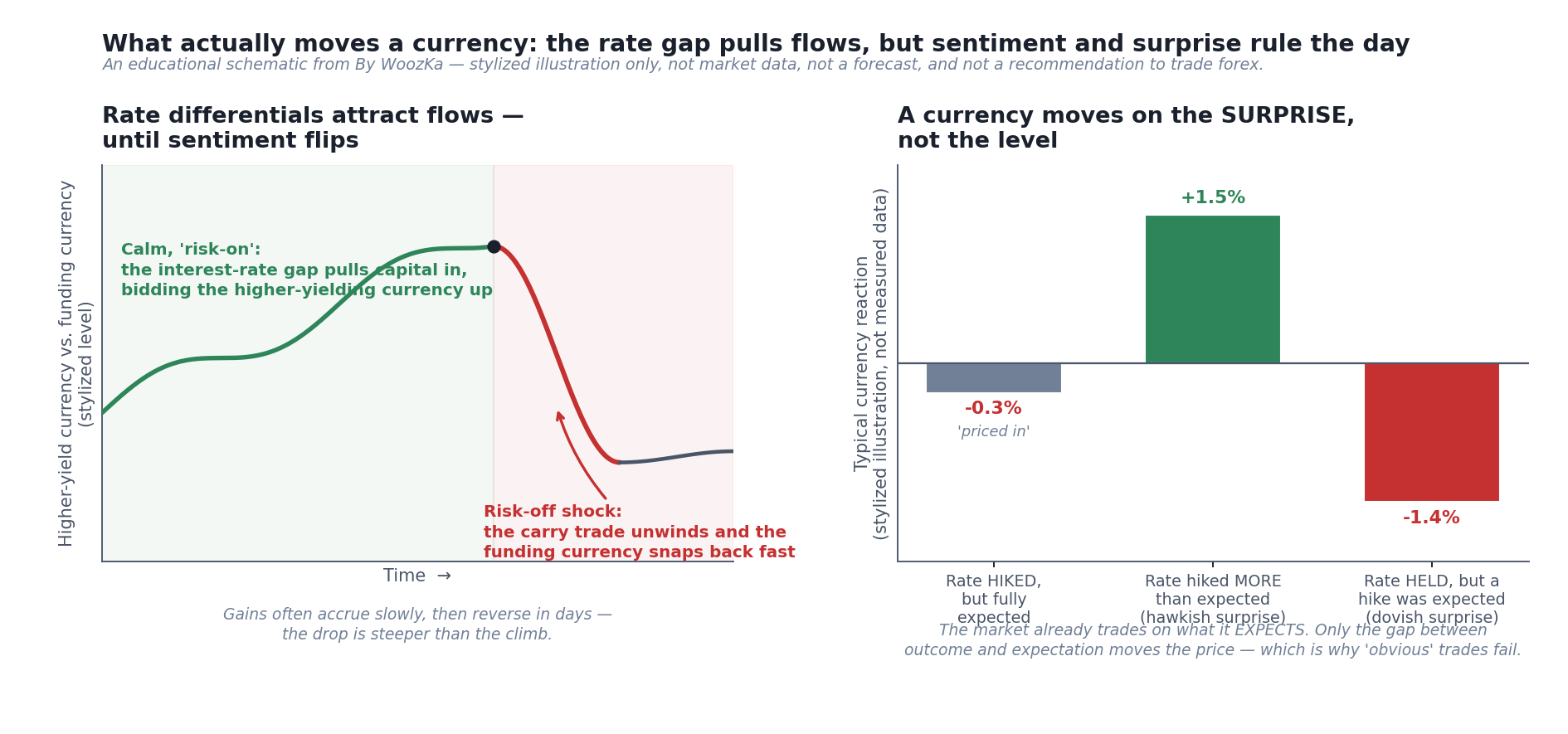
The whole article in one picture. Left: a rate advantage attracts money slowly in calm times, then reverses violently when the mood turns. Right: what moves a currency around a central-bank meeting is not the decision itself but how it differs from what the market already expected.
The foreign exchange market is the biggest market on earth — around $9.6 trillion changed hands per day in April 2025, with the U.S. dollar on one side of 89% of all trades [source: BIS Triennial Central Bank Survey 2025, published Sep 30, 2025]. With that much money moving, it is tempting to think prices swing at random. They don’t. Exchange rates respond to a fairly short list of forces, and once you know them, the daily headlines start to make sense.
Here is the catch, and it’s the reason this article exists in a forex series that leads with risk: knowing what moves a currency is not the same as being able to predict where it goes next. The pillar, How Forex Trading Actually Works, laid out the mechanics — pairs, pips, leverage, margin — and the uncomfortable statistic that roughly 74% to 89% of retail forex/CFD accounts lose money [source: ESMA product-intervention retail account disclosures; figure updated periodically per broker]. A big part of why so many lose is that they learn a driver (“higher rates lift a currency”), treat it as a rule, and get run over when the market does the opposite. So this article does two jobs: explain the real drivers, and show you exactly where each one stops being reliable.
The One-Sentence Answer, and Why It Isn’t Enough
A currency’s price is just supply and demand relative to another currency. EUR/USD rises when, on balance, more people want to hold euros than dollars; it falls when the reverse is true. Everything below is really a list of reasons people’s demand shifts. No single force sets the price — several push at once, often in opposite directions, and the net result is what you see on the chart. Keep that in mind as we go: each driver is a tendency, not a lever.
1. Interest Rates and Central-Bank Policy — the Big One
Over days to months, the single most-watched driver is the gap between one country’s interest rates and another’s. The logic is simple: money seeks a higher return, so when a central bank raises rates (or is expected to), that currency tends to attract capital, and higher demand tends to lift its price. When a central bank cuts, the reverse pressure appears. This is why currency traders hang on every word from the Federal Reserve, the European Central Bank, and the Bank of Japan.
The clearest expression of this is the carry trade: borrow a currency with low interest rates (the “funding” currency), convert it, and hold a currency with higher rates to pocket the difference [source: Federal Reserve Bank of San Francisco Economic Letter 2006-37, “Interest Rates, Carry Trades, and Exchange Rate Movements”]. For years, the Japanese yen was the classic funding currency because Japanese rates sat near zero.
Now the twist that catches beginners. Standard theory — uncovered interest rate parity — says the high-rate currency should gradually depreciate by roughly the interest-rate gap, so that borrowing cheap and buying high yields nothing on average. In the real data, that often doesn’t happen: high-interest-rate currencies have frequently held their value or even appreciated, so the carry trade has historically paid off — a stubborn anomaly economists call the “forward premium puzzle” [source: extensive FX literature on the forward premium anomaly and uncovered interest rate parity]. But those returns are not free. They come with crash risk: the strategy earns a little, steadily, for a long time, and then loses a lot, suddenly, when the mood turns — precisely the pattern in the left panel of the chart above [source: Brunnermeier, Nagel & Pedersen, “Carry Trades and Currency Crashes,” NBER Macroeconomics Annual 2008].
That crash is not hypothetical. In late July 2024 the Bank of Japan raised its policy rate to “around 0.25%” (from a range of 0–0.1%), a move markets read as hawkish; days later, on August 2, 2024, a weak U.S. jobs report (114,000 jobs added versus roughly 175,000 expected) fed expectations of Fed rate cuts. The interest-rate gap that had powered years of yen-funded carry trades suddenly looked like it was closing from both ends. The yen jumped roughly 6% against the dollar in about a week, forcing a stampede to unwind carry positions; Japan’s Nikkei 225 fell about 20% between July 31 and August 5, 2024 — its worst stretch since 1987 [source: BIS Bulletin No 90, “The market turbulence and carry trade unwind of August 2024”]. Years of slow gains reversed in days. That is the honest shape of the “higher rates lift a currency” story.
2. Inflation and Purchasing Power — the Long-Run Anchor
Interest rates dominate the short run; inflation dominates the long run. A currency is a claim on goods and services, and if one country’s prices rise faster than another’s, each unit of its currency buys less over time, so its exchange value tends to erode. This is the intuition behind purchasing power parity (PPP) — the idea that, eventually, exchange rates should adjust so that an identical basket of goods costs about the same in two countries once you convert the price [source: standard purchasing-power-parity theory].
The friendliest illustration is The Economist‘s Big Mac Index, created in 1986 as a deliberately light-hearted way to make exchange-rate theory “a bit more digestible” [source: The Economist Big Mac Index]. A Big Mac is roughly the same product everywhere, built from local ingredients, wages, and rent, so comparing its price across countries gives a rough read on whether a currency looks cheap or expensive versus the dollar. If a burger costs far less abroad once converted, PPP says that currency is “undervalued” and, over the long haul, has a tendency to strengthen toward parity — and vice versa.
Two cautions keep this honest. First, PPP is a long-run gravitational pull, not a timing tool — currencies can sit “overvalued” or “undervalued” for years, so it tells you almost nothing about next week. Second, what matters for rate-driven flows is the real (inflation-adjusted) interest rate, not the headline number: a country with 6% rates and 5% inflation is offering less real yield than one with 3% rates and 1% inflation. This is why a central bank hiking because inflation is out of control can still see its currency struggle — the market looks through the nominal rate to the inflation eating it.
3. Central Banks Do More Than Set Rates
A central bank moves currencies through at least three levers beyond the headline rate:
- Forward guidance. Because markets price the future, what a central bank signals about coming decisions often matters more than today’s move. A “hawkish hold” (no change, but hints of hikes ahead) can lift a currency; a “dovish hike” (a raise, but softer language) can sink it.
- Balance-sheet policy (QE/QT). Creating money to buy bonds (quantitative easing) expands the supply of a currency and tends to weigh on it; shrinking the balance sheet (tightening) does the opposite.
- Direct intervention. Some central banks or treasuries buy or sell their own currency outright to steer it. In 2024, Japan’s Ministry of Finance intervened repeatedly to prop up the yen as it slid past the politically sensitive 160-per-dollar level, spending roughly ¥9.8 trillion in April–June and about ¥5.5 trillion in July–September 2024 buying yen [source: Japan Ministry of Finance, Foreign Exchange Intervention Operations disclosures, 2024]. Intervention can jolt a currency hard in the moment, though it rarely reverses a trend on its own.
And a reminder from the pillar: not every currency floats freely. Some are pegged or tightly managed by their central bank, which is its own kind of driver — until the peg breaks. The January 2015 Swiss-franc shock (referenced in the pillar) is the cautionary tale: when the Swiss National Bank abandoned its cap, the franc moved ~20% in minutes. A single central-bank decision can rewrite a currency’s price faster than any economic trend.
4. Risk Sentiment and “Safe Havens”
Sometimes currencies move for reasons that have nothing to do with the country’s own rates or inflation, and everything to do with global fear and greed. When markets are calm (“risk-on”), money flows toward higher-yielding and emerging-market currencies. When something scares investors (“risk-off”), there is a flight to safety into a handful of currencies that have historically held their value in a panic: the U.S. dollar, the Japanese yen, and the Swiss franc [source: CEPR and central-bank commentary on safe-haven currencies; Babypips Forexpedia, “Safe Haven Currencies”].
Notice how this loops back to the carry trade. The yen and franc are cheap to borrow, so they fund risk-taking in calm times — which quietly weakens them — and then strengthen sharply when the trade unwinds in a scare, as everyone buys them back at once [source: academic work on safe-haven currency behavior and carry-trade funding]. That is the same August 2024 mechanism from Section 1, seen from the sentiment side. One more caveat: “safe haven” is a historical tendency, not a law — analysts in 2026 have openly debated whether the dollar still behaves like a traditional haven, so don’t treat the label as a guarantee.
5. Trade Flows and the Balance of Payments
The oldest textbook driver is international trade. A country that exports more than it imports (a current-account surplus) generates steady foreign demand for its currency, since buyers must convert to pay; a persistent deficit works the other way. Big cross-border investment flows — money moving to buy stocks, bonds, factories, or companies — pull the same levers.
In practice, trade balances move slowly and are usually a weaker day-to-day force than rates or sentiment, which is why they rarely make the headlines that a Fed meeting does. But over years they matter, and a sudden shift — a commodity boom for an exporter, a trade shock — can move a currency meaningfully. (This is also why the Australian and Canadian dollars are called “commodity currencies”: their economies, and thus their exchange rates, lean on raw-material exports.)
The Trap: Knowing the Driver ≠ Predicting the Price
Here is where most “I understand forex now” confidence goes to die. Every driver above is already being watched by millions of participants with far more information than you have, and the price you see has their expectations baked in. That changes everything about how news moves a currency.
A currency reacts to the surprise, not the level. If the market is certain a central bank will hike, the currency largely moves before the meeting, as traders position for it. When the hike arrives exactly as expected, the currency can go nowhere — or even fall, because the news is “priced in” and some traders take profits (“buy the rumor, sell the fact”). The right panel of the chart makes the point: an expected hike barely moves the price, a bigger-than-expected hike (a hawkish surprise) lifts it, and a hold when a hike was expected (a dovish surprise) sinks it. The decision matters far less than the gap between the decision and the expectation.
That is why the “obvious” trade so often loses, and it stacks on top of the leverage math from the rest of this cluster: even a correct read on the economy can lose money if the move was already priced in, and leverage turns that ordinary loss into an account-threatening one. Add the fact that several drivers fire at once and can point in opposite directions — rising rates and a risk-off panic, for instance — and you have the real reason currency forecasting is so hard that most professionals hedge rather than predict. Understanding these forces makes you a more informed observer. It does not hand you an edge, and any source telling you it does is selling something.
If you want to feel how counterintuitive this gets, watch a currency around a scheduled central-bank decision sometime, without any money on the line. You will regularly see the currency move the “wrong” way — falling on a rate hike, rising on a cut — purely because the outcome landed on the other side of what the market had already assumed. That gap between “what happened” and “what was expected” is the single most useful idea in this whole article, and the hardest to trade.
The Same Drivers, With the Figures Multiplied Out
The sections above print a dozen precise numbers — a $9.6 trillion daily market, a jobs report that missed, a currency that moved 6% in a week, and two quarters of Japanese intervention measured in trillions of yen — and never divide one by another. Doing that turns one of this article’s own assertions into something you can see: that intervention “can jolt a currency hard in the moment, though it rarely reverses a trend on its own.” Both halves of the number needed to test it are already printed above. Every figure below was recomputed in code, with USD/JPY derived from European Central Bank daily reference rates.
Six Months of Intervention Is Fifteen Minutes of the Market
Japan’s Ministry of Finance spent roughly ¥9.8 trillion in April–June 2024 and about ¥5.5 trillion in July–September buying yen. Converted at the actual average exchange rate for each quarter — 155.82 and 149.34 — and set beside the market it was aimed at:
| Quarter | Yen spent | US dollars | Share of one day |
|---|---|---|---|
| Apr–Jun 2024 | ¥9.8tn | $62.89bn | 0.655% |
| Jul–Sep 2024 | ¥5.5tn | $36.83bn | 0.384% |
| Total | ¥15.3tn | $99.72bn | 1.039% |
Global currency turnover is $9.6 trillion a day. So a sovereign government, spending on a scale that made headlines for six months, committed 1.039% of a single day’s trading — roughly fifteen minutes of world volume. Spread across the 126 or so trading days it actually covered, it is 0.008% of what changed hands. That is the arithmetic behind the section’s own caution, and it is a very different feeling from “¥15 trillion.”
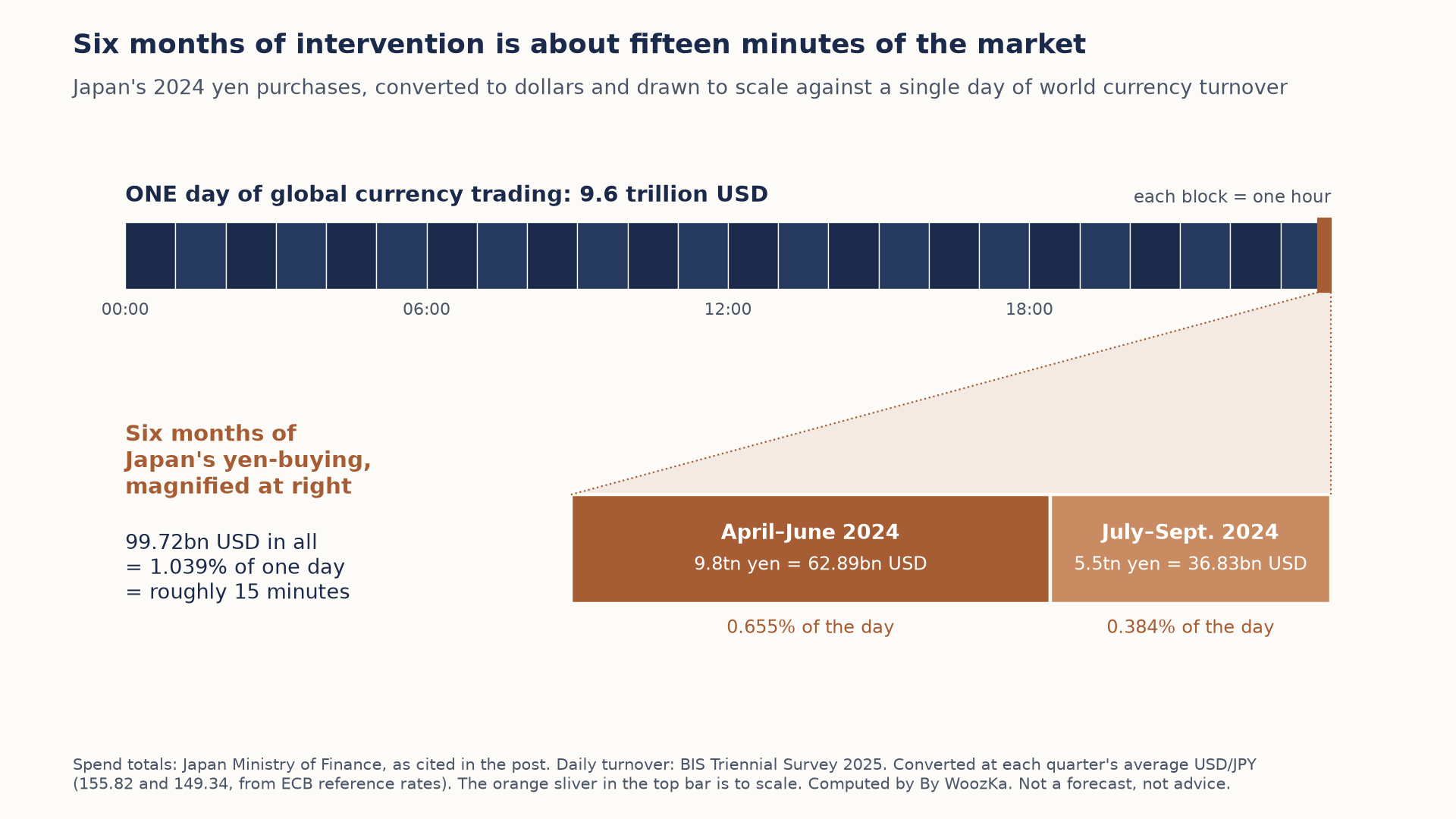
Months of headline-making intervention add up to about 1% of a single day’s currency trading, which is why the article says intervention can jolt a currency but rarely reverses a trend on its own.
The Bigger Spend Sat in the Worse Quarter
Put the two quarters side by side with what the exchange rate did across each one. A rising USD/JPY means a weaker yen — the opposite of what the buying was for.
| Quarter | Spent | USD/JPY | Change | Yen |
|---|---|---|---|---|
| Apr–Jun | ¥9.8tn | 151.65 → 160.62 | +5.91% | Weaker |
| Jul–Sep | ¥5.5tn | 161.14 → 142.75 | −11.42% | Stronger |
The quarter with the larger intervention is the one the yen finished 5.91% weaker. The quarter with a spend 44% smaller is the one it finished 11.42% stronger. Whatever separated those two quarters, it was not how much yen the ministry bought — it was the carry unwind described in section 1, which arrived in the second one.
🔴 That is an association, and it must not be read as a verdict on intervention. There is no counterfactual available: the April–June buying may well have slowed a decline that would otherwise have been steeper, and nothing measurable here can say. What the two rows do establish is narrower and is the article’s own claim — that the direction of a currency over a quarter is set by forces much larger than the intervention, which is why intervention “rarely reverses a trend on its own.”
What One Week Took Back
The carry trade, the section says, “earns a little, steadily, for a long time, and then loses a lot, suddenly.” The yen moved about 6% in roughly a week. A carry position earns the interest-rate gap per year, and this article does not state the gap that applied, so it is swept rather than assumed:
| Rate gap | Years to earn 6% | Weeks of carry |
|---|---|---|
| 2.0% | 3.00 | 156.5 |
| 3.0% | 2.00 | 104.4 |
| 4.0% | 1.50 | 78.3 |
| 5.0% | 1.20 | 62.6 |
| 6.0% | 1.00 | 52.2 |
At a five-point gap the trade needs 1.20 years — about 63 weeks — to accumulate the 6% that came off in one. Across the whole swept range it is 1.2 to 3.0 years, which is what makes “years of slow gains reversed in days” a literal description rather than a figure of speech. The asymmetry is the entire risk profile: the gain is a rate and the loss is a jump, and no amount of being right about the rate gap changes which of the two arrives first.
One last figure, because it is the article’s central thesis in miniature. The trigger was a payroll report of 114,000 against roughly 175,000 expected — a shortfall of 61,000, or 34.9% below expectation. Not a recession, not a collapse; a monthly statistic landing about a third under where the market had already placed it. That is what the section on surprise means when it says the decision matters far less than the gap between the decision and the expectation: a one-third miss on one number preceded a 6% currency move and, on the article’s own figures, a 20% fall in the Nikkei — a move 3.3 times the size of the currency’s.
Method and limits, so this can be checked rather than taken on trust. Each figure was computed in code and verified before publication. The intervention totals, the turnover figure, the payroll numbers and the 6% and 20% moves are the article’s own cited figures, used as given and not independently established here. USD/JPY is derived from ECB daily euro reference rates as the ratio of two published series; those are a 14:15 CET fixing, so they are not intraday highs or lows, and quarter-boundary values are the first and last fixings in each quarter rather than exact quarter-end prints. The conversion uses each quarter’s average rate, which is the right order of magnitude but not the rate any individual operation was executed at, since the ministry does not publish per-day amounts. The rate gap in the last table is swept precisely because the article never states one, and the carry figure ignores compounding, spread and financing costs, all of which make the real gain smaller and the asymmetry worse. The real-interest-rate example in section 2 is deliberately left alone: the exact arithmetic for it belongs to this site’s article on nominal versus real returns, which already works it through. Nothing above is a forecast, no trade or currency is recommended, and no causal claim is made anywhere about what intervention did or did not achieve.
Common Misconceptions About What Moves Currencies
- “Higher interest rates always mean a stronger currency.” No — it’s a tendency, not a rule. Theory (uncovered interest rate parity) actually predicts the high-rate currency should depreciate over time, and if a rate rise is already expected, the currency may not budge or may fall on the news. Real (inflation-adjusted) rates and market expectations matter more than the headline number.
- “The carry trade is easy money.” It earns a little steadily and then can lose a lot suddenly. The August 2024 yen unwind erased years of slow gains in days. Slow-then-violent is the carry trade’s signature, not an exception.
- “A strong economy means a strong currency.” Not directly. Currencies trade on rates, inflation expectations, and sentiment. A booming economy can weaken a currency if it makes rate cuts more likely, or strengthen it if it makes hikes more likely — the link runs through the central bank, not GDP itself.
- “If I understand the drivers, I can predict the price.” The drivers are already priced in by the whole market. You react to surprises you can’t see coming, often with leverage — which is exactly why the loss statistics are what they are.
- “Safe-haven currencies are guaranteed to rise in a crisis.” They have a historical tendency to, mostly because carry trades unwind into them. It is a pattern, not a promise, and even that pattern is being questioned.
Where to Go Next
The drivers in this article are the “why” behind the numbers the rest of the cluster teaches you to handle:
- How Forex Trading Actually Works: A Beginner’s Guide to Currency Pairs — the pillar: pairs, pips, lots, margin, and the full risk picture.
- Leverage in Forex: Why It Cuts Both Ways — why a correct read on the economy can still blow up an account when it’s leveraged.
- Position Sizing in Forex: The Math That Keeps You in the Game — turning a risk rule into a lot size, so a surprise move doesn’t wipe you out.
- Major, Minor, and Exotic Currency Pairs Explained — which pairs react most to the drivers above, and which carry the most risk.
If you want markets and currencies explained plainly — risk-first, never hyped — that’s what the newsletter is for. Subscribe below.
Disclaimer: This article is educational content, not financial advice. I am not a licensed financial advisor, and nothing here is a recommendation to buy or sell any security or asset. Investing and trading involve risk, including the possible loss of the money you invest. Do your own research and consider consulting a licensed financial professional before making investment decisions. Read the full Disclaimer.
Historical and backtested results are hypothetical, carry inherent limitations, and do not guarantee future results. Figures were accurate to the best of my knowledge as of this article’s last-updated date and may have changed.
