Swing Trading Forex vs Day Trading Forex: Which Fits Your Life?
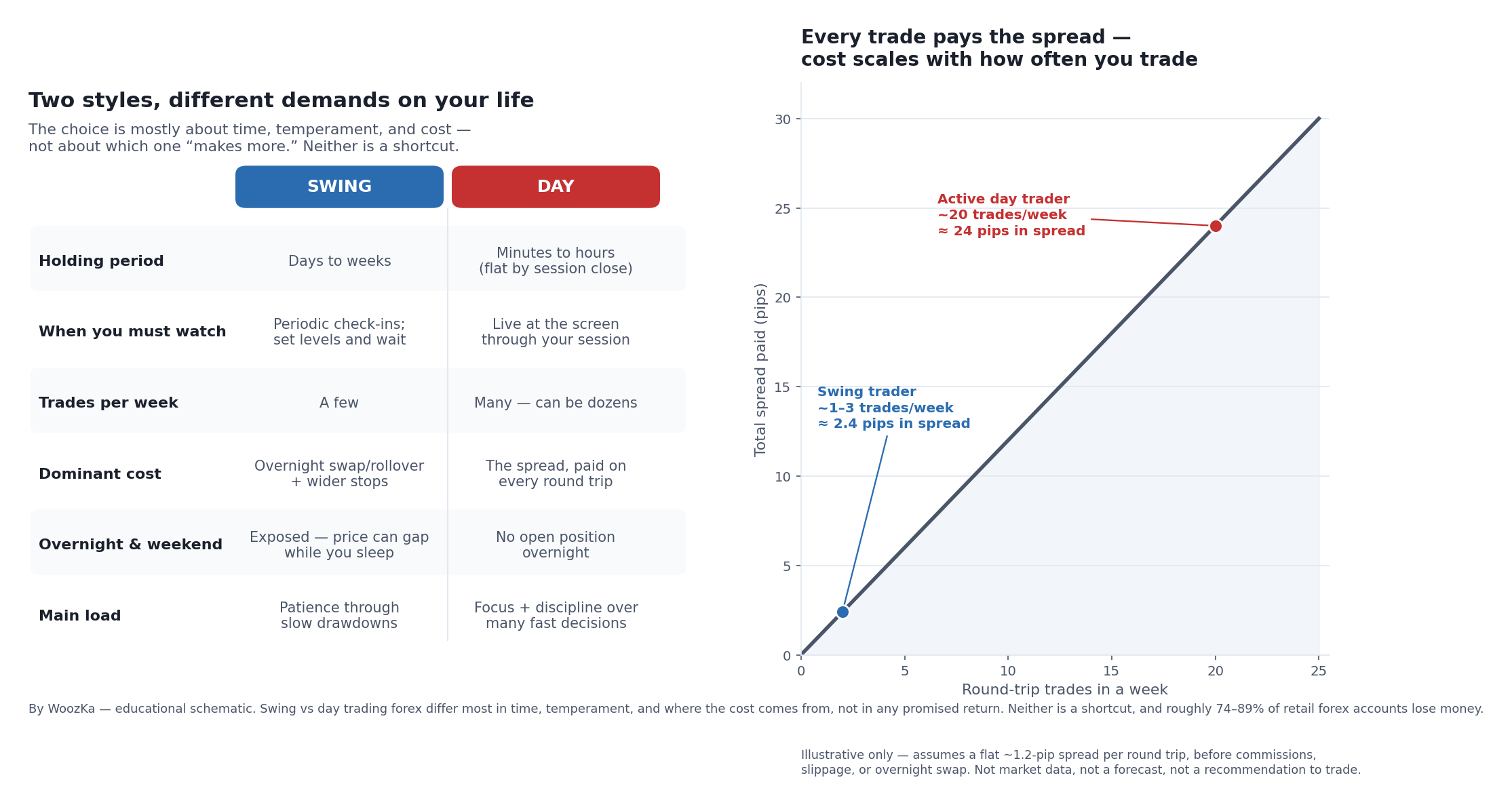
The whole article in one picture. Left: the trade-offs that actually differ between the two styles. Right: the more often you trade, the more you pay in spread — before a single trade is judged a winner or loser.
“Should I swing trade or day trade forex?” is one of the most common questions a beginner asks. It’s also the wrong first question. Before you pick a style, it’s worth sitting with the number that this whole series leads with: across EU brokers, mandated disclosures show that roughly 74% to 89% of retail forex and CFD accounts lose money, and U.S. figures for retail forex are similarly in the majority-losing range [source: ESMA product-intervention retail account disclosures; CFTC retail forex data — figures are updated periodically, so confirm the current disclosure for your specific broker]. Neither swing trading nor day trading changes that starting point. Choosing between them is a question about your time, your temperament, and where you’re willing to pay costs — not a question about which one quietly makes more money.
So this article does two things. It lays out the real, practical differences between the two styles honestly — the demands each puts on your day, and where each one’s costs come from — and it keeps reminding you that the style is downstream of the risk. If you haven’t read it yet, the pillar, How Forex Trading Actually Works, covers the mechanics this piece assumes: pairs, pips, leverage, and margin, plus the reason those loss statistics are what they are.
The two styles side by side. The choice is about time, temperament and cost — not about which one earns more.
| Swing | Day | |
|---|---|---|
| Holding period | Days to weeks | Minutes to hours; flat by session close |
| When you must watch | Periodic check-ins; set levels and wait | Live at the screen through your session |
| Trades per week | A few | Many — can be dozens |
| Dominant cost | Overnight swap/rollover, plus wider stops | The spread, paid on every round trip |
| Overnight and weekend | Exposed — price can gap while you sleep | No open position overnight |
| Main load | Patience through slow drawdowns | Focus and discipline over many fast decisions |
First, What Each Style Actually Means
The styles are defined by one thing: how long you hold a position.
Day trading means opening and closing trades within the same trading day — holding periods of minutes to hours — and ending the day “flat,” with no open position carried overnight. A day trader might place a handful of trades or dozens, all closed before they step away from the screen.
Swing trading means holding a position for days to a few weeks, aiming to capture a larger “swing” in price. A swing trader deliberately holds through overnight sessions and weekends, checking in periodically rather than watching every tick.
There’s a third style worth naming for context: position trading, which holds for weeks to months and sits closest to investing on the spectrum. It’s not the focus here, but it’s the logical next step if “swing” still feels too fast — and it’s a reminder that “trade less often” is always an option.
One clarification that trips up beginners: these are labels for a spectrum, not rigid categories. The honest way to read them is “how often am I in and out, and do I hold overnight?” — because those two facts drive almost every practical difference below.
The Market Runs 24/5 — and That Shapes the Choice
Unlike the stock market, spot forex trades around the clock, five days a week. It opens Sunday evening and closes Friday evening (roughly 5 p.m. New York time on both ends), running as a relay between the major financial centers — Sydney, Tokyo, London, and New York — as each one opens and closes in turn [source: standard forex market-hours references, e.g., OANDA and Babypips forex market-hours guides]. There’s no single opening bell.
That 24/5 structure matters for the swing-vs-day decision in a concrete way. Liquidity isn’t evenly spread across the day: the overlap of the London and New York sessions — roughly 8 a.m. to 12 p.m. New York time — is the busiest window, when the most participants are active, spreads tend to be narrowest, and price moves the most [source: OANDA, “When Is the Best Time for Forex Trading”; Babypips forex market hours]. A day trader has to be present and focused during a liquid window to work at all, which usually means trading their local session or deliberately keeping unusual hours. A swing trader is far less tied to the clock — the trade is open for days, so the exact minute of entry matters less, and check-ins can happen around a normal life. If your schedule can’t reliably give you a live, focused block during a liquid session, day trading isn’t realistically on the table regardless of which you’d “prefer.”
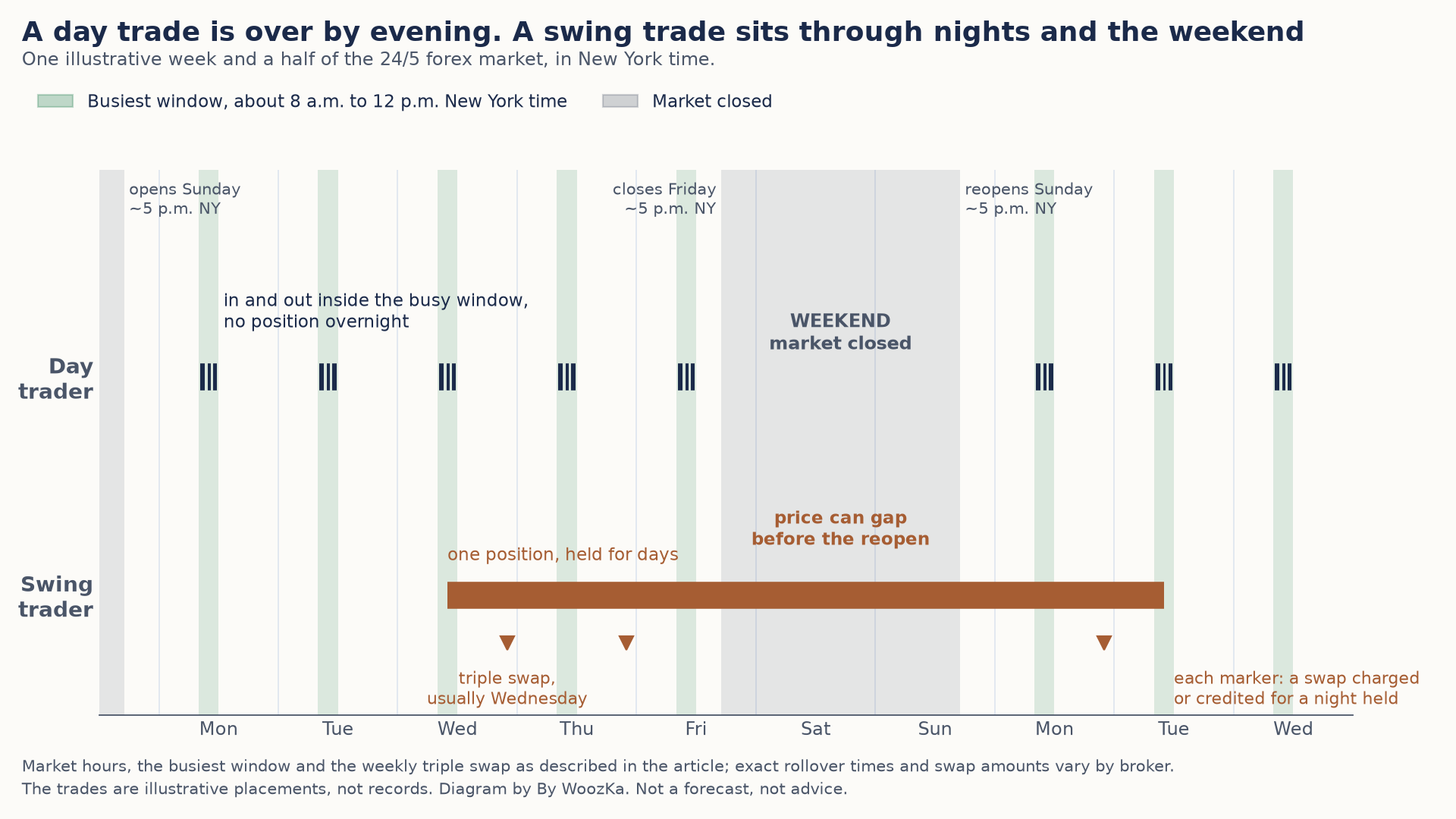
A day trader works inside the liquid hours and is flat by evening. A swing trader skips the screen time but carries every overnight swap and the weekend gap.
The Trade-offs That Actually Differ
Here’s where the two styles genuinely diverge — summarized in the left panel of the chart, and worth walking through one at a time.
1. Time and attention
This is the biggest lifestyle difference. Day trading is an active job while you’re doing it: you’re at the screen, making a stream of fast decisions, managing open risk in real time. Swing trading is closer to periodic monitoring: set your levels, place your stops and targets, and check in. Neither is passive — swing trading still demands homework and discipline — but the shape of the time commitment is completely different. Be honest about which one your actual life, job, and attention span can sustain, not which one sounds more exciting.
2. Where the cost comes from — and neither is free
Every style pays to play, but they pay different tolls, and this is the part beginners most often underestimate.
A day trader’s dominant cost is the spread (and any commission), paid on every single round trip. The right panel of the chart makes the point plainly: if a round trip costs roughly 1.2 pips in spread, then two trades a week costs a couple of pips, but twenty trades a week costs around two dozen pips — before any trade is judged a winner or a loser. The more often you trade, the more you pay simply for participating. High frequency compounds this cost relentlessly, which is one mechanical reason very active trading is such a headwind. (The figures in the chart are illustrative, not a forecast — real spreads vary by pair, broker, and time of day.)
A swing trader’s dominant cost is the overnight swap (also called a rollover or financing fee). When you hold a forex position past the daily rollover, you either pay or receive interest based on the difference between the two currencies’ interest rates — a charge if you’re holding the lower-yielding side, a credit if you’re holding the higher-yielding side [source: standard broker rollover/swap documentation, e.g., FOREX.com and FxPro swap explainers, 2026]. Because banks are closed on weekends, brokers typically apply a “triple swap” once a week (usually Wednesday) to account for the weekend’s settlement days [source: FxPro / FOREX.com rollover-rate documentation]. Hold for days and those swaps add up; hold a losing swing position “hoping it comes back” and you can bleed financing costs on top of the market loss. Swing traders also tend to use wider stops (bigger price moves, so more room), which means either risking more dollars per trade or trading smaller — a real constraint, not a footnote.
The takeaway isn’t “one is cheaper.” It’s that the cost is real and structural in both cases, and it comes out of your account whether you win or lose. A style that fits your life is partly a style whose cost structure you can actually live with.
3. Overnight and weekend risk
Because a day trader closes everything before stepping away, they carry no open position overnight — no exposure to a surprise headline, central-bank statement, or geopolitical event that hits while the market is thin or closed. A swing trader accepts the opposite: prices can gap over a weekend or an overnight session, and a stop-loss order does not guarantee you’ll exit at your intended price if the market leaps straight past it. This series’ pillar points to the January 2015 Swiss-franc shock — when the franc moved about 20% in minutes after the Swiss National Bank abandoned its cap — as the extreme case of a move a stop can’t protect you from. Gap risk is the price a swing trader pays for not having to watch the screen all day. Day traders trade that away and pay for it in screen time instead.
4. Psychological load
The two styles stress different muscles. Day trading demands sustained focus and emotional discipline across many fast decisions — and the sheer number of decisions is itself a risk, because each one is a chance to act on impulse, revenge-trade a loss, or overtrade out of boredom. Swing trading demands patience: the discipline to hold through slow, uncomfortable drawdowns and to not touch a position out of anxiety. People often discover their real answer here by accident — the person who can’t stop checking a multi-day position is telling themselves something, and so is the person who’s exhausted and sloppy after two hours of live day trading.
The Two Tolls, Put on One Scale
The second trade-off above prices one toll and describes the other. A day trader’s spread is given in pips — 1.2 a round trip, a couple of pips at two trades a week, around two dozen at twenty — while the swing trader’s financing is left at “those swaps add up.” They can be put in the same unit. A swap is the gap between two interest rates applied to the position for each day its settlement is pushed forward, which on a pair quoted near 1.1000 converts to pips with nothing but division. The rate gap below is a parameter, run from 1% to 5%, not a quote; the 1.2-pip spread and the trade counts are this article’s own.
What a Night Costs
Position size drops out of this entirely. Spread and financing both scale with the amount traded, so the comparison between them is the same on a micro lot and on a standard one.
| Interest gap | Per day | Full week | In round trips |
|---|---|---|---|
| 1% | 0.30 pips | 2.11 pips | 1.8 |
| 2% | 0.60 pips | 4.22 pips | 3.5 |
| 3% | 0.90 pips | 6.33 pips | 5.3 |
| 4% | 1.21 pips | 8.44 pips | 7.0 |
| 5% | 1.51 pips | 10.55 pips | 8.8 |
The last column is the exchange rate between the two styles’ costs. At a 2% rate gap, carrying a position on the paying side for a whole week costs the same as three and a half day-trade round trips — and one night’s financing overtakes one spread only when the gap reaches about 4%, where the two are 1.21 and 1.2 pips. Below that, a single night is the cheaper toll; at a 1% gap it takes four nights of holding to pay what a day trader pays to get in and out once. The swap is small per night and relentless, which is the reverse of the spread’s profile: nothing while you hold, all of it each time you act.
The Calendar Inside the Swap
This article mentions that brokers book a triple swap once a week, usually on Wednesday, and moves on. The reason is settlement: spot trades settle two business days out, so Wednesday’s rollover pushes settlement from Friday to Monday and is charged for three days, while Saturday and Sunday charge nothing. That makes the cost of a night depend on which night it is. Same 2% gap, same position, five different holds:
| Hold | Nights held | Days charged | Pips |
|---|---|---|---|
| Monday to Tuesday | 1 | 1 | 0.60 |
| Wednesday to Thursday | 1 | 3 | 1.81 |
| Tuesday to Thursday | 2 | 4 | 2.41 |
| Friday to Monday | 3 | 1 | 0.60 |
| Monday to Monday | 7 | 7 | 4.22 |
A position held over the weekend — three nights — is charged for one day. A position held for the single night of Wednesday is charged for three. Per night actually held, the dearest night of the week costs nine times the cheapest, and that ratio is the same at every rate gap and every position size, because it comes from the calendar and not from the market. Over a full week it washes out exactly: seven nights, seven days charged. It only bites on short holds, which is the point worth keeping. The weekend carries the gap risk this article describes in the next trade-off, but it is not where the financing lands; a two-night swing trade that happens to straddle Wednesday pays four days of interest for it.
When Holding Costs More Than Trading
Put both tolls into the week this article’s own chart uses — twenty round trips for the day trader, two for the swing trader, who is assumed here to be in a position on the paying side for all seven days, the most financing the week can produce.
| One week, in pips | Spread | Financing | Total |
|---|---|---|---|
| Day trader, 20 round trips | 24.0 | 0.0 | 24.0 |
| Swing trader, 1% gap | 2.4 | 2.1 | 4.5 |
| Swing trader, 2% gap | 2.4 | 4.2 | 6.6 |
| Swing trader, 5% gap | 2.4 | 10.5 | 12.9 |
On these figures the two totals do not meet until the rate gap reaches 10.2%, which is territory for exotic pairs rather than majors. So the article’s statement that the takeaway is not “one is cheaper” deserves a sharper form. Per position, financing can easily be the larger toll; per week, at the trade counts this article uses, frequency is what dominates, because twenty spreads is a bigger number than seven nights of interest at any rate gap a major pair is likely to show. That is a statement about cost and nothing else. It is the paying side only — on the other side of the same pair the financing column is a credit, which the spread never is — and a lower toll says nothing about whether the trades behind it make money, which is the subject of the section on base rates below.
Method and limits, so this can be checked rather than taken on trust. No calculator on this site computes a swap, so nothing above comes from a shipped tool; every figure is arithmetic on this article’s own 1.2-pip round trip and trade counts and on EUR/USD at 1.1000, the configuration the rest of this series uses, computed in code and checked before publication, with the article’s own 2.4 and 24 pips recomputed first and position size shown to cancel. Four limits are real. The figures are the pure interest-rate gap; a broker’s quoted swap is its own number, differs between the long and short side, and is the one to check before holding anything overnight. The rate gap is a parameter, not an observation of any pair today. A 365-day year is used; a 360-day convention raises every financing figure by 1.4%. And the rollover calendar is the standard one this article and its cited broker documentation describe — holidays shift it, and a broker may book the triple day differently. Nothing here says which style to choose.
Two Myths That Shouldn’t Drive Your Choice
“You need $25,000 to day trade.” This is a stock-market rule, and it does not apply to spot forex. The “pattern day trader” rule — the one requiring a $25,000 minimum balance — governs U.S. equities and options in margin accounts at FINRA-regulated brokers; it has never applied to spot forex [source: Investor.gov, “Pattern Day Trader”; daytrading.com PDT overview]. And even for stocks it’s on the way out: on April 14, 2026 the SEC approved amendments that eliminate the $25,000 minimum and the pattern-day-trader designation, effective June 4, 2026, replacing them with real-time intraday margin standards [source: FINRA Regulatory Notice 26-10; Charles Schwab, “SEC Approves Scrapping $25,000 Day Trader Minimum,” 2026]. Don’t let an outdated or misapplied figure make your decision. The constraints that actually matter in forex are leverage, margin, and position sizing — covered in Leverage in Forex and Position Sizing in Forex.
“Swing trading gets me the lower long-term tax rate.” That’s true for stocks held over a year — but U.S. spot forex is taxed differently. By default it falls under Internal Revenue Code Section 988, which treats gains and losses as ordinary income regardless of how long you held — so the “hold longer, pay less” logic from equity investing does not automatically transfer [source: 26 U.S.C. §988; Green Trader Tax; Universal Tax Professionals, “Forex Tax Reporting,” 2025]. There is an optional election into Section 1256 (with different treatment), and the rules are genuinely complex and situation-specific. This is not tax advice — confirm your own situation with a licensed tax professional. The point for this article is narrow: don’t choose swing over day trading because you assume a stock-style tax break applies. In spot forex, it may not.
What Both Styles Share: the Base Rate
Here’s the honest common ground. No style has a proven, dependable return edge for retail traders, and the evidence gets more sobering the faster and more often you trade. Day trading — the highest-frequency version — is the most-studied, and the results are stark: a landmark study of the entire Taiwanese market from 1992 to 2006 found that in a typical six-month period more than eight out of ten day traders lost money, and fewer than 1% were reliably profitable net of fees; a study of Brazilian day traders found that among those who persisted for more than 300 days, 97% lost money [sources: Barber, Lee, Liu & Odean, “Do Individual Day Traders Make Money? Evidence from Taiwan”; Chague, De-Losso & Giovannetti, “Day Trading for a Living?” (2020) — both discussed in The Difference Between Trading and Investing].
Swing trading isn’t the studied opposite of that — there’s no clean data showing swing traders as a group beat day traders — but the mechanism points one direction: trading less often means paying the spread less often and spending less time exposed to your own worst impulses. That’s a real advantage in cost and behavior. It is not a promise of profit, and it comes bundled with overnight gap risk and swap costs. Read plainly: slowing down tends to reduce some structural headwinds; it does not hand anyone an edge, and any source telling you a particular style is a reliable moneymaker is selling something.
Consider how a beginner usually finds their honest answer: not by reading a comparison table, but by noticing which style they can sustain without cutting corners on risk. The trader who’s calm holding a position for a week and frazzled after an hour of live trading has learned something real about themselves — and it’s worth more than any preference stated in advance.
So — Which One?
Frame the decision in this order, and the “swing vs day” part almost answers itself:
- Decide whether you should be leveraged-trading forex at all. Given the loss statistics, this is a small, deliberate slice of money you can afford to lose entirely — not rent, not savings, not borrowed funds. If that’s not what this is, the style question is moot.
- Match the style to your real schedule and temperament, not your fantasy of them. No reliable live block during a liquid session? Day trading isn’t realistic. Can’t stand holding through an uncertain weekend? Swing trading will grind you down. Be honest.
- Whatever you choose, control risk the same way. Keep leverage low, size every position with a fixed risk rule so one bad trade can’t wipe you out (Position Sizing in Forex), and confirm whether your broker offers negative-balance protection — because in leveraged forex it is possible to lose more than your deposit and end up owing the broker, and not every broker caps that (Margin Calls Explained).
The style is a wrapper around your risk management, not a substitute for it. A well-chosen style with sloppy risk control still blows up; a well-controlled account can work in either style. Pick the one you can run consistently and safely, and treat “which makes more” as the question it actually is — unanswerable in advance, and the wrong thing to optimize first.
Common Misconceptions
- “Day trading is faster, so it makes more money.” Faster means more trades, more spread paid, and more decisions to get wrong. The most-studied high-frequency traders lose at very high rates. Speed is a cost multiplier, not a return multiplier.
- “Swing trading is safer.” It removes intraday screen stress and pays less in spread, but it adds overnight and weekend gap risk that a stop can’t fully protect against. It’s different risk, not less risk.
- “You need $25,000 to day trade forex.” That’s a U.S. stock-margin rule that never applied to spot forex — and it’s being eliminated even for stocks (effective June 4, 2026). Forex is constrained by leverage and margin, not the PDT rule.
- “Holding longer gets me a better tax rate.” True for stocks; U.S. spot forex defaults to Section 988 ordinary-income treatment regardless of holding period. Confirm your own case with a tax professional — don’t assume the stock rule carries over.
- “Pick the right style and the profits follow.” No style has a proven retail edge. The style determines your schedule, your cost structure, and your risk shape — not whether you make money.
Where to Go Next
Style is the last decision, not the first. These come before it:
- How Forex Trading Actually Works: A Beginner’s Guide to Currency Pairs — the pillar: pairs, pips, leverage, margin, and the full risk picture.
- Leverage in Forex: Why It Cuts Both Ways — why the same leverage that funds a style can also end an account.
- Position Sizing in Forex: The Math That Keeps You in the Game — turning a risk rule into a lot size, whichever style you trade.
- Margin Calls Explained: How to Avoid Getting Wiped Out — margin calls, negative-balance risk, and confirming your broker’s protection.
- The Difference Between Trading and Investing — the base-rate evidence on day trading, and the bigger fork this whole question sits inside.
If you want markets explained plainly — risk-first, never hyped — that’s what the newsletter is for. Subscribe below.
Disclaimer: This article is educational content, not financial advice. I am not a licensed financial advisor, and nothing here is a recommendation to buy or sell any security or asset. Investing and trading involve risk, including the possible loss of the money you invest. Do your own research and consider consulting a licensed financial professional before making investment decisions. Read the full Disclaimer.
Historical and backtested results are hypothetical, carry inherent limitations, and do not guarantee future results. Figures were accurate to the best of my knowledge as of this article’s last-updated date and may have changed.
