Should You Invest More in a Bear Market? What the Data Says
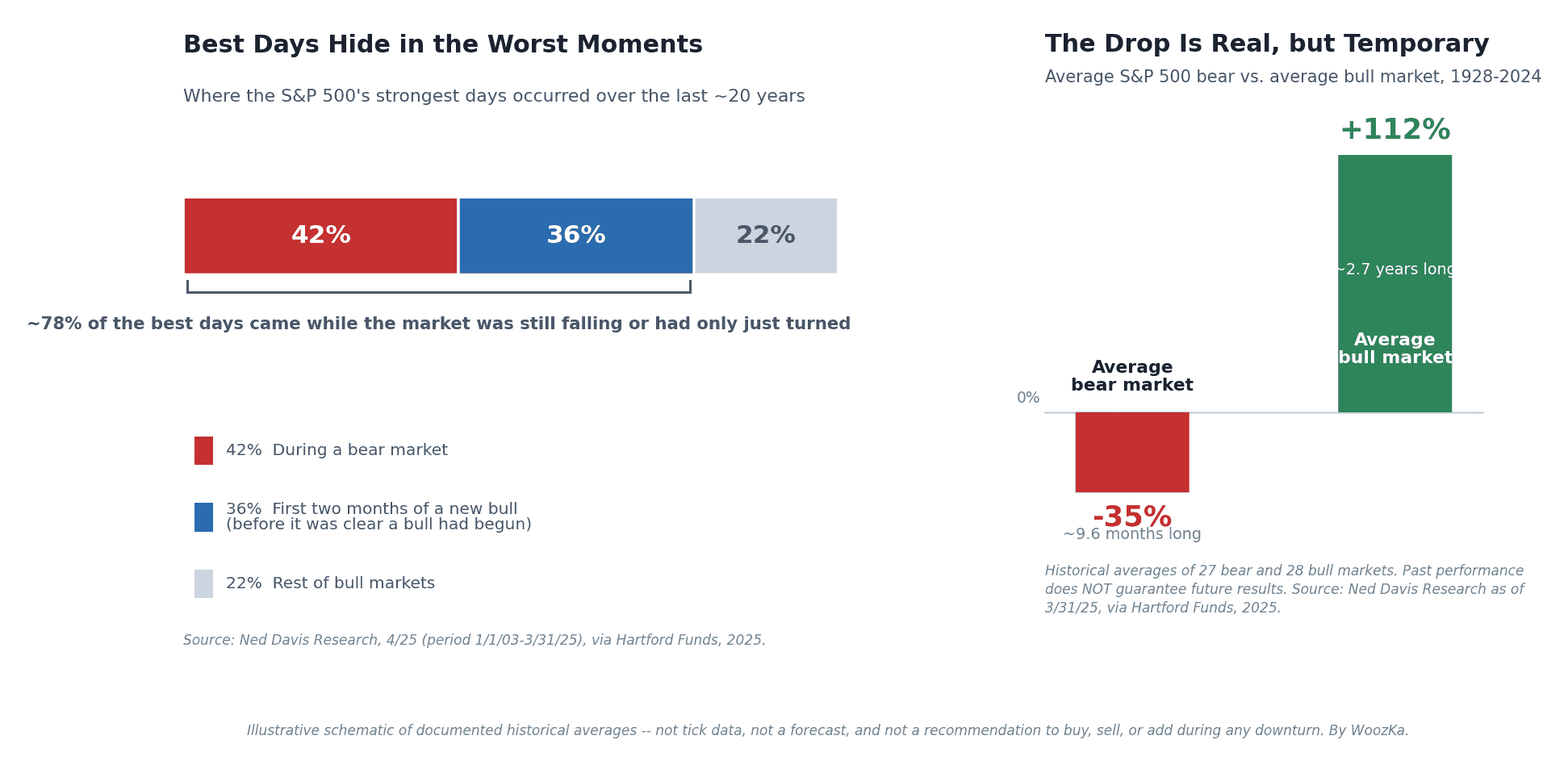
About 78% of the market’s best days over the last 20 years came during a bear market or in the first two months of a new bull — before it was clear a bull had begun. Illustrative of historical averages; past performance does not guarantee future results. Source: Ned Davis Research via Hartford Funds, 2025.
Before anything else: a bear market means real, sometimes prolonged losses on money you have already invested, and nothing in this article is a signal that now is a good time to buy or that any downturn is “the bottom.” This is a piece about a decision you make in advance, with money you can afford to have fall further — not a green light to act on today’s headlines.
The honest answer to “should you invest more in a bear market?” is more careful than either the folk wisdom (“buy the dip!”) or the fear (“get out until it’s over”) makes it sound. This is the research companion to the fear rule in The Autopilot Plan — the rule that says when the news turns bearish, you increase your recurring investment rather than stopping. Here we look at what the data actually supports, and, just as importantly, what it doesn’t.
The short version: the strongest case for continuing — or modestly increasing — your automatic buying during a downturn is not that it reliably earns you more. It’s that it keeps you invested through exactly the moments when most people do the single most damaging thing they can do, which is flee.
First, What a Bear Market Actually Is
A bear market is a decline of at least 20% from a recent peak in a stock index; a drop of 10% to just under 20% is called a correction, and a new bull market is generally dated from the point the index has climbed 20% off its low [source: Hartford Funds, “10 Things You Should Know About Bear Markets,” 2025].
They are a normal, recurring feature of investing, not a rare catastrophe. There have been 27 bear markets in the S&P 500 since 1928 — and also 28 bull markets, with stocks rising substantially over the long run despite all of them [source: Ned Davis Research as of 3/31/25, via Hartford Funds]. On average, a bear market has involved about a 35% decline and lasted roughly 9.6 months, while the average bull market gained about 112% over roughly 2.7 years [source: Ned Davis Research, via Hartford Funds, 2025]. Over a 50-year investing life, you can reasonably expect to live through something like 14 of them.
But “average” hides an enormous range, and that range is the whole reason to be careful. The 2020 pandemic bear market fell about 34% in just 33 days and recovered within months; the 2007–2008 decline ran about 52% over roughly 13 months; and the dot-com bust took about two and a half years to bottom and around 31 months to fully recover [source: Ned Davis Research bear-market table, via Hartford Funds, 2025]. A downturn can be shallow and brief, or deep and grindingly long. Anyone deciding to invest more during one has to be able to withstand the “deep and long” version, because you never know in advance which one you’re in.
The arithmetic of getting back to even
Before any question about whether to buy more, there is a piece of arithmetic worth having in front of you, because it governs what a decline actually costs and it is exact. A fall and its recovery are not symmetric:
| The fall | $100 becomes | Gain needed to get back to even |
|---|---|---|
| 5% | $95.00 | 5% |
| 10% | $90.00 | 11% |
| 20% | $80.00 | 25% |
| 30% | $70.00 | 43% |
| 40% | $60.00 | 67% |
| 50% | $50.00 | 100% |
| 60% | $40.00 | 150% |
| 80% | $20.00 | 400% |
| 90% | $10.00 | 900% |
The conventional bear-market threshold of 20% needs 25% to undo. A halving needs a double. And by the time a position is down 90%, it requires a 900% gain simply to return to where it started — not to profit, just to break even.
The reason is that the gain is computed on the smaller base that the loss left behind. Lose 20% of $100 and the $80 that remains has to work 25% harder to rebuild the missing $20. The gap between the two columns widens the further down the table you read, which is the whole case for caring about the size of a drawdown rather than only its direction.
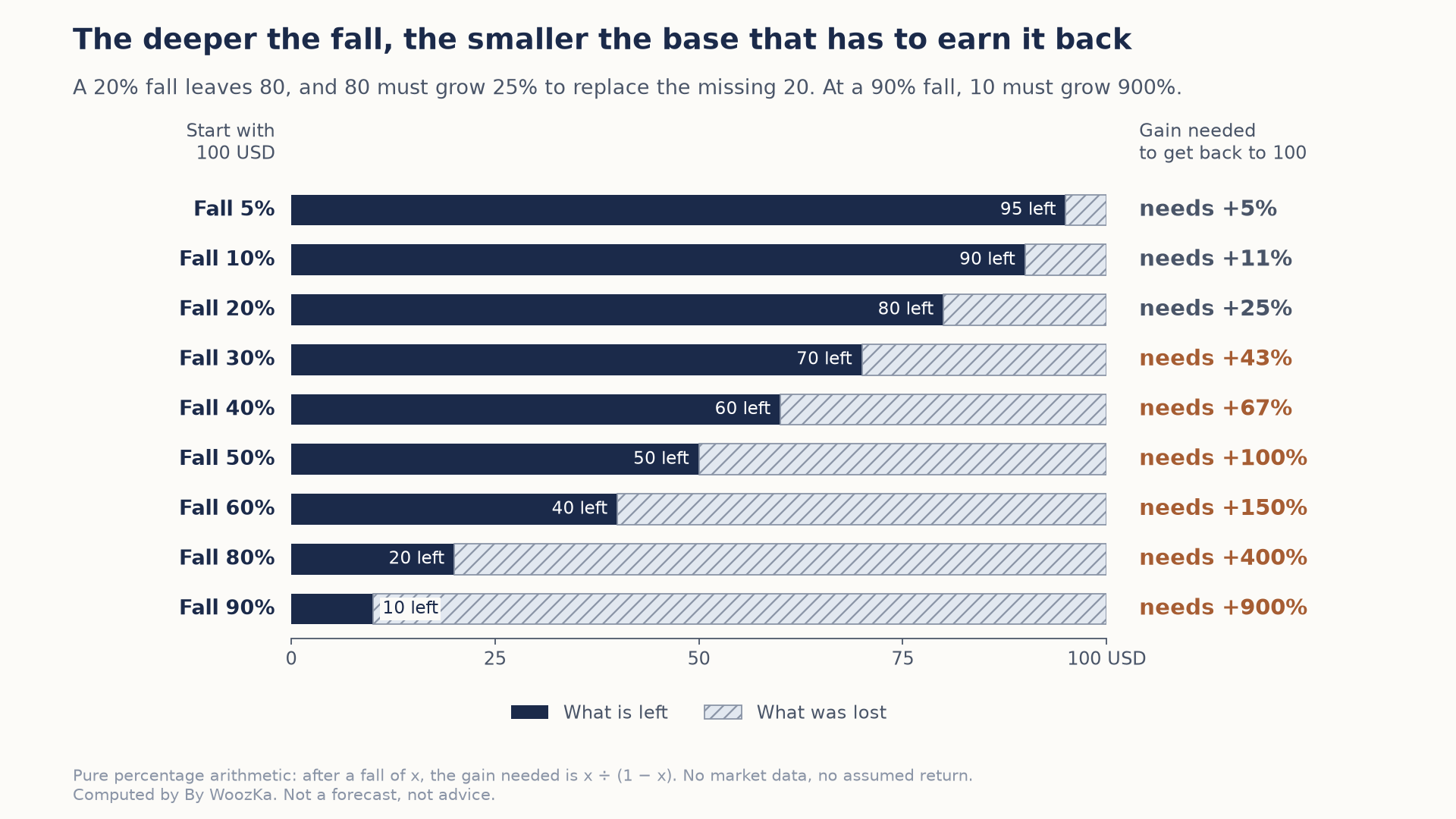
The missing piece has to be rebuilt by whatever is left, and the deeper the fall, the smaller that remaining piece is. That is why a 20% fall needs 25% to undo and a 90% fall needs 900%.
This is not a forecast, and it is deliberately not an argument. No market data is used and no return is assumed anywhere; nothing here says whether, when, or how much to buy. It is one identity about percentages — and notice it cuts both ways. It explains why deep declines are punishing to recover from, and equally why money committed at the lower level needs a far smaller move to do well. Which of those matters more to you is exactly the judgment the rest of this article is about.
Method: after a fall of x, recovering requires a gain of x ÷ (1 − x). The script asserts that applying the fall and then the required gain returns exactly to the starting value at every level, that the required gain always exceeds the fall, that 50% needs exactly +100%, 20% exactly +25% and 90% exactly +900%, and that the asymmetry widens monotonically.
The Range the Average Hides
The section above says that “average” hides an enormous range, that the range is the whole reason to be careful, and names three bear markets to prove it. It never measures the range. Measured — using only figures already on this page, all drawn from the same Ned Davis Research record — nearly all of the spread sits in one of the two dimensions, and it is not the one the headline number describes.
| Bear market | Decline | Time to bottom | × avg |
|---|---|---|---|
| 2020 pandemic | −34% | 1.08 mo | 0.11 |
| 2007–2008 | −52% | 13.00 mo | 1.35 |
| Dot-com bust | −31% | 30.00 mo | 3.12 |
| Average since 1928 | −35% | 9.60 mo | 1.00 |
Across the three, depth runs from −31% to −52% — a spread of 1.68×, and each one lands within half the 35% average (0.89, 1.49 and 0.97 times it). Length runs from 33 days to 30 months — a spread of 27.7×, with not one of them close to the 9.6-month average. Duration varies 16.5 times more than depth does. The pandemic bear took roughly a ninth of the average time; the dot-com bust took more than three times it, on a shallower decline. That is the practical content of the article’s own warning: what you cannot know in advance about a bear market is mostly how long you will be sitting in it, not how far it falls.
The same four averages also answer a question the article raises and then counts the wrong way. It says a 50-year investing life should contain “something like 14” bear markets — a count of episodes. Episodes are not what a person lives through; time is.
| From the four published averages | On the averages |
|---|---|
| Months in a bear, 27 × 9.6 | 259.2 |
| Months in a bull, 28 × 32.4 | 907.2 |
| Share of the record, bear | 22.22% |
| Share of the record, bull | 77.78% |
| Years in a bear per 50-year life | 11.1 |
On those averages the record spends 22.22% of itself inside a falling market, and a 50-year investing life contains about 11.1 years of one. “A normal, recurring feature of investing, not a rare catastrophe” is the article’s phrasing; this is the price of saying it. Not fourteen brief interruptions, but something closer to one year in every four and a half spent in a market that is going down.
One check before any of that is leaned on, because all five figures rest on two counts and two rounded averages from a single source. Those four can be tested against each other: 27 bear markets and 28 bull markets, at their stated average lengths, have to add back up to the period they were drawn from.
| Consistency check | Comes to |
|---|---|
| Span stated, 1928 to 3/31/2025 | 97.25 years |
| Span rebuilt from the averages | 97.20 years |
| Difference | −0.6 months |
| Rounding tolerance on the inputs | ±18.2 months |
| Bears per 50 years, from the count | 13.88 |
| Bears per 50 years, from the lengths | 13.89 |
| One bear market every | 3.60 years |
They do add up. The four averages rebuild the period to within 0.6 months of its stated length, and two independent routes to the article’s “something like 14” — one from the count of bear markets, one from their lengths — agree at 13.88 and 13.89. That is a reason to treat the figures as internally consistent, and it is not a precision claim. Because both durations are published to one decimal place, the rebuilt span carries a rounding tolerance of ±18.2 months — almost all of it from the bull-market figure, where ±0.05 years is multiplied by 28. These averages can show that they hang together; they could not detect a misstatement smaller than about a year and a half.
Method, so it can be checked rather than taken on trust: every figure above is arithmetic on numbers this article already publishes — the counts of 27 and 28, the average decline and length of a bear market, the average length of a bull market, and the three named bear markets — all from the Ned Davis Research record via Hartford Funds as of 3/31/2025, for the S&P 500. No market data is read, no return is assumed, nothing is projected and nothing is recommended; none of this site’s calculators computes a market-history figure, so none is linked here. Months convert at the Gregorian mean of 30.436875 days, and ratios are rounded to two decimals, so the dot-com row’s exact 3.125 prints as 3.12. “Share of the record” measures the peak-to-trough phase Ned Davis counts as a bear market, which is shorter than the time spent below a previous high. Each figure is asserted at the precision shown here before it is printed, including that the reconstruction falls inside its own rounding tolerance.
The Real Question Isn’t “Buy More” — It’s “Will You Keep Buying at All?”
For most investors, the decision that actually determines their long-run outcome in a downturn isn’t whether to add extra — it’s whether they keep investing at all, or panic and sell.
The evidence that people tend to do the wrong thing here is consistent. In March 2020, investors pulled roughly $326 billion out of mutual funds and ETFs — more than three times the roughly $104 billion that fled in October 2008, the worst month of the financial crisis [source: Morningstar data via ThinkAdvisor, April 2020]. In both episodes, the selling clustered near the lows, right before large recoveries. This is the behavior that quietly does the damage: not the market falling, but investors converting a temporary paper loss into a permanent realized one by selling into it, then missing the rebound.
Researchers try to measure the cost of this pattern as a “behavior gap” — the difference between the returns funds produce and the returns their investors actually capture after accounting for the timing of their buys and sells. Morningstar’s Mind the Gap 2024 study found that fund investors earned about 6.3% a year over the decade ending December 31, 2023, versus about 7.3% a year for the funds themselves — a gap of roughly 1.1 percentage points annually, equivalent to giving up around 15% of the funds’ total return, mostly to poorly timed cash flows [source: Morningstar, Mind the Gap 2024]. Morningstar also found the gap was wider for more volatile funds — precisely the ones people are most tempted to trade in a scary market. The exact size of this gap is debated, and it’s an estimate rather than a precise law — some academic work argues the headline figure overstates the true cost [source: Fulkerson, Jordan, Riley & Yan, working paper, 2024] — but the direction is not seriously in dispute: reacting emotionally to downturns has, on average, cost investors return.
So the first-order goal in a bear market is simply to not stop. “Should you invest more?” is a second-order question that only matters if you’ve already cleared the much more important bar of continuing to invest at all.
What the Data Does — and Doesn’t — Say About Buying Into a Downturn
Here is the case for leaning in, stated as strongly as the data honestly allows: historically, bear markets have been where a large share of the market’s best days happen, and those best days have done disproportionate work in building long-run returns.
Of the S&P 500’s strongest single days over the roughly 20 years through early 2025, about 42% occurred during a bear market, and another 36% occurred in the first two months of a new bull market — before it was at all clear that a bull market had begun [source: Ned Davis Research, 4/25, via Hartford Funds]. Add those together and roughly 78% of the best days came while the market was still falling or had only just turned. That’s the left panel of the chart above, and it’s the strongest argument against fleeing: the recovery days are bunched right next to the scary days, so an investor who steps out to “wait for things to calm down” is statistically likely to be absent for the sharpest rebounds. This echoes the finding in our dollar-cost averaging research that missing just the 10 best days over 20 years would have cut a $10,000 S&P 500 investment’s ending value roughly in half.
There’s also the plain mechanical point: a fixed dollar amount buys more shares when prices are lower. If you keep your automatic investment running — or increase it — through a decline, you accumulate shares at prices you won’t see during the good times, and those shares carry more weight if and when the market recovers.
Now the honest limits. None of this lets you time the bottom. The same data that says “the best days happen in downturns” also says you can’t know, while you’re in one, whether you’re near the bottom or only a third of the way down. Buying more in what turns out to be the early part of a long bear market means watching those purchases fall further, sometimes for a year or more. And “the market has always recovered” is a description of the past, not a promise about the future — 27 of 27 U.S. bear markets have so far been followed by a new bull, but that streak is history, not a guarantee, and it is specific to a broad, diversified index. It says nothing about any individual stock, sector, or a market that could behave differently than the American one has.
Why the “Fear Rule” Is a Discipline, Not a Timing Edge
This is the part it’s easy to get wrong, so it’s worth being blunt: increasing your investing in a bear market is best understood as a behavioral commitment device, not a strategy that reliably beats the alternative.
The research on entry timing is clear that spreading money in gradually usually underperforms investing a lump sum immediately, because markets rise more often than they fall — the full argument is in our dollar-cost averaging research. Dollar-cost averaging, and its bear-market extension, tend to shine in one specific scenario: when the market falls meaningfully after you start and takes time to recover. That’s real, but it’s only visible in hindsight, and it’s the exception rather than the rule across history. If anyone tells you that buying dips is a dependable way to earn higher returns, the actual evidence doesn’t back that up.
So what is the fear rule for? Its value is that it pre-commits you, while you’re calm, to do the opposite of the panic instinct — and the panic instinct is the documented, expensive mistake. The rule’s job is to keep you buying (and maybe buying a little more) at the exact moment your gut is screaming to sell, converting fear into a scheduled action instead of a discretionary decision you’ll probably get wrong. Warren Buffett’s much-quoted line — “be fearful when others are greedy, and be greedy when others are fearful” — comes from his October 2008 New York Times op-ed “Buy American. I Am.”, written in the depths of the financial crisis [source: Warren Buffett, The New York Times, October 16, 2008]. It’s often read as a market-timing tip. It’s better read as a statement about temperament: the discipline to keep acting rationally when everyone around you isn’t.
How to Invest More in a Bear Market Without Hurting Yourself
If, after all those caveats, you decide the fear rule fits your plan, the way you implement it matters far more than the decision itself. A few guardrails do most of the work:
- Only use money you genuinely don’t need for years. Bear markets can last many months and take years to fully recover. Money you might need for rent, a near-term goal, or an emergency should not go anywhere near a falling stock market. Fund your emergency savings first; invest only surplus.
- Never borrow to buy the dip. Using margin, credit cards, or any debt to invest more in a downturn is how a survivable decline becomes a catastrophic one — leverage can force you to sell at the worst possible moment. The fear rule is a modest increase in ordinary, cash-funded contributions, not a leveraged bet.
- Keep the increase modest and pre-decided. The Autopilot Plan frames the fear-rule bump as something like 20–50% above baseline — a rule-of-thumb starting point you choose in advance based on your own income and risk tolerance, not a figure any study can optimize for you. Deciding the number while calm is the entire point; picking it in the middle of a crash defeats the purpose.
- Do this with a broad, diversified index — not a single beaten-down stock. Everything here rests on the historical behavior of a broadly diversified market index that has recovered because the economy recovered. “Averaging down” into one falling company is a completely different and riskier activity: individual companies can and do go to zero, and a cheap-looking single stock can be a value trap, not a bargain.
- Mind where you are in life. An investor decades from needing the money can ride out a long downturn; someone close to drawing on the portfolio faces sequence-of-returns risk, where a big decline plus withdrawals early on can do lasting damage. The closer you are to needing the money, the less aggressive any bear-market adjustment should be.
The through-line of all five: the fear rule only works if it can’t force you to sell. Its power comes from being small enough, and funded safely enough, that you can hold every share through whatever comes next.
The Honest Bottom Line
Should you invest more in a bear market? If it means continuing your automatic, diversified, cash-funded investing while everyone else panics — and perhaps nudging it up by a pre-set, affordable amount — the historical data is broadly supportive, chiefly because it stops you from making the far more expensive mistake of fleeing. Bear markets have been normal, historically temporary, and the site of a surprising share of the market’s best days, and staying invested through them has generally rewarded the patient.
But if “invest more” means trying to time the bottom, loading up with money you can’t afford to lose, borrowing to do it, or concentrating into whatever fell hardest, the data does not support that, and the risks are serious. The edge, to whatever extent one exists, is emotional discipline — not prediction. The goal isn’t to be clever about the crash. It’s to make sure the crash can’t make you sell.
Disclaimer: This article is educational content, not financial advice. I am not a licensed financial advisor, and nothing here is a recommendation to buy or sell any security or asset. Investing and trading involve risk, including the possible loss of the money you invest. Do your own research and consider consulting a licensed financial professional before making investment decisions. Read the full Disclaimer. Historical and backtested results are hypothetical, carry inherent limitations, and do not guarantee future results. Figures were accurate to the best of my knowledge as of this article’s last-updated date and may have changed.
Want the full three-rule system this fear rule belongs to — including the base rule and the greed rule — laid out as a setup checklist, plus the weekly market read this blog uses to apply the fear and greed adjustments? Subscribe to the newsletter below.
