Margin Calls Explained: How to Avoid Getting Wiped Out
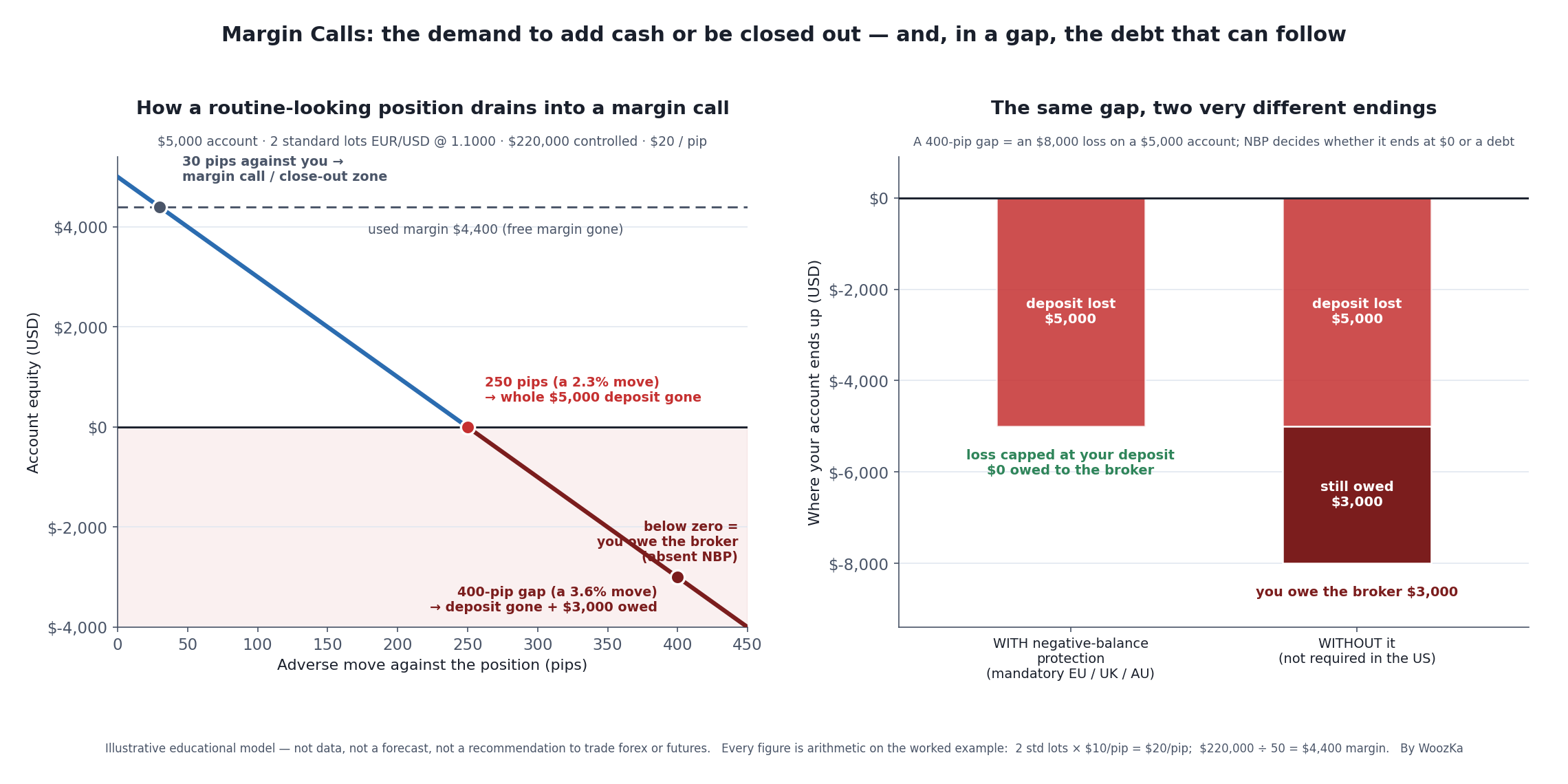
The whole article in one picture: an ordinary-sized leveraged position drains toward a margin call faster than most beginners expect (left), and if a fast market gaps through the close-out level, whether you simply lose your deposit or also end up owing the broker comes down to one thing — whether your broker offers negative-balance protection (right).
Two facts belong at the very top of any article about margin calls, not buried at the bottom.
First: a margin call is not a warning you have time to think about. It is a demand — add cash immediately or your position gets closed at a loss — and on many platforms the “demand” is automatic and instant, with no human on the other end waiting for your reply.
Second, and this is the one the ads never mention: in leveraged trading it is possible to lose more than the money you deposited and end up owing your broker the difference. In a fast, gapping market your account can blow straight through zero before anything can be closed. Some brokers cap that loss at your deposit through a policy called negative-balance protection, but it is not universal, and whether you have it is something you must confirm in writing with your specific broker — never assume it. This is not a fringe scenario: the regulator-mandated disclosures on retail broker websites show that roughly 74% to 89% of retail CFD accounts lose money, and the CFTC’s own customer advisory reports that about two-thirds of customers at registered U.S. OTC forex dealers lost money [source: CFTC, “Customer Advisory: Eight Things You Should Know Before Trading Forex” — percentages of profitable and not-profitable non-discretionary customer accounts disclosed by registered OTC forex dealers, Q2 2021 through Q1 2022; ESMA product-intervention retail account disclosures — the ESMA range is updated periodically and shown on each broker’s own current risk warning].
If you understand the mechanics of a margin call before you fund an account, you can build your trading so the call never arrives. That is the entire goal of this article. If you haven’t read the pillar, How Forex Trading Actually Works, start there — it covers pips, lots, and the basic margin math this article builds on, along with the companion article Leverage in Forex: Why It Cuts Both Ways.
What a Margin Call Actually Is
To open a leveraged position, you don’t pay the full value of what you’re trading — you post a good-faith deposit called margin. Two numbers matter:
- Initial (or used) margin is what the broker sets aside from your balance to open the position. In U.S. retail forex under the 50:1 major-pair cap, that’s 2% of the position’s value.
- Free (or usable) margin is what’s left over — your equity minus the margin currently tied up. It’s the cushion that absorbs losses while the trade is open.
As a position moves against you, your losses eat into that free-margin cushion. Brokers track this with a figure called the margin level: your account equity divided by the margin in use, expressed as a percentage. When the level falls to the broker’s margin-call threshold, you get the call. If it keeps falling to the broker’s stop-out level, the platform starts closing your positions automatically to stop the bleeding — you don’t get a vote [source: standard retail forex/CFD margin mechanics; margin call and stop-out levels are broker-set thresholds]. The exact percentages vary from broker to broker, so treat any specific number as something to confirm on your own broker’s current terms, not a universal rule.
The key idea: a margin call isn’t a penalty the broker chooses to impose. It’s the automatic consequence of your cushion running out. And because leverage makes that cushion thin, it can run out on a move that looks small on the price chart.
How Fast the Cushion Actually Disappears
Numbers make this concrete. Take a $5,000 account at a U.S. broker offering 50:1 on majors, trading EUR/USD at 1.1000, and suppose you open two standard lots — 200,000 units, controlling 200,000 × 1.1000 = $220,000 of currency. That is not an exotic, over-the-top position; it’s the kind of size a beginner reaches for precisely because the leverage makes it look affordable.
- Margin required: $220,000 ÷ 50 = $4,400. That’s 88% of your $5,000 committed to hold this one trade.
- Free margin left: $5,000 − $4,400 = $600. That thin $600 is your entire cushion.
- Pip value: two standard lots is $20 per pip on a USD-quoted pair.
Now watch how little it takes:
| Move against you | Loss | What happens |
|---|---|---|
| 30 pips | $600 | Free margin is gone. You’re in the margin-call / stop-out zone. |
| 250 pips (a 2.3% move) | $5,000 | Your entire deposit is wiped out — equity hits zero. |
| 400-pip gap (a 3.6% move) | $8,000 | Deposit gone and you’re $3,000 in the hole. |
A mere 30 pips — a move that can happen in minutes on an ordinary news day — exhausts the cushion and puts you in close-out territory. A 250-pip move, which is a 2.3% change in the exchange rate, erases the whole account. And a 400-pip gap — still only a 3.6% move, far smaller than some real-world shocks — leaves you owing $3,000 on top of the $5,000 you already lost, unless your broker’s negative-balance protection catches you. That’s the left panel of the chart above. The same math is why disciplined traders keep their positions a fraction of this size; the companion article Position Sizing in Forex: The Math That Keeps You in the Game shows how to work backward from a small risk-per-trade rule to a lot size that leaves a real cushion instead of a $600 sliver.
What Happens When You Can’t Meet the Call
A margin call has exactly three possible endings, and only the first is under your control:
- You add cash and restore your account above the requirement — the position stays open. (Whether that’s a good idea is a separate question; see the misconceptions section.)
- You close the position yourself, taking the loss but ending the bleeding on your terms.
- The broker closes it for you at the stop-out level — the “forced liquidation” — at whatever price the market offers, which in a fast market can be far worse than the level that triggered it.
How this plays out differs by market and jurisdiction, and it’s worth knowing the differences:
- U.S. retail forex. NFA rules require your broker to calculate your margin when a position is opened and at least daily after, and to either collect more margin or liquidate your positions when your deposit is no longer sufficient. In practice, firms’ automated systems usually close positions before losses exceed your deposit — which is what normally distinguishes retail OTC forex from exchange-traded futures [source: NFA Forex Transactions Regulatory Guide; CFTC/NFA retail forex margin rules]. “Usually,” though, is not “always”: an ordinary stop-out assumes the market keeps trading in orderly steps, and a gap can defeat it.
- EU / UK / Australia CFDs. Regulators went further and imposed a hard floor. Under ESMA’s rules (mirrored by the UK’s FCA and Australia’s ASIC), a broker must begin closing a retail client’s positions once account equity — cash plus unrealized profit and loss — falls to 50% of the total initial margin required for the open positions. This is a per-account minimum protection; a firm may act sooner, but not later [source: ESMA product-intervention measures on CFDs, 50%-of-margin close-out rule, in force since August 1, 2018; FCA PS19/18].
- Futures. If your account equity drops below the maintenance margin, the broker issues a call to bring it back up to the initial margin requirement. If you don’t meet the call in the short window allowed — often within a single business day — the position can be liquidated at a loss, and you are liable for any resulting debit [source: Charles Schwab, “How Futures Margin Works,” 2026]. The Futures Contracts 101 article in this cluster walks through the daily mark-to-market process that drives these calls.
In every version, the outcome you least want is the same: a forced liquidation into a bad price, which can leave the account not merely empty but negative.
The Part the Marketing Skips: Owing the Broker
Here’s the scenario the promotional content leaves out. When a market gaps — jumps from one price to a much lower one with no trades in between — a stop-out order can’t execute at the level that triggered it, because that price never traded. The broker closes you at the next available price, which can be far below zero equity. After the dust settles, your account may hold no value at all, and you may still owe the firm the remaining debit balance, which you’re required to repay [source: Charles Schwab margin disclosures — after liquidation an account may have no value and a remaining debit balance must be repaid].
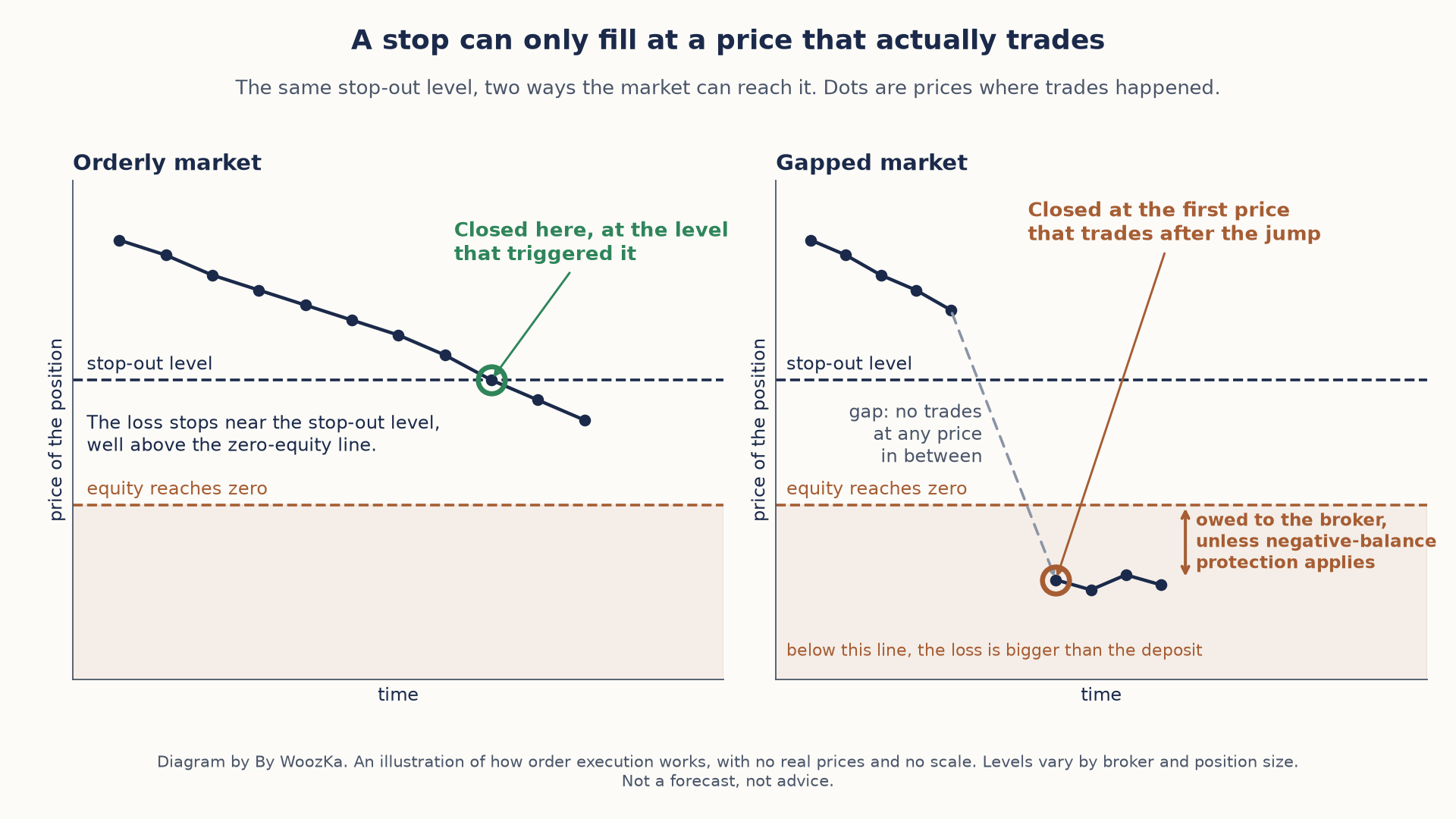
A stop-out closes the position at the next price that actually trades. When the market gaps past both the stop-out level and the point where equity hits zero, the shortfall becomes a debt unless the broker offers negative-balance protection.
This is not hypothetical. On January 15, 2015, the Swiss National Bank abandoned its cap on the Swiss franc without warning, and EUR/CHF fell more than 20% in minutes — a move many times larger than the 3.6% gap in our worked example. Retail forex broker FXCM’s customers were left with roughly $225 million in negative balances, and the firm had to arrange nearly $300 million in emergency financing (a ~$279 million loan the next day) to survive [source: CNBC, “FXCM to ‘forgive’ most clients for negative balances,” Jan 28, 2015; Forbes; GlobeNewswire, FXCM SNB flash-crash data]. FXCM later announced it would “forgive” about 90% of affected clients’ negative balances in certain jurisdictions — but notice the word forgive. That was a discretionary decision by a broker trying to keep its customers and its reputation, not a guarantee any trader was entitled to. A different broker, or a different jurisdiction, and those debts would have stood.
The lesson isn’t “this happens every week” — it doesn’t. It’s that the true worst case of a leveraged account is not “I lose my deposit.” Absent a protection you’ve confirmed you have, the worst case is “I lose my deposit and owe more.”
Negative-Balance Protection: Where You Have It, Where You Don’t
Negative-balance protection (NBP) is the policy that closes exactly this gap. With it, if your account goes negative, the broker absorbs the shortfall and resets you to zero — your maximum loss is capped at what you deposited. Without it, that shortfall is a debt you owe.
The catch is that whether you have it depends entirely on where your broker is regulated and what kind of client you are:
| Jurisdiction / regulator | Negative-balance protection for retail clients? |
|---|---|
| European Union (ESMA) | Mandatory — required by regulation for retail accounts |
| United Kingdom (FCA) | Mandatory |
| Australia (ASIC) | Mandatory |
| United States (CFTC / NFA) | Not required — offered only voluntarily, if at all; you can be liable for a deficit |
[source: ESMA / FCA / ASIC product-intervention measures requiring retail negative-balance protection; U.S. CFTC/NFA rules contain no equivalent mandate — confirm your own broker’s current policy before funding.]
Two things follow. First, a U.S. retail trader is, counter-intuitively, handed more leverage (50:1 vs. the 30:1 cap abroad) and less of this particular safety net. Second, even a broker that advertises NBP may provide it only to clients in the jurisdictions where it’s required. For example, OANDA — a broker operating in both the U.S. and Europe — provides negative-balance protection where it is mandated, such as for EU retail clients, while non-EU and professional clients are not covered by it [source: OANDA negative-balance-protection disclosures, 2026]. That is exactly why “my broker offers negative-balance protection” is not a claim to take on faith from a homepage banner.
So do this before you fund anything: find the negative-balance-protection clause in your broker’s client agreement, in writing, for your account type and country. If you can’t find it, or a support rep can’t point you to it, treat your worst case as unbounded and size accordingly. The date-stamped, broker-by-broker breakdown of who offers what — fees, regulation, and NBP included — lives in the separate Best Forex Brokers for Beginners comparison, which is the right place to check current specifics, since broker policies change.
How to Keep the Call from Ever Arriving
Everything above is the disease. Here’s the prevention. None of it is exotic; it’s the boring discipline that separates accounts that survive from accounts that don’t.
- Size positions off a risk-per-trade rule, not off the margin you’re allowed to use. The single biggest cause of margin calls is treating “I have enough margin to open this” as “I should open this.” Decide the small slice of your account you’re willing to lose if a trade hits its stop first, and let that set the position size. The position-sizing article has the arithmetic.
- Keep a deep free-margin cushion. The $600 cushion in our example is what a margin call looks like waiting to happen. Committing a small fraction of your account to margin — leaving most of it free — means an ordinary adverse move is an inconvenience, not a liquidation.
- Use a stop-loss, but respect its limits. A stop-loss caps your loss under normal conditions by closing the trade at a defined level. It does not protect you across a gap, because the price it needs simply isn’t there. A stop is necessary; it is not a force field.
- Be flat, or much smaller, around known high-impact events. Central-bank decisions, major economic releases, and surprise policy moves are where gaps live. The 2015 franc shock was a policy surprise. You cannot predict the surprises, but you can avoid holding maximum size into the scheduled events most likely to produce one.
- Confirm negative-balance protection in writing before you deposit — the step from the section above. It is the difference between a bounded and an unbounded worst case.
Notice what’s not on this list: “add more money to meet the call and hold on.” That instinct — throwing good money after a losing position to avoid taking the loss — is how a manageable loss becomes an account-ending one.
If you’ve never watched an account approach a margin call in real time, it’s worth sitting with how different it feels from the calm arithmetic on this page. On a spreadsheet, “88% of the account committed as margin” is just a number. Live, it means the balance lurches with every tick, the close-out level creeps closer on an ordinary move, and the pressure to “just add a little more to hold on” is strong exactly when doing so is most dangerous. The traders who last are the ones who never let the position get big enough for that moment to arrive.
The Prevention, Priced
The section above is the only one on this page with no arithmetic in it. It says to keep a deep free-margin cushion and to commit a small fraction of the account, and it never says what fraction, or what any fraction is worth. The worked example makes that answerable, because everything the question needs is already printed here: a $5,000 account, EUR/USD at 1.1000, a 50:1 cap, and 88% of the balance committed as margin. Hold the first three still, vary the last, and the prevention list turns into three tables.
How Much Warning the Cushion Actually Buys
Two distances matter once a position is open: how far the market can move before the call arrives, and how far before the account is empty. The example above prints both — 30 pips and 250 pips — a few lines apart, and never sets one against the other.
| Committed | Cushion | To the call | To zero | Warning |
|---|---|---|---|---|
| 88% | $600 | 30 pips | 250 pips | 12% |
| 70% | $1,500 | 94 pips | 314 pips | 30% |
| 50% | $2,500 | 220 pips | 440 pips | 50% |
| 30% | $3,500 | 513 pips | 733 pips | 70% |
| 20% | $4,000 | 880 pips | 1,100 pips | 80% |
| 10% | $4,500 | 1,980 pips | 2,200 pips | 90% |
| 5% | $4,750 | 4,180 pips | 4,400 pips | 95% |
The first row is this article’s own position, reproduced: $600 free, 30 pips of room, 250 pips to an empty account. The last column is what falls out of putting the two together. The share of the move you get as warning is exactly the share of the account you did not commit. Commit 88% and the call lands 12% of the way to zero; the remaining 88% of that journey happens after the call, with the cushion already gone. Commit a fifth and four-fifths of the road is behind you before the call arrives. The ratio is the untouched fraction and nothing else — the deposit cancels out of both distances, so a bigger account buys no extra warning at all if the position grows with it.
Why Halving the Position More Than Doubles the Room
“Keep a deep cushion” reads like a linear instruction: commit less, get proportionally more room. It is not linear, and the curvature runs the trader’s way.
| Committed | Room now | Room at half | Multiplier |
|---|---|---|---|
| 88% | 30 pips | 280 pips | 9.33× |
| 70% | 94 pips | 409 pips | 4.33× |
| 50% | 220 pips | 660 pips | 3.00× |
| 30% | 513 pips | 1,247 pips | 2.43× |
| 20% | 880 pips | 1,980 pips | 2.25× |
Halving the committed fraction always more than doubles the cushion, at every level, and the payoff is largest exactly where the account is most committed. Cutting this article’s own position in half — from 88% of the balance to 44% — moves the cushion from 30 pips to 280, a factor of 9.33 for a single halving. The same halving further down costs the identical half of the position and returns 2.25. Both halvings give up the same share of the trade; they do not buy the same thing, and the one that feels most expensive is the one that buys most.
Where the Loss Stops Being a Loss
The franc-shock section reports EUR/CHF falling more than 20% in minutes, and the worked example stops at a 400-pip gap. Applying a move of that magnitude to the EUR/USD position the rest of the page is built on prices the sentence the negative-balance section ends on — treat the worst case as unbounded and size accordingly.
| Committed | A debt starts at | Owed after a 20% gap |
|---|---|---|
| 88% | 250 pips | $39,000 |
| 50% | 440 pips | $20,000 |
| 30% | 733 pips | $10,000 |
| 20% | 1,100 pips | $5,000 |
| 10% | 2,200 pips | nothing — the deposit exactly |
| 5% | 4,400 pips | nothing — $2,500 survives |
At the 88% of the worked example, a gap on that scale leaves the trader owing $39,000 — 7.8 times the deposit, on top of losing the deposit — unless negative-balance protection absorbs it. That is the unbounded worst case with a number on it. The 10% row is exact rather than approximate: committing a tenth of the balance is the point at which a 20% gap costs the whole deposit and not one dollar more, and below it the same shock leaves money in the account. None of that is a rule to adopt, and nothing here predicts a shock or says one is due; it is what this article’s own worst case works out to once the two halves of it are multiplied together.
Method and limits, so this can be checked rather than taken on trust. No calculator on this site computes a margin-call distance, so nothing above comes from a shipped tool; every figure is arithmetic on numbers this article already publishes, computed in code and checked before publication, with the article’s own $4,400 of margin, $600 cushion, $20 per pip, 30 pips, 250 pips, 2.3%, 3.6% and $3,000 deficit all asserted before anything else is allowed to print. The model is the one stated above: margin is fixed when the position opens, equity falls with the loss, and the call lands when the free-margin cushion is exhausted — a margin level of 100%. Real call and stop-out levels are broker-set and frequently trigger earlier, which shortens every distance in the first table rather than lengthening it. The 20% figure is the magnitude of the 2015 franc move applied to the EUR/USD position used throughout, not a calculation about EUR/CHF, and it assumes the gap defeats the stop-out entirely, which is the scenario this article describes. Spread, swap and commission are left out, and each of them makes the real cushion smaller than the table shows.
Common Misconceptions About Margin Calls
- “A margin call gives me time to decide.” Often it doesn’t. Many platforms auto-liquidate at a stop-out level with no human involvement and no waiting period. Assume the response is automatic and immediate.
- “The worst I can lose is my deposit.” Only if you’ve confirmed you have negative-balance protection. Without it, a gap can leave you owing the broker — as roughly $225 million in FXCM client deficits showed in 2015.
- “A stop-loss guarantees my maximum loss.” A stop-loss defines your exit level under orderly conditions, but it can’t fill at a price that never traded during a gap. It reduces risk; it doesn’t remove it.
- “I’ll just add cash to meet the call and wait for it to come back.” This adds money to a losing position at the worst possible moment and can turn a survivable loss into a ruinous one. Meeting a call is a decision to increase your commitment to a trade that is already going against you.
- “More leverage protects me from margin calls because it needs less margin.” Backwards. Higher available leverage lets you open a bigger position on the same deposit, which shrinks your cushion and makes a call more likely, not less. Margin calls are avoided by small positions, not big leverage.
Where to Go Next
A margin call is the mechanism that turns a bad trade into a wiped-out account, so understanding it is really about learning to build an account it can’t reach:
- How Forex Trading Actually Works: A Beginner’s Guide to Currency Pairs — the pillar: pairs, pips, lots, and the base margin math.
- Leverage in Forex: Why It Cuts Both Ways — why the broker’s leverage number is a ceiling, not a target, and why losses don’t climb back symmetrically.
- Position Sizing in Forex: The Math That Keeps You in the Game — how to turn a risk-per-trade rule into a lot size that leaves a real cushion.
- Futures Contracts 101: What They Are and Who Trades Them — daily mark-to-market and the calls it drives in exchange-traded futures.
- Best Forex Brokers for Beginners: Fees, Regulation, and Execution Compared — the date-stamped breakdown of who offers negative-balance protection.
If you want markets explained plainly — risk-first, never hyped — that’s what the newsletter is for. Subscribe below.
Disclaimer: This article is educational content, not financial advice. I am not a licensed financial advisor, and nothing here is a recommendation to buy or sell any security or asset. Investing and trading involve risk, including the possible loss of the money you invest. Do your own research and consider consulting a licensed financial professional before making investment decisions. Read the full Disclaimer.
Historical and backtested results are hypothetical, carry inherent limitations, and do not guarantee future results. Figures were accurate to the best of my knowledge as of this article’s last-updated date and may have changed.
