Major, Minor, and Exotic Currency Pairs Explained
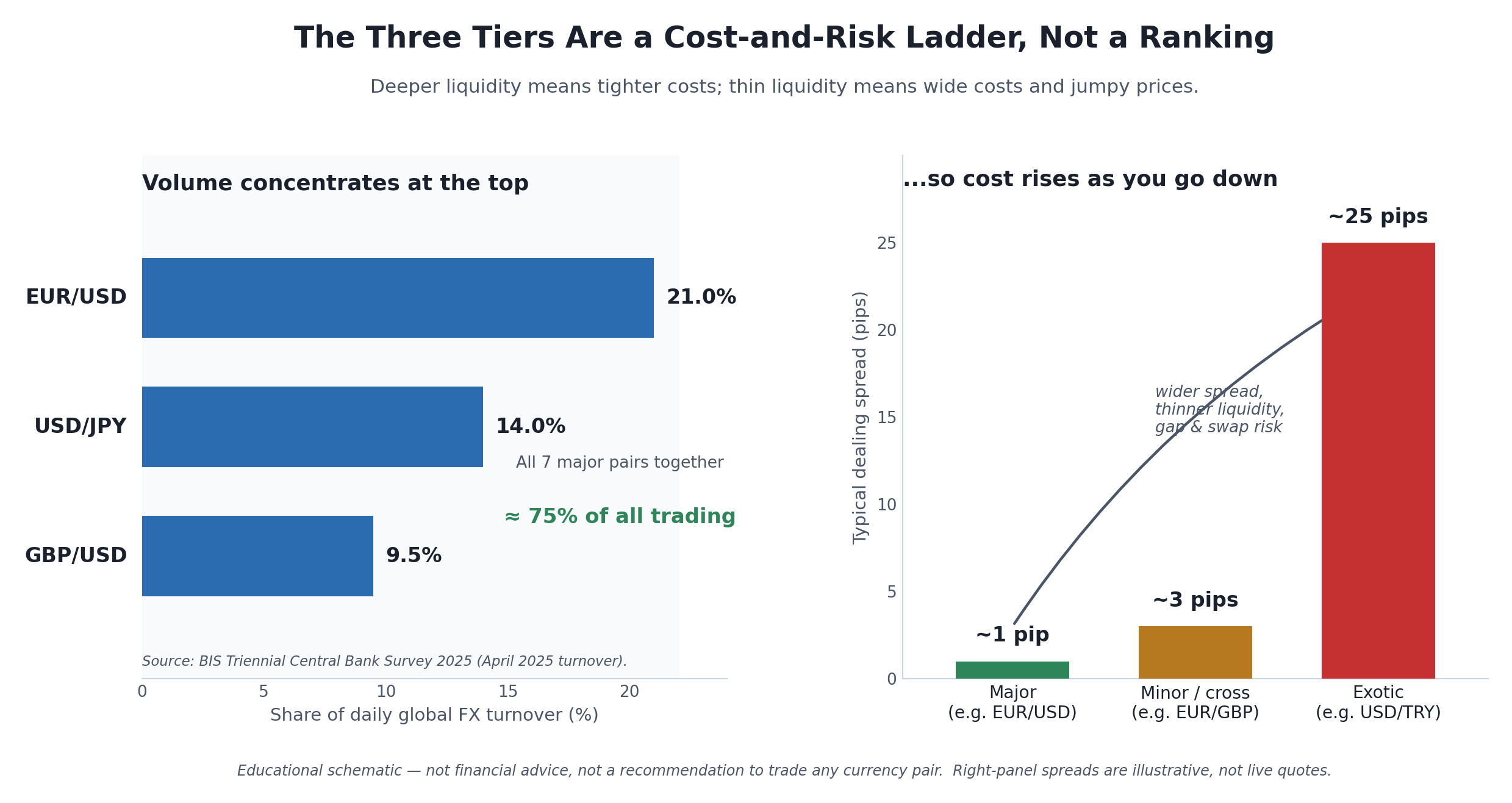 The whole article in one picture. Left: real survey data showing that a few major pairs carry most of the world’s currency trading. Right: an illustrative view of why that matters — the less a pair is traded, the more it costs you to trade it, and the more violently its price can jump.
If you have spent any time reading about forex, you have met the labels: majors, minors, and exotics. They get thrown around as if everyone already knows what they mean, and a lot of beginner content treats them like tiers of prestige — as though “graduating” to exotic pairs is a sign you have arrived. That framing is backwards, and it gets people hurt.
The three groups are really a cost-and-risk ladder. As you move down from majors to minors to exotics, two things happen at once: the pairs get less liquid, and everything about trading them gets more expensive and more unpredictable. This matters in a market where roughly 74% to 89% of retail forex and CFD accounts lose money [source: ESMA product-intervention retail account disclosures; figure updated periodically per broker], because trading costs and price gaps are a big part of why they lose. Understanding the ladder won’t make you a winning trader — the pillar, How Forex Trading Actually Works, is blunt about how hard that is — but it will keep you from starting on the most treacherous rung by accident.
To put the scale in perspective: the global currency market traded about $9.6 trillion per day in April 2025, with the U.S. dollar on one side of 89% of all trades [source: BIS Triennial Central Bank Survey 2025, published Sep 30, 2025]. That dollar dominance is the thread that ties this whole classification together.
First, a Quick Refresher: How to Read a Pair
Every forex trade is a quote of one currency against another, written as a pair like EUR/USD. The first currency is the base; the second is the quote (or counter) currency. The price tells you how many units of the quote currency it takes to buy one unit of the base [source: standard FX market convention; Babypips Forexpedia]. If EUR/USD is trading at 1.1000, one euro costs 1.10 U.S. dollars. When the number rises, the base (the euro) is strengthening against the quote (the dollar); when it falls, the base is weakening.
That is all you need to decode any pair. The three tiers below are just groupings of these pairs by which currencies are involved and how heavily they’re traded — and, as we’ll see, “how heavily they’re traded” quietly determines almost everything that matters to your wallet.
Tier 1: The Majors — Where the Liquidity Lives
Major pairs always include the U.S. dollar on one side, matched against another large, freely traded currency [source: standard FX classification; Kinesis, Equiti currency-pair guides]. There is no official list handed down by a regulator, but the industry near-universally counts seven as the majors:
- EUR/USD — the euro vs. the dollar. Nicknamed “Fiber.” By far the most-traded pair on earth.
- USD/JPY — the dollar vs. the Japanese yen. Nicknamed “Gopher.”
- GBP/USD — the British pound vs. the dollar. Nicknamed “Cable,” after the transatlantic telegraph cable that once carried the quote between London and New York.
- USD/CHF — the dollar vs. the Swiss franc. Nicknamed “Swissie.”
- AUD/USD — the Australian dollar vs. the dollar. Nicknamed “Aussie.”
- USD/CAD — the dollar vs. the Canadian dollar. Nicknamed “Loonie,” after the bird on Canada’s one-dollar coin.
- NZD/USD — the New Zealand dollar vs. the dollar. Nicknamed “Kiwi.”
The nicknames are just trading-desk shorthand, but they’re worth knowing because you’ll see them constantly in commentary. What actually sets the majors apart is liquidity — the sheer volume of buyers and sellers standing ready at any moment. In the 2025 BIS survey, EUR/USD alone accounted for about 21% of all global FX turnover (roughly $2.0 trillion a day), USD/JPY about 14%, and GBP/USD (“Cable”) close to 9.5% [source: BIS Triennial Central Bank Survey 2025]. Taken together, the seven majors are commonly estimated at roughly three-quarters of all forex trading volume [source: industry aggregates of BIS turnover data; LiteFinance, Saxo major-pairs guides].
That deep liquidity buys you three concrete things: the tightest spreads (the gap between the buy and sell price, which is your main cost), the most reliable execution (your order fills near the price you saw), and prices that generally move in a continuous stream rather than lurching. None of that makes majors “safe” — leverage can wipe out an account trading EUR/USD just fine — but it makes them the cheapest and most predictable pairs to trade, which is a real advantage for a beginner who is already fighting the odds.
Tier 2: The Minors — Crosses Without the Dollar
Minor pairs, also called “crosses,” pair two major currencies with each other but leave the U.S. dollar out [source: standard FX classification; Babypips, Equiti]. Common examples:
- EUR/GBP — euro vs. pound
- EUR/JPY — euro vs. yen
- GBP/JPY — pound vs. yen (volatile enough to earn the nickname “The Beast” or “The Dragon” on some desks)
- EUR/CHF, AUD/JPY, NZD/CAD, and dozens of other combinations of the majors
The name “cross” is a historical artifact. For much of the twentieth century, converting, say, pounds into yen meant routing through the dollar in two steps (GBP→USD, then USD→JPY). A direct GBP/JPY quote let you cross the dollar out of the middle — hence “cross rate.” Today most crosses are quoted directly, but the label stuck.
Because they skip the world’s most-demanded currency, crosses are less liquid than the majors but far more liquid than exotics. Practically, that means wider spreads than a major — you pay a bit more to get in and out — and sometimes chunkier moves, since there are fewer participants to absorb a large order. EUR/GBP is calm and heavily traded; GBP/JPY can swing hard. The minors are a legitimate step for a trader who understands the majors and wants exposure to a specific relationship (say, a view on the euro relative to the pound rather than the dollar) — but they are a step down the liquidity ladder, and you feel it in the cost.
Tier 3: The Exotics — Where the Costs and the Risks Balloon
An exotic pair matches one major currency with the currency of a smaller or emerging-market economy [source: standard FX classification; Kinesis, Narvi currency-pair guides]. Examples include:
- USD/TRY — dollar vs. Turkish lira
- USD/ZAR — dollar vs. South African rand
- USD/MXN — dollar vs. Mexican peso
- EUR/PLN — euro vs. Polish zloty
- USD/HUF — dollar vs. Hungarian forint
- and pairs involving the Brazilian real, Indonesian rupiah, Chilean peso, and other developing-market currencies.
Exotics are where beginners most often get an expensive surprise, because on a chart an exotic can look thrilling — big daily ranges, dramatic trends, and often a large interest-rate gap that promises “carry.” Underneath, though, exotics stack up several disadvantages at once:
1. Spreads are wide — often several times a major’s, sometimes far more. Because so few participants trade these pairs, the buy/sell gap is much larger. It’s common to see exotic spreads that are two or three times the spread on EUR/USD or USD/JPY [source: Babypips, Equiti], and for the thinnest exotics the gap can be an order of magnitude wider. That cost is paid on every single trade, in both directions.
2. Liquidity is thin, so prices gap and slip. A major pair usually fills cleanly at the price you see; an exotic can have wide spreads and shallow depth, meaning a modest order moves the price and your fill can land well away from your intended level [source: industry liquidity commentary; onsafx, VT Markets execution guides]. In fast conditions the price can jump — skipping right over a stop-loss — rather than sliding smoothly through it.
3. Overnight (swap) costs can be brutal. Holding a position past the daily rollover accrues a swap charge based on the interest-rate difference between the two currencies. On high-rate exotics that swap can be large, and on the day brokers book triple swap (often Wednesday), it can erase a chunk of the position’s gains in a single rollover [source: broker swap/rollover documentation; FXNX, Switch Markets swap guides, 2026]. The very rate gap that makes an exotic look attractive is also what makes carrying it expensive when the trade runs against you.
4. The underlying currency can simply keep falling. Emerging-market currencies can be subject to high inflation, capital controls, and chronic devaluation. The Turkish lira is the textbook cautionary tale: it has depreciated by more than 20% against the dollar in some recent years amid inflation running around 30%+ [source: reporting on Turkish lira and inflation, 2024–2025; the exchange rate and the inflation rate both keep moving, so check current readings before relying on these]. A beginner who bought lira “because the yield is huge” can watch the currency’s decline swamp any interest they earned — a slow bleed on top of the wide spreads and gap risk.
5. Exotics are hypersensitive to politics and headlines. With fewer participants and less depth, a single central-bank surprise, election, or geopolitical shock can move an exotic violently [source: Kinesis, Narvi currency-pair guides]. That’s the “excitement” — and it’s exactly the kind of unpredictable, discontinuous move that punishes leverage hardest.
None of this means exotics are illegitimate; experienced, well-capitalized traders trade them deliberately, with the costs and risks priced in. It means they are the worst possible place for a beginner to learn, because every mistake costs more and every stop is less reliable.
The Regulators Grade Them the Same Way You Should
Here is the clearest evidence that the three tiers really are a risk ladder and not a prestige ranking: financial regulators cap leverage lower on the riskier tiers. They are, in effect, publishing their own risk rankings of these pairs.
In the European Union, ESMA’s rules cap retail leverage at 30:1 on major currency pairs and step it down to 20:1 on non-major (minor and exotic) pairs — part of a tiered schedule that goes all the way down to 2:1 on crypto [source: ESMA product-intervention measures on CFDs; ESMA FAQ]. In the United States, the CFTC and NFA cap retail forex leverage at 50:1 on major currency pairs and 20:1 on everything else [source: NFA Forex Regulatory Guide; CFTC retail forex rule]. (These are the caps as documented through this article’s last-updated date; regulatory limits change, so confirm the current figure for your jurisdiction and broker.)
Read that plainly: the authorities whose job is to protect retail traders have decided that minors and exotics are risky enough to warrant less leverage than majors. When the rulebook itself treats the tiers as a risk ladder, a beginner reading “exotic pairs are for advanced traders” should take it literally, not as a challenge to level up.
What That Cap Is Worth, Counted in Rungs
I bought a $6,000 EA product and ran it on MetaTrader 4 and 5. It used martingale — up to seven times, nine at most, doubling each time. I ran it on GBPAUD, in a personal account, at 200:1 with an offshore broker. On September 23, 2022, in the British pound selloff, it wiped out my 100K account.
Every element of that sits on the ladder this article has just described. GBPAUD is a cross — tier 2, a minor — so the regulated ceiling for it is 20:1 in both the United States and the European Union, not the 50:1 or 30:1 a major would carry. Going offshore replaced a 20:1 ceiling with 200:1. The section above says the caps are the clearest evidence the tiers are a risk ladder and asks you to read that plainly. Reading it plainly turns out to mean arithmetic, and the arithmetic is unusually clean, because a doubling system has an exact size at every step. Everything below was worked through in code.
A Cap Does Not Limit Your Position. It Limits How Many Times You Can Double.
A martingale opens a position, and if price goes against it, opens another at twice the size, and repeats. After n steps the total on the table is 2ⁿ − 1 times the opening size. That grows fast enough that the broker’s margin requirement, not the trader, decides where the ladder stops. Taking the opening position as equal to the account — a reference case, since the opening size is a separate choice — each ceiling funds this many rungs:
| Ceiling | Where it applies | Rungs funded | Total exposure |
|---|---|---|---|
| 20:1 | Non-major — GBPAUD’s tier | 4 | 15× |
| 30:1 | ESMA, major | 4 | 15× |
| 50:1 | NFA, major | 5 | 31× |
| 200:1 | Offshore | 7 | 127× |
| 400:1 | Offshore | 8 | 255× |
| 800:1 | Offshore | 9 | 511× |
The right-hand columns move very differently, and that is the first result. Each doubling of the ceiling buys exactly one extra rung — verified from 25:1 through 800:1 — because the ladder needs two-to-the-n while leverage supplies only its logarithm. So moving from the regulated 20:1 to 200:1 was ten times the leverage and bought three rungs. Across every opening size from 0.01× to 3.99× the account, the gain is always three rungs, occasionally four, and never more, since the base-2 logarithm of ten is 3.3219. That bound holds without knowing the opening size, which is why it is the figure worth carrying.
Each Rung Roughly Halves the Move You Can Survive
The companion article Leverage in Forex: Why It Cuts Both Ways establishes the rule that at leverage L an adverse move of 1 ÷ L ends the account. What a martingale adds is that it manufactures its own L: the trader never selects 127:1, the ladder assembles it one rung at a time.
| Rungs | Effective leverage | Move that ends it | vs. previous rung |
|---|---|---|---|
| 3 | 7× | 14.286% | — |
| 4 | 15× | 6.667% | 0.467× |
| 5 | 31× | 3.226% | 0.484× |
| 6 | 63× | 1.587% | 0.492× |
| 7 | 127× | 0.787% | 0.496× |
| 8 | 255× | 0.392% | 0.498× |
| 9 | 511× | 0.196% | 0.499× |
The last column converges on one half and never reaches it, and there is an identity underneath: each rung is exactly one opening-unit larger than every rung before it combined. The final step is therefore always just over half the total commitment, so adding one rung nearly halves the move the account can absorb. Nine rungs is not a slightly bolder version of seven. It is the difference between needing a 0.787% move to be finished and needing 0.196%.
The Week It Actually Happened
GBPAUD is not quoted directly by a central bank, but it can be derived exactly from two that are: the European Central Bank publishes daily euro reference rates for both sterling and the Australian dollar, and their ratio is the cross. Through that week it read 1.70074 on September 22, 1.68116 on September 23 — a fall of 1.151% — and 1.65330 by September 28, giving 3.23% peak to trough from the 15th [source: European Central Bank daily euro foreign-exchange reference rates, series EXR/D.GBP.EUR.SP00.A and EXR/D.AUD.EUR.SP00.A; GBPAUD derived as the ratio]. Set that against each ceiling:
| Ceiling | Rungs | Ends at | Sept 23, −1.151% | The week, −3.23% |
|---|---|---|---|---|
| 20:1 | 4 | 6.667% | Survives | Survives |
| 30:1 | 4 | 6.667% | Survives | Survives |
| 50:1 | 5 | 3.226% | Survives | On the line |
| 200:1 | 7 | 0.787% | Wiped | Wiped |
The day’s move lands between the two: 1.151% is comfortably below the 6.667% that four rungs absorb and comfortably above the 0.787% that seven can. So the three rungs the regulated ceiling would have withheld are precisely the difference between surviving that week and not. That is what the section above is asserting when it says the regulators have published their own risk ranking — on this pair, in that week, the ranking was worth the account.
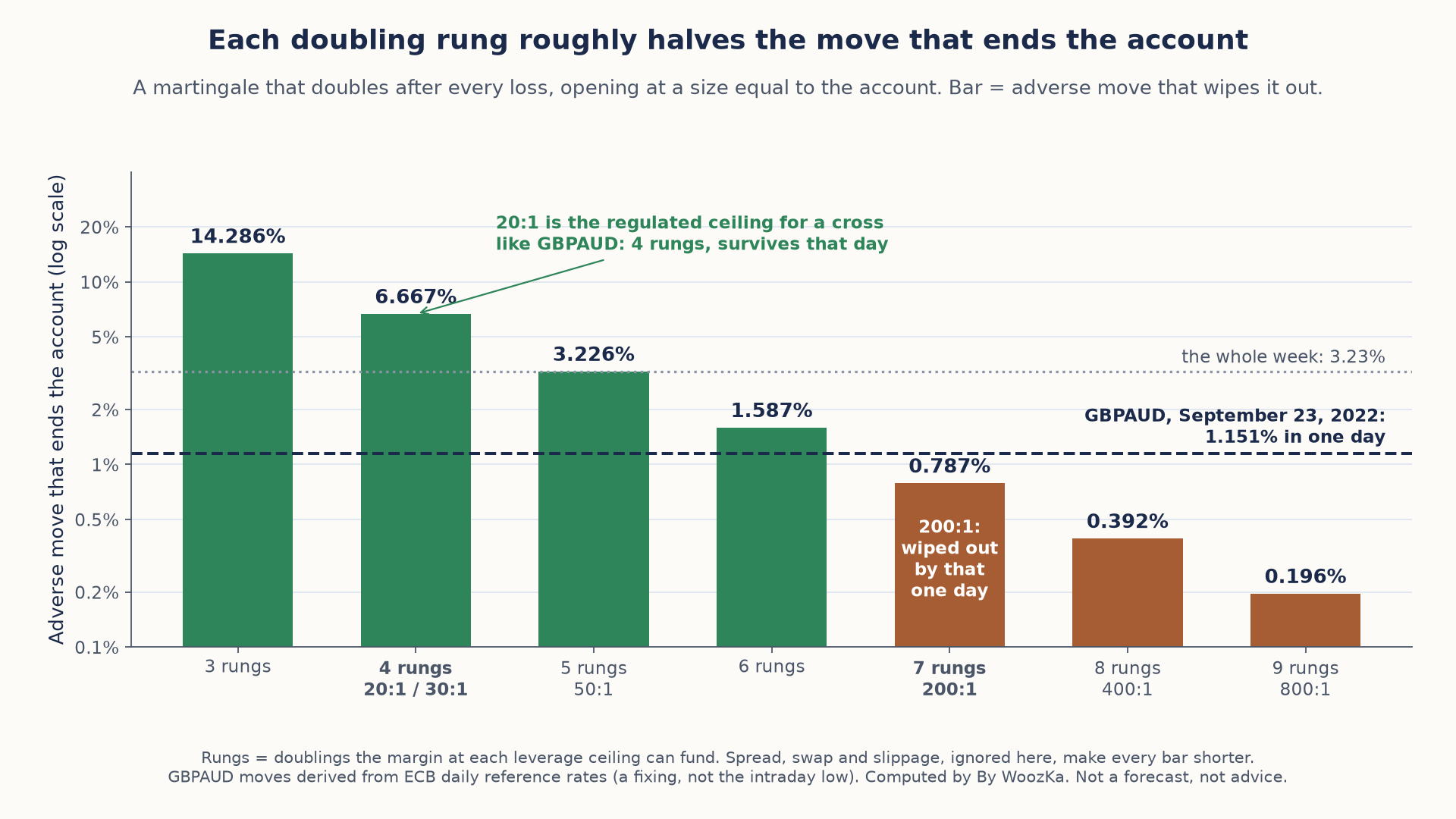 Each extra doubling roughly halves the move an account can survive, so the three rungs a 200:1 offshore ceiling adds over the regulated 20:1 are exactly what turned an ordinary 1.151% day into a wipeout.
Three things follow, and they are worth keeping apart:
- The tier set the ceiling. GBPAUD is a cross, so its regulated ceiling is 20:1 rather than a major’s 50:1 — and at 50:1 the same ladder survives the day but sits almost exactly on the line for the week. The tier was not a label; it was three rungs of margin.
- The move was not large. September 2022 is remembered for sterling against the dollar, where the move was far bigger. Against the Australian dollar it was 1.151% in a day. A ladder at 127× does not need a famous crash; it needs about one percent.
- None of this makes a martingale survivable at 20:1. Four rungs absorb 6.667%, which is larger than this particular week and smaller than plenty of others. A lower ceiling buys rungs, not immunity, and the arithmetic above prices exactly one episode rather than the strategy.
Method and limits, so this can be checked rather than taken on trust. Every figure was computed in code using exact fractions, with each result checked before it appears here. The ceilings are this article’s own published table. The multiplier, the rung counts, the 200:1 and the pair are the site owner’s own account of what he ran, used as given. The GBPAUD levels are derived from ECB daily reference rates, which are a 14:15 CET fixing and therefore not an intraday low — the true low on the day was worse than 1.151%, by an amount this analysis does not know. Several things are deliberately not computed because they were not known: the opening lot size, so it is swept and the headline bound is the one that does not depend on it; the spacing between rungs, so no pip distance to ruin is calculated; and which rung the account actually died on, which is not asserted anywhere. The “ends at” column is the move that exhausts equity against the fully extended ladder and ignores spread, swap and slippage, all of which make the real figure smaller and all of which this article argues are worse on a cross than on a major. Nothing above is a forecast, no broker, product or jurisdiction is recommended, and no trade of any kind is suggested.
A Beginner Watching an Exotic Quote for the First Time
Picture someone new who has just learned all this, watching a live exotic quote for the first time. They pull up USD/TRY next to EUR/USD, expecting them to feel similar. Instead the exotic’s buy and sell prices sit noticeably far apart, the number twitches in visible jumps instead of a smooth stream, and when they read the overnight financing line they realize that simply holding the position costs money every night. The “opportunity” they’d read about — the big trend, the fat interest rate — is still there on the chart, but now they can see the toll booth attached to it. That single side-by-side comparison teaches the ladder better than any article can: the exciting pair is exciting precisely because it is thin, and thin is expensive.
Common Misconceptions About Currency-Pair Tiers
- “Exotic pairs are the advanced, high-reward tier you graduate to.” They are the high-cost, high-risk tier. Wider spreads, thinner liquidity, gap risk, and heavy swap charges make them harder to trade profitably, not easier — which is why regulators cap their leverage lower.
- “A minor pair is riskier than a major because it has no dollar.” Not because of the missing dollar itself, but because fewer people trade it, so its spreads are wider and its moves can be choppier. It’s a liquidity story, not a patriotism story.
- “A big interest-rate gap on an exotic is basically free yield.” The swap you collect can be swamped by a wide spread, a currency that keeps devaluing, and a violent unwind when sentiment turns. High carry usually comes attached to high risk — that’s why the yield is high.
- “Spread doesn’t matter much; I’m after the big move.” Spread is a cost you pay on every trade, entry and exit. On exotics it can be several times a major’s, quietly taxing every position before the “big move” even has a chance to happen.
- “The majors are the safe pairs.” Tighter cost and deeper liquidity are real advantages, but safe is the wrong word. Leverage can wipe out an account trading EUR/USD as surely as one trading USD/TRY. The tiers rank cost and liquidity, not whether you can lose money — you always can.
Where to Go Next
Currency-pair tiers are the map; the rest of this cluster is how to navigate it without getting hurt:
- How Forex Trading Actually Works: A Beginner’s Guide to Currency Pairs — the pillar: pips, lots, margin, and the full, loss-rate-first risk picture.
- Leverage in Forex: Why It Cuts Both Ways — why the leverage caps above exist, and how a small adverse move becomes a total wipeout.
- What Moves Currency Prices? Interest Rates, Inflation, and Central Banks — the forces behind the moves you’ll see in every tier, and why knowing them still isn’t a crystal ball.
- Position Sizing in Forex: The Math That Keeps You in the Game — how to size a trade so a wide-spread, gap-prone pair can’t take you out in one shot.
If you want markets and currencies explained plainly — risk-first, never hyped — that’s what the newsletter is for. Subscribe below.
Disclaimer: This article is educational content, not financial advice. I am not a licensed financial advisor, and nothing here is a recommendation to buy or sell any security or asset. Investing and trading involve risk, including the possible loss of the money you invest. Do your own research and consider consulting a licensed financial professional before making investment decisions. Read the full Disclaimer.
Historical and backtested results are hypothetical, carry inherent limitations, and do not guarantee future results. Figures were accurate to the best of my knowledge as of this article’s last-updated date and may have changed.
