Emergency Fund Math: How Many Months of Expenses Do You Actually Need?
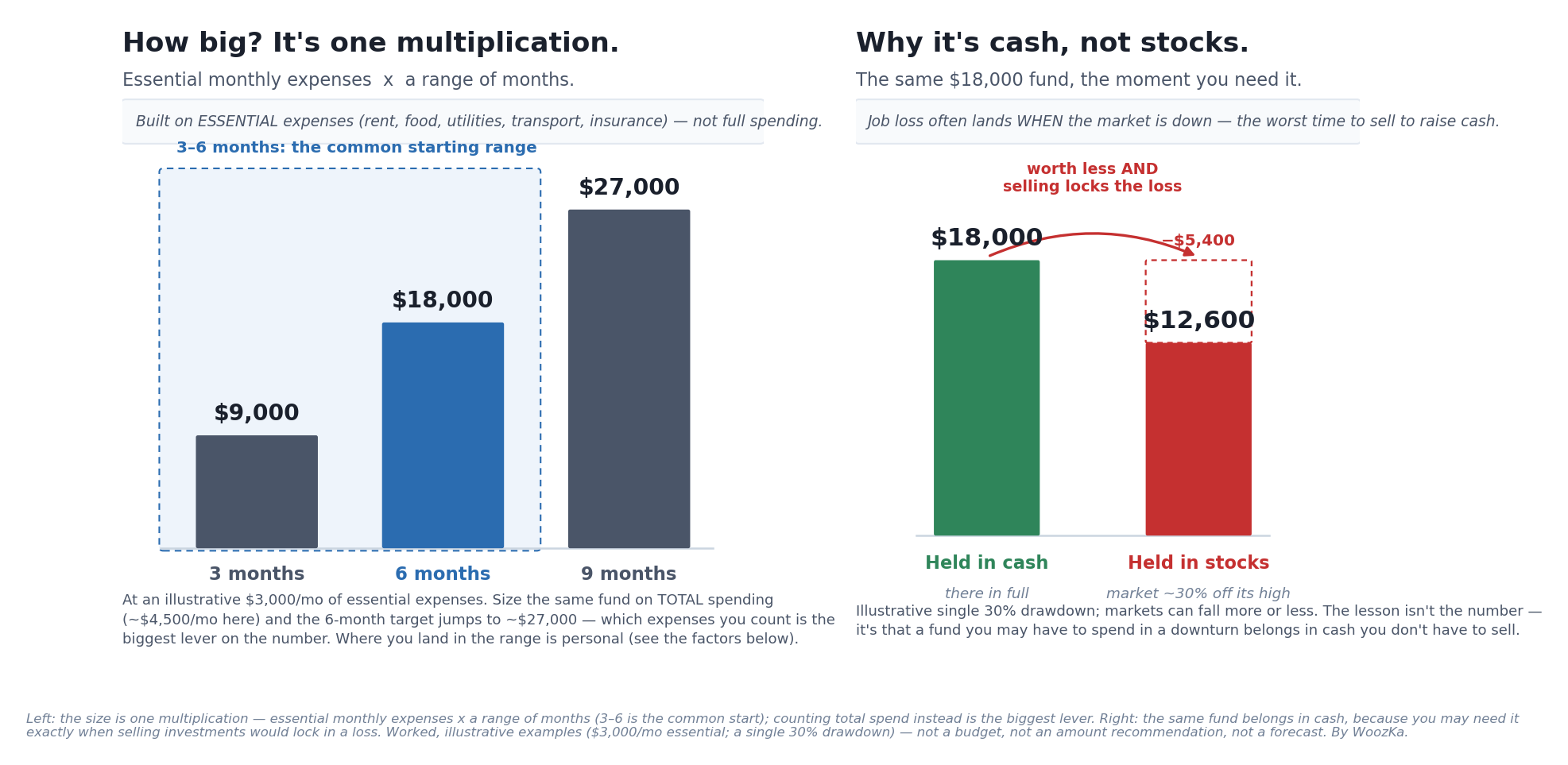 Left: sizing an emergency fund is one multiplication — essential monthly expenses times a range of months. On an illustrative $3,000/month of essentials, 3–6 months is $9,000–$18,000; where you land in the range is personal. Right: the same $18,000 fund belongs in cash, because the moment you need it often coincides with a market drop, and an “invested” emergency fund can force you to sell at a loss. Both panels are illustrative examples built from the figures below — not your budget, and not a recommendation of any specific amount.
“How much emergency fund do I need?” is one of the most-Googled questions in personal finance, and it has a frustrating real answer: it depends, but the math is simple. The sizing itself is one multiplication. The two decisions that actually change your number — which expenses you count, and where you keep the money — are where almost everyone gets it slightly wrong, in ways that quietly cost real dollars. This is the “secure the base” step the rest of investing assumes: the cash cushion that lets you keep your long-term money invested through a rough patch instead of selling it at the worst possible time.
This is foundational money literacy, not personal financial planning. Nothing here tells you what your number should be, which account to open, or what to do with your savings — it hands you the arithmetic and the ranges so you can run the math yourself. Let’s do exactly that.
The One-Sentence Version
An emergency fund is a pile of cash equal to your essential monthly expenses multiplied by a number of months — commonly 3 to 6 — kept somewhere you can reach it instantly, so an unexpected expense or income gap doesn’t force you into debt or into selling investments at a loss.
That’s the whole idea. The rest of this article is the two questions hiding inside that sentence: what counts as “essential monthly expenses,” and how many months is right for you.
What an Emergency Fund Actually Is (and Isn’t)
An emergency fund is self-insurance. You are setting aside money today so that a future shock — a job loss, a medical bill, a car repair, a broken furnace — is an inconvenience instead of a crisis. Its entire job is to be available and stable at the exact moment things go wrong.
That definition rules two things out. First, it is not an investment. You are not trying to grow this money; you are trying to guarantee it’s there. (Cash is not free of every risk — over years, inflation erodes its purchasing power, which we’ll deal with head-on below — but it won’t be down 30% on the Tuesday you get laid off.) Second, it is not your long-term savings or your down-payment fund. Mixing goals is how an “emergency fund” quietly gets spent on a vacation and isn’t there when a real emergency arrives. On your personal balance sheet, the emergency fund is a liquid asset whose purpose is to protect all your other plans — the counterpart to the high-interest debt that sits on the other side of the ledger (see Assets vs Liabilities).
Step 1: Build It on Essential Expenses, Not Total Spending
The single biggest lever on your emergency-fund number isn’t the number of months — it’s which expenses you’re counting.
Your emergency fund is meant to cover what you’d still have to pay if your income stopped tomorrow: rent or mortgage, groceries, utilities, transportation, insurance, minimum debt payments, and essential medical costs (the Consumer Financial Protection Bureau frames the target around exactly these “essential” or “must-pay” expenses) [source: Consumer Financial Protection Bureau, “An essential guide to building an emergency fund,” 2026 — consumerfinance.gov]. It is not meant to fund your normal lifestyle indefinitely. In a genuine emergency, the streaming subscriptions, restaurant meals, and travel pause — so they don’t belong in the number you have to save up first.
Watch how much this matters. Take the illustrative figures in the chart’s left panel: if your total monthly spending is about $4,500 but your essential spending is about $3,000, then a six-month fund is $18,000 built on essentials versus $27,000 built on total spending [author’s own calculation; illustrative]. That’s a $9,000 difference — and the $18,000 version is not only more achievable, it’s the more correct target, because $18,000 genuinely covers six months of the bills you couldn’t skip. Sizing your fund on essentials makes the goal both smaller and more accurate at the same time.
Practical way to find your number: add up the bills that would still arrive if your paycheck stopped. That essential monthly figure is the thing you multiply.
Step 2: Pick Your Range — and Why “3 to 6 Months” Is a Range, Not a Rule
What the range costs in time, which the advice rarely mentions: take essential expenses of $3,000 a month, so a three-month fund is $9,000 and a six-month fund is $18,000. Saving $400 a month into an account paying 4%, the three-month fund is full at month 22 — a little under two years. The six-month fund is not twice that; it lands at month 42, about three and a half years. That is the real decision hiding inside “three to six months”: not how much cash you want, but how many years you are willing to spend accumulating it while the rest of your plan waits. Run your own essentials and savings rate through the Compound Growth Calculator before picking a number off a rule of thumb.
The classic guidance is to hold three to six months of essential expenses. That’s the widely-taught convention, and the CFPB presents it explicitly as a range tied to your circumstances rather than a one-size-fits-all number [source: Consumer Financial Protection Bureau, 2026]. On the illustrative $3,000/month of essentials, that’s roughly $9,000 to $18,000 — the shaded band in the chart.
But three to six months is a starting range, not your answer. Where you land inside it — or above it — depends on how stable your income is and how many people depend on it. Factors that push toward the higher end (six months or more):
- Variable or single income. Self-employed, commission-based, gig, or freelance income — or a household that runs on one paycheck — has less of a buffer built in, so a bigger cash cushion does more work.
- Dependents. More people relying on your income raises the cost of a gap.
- A specialized or slow-to-replace job. If your role would take many months to re-fill at a similar salary, a longer runway matters more.
- Higher fixed obligations or health risk. Large non-negotiable bills, or ongoing medical needs, argue for more.
Factors that can justify the lower end (closer to three months): two stable incomes, an in-demand skill set, low fixed costs, or other genuinely liquid resources you could tap. The point of listing these is not to hand you a formula — it’s to show that the “right” figure is genuinely personal, and that reasonable people with different lives land in different places within (and sometimes beyond) the range. Only you can set your own number; this article gives you the inputs, not the answer.
What the Data Says About Who Actually Has One
Emergency funds are widely recommended and, in practice, widely thin — which is exactly why the topic matters.
According to the Federal Reserve’s Survey of Household Economics and Decisionmaking (SHED), in the 2025 report released May 13, 2026, 63% of adults said they could cover a hypothetical $400 emergency expense entirely with cash or its equivalent (cash, savings, or a credit card paid off at the next statement). That share was unchanged from the previous three years and down from a high of 68% in 2021 — meaning roughly 37% could not fully cover even a $400 surprise from cash [source: Federal Reserve, “Economic Well-Being of U.S. Households in 2025,” released May 13, 2026; the 13th annual SHED, surveying nearly 13,000 adults in October 2025 — federalreserve.gov; confirm the current year’s figures, they’re updated every May].
Zoom out from $400 to a real cushion and the picture thins further: in the same survey, 55% of adults said they had set aside three months of expenses in an emergency or “rainy day” fund — unchanged from 2024 and down from a 59% high in 2021 [source: Federal Reserve SHED 2025, released May 2026 — confirm current; this comes from the same annual survey as the figure above]. So a little under half of adults did not have even a three-month cushion. If you’re building one, you’re doing something a large share of households haven’t managed to — and the size of that gap is the reason this unglamorous, boring pile of cash is one of the highest-leverage things in personal finance.
Why the Fund Is Cash, Not Investments
Here’s the part people talk themselves out of. It feels wasteful to keep $18,000 in a savings account “doing nothing” when it could be invested. So a common instinct is to keep the emergency fund in stocks or a brokerage account for the growth. The math in the chart’s right panel shows why that undoes the whole point.
Emergencies aren’t randomly timed. A job loss frequently happens during an economic downturn — and downturns are exactly when the stock market tends to be down too. So the moment you’d need to spend your emergency fund is disproportionately likely to be a moment when your investments are worth less. Take the same $18,000 fund: if an emergency hits when the market is roughly 30% off its high, an invested emergency fund is worth about $12,600 — a $5,400 shortfall — and spending it means selling at a loss, permanently locking in that drawdown right when you’re most financially stretched [author’s own calculation; illustrative single 30% drawdown; markets can fall more or less]. Held in cash, the same $18,000 is simply there, in full.
This is the emergency fund’s real job: it’s the buffer that lets your long-term money stay invested through a downturn instead of being sold at the bottom. It’s the practical reason “don’t panic-sell in a bear market” is even possible advice — the emergency fund is what you spend so your portfolio isn’t (see Should You Invest More in a Bear Market? and, for why job loss and market drops cluster together, Recession Indicators). That’s why an emergency fund belongs in genuinely liquid, stable places — a savings or money-market account, or a similar cash-equivalent — not in stocks, and not somewhere you’d owe a penalty or wait days to access it.
The Honest Counterweight: Inflation
If cash is the right home for this money, there’s one real cost to acknowledge: idle cash loses purchasing power to inflation over time. This is the genuine trade-off, and pretending it away would be dishonest.
The math is small but real. Hold $18,000 for a year in an account paying almost nothing — say 0.40% — while inflation runs 3%, and its real value falls to about $17,546: you’ve quietly lost roughly $454 of purchasing power even though the balance barely moved [author’s own calculation; illustrative]. Hold the same $18,000 in an account paying a competitive 4% APY against that 3% inflation, and its real value is about $18,175 — you’ve roughly kept pace [author’s own calculation; illustrative]. Same money, same emergency-readiness, very different erosion — driven entirely by the rate on the account.
Two takeaways, both consistent with keeping the fund in cash. First, a competitive yield on your cash matters — this is where understanding APR vs APY pays off, since the APY is the all-in rate you’re comparing, and both savings and card rates move with the Fed (see Why Interest Rates Move Markets). Second, and just as important: size the fund as enough, not maximized. Inflation on cash is precisely why you don’t hold a decade of expenses in a savings account “just in case” — beyond a sensible cushion, money is better put to work. The emergency fund is deliberately finite: big enough to cover the shocks you can foresee, not so big that it becomes a drag. For the full mechanics of that erosion, see What Is Inflation, Really?.
The Arithmetic Behind the Range
There is a sentence a few sections above that deserves more than the two numbers it arrives with: the real decision inside “three to six months” is not how much cash you want, it is how long you are prepared to spend accumulating it. Priced in dollars the range looks like a choice between $9,000 and $18,000. Priced in time it looks like something else entirely. Every figure below runs this article’s own illustrative numbers — $3,000 a month of essentials, $400 a month saved, 4% on the account — and the build times come from the Compound Growth Calculator this article already links, so you can reproduce every row of them.
What Each Target Costs in Time
Same essentials, same monthly saving, same rate. Only the target moves.
| Months of cover | Fund size | Months to fill |
|---|---|---|
| 3 | $9,000 | 22 |
| 4 | $12,000 | 29 |
| 5 | $15,000 | 36 |
| 6 | $18,000 | 42 |
| 9 | $27,000 | 61 |
Read the last column as a ladder and something quietly encouraging falls out: each block of three months costs less time than the block before it. The first three months of cover take 22 months of saving. The next three take 20. The three after that take 19. The reason is that by the end the balance is doing part of the work: reaching $18,000 takes $16,800 of your own money and $1,201 of interest. That is also the precise answer to why the six-month fund “is not twice” the three-month fund — it is 1.91 times the build time, not two, and compounding is the whole of the difference.
The Same Six Months, Counted Two Ways
The section above calls counting essentials rather than total spending the single biggest lever, and prices it at $9,000. Priced in time, on the same $400 a month, it looks like this — $3,000 of essentials against $4,500 of total spending.
| Counted on | Target | Months to fill | Months it covers |
|---|---|---|---|
| Essentials | $18,000 | 42 | 6.0 |
| Total spending | $27,000 | 61 | 9.0 |
That extra $9,000 is 19 extra months of saving — more than a year and a half. But the last column is the part worth sitting with. Because $4,500 is exactly one and a half times $3,000, six months of total spending is exactly nine months of essentials: $27,000 either way, the same number reached by two different routes. So the saver who sizes on total spending is not building a six-month fund that is merely too big. They are building a nine-month fund, spending 19 extra months to do it, and calling it six. Whatever number of months you decide you want, the expense figure you multiply is what determines whether you actually get it.
The Target Moves While You Save
This article works out a 42-month build time in one place and a 3% inflation drag in another, and never puts the two together. Doing so is uncomfortable. If essential expenses rise at that same 3% — and essentials are prices, so assuming they do is the natural reading — then over 3.5 years $3,000 a month of essentials becomes $3,326.99 a month, and six months of them costs $19,961.94. Here is where three savers stand in month 42, having done everything right.
| APY on the fund | Balance | Months it covers |
|---|---|---|
| 0.40% | $16,915 | 5.1 |
| 3.00% | $17,690 | 5.3 |
| 4.00% | $18,001 | 5.4 |
The saver at 4% hit $18,000 exactly on schedule, on time and in full, and owns 5.41 months of cover rather than six — $1,961.22 short of what six months now costs. Nothing went wrong; the target moved. And the rate on the account turns out to govern the schedule as well as the erosion, which this article treats purely as an inflation question: $18,000 arrives at month 42 at 4%, month 43 at 3%, and not until month 45 at 0.40%. In month 42 the 0.40% saver is still $1,084.69 short of the nominal number, before the moving target is counted at all.
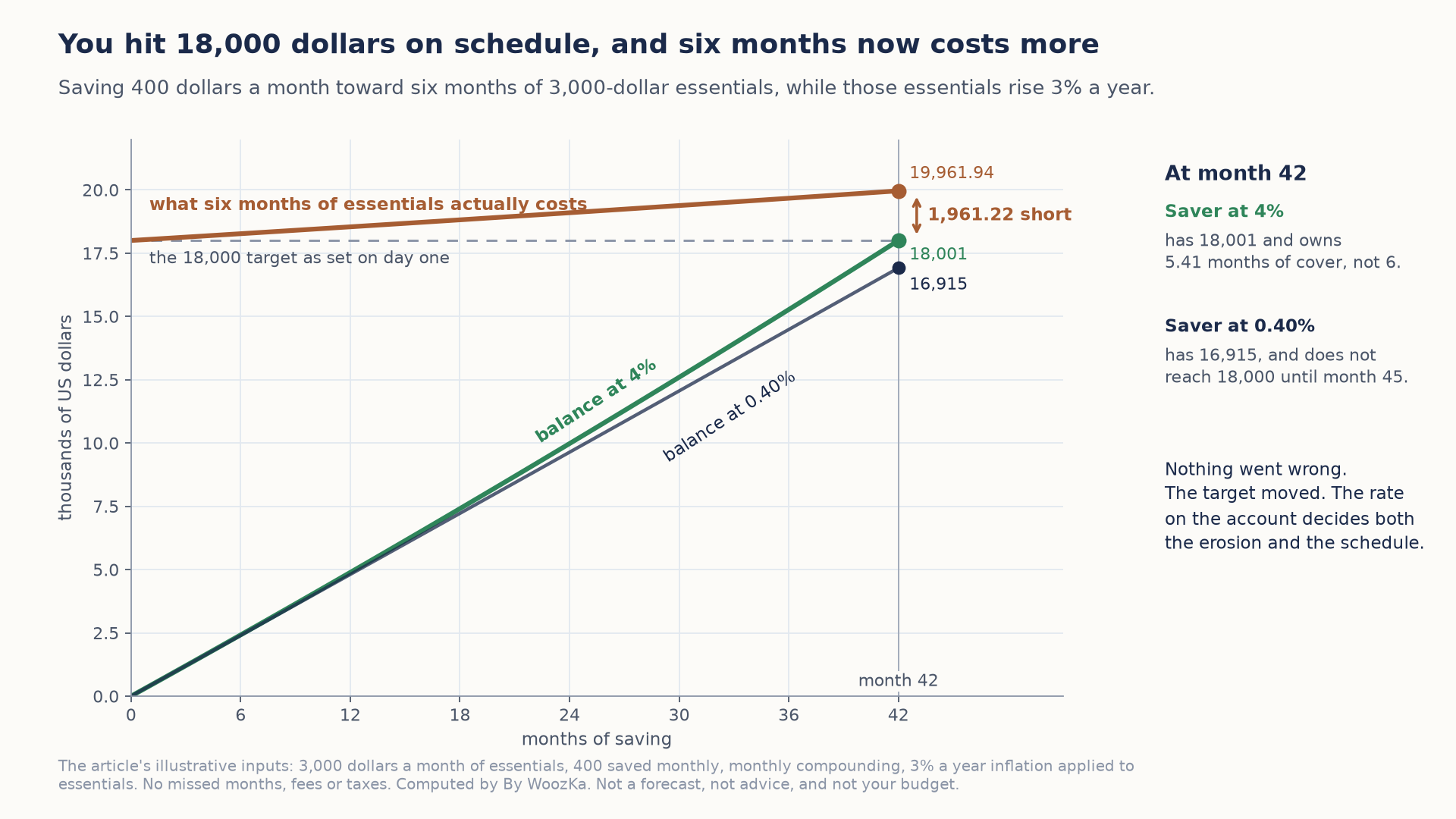 The saver at 4% reaches 18,000 dollars exactly on time, but if essentials rise 3% a year, six months of them now costs 19,961.94. The target is set in today’s dollars and aimed at a cost that keeps moving while you save.
None of that is an argument for a bigger number, and it is emphatically not a reason to reach for returns with money whose whole job is to be there. It is an argument for reading the target as what it is: a figure in today’s dollars, aimed at a cost that will have moved by the time you arrive. The two levers this article already names are exactly the two that answer it — the expense figure you multiply, and the yield on the account — and both of them are visible in the tables above.
Assumptions, sources and limits for the three tables above. Every input is this article’s own illustrative figure — $3,000 of essentials, $4,500 of total spending, $400 saved monthly, 4% and 0.40% account rates, 3% inflation — and none of them is a recommendation or a claim about your budget. Build times come from computeCompound, the function behind the Compound Growth Calculator linked above, at monthly compounding, so every row is reproducible in your browser; “months to fill” is the first whole month the balance reaches the target. One extension is made explicit: the third table applies the 3% inflation figure to essential expenses as well as to the cash, whereas the article applies it only to the cash. Constant contributions, no fees, no taxes and no missed months are assumed, and no investment return is assumed anywhere. The code behind these tables reports every figure above; it also re-derives this article’s own published numbers from scratch — month 22 and month 42, the $9,000 lever, $17,545.63 and $18,174.76 of real value, the $454.37 of lost purchasing power, and the $5,400 invested-fund shortfall — and checks that each one matches before reporting anything.
How to Actually Build It
The building is deliberately unexciting, which is the point.
Pick a target using Steps 1 and 2 (essential expenses × your chosen months). Then automate small, recurring transfers into a separate liquid account — the CFPB specifically recommends recurring automatic transfers so the fund builds without a monthly decision [source: Consumer Financial Protection Bureau, 2026]. Keeping it in a separate account from your checking matters more than it sounds: money you don’t see is money you don’t accidentally spend, and a small psychological wall is often the difference between a fund that survives and one that doesn’t.
Two sequencing notes, both framed as arithmetic rather than instruction. A common approach is to build a small starter cushion first (enough to cover a single common surprise) before turning to other goals, then grow it to the full target over time — because a $1,000 shortfall handled in cash is a shortfall that didn’t become high-interest debt. And if you’re carrying a balance at a ~20%+ APR, note that paying it down is a certain saving at that rate, which competes directly with how fast you grow the fund; that’s the trade-off to weigh, not a rule about which comes first (see The Real Cost of Carrying Credit Card Debt, the deep-dive on that math). Your income stability, your peace of mind, and your specific rates all belong in that sequencing decision — it’s yours to make.
A 4-Question Checklist
Whenever you’re sizing or sanity-checking an emergency fund, four questions do most of the work:
- What are my essential monthly expenses? The bills that would still arrive if my paycheck stopped — not my full spending. This is the number I multiply.
- How many months, given my life? Start at the 3–6 range, then move up for variable/single income, dependents, or a slow-to-replace job.
- Where is it kept? Genuinely liquid and stable — a savings or money-market account, reachable instantly — never invested in stocks I might have to sell at a loss.
- Is it earning a competitive yield, and is it finite? A decent APY slows inflation’s erosion; a sensible cap keeps me from over-holding cash that could be working elsewhere.
Answer those four and you’ve done the actual math — and made the two decisions (which expenses, where you keep it) that matter more than the exact month count.
The Bottom Line
An emergency fund’s size is a single multiplication: essential monthly expenses times a number of months, with three to six the common starting range and the exact figure personal to your income stability and dependents. But the two decisions that quietly matter most are counting essential expenses rather than total spending — which makes the goal both smaller and more accurate — and keeping the money in stable cash rather than investments, so a shock that lands during a downturn doesn’t force you to sell at a loss. Cash isn’t free of inflation, which is exactly why you hold enough and not more, in an account paying a competitive yield. It’s the least glamorous line in a financial plan and one of the most protective: the boring cushion that lets everything else — including staying invested through a bad year — actually work. Build the base first; the economic machine will keep throwing surprises, and this is how you meet them without selling the future to pay for the present.
Disclaimer: This article is educational content, not financial advice. I am not a licensed financial advisor, and nothing here is a recommendation to buy or sell any security or asset. Investing and trading involve risk, including the possible loss of the money you invest. Do your own research and consider consulting a licensed financial professional before making investment decisions. Read the full Disclaimer. Historical and backtested results are hypothetical, carry inherent limitations, and do not guarantee future results. Figures were accurate to the best of my knowledge as of this article’s last-updated date and may have changed.
This is the second piece in the money-terminology cluster, after APR vs APY: once you can read a rate, the next foundation is knowing how much cash to keep between you and a bad month. Still ahead in this cluster: how credit scores actually work, and the full cost of a carried card balance. For the weekly market read this blog uses to apply the fear-and-greed rules from the Autopilot Plan — the discipline an emergency fund makes possible — subscribe to the newsletter below and grab the money-foundations checklist.
