Dividend Investing 101: Building an Income Stream From Stocks
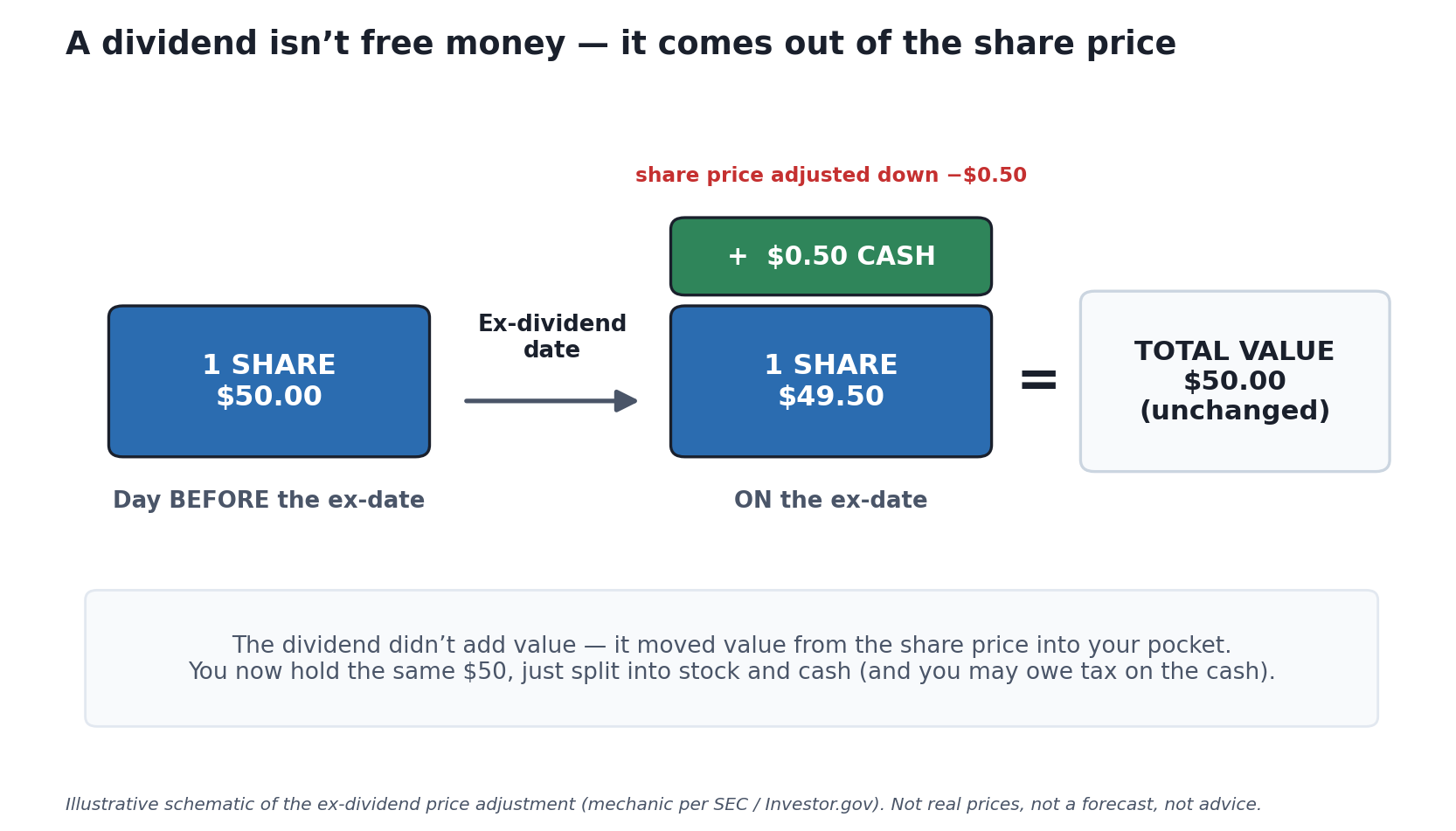
On the ex-dividend date, a stock’s price is adjusted down by roughly the dividend it pays — so the cash didn’t appear from nowhere, it moved out of the share price. This is the single mechanic most beginners get wrong, and it’s the honest starting point for everything below. Illustrative schematic, not real prices and not advice.
The pitch for dividend investing is genuinely appealing: own shares in established companies, and a few times a year they send cash straight to your account — an income stream you didn’t have to sell anything to receive. It’s real, it has a long and respectable history, and for a lot of long-term investors it’s a sensible part of the plan. But it’s also one of the most misunderstood corners of the stock market, wrapped in myths that range from harmlessly optimistic (“dividends are free money on top of my gains”) to genuinely dangerous (“just buy whatever pays the highest yield”).
This guide is the beginner’s version done honestly. It explains what a dividend actually is, the one mechanic that corrects the biggest myth, why dividends still matter despite that mechanic, how you’d actually start, the traps that catch new investors, and how the whole thing is taxed. If you haven’t opened an account yet, start with the pillar for this section — How to Open Your First Brokerage Account — because everything here assumes you can buy a share in the first place.
What a Dividend Actually Is
A dividend is a portion of a company’s profits paid out to shareholders, usually in cash. The company’s board of directors declares each dividend — it is not automatic, not contractually owed, and not the same as the interest a bank pays you. In the United States, dividend-paying companies typically pay quarterly, though the schedule varies. Plenty of companies pay no dividend at all, choosing instead to reinvest their profits back into growth; a company not paying a dividend isn’t doing anything wrong, it’s just allocating capital differently.
The headline number you’ll see quoted is the dividend yield: the annual dividend per share divided by the current share price, expressed as a percentage. A stock at $100 paying $3 per year yields 3%. Keep that formula in mind, because it has a trap built into it that we’ll get to — the yield can rise for a bad reason (the price falling) just as easily as a good one (the dividend rising).
The Mechanic That Corrects the Biggest Myth
Here is the thing almost every beginner gets wrong, and it’s worth understanding before you buy a single dividend share. A dividend is not free money layered on top of your stock. When a company pays a dividend, it hands out cash it used to hold — so the company is worth slightly less afterward, and the share price is adjusted down to reflect it.
That adjustment happens on a specific day called the ex-dividend date. There are four dates in every dividend’s life: the declaration date (the board announces it), the ex-dividend date (the cutoff — buy on or after this day and you do not get this dividend; the seller does), the record date (who’s on the books), and the payment date (cash actually arrives) [source: U.S. Securities and Exchange Commission, Investor.gov, “Ex-Dividend Dates: When Are You Entitled to Stock and Cash Dividends”]. On the ex-dividend date, the SEC notes, a stock’s price may fall by roughly the amount of the dividend [source: SEC/Investor.gov, “Ex-Dividend Dates”].
The schematic at the top of this article is that idea in one picture. A $50 stock that pays a $0.50 dividend tends to open the ex-date near $49.50. You now hold a share worth $49.50 plus $0.50 in cash — the same $50 you had the day before, just split into two pieces. The dividend didn’t add value; it moved value from the share price into your pocket.
This has a practical consequence worth naming: you cannot reliably “capture” a dividend by buying a stock the day before the ex-date and selling right after. The price drop tends to offset the dividend you collect, and in a taxable account you may even come out behind after taxes and trading friction. The dividend is a slice of your own returns being handed back to you, not a bonus for good timing.
None of this makes dividends bad. It just means the honest way to judge a dividend stock is by its total return — price change plus dividends — not by the dividend alone. Which leads to the natural question: if a dividend is just your own money coming back, why does anyone care about them at all?
Why Dividends Still Matter
Because over long horizons, that returned cash — reinvested — has done a remarkable amount of the heavy lifting. Research by Hartford Funds using Ned Davis Research data found that reinvested dividends and the power of compounding accounted for roughly 85% of the cumulative total return of the S&P 500 Index going back to 1960 [source: Hartford Funds, “The Power of Dividends: Past, Present, and Future,” data from Ned Davis Research].
Read that carefully, because it’s widely misquoted. The figure is not “dividends are 85% of returns” in some magical sense — it’s what happens when you take the dividends a broad index throws off and reinvest them to buy more shares, which then pay their own dividends, compounding over more than six decades. And it’s period-dependent: in high-return decades like the 1980s and 1990s, dividends were a much smaller share of the total; in flatter decades they carried far more of it [source: Hartford Funds, “The Power of Dividends”]. The lesson isn’t “dividends beat everything.” It’s that reinvestment and time, not the payout by itself, are what make dividends powerful.
The same body of research is often cited for a second point: over a roughly 50-year window, companies that grew or initiated dividends delivered higher average annual returns (about 10.2%) than dividend payers generally (about 9.2%), while non-payers lagged well behind (about 4.3%) [source: Hartford Funds / Ned Davis Research, “The Power of Dividends”]. That’s a real and interesting association — companies able to raise dividends year after year tend to be profitable and disciplined — but it is an association drawn from the past, not a promise about the future, and past performance does not predict future results. It’s a reason to take dividend growers seriously, not a formula that guarantees anything.
How to Actually Start
The mechanics are refreshingly simple; the discipline is where it’s won or lost.
1. You need a brokerage account. Dividends land as cash in that account. If you don’t have one yet, the brokerage-account walkthrough covers it end to end.
2. Decide between individual dividend stocks and a dividend fund. Buying single dividend-paying companies gives you control and concentrated exposure — and concentrated risk: if one company cuts its dividend, a big slice of your income can vanish at once. A dividend-focused index fund or ETF spreads that risk across dozens or hundreds of payers for a small expense ratio. Neither is “correct,” and this is a category distinction, not a recommendation of any specific security or fund — but for most beginners the diversified route removes the single hardest part (picking individual companies well).
3. Choose reinvest or take the cash. Most brokerages offer a dividend reinvestment plan (DRIP) that automatically uses each dividend to buy more shares (often fractional ones). If your goal is long-term growth, reinvesting is the engine behind that compounding figure above. If you actually need the income now — say, in retirement — you take it as cash instead. The autopilot approach to investing pairs naturally with reinvestment, and dividend reinvestment is really just dollar-cost averaging funded by the dividends themselves.
4. Learn the two or three numbers that matter before you’re dazzled by a yield: the yield itself, the payout ratio (the share of earnings paid out as dividends — a ratio pushing past 100% means the company is paying out more than it earns, which is rarely sustainable), and the dividend growth history. On that last point, one useful reference set is the S&P 500 “Dividend Aristocrats” — companies that have raised their dividend for at least 25 consecutive years; as of 2026 there are about 69 of them [source: S&P Dow Jones Indices, S&P 500 Dividend Aristocrats; count corroborated by Sure Dividend and Simply Safe Dividends 2026 lists — confirm the current number, it changes with quarterly rebalancing]. That list is an illustration of consistency, not an endorsement of any name on it.
The Risks and Traps That Catch Beginners
This is the part the “passive income” pitch usually skips, and it’s the most important section here.
Dividends are not promised. A board can cut, suspend, or eliminate a dividend at any time, and they do — especially when business turns down. In 2020, as the pandemic hit, roughly 65 companies in the S&P 500 cut or suspended their dividends, including household names like Disney and Boeing that halted them entirely [source: reporting on 2020 S&P 500 dividend actions — Bloomberg Law analysis; Nasdaq; Kiplinger]. Banks did the same in the 2008–2009 financial crisis. An “income stream” built on dividends is a stream that can slow to a trickle exactly when you might need it most. Treat dividend income as likely, not certain.
Beware the yield trap. Because yield is dividend divided by price, a falling price mechanically pushes the yield up. A stock quietly advertising a 12% yield is often not a generous gift — it’s a company whose price has collapsed because the market expects the dividend to be cut. New investors sort a screener by highest yield and walk straight into this. A suspiciously high yield is a question to investigate, not a prize to grab.
Don’t go blind to total return. It’s possible to collect a steady dividend from a company whose share price is slowly sinking, and lose money overall while feeling like you’re “getting paid.” Always judge the whole picture — price plus dividends — not the income line in isolation.
Remember what you actually own. Dividend stocks are still stocks. They can fall hard, they are not FDIC-insured, and they are not a substitute for a savings account, a bond, or an emergency fund. A high-quality dividend payer is less volatile than a speculative growth name, on average — but “less” is not “safe.”
How Dividends Are Taxed
Taxes are where dividend investing gets genuinely technical, so here’s the beginner-level map — and a standing caveat that tax rules change and depend on your situation, so confirm the current figures and consider a tax professional before acting.
Dividends come in two flavors. Qualified dividends are taxed at the lower long-term capital-gains rates — 0%, 15%, or 20% depending on your income. To qualify, the payer must be a U.S. or qualifying foreign corporation, and you must hold the stock for more than 60 days during the 121-day period that begins 60 days before the ex-dividend date [source: IRS, Topic No. 404, “Dividends”; IRS Publication 550]. Ordinary (non-qualified) dividends are taxed at your regular income-tax rate, which is higher for most people [source: IRS Topic No. 404].
For 2026, the qualified-dividend/long-term-gains 0% bracket runs up to about $49,450 of taxable income for single filers and about $98,900 for married couples filing jointly; the top 20% rate only applies at high incomes (above $545,500 single / $613,700 joint), with the common 15% rate in between [source: IRS Revenue Procedure 2025-32, 2026 inflation adjustments, as reported by Kiplinger and the Tax Foundation — confirm current thresholds; a new revenue procedure resets them for each tax year]. High earners may also owe the 3.8% Net Investment Income Tax above $200,000 (single) / $250,000 (joint) of modified adjusted gross income [source: IRS, Net Investment Income Tax].
One consequence trips people up: in a taxable account, a dividend is taxable in the year you receive it even if you automatically reinvest it. You get a tax bill for cash you never saw as spendable money. That’s a big reason many investors prefer to hold dividend-heavy positions inside tax-advantaged accounts like an IRA or 401(k), where the dividends can compound without an annual tax drag. Whether that fits your situation is exactly the kind of question a tax professional should weigh in on.
Three Numbers This Article States and Never Multiplies
Everything above is stated correctly, and three of its claims are left as assertions when the article already publishes enough to settle them exactly. The dividend-capture warning names a trade and never prices it. The return figures for growers, payers and non-payers are quoted per year and never carried out to the horizon that measured them. And two counts — one in the starting section, one in the traps section — describe the same 500 companies and are never placed side by side. Every input below is a price, rate, count or rule this article already publishes; nothing external is added.
Why Dividend Capture Fails Even When Everything Goes Right
The article says you cannot reliably capture a dividend by buying the day before the ex-date and selling right after. Grant the trader every advantage the article does not grant: the price drop is exactly the dividend rather than roughly it, commissions are zero, and the spread is zero. On the article’s own schematic the round trip is then worth precisely nothing — buy at $50.00, sell at $49.50, collect $0.50, net $0.00.
The tax rule the article states later is what turns that zero into a loss, and it does so by construction rather than by bad luck. A qualified dividend requires more than 60 days of holding inside a 121-day window. A trade held about a day is short by 60 days, so the dividend is ordinary — not because of the trader’s bracket, their broker or the stock, but because the strategy is defined as not holding. The days need not be consecutive, which sounds like an escape and is not one: accumulating 61 of them means abandoning the trade that was supposed to be captured.
Set against that, here is what the same $0.50 is worth to someone who simply held the share, at each qualified rate the article publishes.
| Qualified rate | Tax on $0.50 | Holder keeps | Share kept |
|---|---|---|---|
| 0% | $0.00 | $0.50 | 100.0% |
| 15% | $0.07 | $0.42 | 85.0% |
| 20% | $0.10 | $0.40 | 80.0% |
The capture trader keeps less than every row, because their rate is the ordinary one and the article states plainly that it is higher. The sharpest version needs no ordinary bracket at all: in the 0% qualified band — which the article puts at taxable income up to roughly $49,450 single — a held dividend is taxed at nothing, so the capture trade converts an untaxed event into a taxed one and forfeits 100% of the dividend’s tax advantage. That is the whole result: in its best case the trade earns zero before tax and cannot be taxed favorably, so its expected value is negative before a single cent of commission or spread is counted.
The Article Reports Two Gaps and Emphasizes the Smaller One
The Hartford and Ned Davis figures appear as three annual averages over roughly a 50-year window: growers about 10.2%, payers generally about 9.2%, non-payers about 4.3%. Annual percentages are hard to compare by eye, so here they are carried out to the article’s own horizon on a $10,000 unit of account, using the site’s compound growth calculator.
| Group | Annual average | $10,000 after 50 years |
|---|---|---|
| Dividend growers | 10.2% | $1,285,522.63 |
| Dividend payers | 9.2% | $814,951.79 |
| Non-payers | 4.3% | $82,075.86 |
The comparison the sentence leads with — growers over payers — is worth 1.577× at the end of the window. The comparison it moves past in three words is worth 9.929×. The second gap is 4.9× the first measured in annual points and 15.5× the first measured in compounded excess, so the article’s own numbers say the decisive divide in that dataset is paying versus not paying, and the growers-versus-payers margin is the fine print.
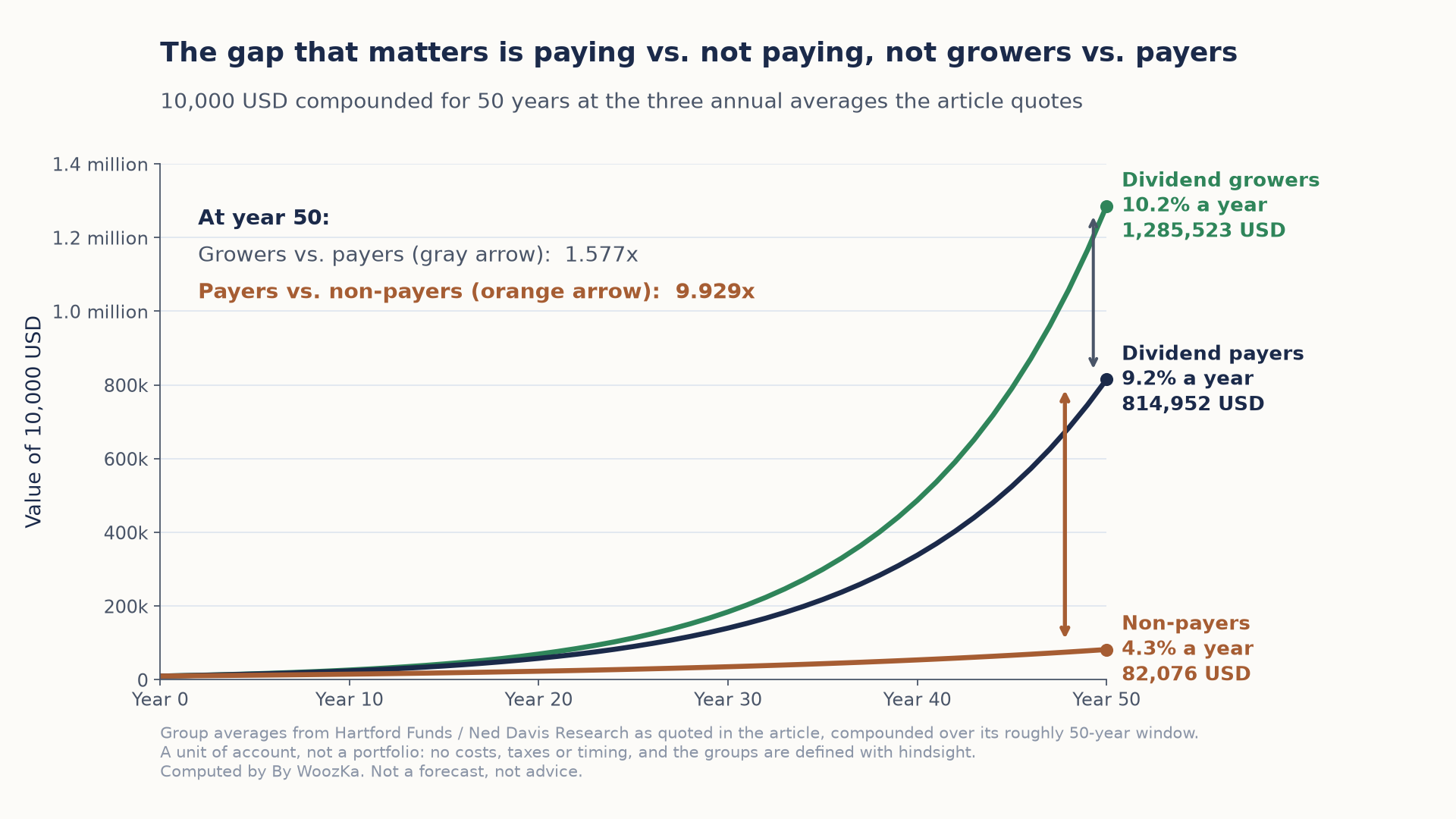
Carried out to the article’s own 50-year window, the growers’ edge over payers is 1.577x while the payers’ edge over non-payers is 9.929x, so the divide that matters in this dataset is whether a company pays at all. These are hindsight-defined group averages with no costs or taxes, not an investor’s return.
That margin is also slower than it looks. At 10.2% against 9.2%, one stake takes 76.0 years to reach twice the other — longer than the roughly 50-year window that produced the figures in the first place. A one-point annual edge is real and it is not fast, and an investor who expects to feel it inside a decade is expecting the wrong thing from it.
Twenty-Five Years Up, One Quarter Down
Two counts above describe the same index and never meet. The starting section reports about 69 companies that have raised a dividend for at least 25 consecutive years; the traps section reports about 65 that cut or suspended one during 2020 alone.
| Group | Count | Share of 500 |
|---|---|---|
| Raised 25+ straight years | 69 | 13.8% |
| Cut or suspended in 2020 | 65 | 13.0% |
They are nearly the same size, and they cannot overlap: a streak has to be unbroken to count, so a 2020 cut disqualifies a company from the 2026 list by definition. For roughly every company that has raised for a quarter of a century, 0.94 companies broke a dividend in a single bad year. That is the article’s “treat dividend income as likely, not certain” stated as a ratio rather than an adjective.
The asymmetry underneath it is what makes the label brittle. Twenty-five years is 100 consecutive quarters, and the streak is destroyed by one of them — a company 24 years in that cuts once is returned to zero, giving up 96 quarters of standing in a single decision. The consistency the list certifies is real, and it is certification of a past that one board meeting can end.
Dividend numbers above: what they assume, and what backs them. Every input above — the $50.00 and $0.50 schematic, the 0/15/20% qualified rates, the 60-of-121-day holding rule, the 10.2/9.2/4.3 averages and their roughly 50-year window, and the counts of 69 and 65 against a 500-company index — is a figure this article already publishes and sources; nothing external is imported, and every published value is re-checked in code before the tables report anything. The compounding was produced by the site’s shipped calculator and matches the script to the cent. The capture arithmetic is an upper bound on that trade and not a model of it: it assumes the ex-date drop equals the dividend exactly, which the article correctly describes only as roughly true, and it ignores commissions and spread, both of which make the trade worse rather than better. The $10,000 is a unit of account, not a portfolio, and compounding a group average is not an investor’s return — it excludes costs, taxes and timing, and “dividend growers” is a category a company can only enter by having already grown, so the group is defined with hindsight. Those figures are a historical association over one window, exactly as the article says, and nothing above forecasts a return, endorses a category or recommends buying, selling or holding any security. Tax rules change and depend on your situation; the brackets here are the article’s own and should be confirmed against current guidance.
The Sane Way to Think About It
Strip away the hype and dividend investing is neither a magic income machine nor a myth. It’s a real, historically meaningful component of stock returns that becomes genuinely powerful when the payouts are reinvested and compounded over long stretches of time. The honest beginner’s version comes down to a few habits: judge stocks by total return, not yield alone; treat a sky-high yield as a warning rather than a windfall; remember that no dividend is promised; and don’t let the “getting paid” feeling blind you to whether you’re actually coming out ahead.
Picture the moment this usually clicks. You buy your first dividend stock, the payment lands in your account a few weeks later, and — if you’re paying attention — you notice the share price ticked down by almost exactly the dividend on the ex-date. That’s not the broker cheating you; that’s the whole mechanic working as designed, and understanding it is what separates an informed dividend investor from someone chasing a number.
If dividends are your on-ramp to owning individual companies, the next literacy step is learning to read what those companies report — and the natural companion pieces in this section (how to read an earnings report, what a P/E ratio really tells you) build directly on the account you opened in the pillar. The weekly plain-English newsletter, below, is where these ideas get connected over time.
Disclaimer: This article is educational content, not financial advice. I am not a licensed financial advisor, and nothing here is a recommendation to buy or sell any security or asset. Investing and trading involve risk, including the possible loss of the money you invest. Do your own research and consider consulting a licensed financial professional before making investment decisions. Read the full Disclaimer.
Historical and backtested results are hypothetical, carry inherent limitations, and do not guarantee future results. Figures were accurate to the best of my knowledge as of this article’s last-updated date and may have changed.
