Crypto Tax Basics: What You Owe and When
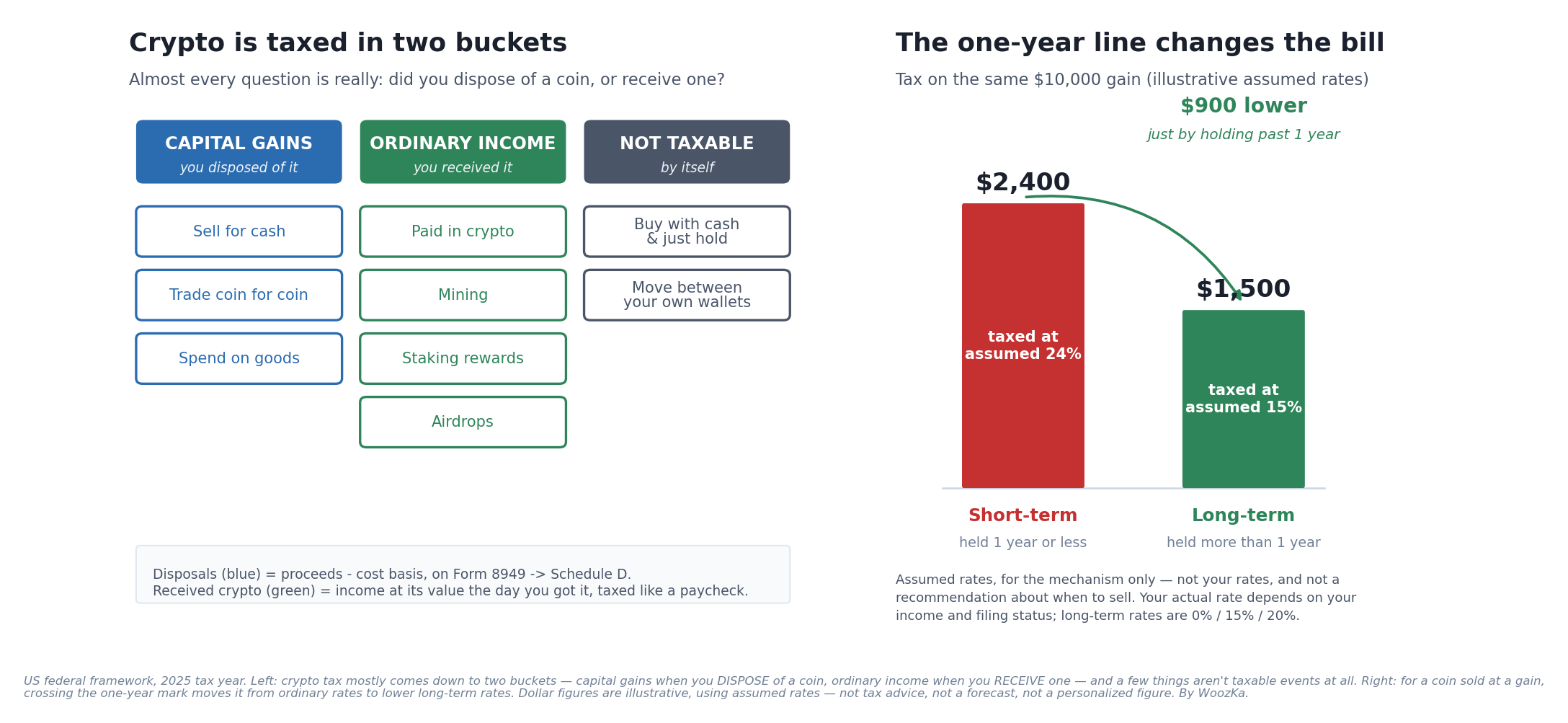
Two ideas in one picture. Left: almost every crypto tax question is really asking “did I dispose of a coin (capital gains) or receive one (ordinary income)?” — and some things you do aren’t taxable events at all. Right: for a coin you dispose of at a gain, crossing the one-year holding line moves it from ordinary rates to lower long-term rates. The dollar figures are illustrative, using assumed rates, to show the mechanism — not a calculation of your bill.
If you’ve bought, traded, earned, or spent any crypto, “do I owe tax on this?” is a fair and slightly nerve-wracking question — and the honest starting answer is: probably, on more of it than you’d guess, and the rules are more knowable than they feel. This article walks through the basics of how crypto is taxed so the paperwork stops being a black box. It is the companion the pillar on buying your first Bitcoin safely promised: owning crypto responsibly includes understanding the tax that comes with it.
One caveat has to come first, and it is not boilerplate. This is educational content about the general framework in the United States — it is not tax advice, and it is not a substitute for a qualified tax professional who knows your full situation. Tax rules differ from country to country, they change from year to year, and the way they apply to your specific transactions can turn on details a general article can’t see. Every rule below is sourced to a named IRS authority and date-stamped so you can check whether it still holds when you read it — but if real money is at stake, confirm your own case with a CPA or tax professional and against current IRS guidance. If you’re outside the US, treat this as a map of how these systems tend to be built, not as your local law.
Even so, here is the whole framework, one piece at a time.
The two buckets, and what falls outside them. Every cell below is from the schematic above.
| Capital gains — you disposed of it | Ordinary income — you received it | Not a taxable event by itself |
|---|---|---|
| Selling for cash | Getting paid in crypto | Buying with cash and holding |
| Trading one coin for another | Mining | Moving coins between your own wallets |
| Spending crypto on goods | Staking rewards | |
| Airdrops |
The Foundation: The IRS Taxes Crypto as Property, Not Money
Almost everything about US crypto tax flows from a single decision the IRS made back in 2014 and has reaffirmed since: for federal tax purposes, virtual currency is treated as property, and the general tax rules that apply to property transactions apply to crypto [source: IRS Notice 2014-21, which “applied general principles of tax law to determine that virtual currency is property,” still the foundational guidance, supplemented by Rev. Rul. 2019-24 and Notice 2023-34]. The IRS now uses the broader term “digital asset” — defined as “any digital representation of value that is recorded on a cryptographically secured distributed ledger or any similar technology” and “that is not cash” — which sweeps in cryptocurrencies, stablecoins, and NFTs [source: IRS, “Digital assets” and “Frequently asked questions on digital asset transactions,” irs.gov, updated for the 2025 tax year].
That one word — property — does the heavy lifting. It means crypto is taxed the way a stock or a piece of real estate is, not the way the dollars in your bank account are. Spending a dollar isn’t a taxable event; the dollar is money. But spending a coin is a disposal of property, and disposing of property that has changed in value since you got it can create a taxable gain or loss. This is the single most common thing beginners miss, and the reason so many people owe tax they didn’t expect: the tax code doesn’t see your Bitcoin as cash, it sees it as an asset you’re selling every time you use it.
Once you internalize “crypto is property,” the rest of the system organizes itself into two buckets.
The Two Buckets: Capital Gains vs. Ordinary Income
Nearly every crypto tax question reduces to one of two situations:
- You disposed of a coin you already owned → this is a capital gains event. You compare what the coin was worth when you got rid of it against what it cost you, and the difference is a capital gain (or loss).
- You received a new coin as some form of income → this is an ordinary income event. The coin’s fair market value when you received it is income, taxed like wages or interest.
Keeping these two buckets straight is 80% of understanding crypto tax. Let’s take them one at a time.
Bucket 1 — Capital gains: what counts as “disposing” of crypto
Because crypto is property, you trigger a capital gain or loss whenever you dispose of a financial interest in it. The IRS lists the disposals plainly [source: IRS, “Frequently asked questions on digital asset transactions,” irs.gov]:
- Selling crypto for cash (dollars or another government currency). The obvious one.
- Trading one crypto for another — swapping Bitcoin for Ethereum, or any coin for any coin. This surprises people, but it’s a disposal of the first coin: you sold your Bitcoin (a taxable event) and happened to buy Ethereum with the proceeds. No cash ever hit your bank account, and you still realized a gain or loss.
- Spending crypto on goods or services — buying a laptop, a coffee, or a plane ticket with crypto is a disposal of that crypto at its value that day.
- Any other disposition of a financial interest in a digital asset.
For each of these, you calculate the gain or loss and report it on Form 8949, then carry the total to Schedule D of your Form 1040 [source: IRS, “Digital assets,” irs.gov]. The gain itself is just arithmetic: proceeds (what the coin was worth when you disposed of it) minus your cost basis (what it cost you to acquire it). We’ll come back to cost basis, because it’s where the real work lives.
Bucket 2 — Ordinary income: crypto you earn is taxed when you receive it
When crypto comes to you as a form of income, its fair market value at the moment you receive it is ordinary income — taxed at your regular income tax rate, the same brackets as a paycheck. The IRS treats these as income events [source: IRS, “Taxpayers need to report crypto, other digital asset transactions on their tax return,” and “FAQs on digital asset transactions,” irs.gov]:
- Getting paid in crypto for goods or services (freelancing, a job, selling something).
- Mining rewards — the value of coins you mine is income when received.
- Staking rewards — the IRS ruled specifically on this: the fair market value of staking rewards is ordinary income in the year you gain “dominion and control” over them, meaning the moment you have “the ability to sell, exchange, or otherwise dispose of” the rewards. This applies whether you stake directly or through an exchange [source: IRS Rev. Rul. 2023-14, issued July 31, 2023].
- Airdrops and hard-fork coins — new digital assets you receive are generally income at their value when you receive them.
There’s a subtlety worth internalizing here: income crypto gets taxed twice-ish, in two different buckets. The value when you receive it is ordinary income (bucket 2) — and that same value becomes your cost basis. If you later sell it for more, the additional appreciation is a capital gain (bucket 1). Receive $500 of staking rewards, and you have $500 of ordinary income now and a $500 basis; sell those coins later for $700, and you have a separate $200 capital gain. Two events, two buckets, one coin.
What Is Not a Taxable Event
Just as important as knowing what’s taxed is knowing what isn’t — because fear of the tax bill sometimes stops people from doing perfectly untaxed things. Generally, in the US, these are not taxable events on their own [source: IRS, “Determine how to answer the digital asset question,” and “FAQs on digital asset transactions,” irs.gov]:
- Buying crypto with cash and holding it. Purchasing Bitcoin with dollars and just holding creates no taxable event and no gain — a gain only exists once you dispose of it. (You can even answer “No” to the tax return’s digital-asset question if buying-and-holding is all you did.)
- Transferring crypto between wallets or accounts you own. Moving your own coins from an exchange to your own hardware wallet, or between two of your own wallets, is not a disposal — you still own the same property.
- Holding through price swings. Unrealized gains — a coin that’s up on paper but that you haven’t sold — are not taxed. Tax attaches at the disposal, not the appreciation.
Gifting and donating crypto have their own special rules (gift-tax thresholds for the giver, potential deductions for donations to qualified charities) that are beyond a basics article — flag them for a professional if they apply to you.
The One-Year Line: Short-Term vs. Long-Term Gains
For coins in bucket 1 (capital gains), how long you held the coin before disposing of it changes the tax rate — often significantly. Your holding period starts the day after you acquire the coin and ends the day you dispose of it [source: IRS, “FAQs on digital asset transactions,” irs.gov]:
- Held one year or less → short-term capital gain, taxed at your ordinary income rate (the same brackets as your salary).
- Held more than one year → long-term capital gain, taxed at the lower long-term capital gains rates of 0%, 15%, or 20%, depending on your total taxable income and filing status [source: IRS Topic no. 409, “Capital gains and losses,” irs.gov].
For the 2025 tax year, the long-term rate is 0% until your taxable income passes roughly $48,350 (single filers) or $96,700 (married filing jointly), then 15% across the broad middle, and 20% only at high incomes [source: IRS 2025 inflation-adjusted thresholds, as reported by Kiplinger and NerdWallet, 2025 — thresholds adjust yearly for inflation; confirm the current figures]. The exact upper boundaries move every year, so treat the structure (0/15/20% long-term vs. ordinary short-term) as the durable lesson, not any single dollar figure.
Here’s why the line matters, worked with illustrative, clearly-labeled assumed rates. Say you disposed of a coin at a $10,000 gain:
| Held ≤ 1 year (short-term) | Held > 1 year (long-term) | |
|---|---|---|
| Rate applied | Ordinary income rate (assume 24%) | Long-term rate (assume 15%) |
| Tax on a $10,000 gain | $2,400 | $1,500 |
Same coin, same $10,000 gain — the only difference is whether you crossed the one-year mark. In this illustration that timing is worth $900. These are assumed rates for teaching the mechanism, not your rates and not a recommendation about when to sell — the right time to dispose of an asset depends on far more than the tax, and the tax rate you’d actually pay depends on your own income and filing status. But the direction of the effect is real and worth knowing: the tax code rewards longer holding periods.
The Hard Part: Cost Basis and Records
Notice that every capital-gains calculation needs one number that the blockchain doesn’t hand you: your cost basis — what the coin cost you to acquire, including fees. Proceeds are usually easy (what the coin was worth when you disposed of it). Basis is where people get stuck, because you have to have tracked it across every buy, trade, and transfer, sometimes over years.
Two things have made basis tracking stricter recently, and both are worth knowing:
1. The end of “universal” wallet accounting. Through 2024, many people tracked basis as if all their crypto sat in one big pool. Starting January 1, 2025, the IRS requires basis to be tracked per wallet or per account — you can no longer treat coins spread across several wallets as one universal pool when you calculate gains on a disposal [source: IRS Rev. Proc. 2024-28, “the end of universal wallet accounting,” as summarized by RSM, Withum, and Aprio, 2024]. The IRS provided a one-time safe harbor to reasonably allocate any unused basis to the specific wallets holding your coins as of January 1, 2025 — a setup step that generally had to be in place by that date and is irrevocable [source: Rev. Proc. 2024-28]. If you held crypto across the 2024→2025 line and haven’t sorted this out, it is exactly the kind of thing to raise with a tax professional.
2. You still have to keep your own records. Even with new broker forms (next section), the IRS expects you to maintain records that establish the basis and holding period of every unit — acquisition dates, costs, and amounts [source: Rev. Proc. 2024-28 record-keeping requirements; IRS “Digital assets,” irs.gov]. Crypto tax software exists precisely because doing this by hand across multiple exchanges and wallets is painful; whatever tool you use, the underlying obligation to be able to prove your numbers is yours.
The practical takeaway: your future self’s tax return is only as good as the records your present self keeps. The single highest-leverage habit in crypto tax is logging the date, amount, and dollar value of every acquisition and disposal as it happens, not reconstructing it in a panic each April.
How much paperwork one sale actually creates
“Track your basis” sounds like a filing chore until you count it. A sale is one action on an exchange, but for tax purposes it is not one event — it consumes the purchase lots underneath it, and each lot consumed is its own gain or loss with its own acquisition date. The number of separate line items that produces is fixed by how fragmented your buying was:
| Separate purchases you made | Sell 10% of the position | Sell 25% of the position | Sell 50% of the position | Sell 100% of the position |
|---|---|---|---|---|
| 12 | 2 | 3 | 6 | 12 |
| 52 | 6 | 13 | 26 | 52 |
| 104 | 11 | 26 | 52 | 104 |
| 250 | 25 | 63 | 125 | 250 |
Line items produced by one transaction. Someone who bought weekly for two years and then sells half is not reporting a sale — they are reporting 52 of them, each with a different date and a different cost. This is the arithmetic behind the section above: the difficulty was never the trade, it was the record, and it compounds with every purchase you have ever made rather than with the size of the sale.
It is also why the shift away from pooling everything together matters so much in practice. Once lots have to be tracked per wallet, the same fragmentation is multiplied by the number of places you keep coins.
“I have held it over a year” is usually only partly true
The one-year line described above is clean when you bought once. Almost nobody buys once. If you have been buying steadily, your position is not on one side of the line or the other — it is split, and the split is a calendar fact you can work out exactly:
| Buying weekly for | Purchase lots | Lots past the one-year mark | Share of the position |
|---|---|---|---|
| 13 weeks | 13 | 0 | 0% |
| 26 weeks | 26 | 0 | 0% |
| 52 weeks | 52 | 0 | 0% |
| 78 weeks | 78 | 26 | 33% |
| 104 weeks | 104 | 52 | 50% |
| 156 weeks | 156 | 104 | 67% |
Buying the same amount every week and then selling the whole position at once. Two results are worth noticing.
A year of buying leaves nothing over a year old. Someone who started a weekly habit twelve months ago and sells today has 0% of the position past the mark — the oldest lot only just arrives at the line, and every other lot is younger. The instinct that “I have been doing this a year” describes the habit, not the coins.
Even two full years of buying leaves only about half. At 104 weeks it is 50%; you have to be 156 weeks in before it reaches 67%. A steadily built position is always carrying a young tail, because you keep adding to it.
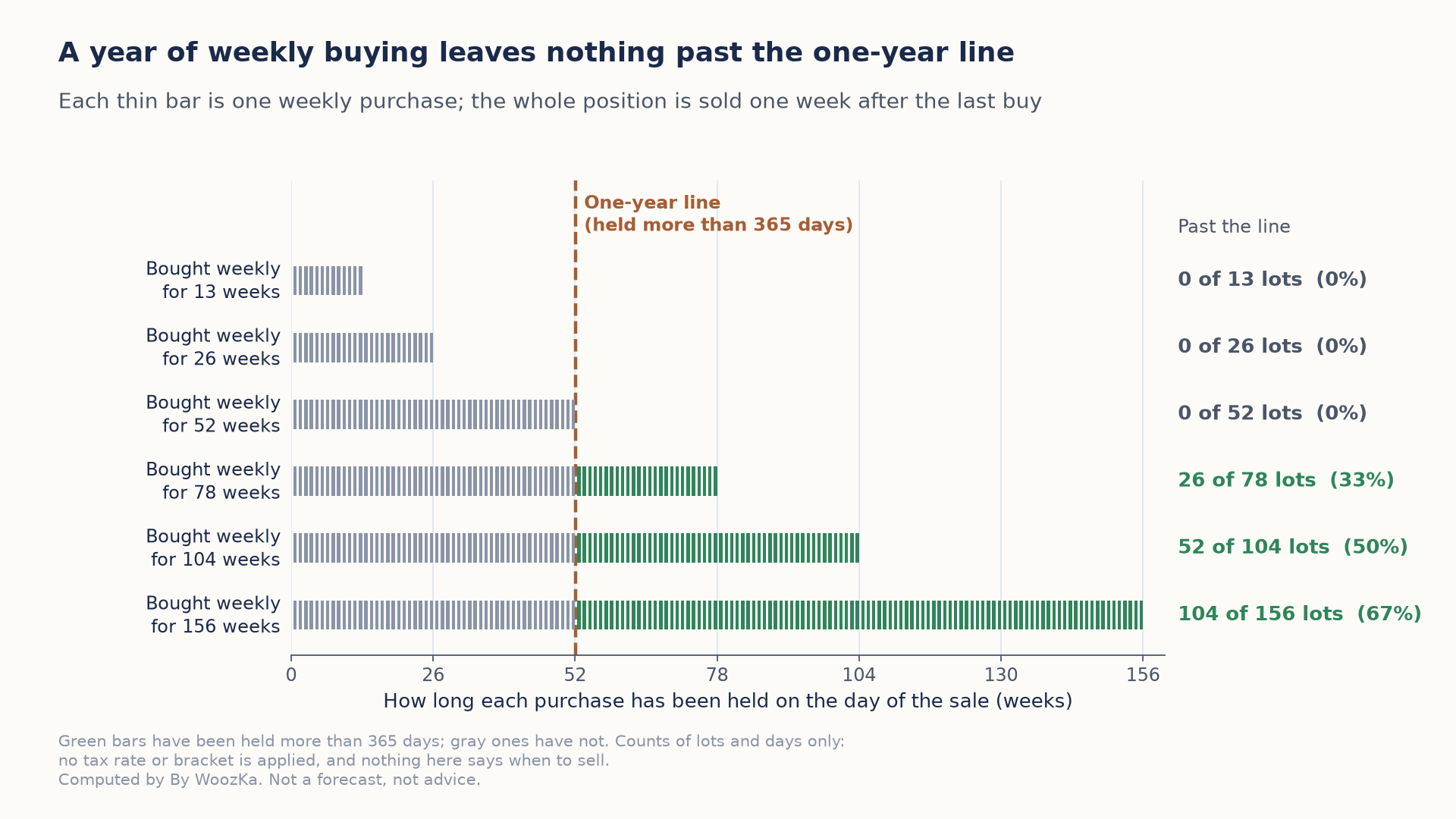
A steadily built position is always split by the one-year line: a year of weekly buying leaves 0% of the lots past it, two years leaves 50%, and three years leaves 67%. This counts lots and days only; it is not a tax calculation and says nothing about when to sell.
None of which tells you when to sell — that depends on your own circumstances and is a question for a professional, as the article says. What it does mean is that a position built gradually needs to be looked at lot by lot rather than as one holding, and that is a records problem before it is anything else.
Method, so it can be checked rather than taken on trust: the first table counts the purchase lots a sale consumes when lots are taken oldest first; the second dates every weekly lot and counts how many have been held longer than a year at the moment of sale. The script verifies the second count a second way, from explicit buy and sell calendar days, and asserts that selling the entire position touches every lot. It contains no tax rate, bracket, threshold or form — it counts lots and days, and nothing it produces is a tax calculation. Every count above is output from that code, not a hand transcription.
The New Paperwork: Form 1099-DA and the Tax-Return Question
Two reporting changes are landing right now, and beginners should know what to expect.
Form 1099-DA is arriving. Beginning with transactions on or after January 1, 2025, crypto brokers (custodial exchanges, certain wallet providers, kiosks, and some payment processors) must report customers’ digital-asset dispositions to the IRS and to you on a new Form 1099-DA [source: IRS, “Final regulations and related IRS guidance for reporting by brokers on sales and exchanges of digital assets,” and “About Form 1099-DA,” irs.gov]. Two things to understand about the rollout:
- For the 2025 tax year, brokers generally report only your gross proceeds, not your cost basis — basis reporting is voluntary for 2025 and becomes mandatory for covered transactions starting January 1, 2026 [source: IRS, “Frequently asked questions about broker reporting,” irs.gov]. So the first 1099-DA many people receive (statements are due to taxpayers by mid-February 2026) will tell the IRS what you sold for but not what you paid — you still have to supply the basis to compute the actual gain. A form showing only proceeds can look alarming, as if the whole amount were profit; it isn’t, but the gap is on you to fill with your own records.
- Getting a 1099-DA doesn’t change what you owe — it just means the IRS now has a copy too. The reporting was always required; the form makes mismatches easier for the IRS to spot.
Everyone answers the digital-asset question. At the top of Form 1040, there’s a yes/no digital-asset question, and you must answer it whether or not you received a 1099-DA and whether or not you did anything taxable [source: IRS, “1040 (2025)” instructions and “Determine how to answer the digital asset question,” irs.gov]. You check “Yes” if during the year you received crypto (as a reward, award, or payment) or sold, exchanged, or otherwise disposed of it. You can check “No” if all you did was hold, buy with cash, or move coins between your own wallets. It’s a small box, but leaving it blank or answering carelessly is an easy, avoidable mistake.
One Real Difference From Stocks: The Wash-Sale Gap (Read the Caution)
Here’s a genuine crypto-vs-stocks difference that gets a lot of attention — presented factually, with its caveats, because it is not the free lunch some corners of the internet make it sound like. With stocks, the wash-sale rule (Internal Revenue Code §1091) blocks you from claiming a loss if you sell a security at a loss and buy it back within 30 days. That rule is written to apply to “stock or securities” — and because the IRS classifies crypto as property, not a security, the wash-sale rule does not currently apply to crypto [source: IRC §1091; analysis by TokenTax, CoinLedger, and multiple CPA firms, 2025].
Before treating that as a strategy, sit with the caveats, because they’re the whole point:
- It may not last. Congress has repeatedly proposed extending the wash-sale rule to digital assets (starting with the 2021 Build Back Better bill and in successive Treasury “Greenbook” budget proposals). The new Form 1099-DA even includes a box for disallowed wash-sale losses — a hint the plumbing is being prepared [source: same CPA analyses, 2025]. A rule that’s absent today can be present next year.
- The economic-substance doctrine still applies. Selling a coin at a loss and instantly rebuying it purely to bank a deduction — with no real change in your economic position — is the kind of transaction the IRS can challenge under the general economic-substance doctrine [source: same analyses]. “Technically allowed” is not the same as “safe from challenge.”
- This is precisely the kind of edge case to run past a professional, not to freelance based on a blog post.
The reason this article raises it at all is educational: it’s a clean illustration of why the “crypto is property” classification matters — the same classification that creates the coin-for-coin taxable event also, for now, leaves this gap. Understanding the mechanism is the goal; exploiting it is a decision for you and your tax advisor, with eyes open.
Common Beginner Mistakes
- Assuming “I never cashed out to dollars, so I owe nothing.” Trading coin-for-coin and spending crypto are both disposals. A very active year of swaps can generate real tax with no fiat ever touching your bank.
- Forgetting that earned crypto is income the day you get it. Staking and airdrop rewards are ordinary income at receipt — even if you never sell them and even if they later drop in value.
- Not tracking basis until April. Reconstructing years of transactions across exchanges and wallets after the fact is the single biggest source of crypto-tax pain (and errors). Log as you go.
- Ignoring the per-wallet rule. The 2025 shift away from universal accounting changed how basis must be tracked; old spreadsheets may no longer match the required method.
- Treating a proceeds-only 1099-DA as your gain. For 2025, the form may show only what you sold for. The taxable gain is proceeds minus basis — and the basis is yours to supply.
- Leaving the Form 1040 digital-asset question blank. Everyone answers it. It costs nothing to answer correctly and invites scrutiny to skip.
Putting It Together
Crypto tax feels intimidating mostly because it’s unfamiliar, not because it’s arbitrary. Almost all of it comes back to three ideas: the IRS treats crypto as property; disposing of property creates capital gains while receiving crypto creates ordinary income; and the whole system runs on records — your cost basis and holding periods, tracked as you go. Get those three straight and the forms (8949, Schedule D, the new 1099-DA, the 1040 question) are just where the numbers land.
The best thing you can do isn’t clever — it’s boring and early: keep a running log of every buy, trade, earn, and spend, with the date and dollar value, from your very first transaction. The person who does that has a tedious afternoon at tax time. The person who doesn’t has a stressful, expensive, error-prone reconstruction — and sometimes a bill they can’t reduce because they can’t prove what a coin cost them. And because these rules are US-specific and genuinely do change year to year, the second best thing is knowing when to stop reading general articles and talk to a professional about your return.
Where to Go Next
Tax is the part of owning crypto that comes after you’ve bought and held it responsibly; these build on the same foundation:
- How to Buy Your First Bitcoin Safely: A Step-by-Step Guide — the pillar: buying and custody done in the risk-first way this tax picture assumes.
- Crypto Position Sizing: How Much of Your Portfolio Should Be Crypto? — because selling to rebalance is a taxable event, sizing and tax planning are two halves of the same decision.
- Crypto Wallets Explained: Hot vs Cold Storage for Beginners — where your coins live, and why moving between your own wallets isn’t a taxable event.
- Common Crypto Scams and How to Spot Them Before You Lose Money — a stolen coin and a sold coin are taxed very differently; knowing the line matters.
If you want markets and the money machinery around them explained plainly — risk-first, never hyped — that’s what the newsletter is for. Subscribe below.
Disclaimer: This article is educational content, not financial advice. I am not a licensed financial advisor, and nothing here is a recommendation to buy or sell any security or asset. Investing and trading involve risk, including the possible loss of the money you invest. Do your own research and consider consulting a licensed financial professional before making investment decisions. Read the full Disclaimer.
Historical and backtested results are hypothetical, carry inherent limitations, and do not guarantee future results. Figures were accurate to the best of my knowledge as of this article’s last-updated date and may have changed.
A tax-specific note, given the subject: nothing here is tax advice either. This article describes the general US federal framework as of the 2025 tax year; it is not a substitute for a CPA or tax professional, does not cover state or non-US taxes, and cannot account for your specific situation. Tax rules change and are applied case by case — confirm anything that affects real money against current IRS guidance and with a qualified professional.
