The Real Cost of Carrying Credit Card Debt (With the Math)
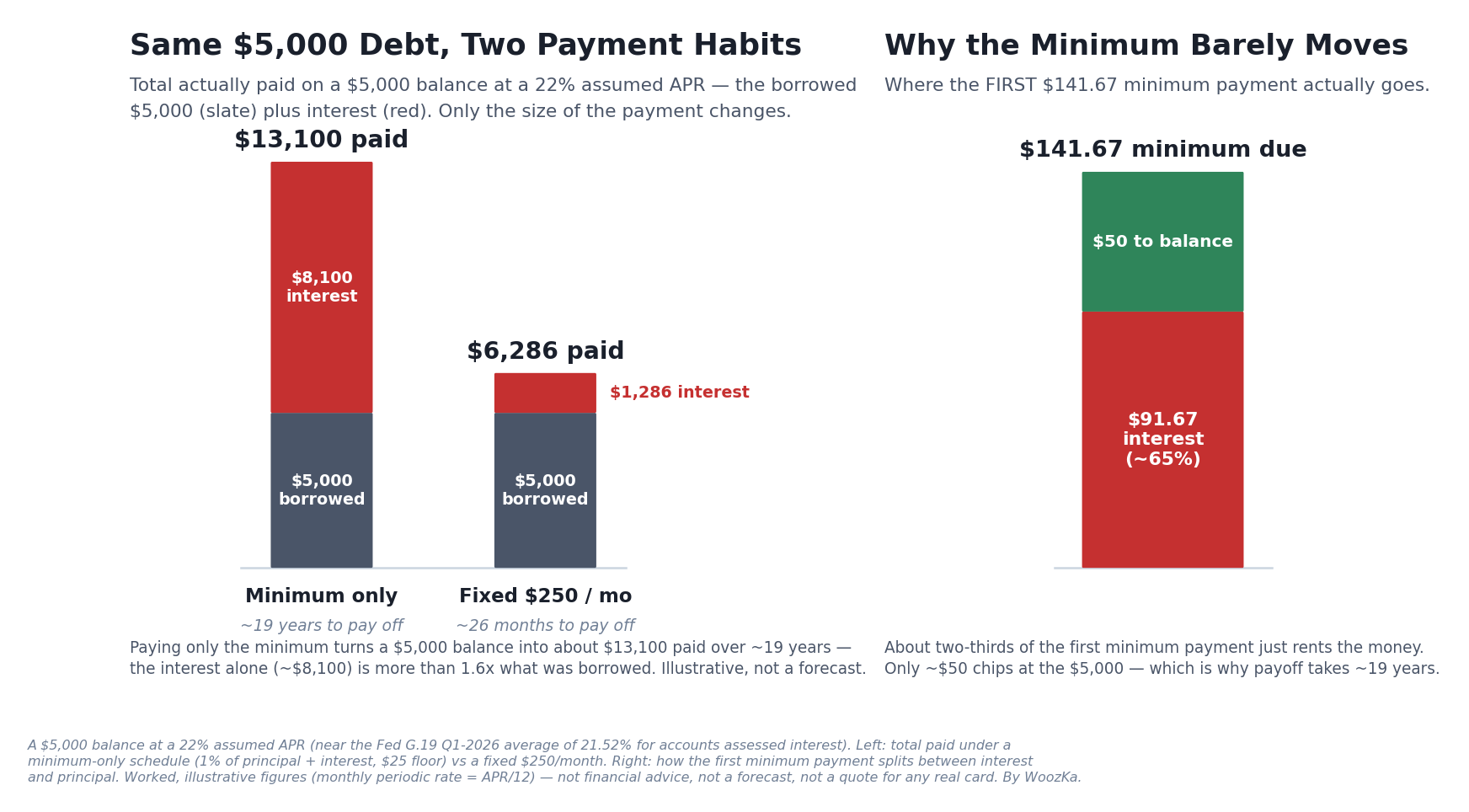 Left: the same $5,000 balance costs about $13,100 over ~19 years if you pay only the minimum, but about $6,286 over ~2 years on a fixed $250/month — the interest bill drops from ~$8,100 to ~$1,286. Right: the minimum is structured so most of your first payment just rents the money — only about $50 of the first $141.67 touches the balance. Both panels are illustrative examples built from the sourced figures below, using a stated 22% APR — not any real card’s terms, and not a recommendation.
There is a number on your credit-card statement that costs more money than almost any investment decision you will ever make, and it is not the balance. It is the minimum payment — specifically, the quiet assumption that paying it is “handling” the debt. It isn’t. The minimum payment is engineered to keep a balance alive for as long as legally comfortable, and the arithmetic of why is worth seeing once, in full, because once you’ve seen it you can never un-see it on your own statement.
This is foundational money literacy, not financial advice. Nothing here tells you which card to get, whether to pay off a balance instead of investing, or what to do with your money — it shows you how the cost of a carried balance is calculated so you can run the numbers on your own statement and make your own call. Every figure below is a worked, clearly-labeled example using a stated interest rate, not a quote for any real card. Let’s start with the scale of the thing, then do the math.
The One-Sentence Version
A credit-card balance carried month to month is one of the highest-cost, most-certain expenses a household can hold — and the minimum payment is designed so that most of it goes to interest, which is exactly why a balance can outlive a decade.
Everything below is the arithmetic behind that sentence.
The Scale of the Problem
Carried credit-card debt is not a fringe problem; it is a mainstream one. Americans owed about $1.25 trillion on credit cards as of the first quarter of 2026, according to the Federal Reserve Bank of New York’s Household Debt and Credit Report — a figure that rose about 5.9% from a year earlier even as it dipped seasonally from the prior quarter [source: Federal Reserve Bank of New York, Household Debt and Credit Report, Q1 2026, released May 12, 2026 — confirm current; the New York Fed reissues this report every quarter]. About 78% of U.S. adults — 208 million of 267 million — had a credit card in their own name at the end of 2023, and by year-end 2024 there were 608 million open general-purpose accounts against 185 million open private-label ones, 793 million between them [source: Consumer Financial Protection Bureau, Consumer Credit Card Market Report, 2025 edition released December 2025; the combined account total is arithmetic on the report’s own two figures].
The cost of all that carried debt is enormous and going in the wrong direction. In 2024, consumers were assessed roughly $160 billion in credit-card interest — up from about $105 billion in 2022 — plus about $31.3 billion in fees, per the CFPB’s market report [source: CFPB, Consumer Credit Card Market Report, 2025 edition]. And the rates behind those charges are historically high: as of the first quarter of 2026, the average interest rate across all U.S. credit-card accounts was about 21.0%, and about 21.5% for accounts actually assessed interest — that is, accounts carrying a balance — according to the Federal Reserve’s G.19 Consumer Credit release [source: Federal Reserve Statistical Release G.19, Q1 2026 — confirm current; the figure moves with the Fed’s rate decisions]. The CFPB found average APRs on general-purpose cards reached about 25.2%, and about 31.3% on private-label (store) cards, in 2024 — the highest levels in its data going back to at least 2015 [source: CFPB, Consumer Credit Card Market Report, 2025 edition].
Those are averages, used here to make the math concrete — your own rate could be well above or below them, and this is not a claim about any specific card. But they set the stage: at rates north of 20%, how you pay a balance down matters enormously. Which brings us to the minimum payment.
What “Minimum Payment” Actually Means
The minimum payment is not a suggestion of what you should pay. It is the smallest amount that keeps your account current, and card issuers calculate it with a formula that is worth understanding, because the formula is the whole trap.
Most large issuers set the minimum as roughly 1% of your principal balance, plus the interest and any fees charged that billing cycle [source: CFPB findings, via NerdWallet, “How Credit Card Issuers Calculate Minimum Payments,” 2026]. Other issuers use the greater of a flat percentage of the balance — commonly 1% to 3%, with 2% typical — or a small dollar floor, usually $25 to $35 [source: Experian, “How Are Credit Card Minimum Payments Calculated?,” 2026; NerdWallet, 2026]. You can find the exact method your card uses in your cardholder agreement or on your statement.
Look closely at the first method, because it is the most common and the most revealing. If the minimum is “1% of the balance plus the interest,” then by construction the minimum barely exceeds the interest — it covers the month’s interest and chips away just 1% of what you owe. A balance falling by 1% a month is a balance that takes many years to disappear. The formula isn’t hidden or illegal; it’s printed plainly. It’s just designed around the lender’s interest, not yours.
The Worked Example: $5,000 at 22%
Let’s make it real with a single, fully-worked example. Take a $5,000 balance at a 22% APR — an illustrative rate chosen because it sits just above the ~21.5% average for accounts carrying a balance in early 2026; it is a stated assumption, not a quote for any real card. To keep the math transparent and checkable, we’ll use a monthly periodic rate of 22% ÷ 12 ≈ 1.833% per month (real cards typically accrue interest daily, which can push the actual totals a touch higher) [author’s own calculation; illustrative, assumptions stated].
Paying only the minimum — using the common “1% of principal plus interest, with a $25 floor” method — that $5,000 balance takes about 230 months, or roughly 19 years, to reach zero, and costs about $8,100 in interest along the way. You would pay back about $13,100 in total on $5,000 borrowed — meaning the interest alone is more than 1.6 times the original balance [author’s own calculation; illustrative]. That is the tall left bar in the featured chart. Nineteen years is not a typo. A balance you could have run up on a single furniture purchase can, on minimum payments, follow you from one apartment to the next, through job changes and moves, quietly costing more in interest than it did to buy the thing in the first place.
Why so long? The right panel of the chart answers it. In the very first month, the interest on $5,000 at 1.833% is about $91.67. The minimum payment that month is about $141.67 — so of that first payment, $91.67 goes straight to interest and only about $50 actually reduces the balance [author’s own calculation; illustrative]. Roughly two-thirds of your first payment just rents the money; one-third does any real work. And because the balance falls so slowly, next month’s interest is only slightly smaller, so the pattern repeats for years. That is the mechanism. The minimum payment isn’t paying down your debt so much as feeding it.
The Lever: A Fixed Payment Changes Everything
Here is the part that turns this from a horror story into something useful. The single most powerful variable in that whole calculation is one you control: the size of the payment. Because minimum payments shrink as the balance shrinks, they stretch the timeline; a fixed payment that doesn’t shrink attacks the principal harder every month, and the effect compounds in your favor.
Run the same $5,000 at 22%, but pay a fixed $250 a month instead of the declining minimum. The balance is gone in about 26 months — a little over two years — for about $1,286 in total interest [author’s own calculation; illustrative]. That’s the short right bar in the chart’s left panel. Same debt, same rate, same starting point: the only thing that changed was holding the payment flat at $250 instead of letting it slide down to the minimum. The result is roughly $6,800 less interest and about 17 fewer years. You didn’t need a windfall or a balance transfer or a clever trick — just a payment that doesn’t get smaller every month.
This is the honest, non-magical lesson of the whole topic: with high-rate revolving debt, paying more than the minimum is not a moral virtue, it is arithmetic, and the arithmetic is dramatic. Even a payment modestly above the minimum bends the curve; a fixed payment bends it hard.
The Same Payment, Held Flat: Separating the Two Levers
The comparison just above moves two things at once. It raises the payment from $141.67 to $250 and stops it shrinking, then credits the result to holding it flat. Those are separable, and separating them is where the surprise is — because you can take the very first minimum payment, $141.67, and simply never let it fall.
Not one extra dollar in month one. The same check, written every month until the balance is gone:
| Payment plan | First payment | Months | Total interest |
|---|---|---|---|
| Minimum only | $141.67 | 230 (19 yr) | $8,099.77 |
| First minimum, held flat | $141.67 | 58 (5 yr) | $3,121.43 |
| Statement’s 3-year payment | $190.95 | 36 (3 yr) | $1,874.28 |
| A fixed $250 | $250.00 | 26 (2 yr) | $1,285.72 |
The first two rows begin identically. Same balance, same rate, same $141.67 payment in month one — and they end 172 months and $4,978.35 apart. Per dollar borrowed that is $1.62 of interest against $0.62 — the same first check, 2.6 times the cost. The entire difference is that one payment is allowed to shrink and the other is not. That is the cleanest possible statement of this article’s own point: the minimum is not expensive because it is small, it is expensive because it keeps getting smaller, and it does so precisely as fast as the balance falls, which is what stretches the timeline to 230 months.
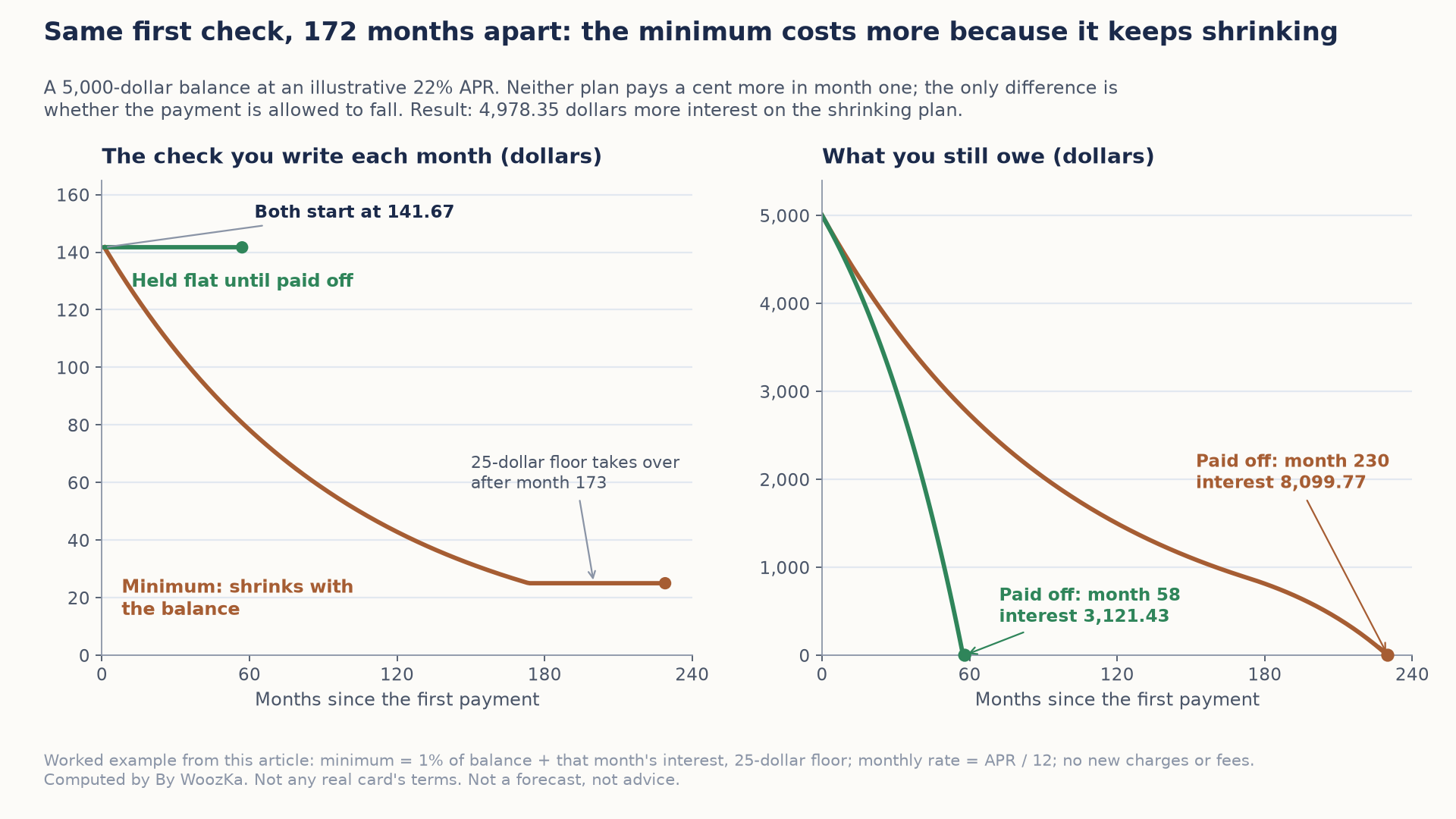 Both plans write the same 141.67-dollar check in month one. The only difference is that the minimum is allowed to shrink, and that alone adds 172 months and 4,978.35 dollars of interest.
The third row is the one already printed on your statement. Regulation Z requires the warning box to show the fixed payment that would clear the balance in three years; on this example that payment is $190.95 — just $49.29 a month more than the minimum. That $49-and-change is the whole distance between 230 months and 36, and between $8,099.77 of interest and $1,874.28. It is also worth noticing that the $250 used above is already more than the three-year figure, which is why it lands a little inside three years.
Why the Interest Rate Is Not the Trap
Here is the part that is genuinely counterintuitive, and it falls straight out of the formula rather than out of any simulation. If the minimum is 1% of the principal plus the interest charged that cycle, then the interest term appears on both sides and cancels:
payment − interest = (0.01 × balance + i × balance) − i × balance = 0.01 × balance
The principal you retire is exactly 1% of the balance whatever the rate is. A $5,000 balance sheds exactly $50.00 in month one at 21.0% and exactly $50.00 in month one at 31.3%. The balance traces the identical path at every rate on this table — 99% of last month’s balance, month after month:
| APR | Interest, month 1 | Principal, month 1 | Months | Total interest |
|---|---|---|---|---|
| 21.0% | $87.50 | $50.00 | 228 | $7,707.72 |
| 21.5% | $89.58 | $50.00 | 229 | $7,903.64 |
| 22.0% | $91.67 | $50.00 | 230 | $8,099.77 |
| 25.2% | $105.00 | $50.00 | 236 | $9,360.94 |
| 31.3% | $130.42 | $50.00 | 247 | $11,787.59 |
Read the third column down: it does not move. Then read the last two. Across a rate range of more than ten percentage points — from the average card to a store card — the payoff time moves only from 228 months to 247, while the interest bill moves from $7,707.72 to $11,787.59. The rate barely changes how long you are in debt. It changes how much you pay to be there. The thing setting the timeline is the 1%.
Which leaves one loose end worth naming, because it inverts what the term looks like. A balance falling 1% a month is exponential decay, and exponential decay never reaches zero — on the percentage formula alone this debt would run forever. The $25 floor, the least generous-looking clause in the whole formula, is the only reason it ever terminates. On the 22% example the percentage formula governs the first 173 months and the floor grinds out the last 57: roughly a quarter of the sentence is served by the one term that looks like a penalty.
The assumptions behind these payment schedules, stated so you can test them. The monthly periodic rate is APR ÷ 12, the convention this article states above; real cards typically accrue interest daily, which makes actual totals modestly higher than these, so every figure here is a floor rather than a ceiling. The schedules assume no new charges and no fees. The “1% of principal plus interest, with a $25 floor” minimum is the common method sourced earlier in this article, not a universal one — some issuers use a flat 2% of the balance, or a different floor — so your own cardholder agreement is what governs your card. These are worked illustrations on a stated rate, not any real card’s terms, not a recommendation, and no investment return is assumed anywhere. The code behind them reports every number above; it also re-derives this article’s own published figures from scratch — the 230-month payoff, the $8,100 interest bill, the $141.67 first payment, the 24.36% effective annual rate and the $1,285.72 on a fixed $250 — and checks that each one matches before reporting anything, so the article checks out against its own arithmetic.
The Pay-It-Off-vs-Invest Question, as Arithmetic
The comparison, run both ways: leave $5,000 sitting on a 22% card for three years and it compounds to $9,616.31. Put the same $5,000 into an investment returning 7% over those same three years and you have $6,164.63. The debt runs $3,451.68 ahead of the investment — and note that a 22% APR compounded monthly is really 24.36%, so the number on the statement understates what it costs you. That gap is why “pay it off or invest?” is usually not a close call at card rates. Change the balance, the rate and the horizon in the Compound Growth Calculator to find where it stops being obvious for your own numbers.
Once you see that a carried balance costs an effective rate north of 20%, an obvious question follows: is money better spent paying it down or investing it? This article won’t answer that for you — it’s a personal decision that depends on your full situation — but it will show you the arithmetic that belongs in the decision, because that arithmetic is unusually clean.
When you pay down a balance charging, say, 22%, the interest you avoid is a certain number. Every dollar you put toward that balance stops costing you about 22% a year, with daily compounding pushing the effective cost to roughly 24.6% [author’s own calculation; illustrative]. That avoided cost is known and locked in — it does not depend on what any market does. An investment return, by contrast, is uncertain: the long-run average of a diversified stock portfolio is far below that carried-balance rate, and it comes with real volatility and the genuine possibility of loss in any given year. So the arithmetic of the trade-off is that paying down a ~22% balance produces a certain saving that a typical investment return is unlikely to match — a rare case where the “safe” move and the high-return move are the same move.
That is the math, and only the math. It is not an instruction to pay off every balance before investing a dollar — reasonable people weigh other things: keeping a cash buffer so a surprise doesn’t send them right back to the card, capturing an employer retirement match, the psychological weight of debt, and their own goals and circumstances. The decision is yours. What this section gives you is the number to put on one side of the scale. For the broader framework on which debts are worth carrying and which aren’t, see Good Debt vs Bad Debt; for why a carried balance sits squarely on the liability side of your personal ledger, see Assets vs Liabilities; and for the cash cushion that keeps a single emergency from becoming a new balance, see Emergency Fund Math.
What Actually Helps (and What’s Just Noise)
Because this is a mechanism, not a personality flaw, the things that help are mechanical too — and none of them is a gimmick:
- Pay more than the minimum, and keep the payment fixed. As the worked example shows, this is the single biggest lever, and it’s entirely in your control. A payment that doesn’t shrink with the balance is what collapses the timeline.
- Attack the highest-rate balance first. If you carry more than one balance, the arithmetic favors putting extra dollars toward the highest APR, because that’s where each dollar avoids the most interest. (Some people instead pay the smallest balance first for the motivational win — that’s a behavioral choice, not the lowest-cost one; both are defensible, and the cost difference is usually modest.)
- Stop adding to the balance. New purchases on a carried balance can start accruing interest immediately, because carrying a balance often forfeits the interest-free grace period on new spending [source: CFPB, “How does my credit card company calculate the amount of interest I owe?,” 2026]. The math above assumes no new charges; new charges make it worse.
- Understand what a lower rate would do — then confirm the real terms. A lower APR, whether from a balance-transfer offer or otherwise, changes the arithmetic in your favor, but such offers carry their own fine print (transfer fees, promotional windows that expire, go-to rates). Those are mechanisms to evaluate with the same math, not products this article recommends. Run the numbers on the actual terms before assuming a switch helps.
What doesn’t help is anything promising to erase debt effortlessly. Treat “settle your debt for pennies” pitches and upfront-fee “credit repair” offers with heavy skepticism — the durable path out of a carried balance is unglamorous arithmetic: a fixed payment, larger than the minimum, aimed at the highest rate, with no new charges piling on.
Read Your Own Statement: The Warning Box
You don’t have to take any of this on faith, because federal law already puts the proof on your own statement. Since the Credit CARD Act of 2009, U.S. credit-card statements must include a minimum-payment warning: a box showing how long it would take to pay off your current balance making only minimum payments, roughly how much you’d pay in total, and the fixed monthly payment that would clear the balance in three years [source: Credit CARD Act of 2009, implemented through Regulation Z; CFPB]. Find that box on your next statement and compare its two rows. The gap between the “minimum payment” timeline and the “pay off in 36 months” timeline is this entire article, printed by your own issuer. It is the cheapest financial lesson you will ever get, and it’s already in your mailbox.
A 30-Second Checklist for a Carried Balance
Whenever you’re carrying a balance, four questions tell you what it’s really costing and what to do about it:
- What’s the APR, and is it accruing daily? A rate above 20% compounding daily is expensive money; know the number.
- What does the minimum actually cover? If it’s “1% plus interest,” most of it is interest — the minimum is barely treading water.
- What’s the biggest fixed payment I can hold steady? Not the minimum — a flat, larger number is what collapses the payoff time.
- What does my statement’s warning box say? Compare the minimum-only timeline to the 36-month payment. That gap is your opportunity, quantified by your own lender.
Answer those four and you’ve done more real analysis of your debt than most people ever do — using nothing but the numbers already on your statement.
The Bottom Line
A carried credit-card balance is expensive in a specific, checkable way: at rates above 20%, and with a minimum payment engineered to cover little more than the interest, a balance can take the better part of two decades to clear and cost more in interest than it did to run up. On a $5,000 balance at 22%, paying only the minimum runs about 19 years and about $8,100 in interest — roughly $13,100 paid on $5,000 borrowed — while a fixed $250 a month clears it in about two years for about $1,286. Same debt, same rate; the payment size is the whole story. And because the avoided interest is certain, paying down high-rate debt is one of the few places in personal finance where the safe move and the high-return move line up — though whether to prioritize it over other goals is your call, not this article’s. This is the “secure the base” step the rest of this site keeps pointing to: you can learn to read a rate with APR vs APY and understand the economic machine at the macro level, but the highest-certainty win available to most households is quietly sitting on their own credit-card statement.
Disclaimer: This article is educational content, not financial advice. I am not a licensed financial advisor, and nothing here is a recommendation to buy or sell any security or asset. Investing and trading involve risk, including the possible loss of the money you invest. Do your own research and consider consulting a licensed financial professional before making investment decisions. Read the full Disclaimer. Historical and backtested results are hypothetical, carry inherent limitations, and do not guarantee future results. Figures were accurate to the best of my knowledge as of this article’s last-updated date and may have changed.
This is the debt-cost piece of the money-terminology cluster: once you can read a rate (APR vs APY), size a cash cushion (Emergency Fund Math), and see how credit scores actually work, the last everyday number worth mastering is what a carried balance truly costs. For the weekly market read this blog uses — and the fear-and-greed discipline from the Autopilot Plan — subscribe to the newsletter below and grab the money-foundations checklist.
