Common Crypto Scams and How to Spot Them Before You Lose Money
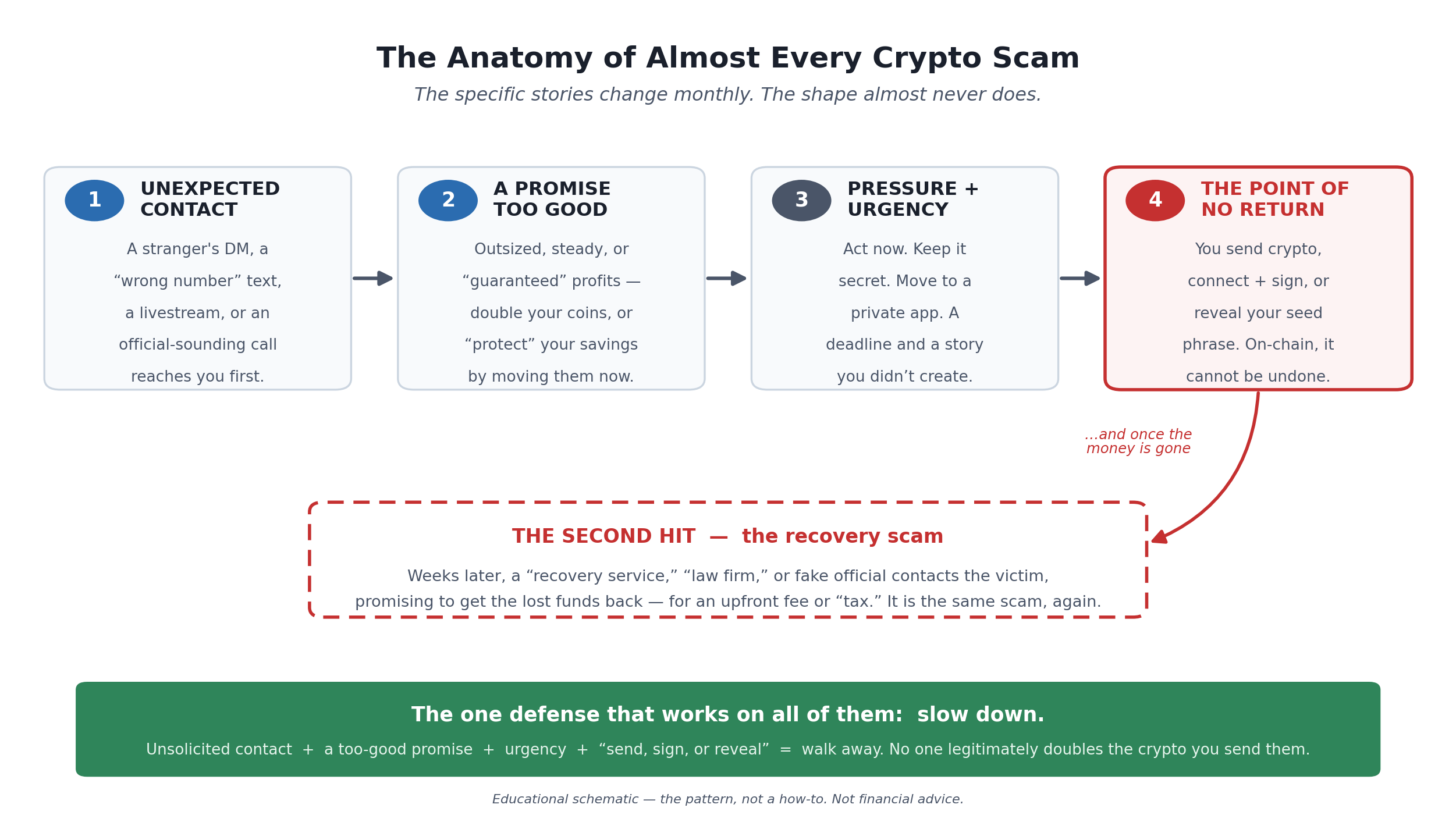
Almost every crypto scam, regardless of the cover story, walks through the same four steps — and then, for many victims, a fifth. Learn the shape and you’ll recognize versions you’ve never seen before.
If you’ve read the pillar on buying your first Bitcoin safely, you already know the single hardest fact about crypto: moving it is usually irreversible. There is no chargeback, no fraud department that reverses the transfer, no support line that claws the money back. That one property is exactly why fraud has migrated onto crypto rails so aggressively — and why the most valuable skill a beginner can build isn’t picking coins, it’s recognizing a scam before the irreversible step.
The numbers are not small. The FBI’s Internet Crime Complaint Center logged roughly 149,000 complaints involving digital assets in 2024, totaling about $9.3 billion in reported losses — a 66% jump over the prior year [source: FBI IC3 2024 Annual Report, April 2025]. The Federal Trade Commission reported that Americans lost $5.7 billion to investment scams in 2024, up 24%, and that consumers reported losing more money to scams paid with bank transfer or cryptocurrency than to all other payment methods combined [source: FTC, “New FTC Data Show a Big Jump in Reported Losses to Fraud to $12.5 Billion in 2024,” March 2025]. Blockchain-analytics firm Chainalysis estimated crypto scam losses reached a record ~$17 billion in 2025, with the average scam payment rising from roughly $782 in 2024 to $2,764 in 2025 as AI-generated impersonation made the cons more convincing [source: Chainalysis, “2026 Crypto Crime Report: Scams,” January 13, 2026].
One more thing up front, because it frames everything below: crypto assets are volatile and can lose all their value on their own, without any fraud involved. Nothing here is a reason to think crypto is “safe if you just avoid scammers.” This article is about not handing your money to a thief on top of the market risk you’re already taking — and it is educational content, not advice, and not a suggestion to hold crypto in any amount.
Why Crypto Is the Scammer’s Favorite Payment Rail
Before the specific scams, understand why so many old cons have put on a crypto costume. It comes down to a handful of properties that are genuine features of the technology and, for a fraud victim, genuine bugs:
- Transfers are irreversible. Once a transaction confirms, it’s final. A bank wire can sometimes be recalled within a window; a credit-card charge can be disputed; a crypto transfer generally cannot.
- There’s no central fraud desk. No institution sits in the middle with the power — or the obligation — to reverse a payment or freeze an account on your behalf.
- It’s fast, global, and always open. Money can leave the country in minutes, at 3 a.m., on a holiday, which is exactly what a scammer running victims across time zones wants.
- It feels like technology, not money. Wallets, addresses, and apps add just enough unfamiliarity that a confident-sounding “manager” can talk a newcomer through steps they’d never take at a bank counter.
The takeaway isn’t “crypto is a scam.” It’s that the same con that used gift cards or wire transfers a decade ago now asks for crypto — because crypto removes the safety nets the con used to have to work around. That’s why the patterns below matter more than any single story.
The Shape Almost Every Scam Shares
Look at the diagram at the top of this article. Strip away the cover story and nearly every crypto scam runs the same four steps: unexpected contact → a promise too good to be true → manufactured urgency → an irreversible step (you send crypto, you connect a wallet and sign, or you reveal your seed phrase). For a large share of victims there’s a fifth step weeks later — a recovery scam that re-targets the same person. The specific characters change constantly; the skeleton almost never does. If you can name which step you’re standing on, you can step off before the irreversible one.
With that map in hand, here are the patterns you’ll actually meet — grouped by how they take the money.
Group A — Scams That Get You to Send the Money
1. The Relationship, Then the “Platform” (Pig Butchering)
This is the single costliest pattern, and the most emotionally engineered. It usually begins with a message that seems like a wrong number, a friendly stranger on social media, a match on a dating app, or an invitation into a group chat “full of successful investors” [source: FTC, “What To Know About Cryptocurrency and Scams,” consumer.ftc.gov; FTC social-media-scams reporting, 2025]. There’s no pitch at first — just conversation, sometimes for weeks. Trust builds. Eventually the new “friend” or “mentor” mentions a crypto platform or strategy that’s doing remarkably well, and offers to show you.
The platform is fake. It’s a slick website or app that displays rising balances and lets you make a small test withdrawal early on to prove it “works.” Then you’re encouraged to add more. When you finally try to take out a meaningful amount, you’re told you must first pay a “tax,” a “fee,” or “unlock” the account — more money that vanishes the same way. The FBI classifies this as cryptocurrency investment fraud, often called “pig butchering,” and it accounted for roughly $5.8 billion in reported losses across 41,557 complaints in 2024 alone [source: FBI IC3 2024 Annual Report].
The tell: an unexpected relationship — romantic, friendly, or professional — that drifts toward a specific investment only they introduced you to, on a platform they named, showing gains that look steady and outsized, where you can’t withdraw without paying something first. Steady, high, low-drama returns are the signature of a fake dashboard, not a real market.
2. The “Move Your Money to Safety” Call and the Bitcoin ATM
Here the emotional lever is fear, not romance. You get a call, text, or pop-up: your bank account has been “compromised,” there’s a “warrant” out for you, a “tech-support” agent needs to protect your computer, or a business you use flags a fraudulent charge. The fix, they say, is to move your cash somewhere “safe” — and increasingly, that means feeding it into a Bitcoin ATM (a crypto kiosk) using a QR code they provide, which sends the cash straight to their wallet.
The FTC’s data on these kiosks is stark. Reported losses at Bitcoin ATMs grew nearly tenfold from 2020 to 2023, then topped $65 million in just the first half of 2024 [source: FTC Data Spotlight, “Bitcoin ATMs: A payment portal for scammers,” September 2024]. Older adults are hit hardest: people 60 and over were more than three times as likely as younger adults to report a loss at these machines, and reported $46 million — about 71% of all Bitcoin-ATM losses — in the first half of 2024, with a median loss of $10,000. The overwhelming majority of these reports involve government impersonation, business impersonation, and tech-support scams [source: same FTC Data Spotlight].
The tell: anyone who creates a sudden crisis and then directs you to a crypto ATM or kiosk is running this scam. No real government agency, bank, or company will ever ask you to resolve a problem by putting cash into a Bitcoin machine. That instruction, by itself, is the whole diagnosis.
3. Giveaways, “Double Your Crypto,” and Deepfake Impersonation
The promise here is a mathematical impossibility dressed up as generosity: send some crypto to this address and you’ll instantly get back double. Modern versions are disturbingly polished. Scammers hijack YouTube channels, rebrand them to look like official Tesla, SpaceX, or exchange channels, and run 24/7 “live” streams featuring AI-generated deepfakes of public figures whose synthesized voices tell viewers to visit a site and deposit crypto to a giveaway [source: Engadget, “Deepfakes of Elon Musk are pushing crypto giveaway scams on YouTube Live”; Bitdefender reporting on crypto-doubling streams]. One fraudulent stream reportedly drew more than 30,000 concurrent viewers, and a single deepfake broadcast pulled in over $50,000 in under two hours [source: same reporting].
The tell: the offer inverts how the world works — you send first, on the promise of getting more back. No legitimate person, company, or celebrity doubles the crypto you send them. A famous face plus urgency plus a wallet address to send to is not an opportunity; it’s the entire con in three parts.
Group B — Scams That Drain the Wallet Directly
4. Phishing Sites, Fake Apps, and Wallet Drainers
Not every scam asks you to send funds. Some get you to authorize their removal. A “wallet drainer” is malware, usually planted on a convincing phishing site, that tricks you into signing a malicious transaction or token approval — after which the attacker can move your funds. Often they never see your keys at all; you clicked “confirm” on something you didn’t fully read. In 2024, wallet-drainer attacks stole roughly $494 million across about 332,000 victim addresses, up about 67% in losses over the prior year [source: Scam Sniffer 2024 Web3 Phishing Report, January 2025, as reported by BleepingComputer and Infosecurity Magazine]. The bait is usually a “connect your wallet and claim” offer — a free airdrop, a mint, a “check if you’re eligible” page.
The tell: any site that wants you to connect your wallet and then sign, approve, or grant a “permission” in exchange for something free or urgent. Reach wallets and exchanges through your own bookmarks, download apps only from official sources, and read what you’re approving on the device’s own screen. In crypto, “confirm” is final.
5. Fake “Support” and Seed-Phrase Phishing
Somewhere in your loss, panic, or confusion, “support” appears — a helpful account in your DMs, a search-ad “help line,” a lookalike email — offering to fix it. What they’re really after is your recovery phrase (seed phrase), your private key, or remote access to your device. This one has a bright-line rule that never has an exception:
The tell / the rule: no legitimate wallet, exchange, or company will ever ask for your recovery phrase. Anyone who does — “to verify,” “to sync,” “to restore,” “to help” — is a thief, 100% of the time. Real support never needs it, because the phrase is the whole wallet. Type it nowhere, tell it to no one.
6. Address Poisoning and Clipboard Swaps
This one exploits a small human habit: reusing an address from your transaction history instead of retyping it. In an address-poisoning attack, the scammer generates a “vanity” address whose first and last characters match one you actually use, then sends you a tiny or zero-value transaction so their lookalike address lands in your history. Later, when you go to send funds and copy “the usual address” from your past transactions, you copy theirs — and the money is gone [source: Cointelegraph, “How does zero-value transfer work?”; MetaMask Help Center, “Address poisoning scams”; Ledger Academy, 2025]. It costs the attacker almost nothing, which is why it scaled: address-poisoning losses ran to roughly $1.8 million in February 2025 and $1.2 million in March 2025, with a single incident exceeding $2.6 million in May [source: address-poisoning reporting, 2025].
The tell: you’re about to send to an address you “recognize” from history. Verify the entire destination address, not just the first and last few characters, and prefer a saved, verified address book or a small test transaction over copying from your transaction log.
Group C — Scams Built Into the “Investment” Itself
7. Rug Pulls and Fake Tokens
Sometimes the fraud is the asset. A new token launches with heavy hype, coordinated social buzz, and pressure to “get in early before it moons.” Once enough people have bought in, the creators pull the liquidity or dump their holdings, the price collapses to near zero, and buyers discover they can’t sell into a market that no longer exists. The project’s anonymous team disappears. Unlike the cons above, no one calls you — the trap is baited and you walk in.
The tell: an anonymous or unverifiable team, a token you heard about through hype rather than research, promises of outsized gains framed as near-certain, pressure to buy right now, and thin or locked liquidity that would make exiting hard. Age, transparency, and the ability to actually sell matter more than the size of the promised upside.
The word doing the most work there is research, and it has a concrete meaning rather than a vague one. A project publishes its own document setting out what the token is for, how many exist, who holds them, and what the team has committed to build — and those claims can be checked against each other before any money moves. How to read a crypto whitepaper walks through what to look for, and what an absent or evasive answer tells you.
Group D — The Scam After the Scam
8. Recovery and Refund Scams
This is the cruelest pattern, because it targets people who have already lost money. According to the FBI, almost all victims of cryptocurrency fraud are subsequently contacted by recovery-fraud schemes — scammers impersonating law enforcement, government agencies, law firms, or “asset recovery” companies, claiming they can get the lost funds back [source: FBI, “Cryptocurrency Investment Fraud” victim resources; FBI field-office recovery-scam advisories; CFTC, “Don’t be Re-Victimized by Recovery Frauds”]. They ask for an upfront fee, a “tax,” or a “retainer” — and once you pay, the requests keep coming.
The tell / the rule: anyone who contacts you promising to recover stolen crypto for a fee is running the second scam. The FBI does not charge victims a fee to investigate, does not ask for payment to release “recovered” funds, and does not move communications to private messaging apps [source: same FBI/CFTC guidance]. Legitimate help does not arrive as an unsolicited DM asking for money. If you’ve been defrauded, report it through the FBI’s Internet Crime Complaint Center at IC3.gov and the FTC at reportfraud.ftc.gov — and treat every “we can get it back” offer as a red flag, not a lifeline.
The Same Statistics, Divided by Each Other
Everything above is a catalog of shapes standing beside a wall of totals — billions here, complaint counts there — and none of those numbers is ever divided by another one. They are worth dividing, because the ratios say things the totals do not, and one of them explains why two figures in this very article appear to contradict each other. The FBI figures below were re-read from the IC3 2024 Annual Report itself rather than taken from the summaries: the report gives 149,686 crypto-referencing complaints where this article rounds to 149,000, and confirms the $9.3 billion, the 66% rise, and the 41,557 complaints exactly. Every result below was recomputed independently.
One Pattern Is a Quarter of the Complaints and Nearly Two-Thirds of the Money
| Category, 2024 | Complaints | Losses | Per complaint |
|---|---|---|---|
| All crypto-referencing | 149,686 | $9.3bn | $62,130 |
| Crypto investment fraud | 41,557 | $5.8bn | $139,567 |
| Share of the total | 27.76% | 62.37% | 2.246× |
The article calls the relationship-then-platform con “the single costliest pattern,” and the arithmetic says how costly: 27.76% of the complaints and 62.37% of the dollars. A complaint in that category averages $139,567 against $62,130 across all crypto fraud — 2.246 times as much. The last two numbers in that bottom row are not two findings but one: dividing the dollar share by the complaint share gives exactly the ratio of the averages, 2.246 either way. Concentration and severity are the same measurement seen from two directions.
The Age Pattern the Article States for Bitcoin ATMs Holds Across All of It
The Bitcoin-ATM section reports that people 60 and over are hit hardest at those machines. The IC3 report carries the same breakdown for crypto fraud as a whole, and the article does not use it. The over-60 group turns out to be both the largest group by count and the most expensive per complaint.
| Age | Complaints | Losses | Per complaint |
|---|---|---|---|
| Under 20 | 1,819 | $7.8m | $4,276 |
| 20–29 | 13,591 | $370.4m | $27,257 |
| 30–39 | 22,218 | $1,006.4m | $45,296 |
| 40–49 | 22,555 | $1,462.0m | $64,821 |
| 50–59 | 19,317 | $1,184.9m | $61,340 |
| Over 60 | 33,369 | $2,839.3m | $85,089 |
Measured against the under-20 average, the column climbs 6.4×, 10.6× and 15.2× through the twenties, thirties and forties, eases to 14.3× in the fifties, then peaks: an over-60 complaint averages $85,089, 19.9 times the under-20 figure and about a third more than the 40–49 group, which files a similar number of complaints. That group is 29.56% of the age-identified complaints and 41.32% of their dollars. The pattern the article notes at the kiosk is not a kiosk phenomenon; it runs through the whole dataset. One honest caveat about this table: it covers 112,869 complaints and $6.87 billion, not the 149,686 and $9.3 billion above, because the report excludes complaints with no age recorded — 75.4% of complaints and 73.9% of dollars carry one. The two tables cannot be mixed.
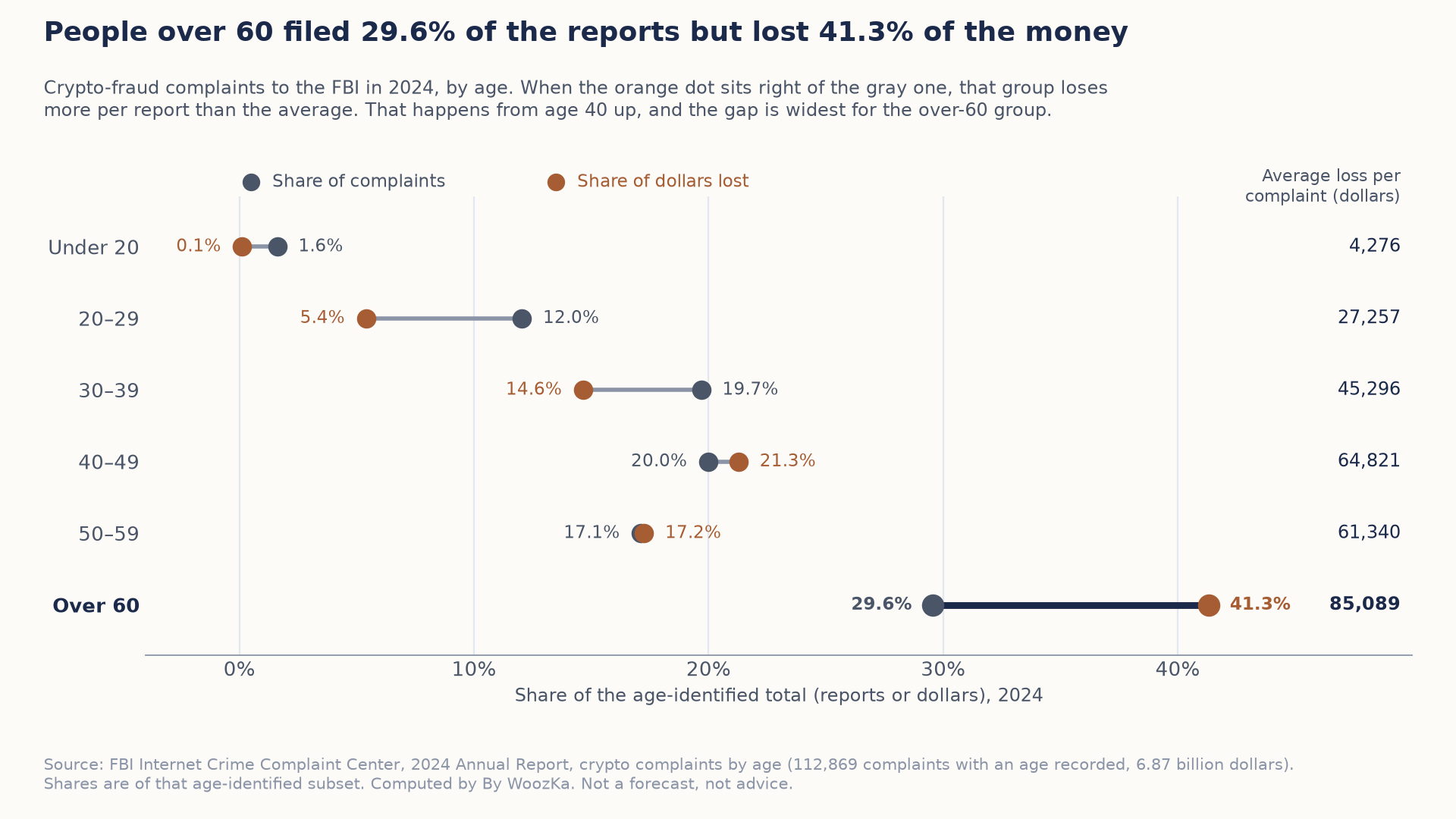
From age 40 up, each group’s share of the money lost is larger than its share of the complaints, and the gap is widest for people over 60.
Why Two “Average Loss” Figures Here Differ by Twenty-Two Times
The opening section reports an average scam payment of $2,764 in 2025. Divide the FBI’s own totals and you get $62,130. Both are in this article, four paragraphs apart, and both are correct.
| Figure | What it counts | Average |
|---|---|---|
| IC3, all crypto | Complaints filed with the FBI | $62,130 |
| IC3, investment fraud | The same, one category | $139,567 |
| Chainalysis 2025 | Scam payments traced on-chain | $2,764 |
The denominators are different populations. A complaint exists because somebody sat down and filed one with a federal agency, which selects hard for large losses; an on-chain estimate counts individual payments whether or not anyone ever reported them, and one victim can make several. A reader who treats either number as “the average” is wrong by a factor of about twenty-two in one direction or the other — and the same trap applies to the figures this analysis deliberately leaves alone. The Bitcoin-ATM section gives a median of $10,000, which cannot be divided into a total; and the FBI’s $9.3 billion and the FTC’s $5.7 billion count overlapping populations, so adding them is not a bigger number, it is a wrong one.
One last ratio, because it answers a question people ask about the deepfake streams. A single broadcast reportedly took over $50,000 in under two hours from an audience of over 30,000 concurrent viewers. At this article’s own 2025 average scam payment, that take is roughly eighteen payments — so at most eighteen people, about one viewer in 1,658, or 0.06%. The operation earned around $25,000 an hour while 99.94% of the audience did exactly the right thing. That is the useful way to read it: these cons are not built to persuade most people, and they do not need to. Recognition has to be the defense precisely because being in the sensible majority is not, by itself, protection — the stream runs until it finds the eighteen.
Method and limits, so this can be checked rather than taken on trust. Every figure was computed in code, and each result was checked before it appeared here. The FBI inputs were re-read from the IC3 2024 Annual Report PDF directly, not from secondary coverage, and the article’s figures matched it exactly apart from the rounding noted above; the age table is transcribed from that report. The other inputs — the Chainalysis averages and the deepfake-stream reporting — are the article’s own cited estimates, used as given and never as facts this analysis establishes; the stream figures in particular are single-incident press reports, and the eighteen-payment estimate applies a whole-market average to one broadcast, so treat it as an order of magnitude rather than a count. Averages over these distributions are means over a very long tail, which means most victims lost considerably less than any average here, and the wallet-drainer figures were left out entirely because that division is already done on this site in the wallets article. Complaint data measures what was reported, not what happened. Nothing here is a forecast, a security recommendation, or legal advice, and none of it changes the article’s own conclusion: the defense is recognizing the shape before the irreversible step.
The Unifying Tells (Print This List)
Notice how much the eight patterns overlap. Almost all of them light up several of these at once — and any one of them is reason to stop:
- You didn’t start the contact. The stranger, the “wrong number,” the DM, the caller, or the livestream came to you.
- The promise is too good. Outsized, steady, or “guaranteed” profits; doubling your money; “protecting” your savings by moving them now. Real markets don’t offer smooth, high, drama-free returns, and nobody legitimately doubles crypto you send first.
- There’s urgency and secrecy. A deadline you didn’t set, pressure to act before you can think, and requests to keep it private or move to a personal app.
- You’re asked to send, sign, or reveal. Send crypto to an address, connect a wallet and approve a transaction, or hand over your recovery phrase. The recovery phrase request is always a scam.
- You can’t get your money out without paying more. “Fees,” “taxes,” or “unlock” charges standing between you and your balance mean the balance was never real.
- An authority or a celebrity is invoked. A “government official,” a “bank,” a “tech-support agent,” or a famous face — plus, somewhere, a crypto address or kiosk.
The single habit that defeats nearly all of them is the one in the green band of the diagram: slow down. Scams are built to collapse your decision-making window. Stepping away for an hour — or a day — to verify through a channel you looked up yourself dissolves most of them.
A Sane Default Defense for a Beginner
None of this is a recommendation of any product; it’s the general, widely taught hygiene that makes you a hard target. Confirm current best practices yourself:
- Reach everything through your own bookmarks. Never through a link in an email, DM, ad, or text. Type it, bookmark it, use the bookmark.
- Treat unsolicited contact as guilty until proven innocent. No real institution resolves a “crisis” by having you buy crypto or move it to a kiosk. Hang up and call the organization back on a number you look up independently.
- Guard the recovery phrase offline and share it with no one — ever. Store it physically (paper or metal), never in a photo, cloud note, or synced app, and understand that anyone asking for it is a thief. As holdings grow, a hardware wallet moves your keys offline; see Crypto Wallets Explained for the full custody picture.
- Verify the full destination address every time, and read what you’re signing on the device’s own screen before you approve it.
- Assume no one doubles your crypto and no one guarantees a market return. Both are impossibilities, and both are bait.
- If you’re defrauded, report — and refuse the “recovery.” File with IC3.gov and reportfraud.ftc.gov, and treat any “we can recover your funds for a fee” contact as the next scam.
The goal isn’t paranoia. It’s a small set of reflexes — bookmarks, independent call-backs, address checks, and a hard “no” on the seed phrase — that make the whole catalog above bounce off you.
Almost everyone who spends time in crypto eventually gets the message — the too-friendly stranger who steers the conversation toward a “platform,” the group chat where everyone but you seems to be getting rich, the “support” account that appears the moment you post a question. The people who don’t lose money aren’t smarter or more technical; they’ve usually just seen the shape once before, felt the little tug of urgency, and recognized it for what it was. The first time you catch one in the wild — you notice the unsolicited contact, the too-good promise, the push to hurry — and simply stop, the whole thing loses its power. That recognition is the entire skill, and it’s learnable in an afternoon.
Where to Go Next
You now have the map: the common shape, the eight patterns, and the reflexes that neutralize them. To go deeper on the safety side this article opened:
- How to Buy Your First Bitcoin Safely: A Step-by-Step Guide — the pillar this piece supports, covering sizing, exchanges, real costs, and the buy itself.
- Crypto Wallets Explained: Hot vs Cold Storage for Beginners — custody, seed phrases, and the wallet-level failure modes several scams here exploit.
- Crypto Position Sizing: How Much of Your Portfolio Should Be Crypto? — how to bound your risk so no single loss can hurt too much.
- Best Crypto Exchanges Compared: Fees, Security, and Coin Selection — reaching real platforms through the front door, with current fees and security history.
If you’d like the plain-English read on crypto and investing — explained, never hyped, and always risk-first — that’s what the newsletter is for. Subscribe below.
Disclaimer: This article is educational content, not financial advice. I am not a licensed financial advisor, and nothing here is a recommendation to buy or sell any security or asset. Investing and trading involve risk, including the possible loss of the money you invest. Do your own research and consider consulting a licensed financial professional before making investment decisions. Read the full Disclaimer.
Historical and backtested results are hypothetical, carry inherent limitations, and do not guarantee future results. Figures were accurate to the best of my knowledge as of this article’s last-updated date and may have changed.
