How to Automate Your Investing: Recurring Buys on Every Major Brokerage
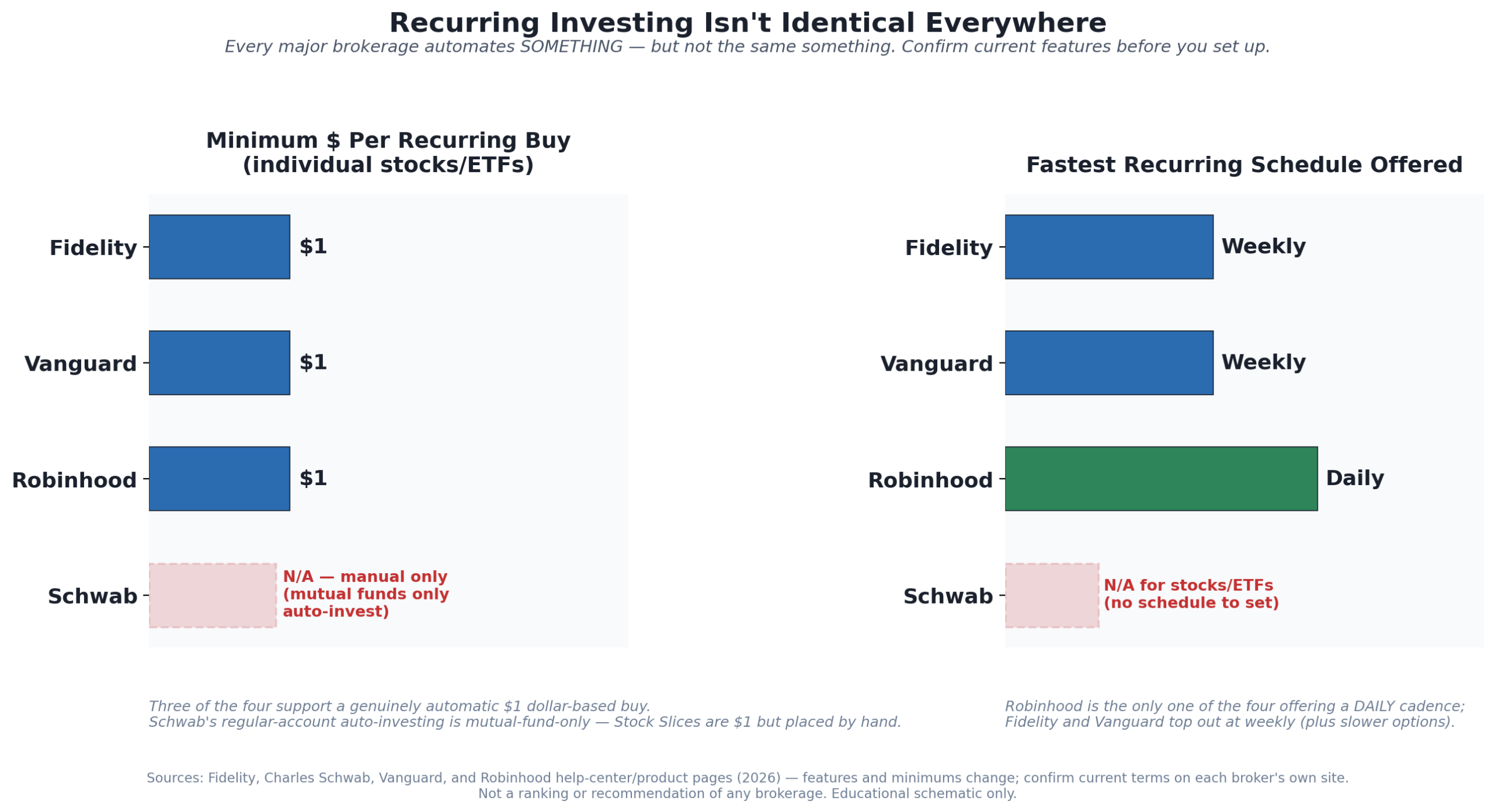
Three of the four brokerages here support a genuinely automatic $1 recurring buy directly into a stock or ETF; Schwab’s regular-account automation is built around mutual funds instead, and Robinhood is the only one offering a daily schedule. Sources: each broker’s own help-center pages, 2026 — confirm current features before you set anything up.
The Autopilot Plan is built on one idea: a fixed amount, invested on a fixed schedule, with no decision required once it’s set up. That article covers the what and the why. This one covers the how — the actual settings screen, broker by broker, that turns “I should really automate my investing” into a recurring order that runs whether or not you remember it exists next Tuesday.
The mechanics are genuinely simple once you’ve done them once. But they are not identical across brokerages, and one of the differences below is the kind of thing that trips people up: a large, well-known broker that most people assume automates everything actually doesn’t — not for individual stocks and ETFs, anyway. More on that shortly. Nothing in this article ranks or recommends a specific brokerage; it explains what each one’s automation feature actually does, mechanically, as of 2026, so you can set it up correctly on whichever one you use.
What “Automatic Recurring Investing” Actually Means
At its simplest, a recurring investment is a standing instruction you give a broker once: on this schedule, for this dollar amount, buy this stock or fund — automatically, without you placing a new order each time.
The feature that makes this clean is dollar-based (rather than share-based) ordering combined with fractional shares. Instead of specifying “buy 2 shares,” you specify “invest $25,” and the broker converts that dollar amount into however many whole-or-fractional shares it buys at the market price that day. That’s what lets a $10-a-day or $50-a-week plan run on autopilot regardless of what a single share happens to cost — the mechanics of why that matters are covered in more depth in What Are Fractional Shares?; this article assumes that piece as background and focuses on the recurring-schedule feature itself.
Two things happen behind the scenes on the date you’ve scheduled: money moves (from a linked bank account or from cash already sitting in your brokerage account), and an order gets placed and filled, typically sometime during that day’s regular market hours. If the scheduled date lands on a weekend or market holiday, brokers generally roll the purchase to the next trading day rather than skipping it.
The Universal Setup, in Five Steps
Regardless of which broker you use, setting up a recurring investment follows roughly the same sequence:
- Open the detail page for the specific stock or ETF you want to buy (not a general “deposit” or “transfer” screen — the recurring order is usually tied to a specific security).
- Select the recurring or automatic investment order type, as opposed to a one-time buy.
- Enter a dollar amount rather than a share count, so the fractional-share math is handled for you.
- Choose a frequency and start date — the options that are actually available vary by broker, covered below.
- Choose a funding source — a linked bank account (via ACH transfer) or cash already sitting in the brokerage account’s core/settlement position, again depending on the broker.
That’s the whole shape of it. The differences that matter are which securities each broker will let you put on autopilot this way, what the minimum dollar amount is, and how fast a schedule you can set — which is where the four major brokerages below genuinely diverge.
Fidelity
Fidelity supports recurring investments directly into individual stocks, ETFs, mutual funds, and its own “Basket Portfolios” product, across brokerage, retirement, HSA, and 529 account types [source: Fidelity, “What are recurring investments and how do you set them up?,” fidelity.com, 2026].
- Minimum: as little as $1 per recurring purchase for stocks, ETFs, and baskets ($10 minimum for mutual funds) [source: Fidelity, 2026].
- Frequency: weekly, every two weeks, or monthly [source: Fidelity, 2026].
- Funding: from your Fidelity core cash position or a linked bank account [source: Fidelity, 2026].
- Setup path: open the stock or ETF’s detail page, choose “Recurring Investment” from the Trade menu, select the security type (Stocks/ETFs, Mutual Funds, or Basket Portfolios), and enter amount, frequency, and funding source [source: Fidelity, 2026].
Vanguard
Vanguard added true dollar-based, fractional-share recurring purchases for its own ETFs directly in its brokerage account — a meaningfully newer feature than its long-standing mutual-fund automatic investment plans [source: Vanguard, “How recurring investing could help you save more,” investor.vanguard.com, 2026].
- Minimum: $1 for a recurring ETF purchase; amounts can run up to $25,000 per instruction [source: Vanguard, 2026].
- Frequency: weekly, biweekly, or twice-monthly options, set to repeat indefinitely or through a fixed end date [source: Vanguard, 2026].
- Funding: for ETF recurring purchases specifically, the money must already be sitting in the account’s settlement fund by the scheduled date — unlike some competitors, Vanguard’s ETF auto-buy does not itself pull directly from an external bank account on the purchase date, so you need a separate transfer or standing deposit set up to keep the settlement fund stocked [source: Vanguard, 2026; Bogleheads community documentation of the feature, 2026 — confirm current funding mechanics directly with Vanguard before relying on this]. Mutual fund automatic investments, by contrast, can draw from an external linked bank account [source: Vanguard, 2026].
- Dividend reinvestment: Vanguard ETF holders can separately opt to have dividends automatically buy more fractional shares of the same fund [source: Vanguard, 2026].
Robinhood
Robinhood’s recurring-investment feature is broad in scope: one interface handles stocks, ETFs, and crypto, and it offers the fastest schedule of the four brokerages covered here [source: Robinhood, “About recurring investments and orders,” robinhood.com, 2026].
- Minimum: dollar-based orders with no fixed floor beyond what a fraction of a share will accept; Robinhood’s own materials describe $10 as the most common recurring amount, though smaller amounts are supported [source: Robinhood, 2026].
- Frequency: daily, weekly, biweekly, or monthly — the only one of the four with a daily option [source: Robinhood, 2026].
- Funding: your account’s buying power or a linked bank account. If you pay with buying power, you can add a backup payment method so a recurring order isn’t skipped when buying power runs out; an order funded straight from the bank can wait up to 5 business days for the transfer unless instant deposits cover it [source: Robinhood, “About recurring investments and orders,” robinhood.com, 2026].
- A genuinely useful gotcha: not every security qualifies. Robinhood generally requires a share price above $1 and a market capitalization of at least $25 million, and it excludes inverse, leveraged, and volatility exchange-traded products, along with pre-IPO instruments and anything that doesn’t support fractional trading [source: Robinhood, 2026]. If you can’t find the recurring-investment option on a specific ticker, this eligibility list is the first thing to check.
- Dividend reinvestment (DRIP): available as a separate, distinct setting from recurring investments — worth turning on alongside your recurring buy if you want dividends working continuously too [source: Robinhood, “Dividend reinvestment (DRIP),” robinhood.com, 2026].
Schwab — the Exception Worth Knowing
Here’s the detail most people assume isn’t true until they check for themselves: Charles Schwab, one of the largest brokerages in the country, does not currently offer a fully automatic, schedule-it-and-forget-it recurring purchase into individual stocks or ETFs in a standard brokerage account.
Schwab’s fractional-share feature — “Stock Slices,” now folded into its general “fractional shares” branding — lets you buy a slice of most U.S.-listed stocks and ETFs for as little as $1, commission-free [source: Charles Schwab, “Fractional Shares—Invest in Stock Slices,” schwab.com, 2026]. That part works exactly like fractional investing at any other broker. The part that doesn’t carry over is automation: each fractional-share purchase at Schwab is placed manually. There is no recurring-schedule setting attached to Stock Slices the way there is for Fidelity’s, Vanguard’s, or Robinhood’s stock/ETF recurring investments. Schwab’s true “set it and walk away” automatic investing plan exists, but it’s built around eligible mutual funds, not individual stocks or ETFs [source: brokerage feature comparisons and Schwab’s own automatic-investing program documentation, 2026 — this is a narrower, more specific claim than most broker comparisons make, so confirm directly on Schwab’s site before assuming either way, since broker features change without much notice].
This isn’t a criticism of Schwab — its mutual fund lineup and overall cost structure remain competitive, and a Schwab account can still absolutely support the Autopilot Plan’s base rule if you’re comfortable investing in a low-cost index mutual fund instead of an ETF, or you’re willing to manually place the same-sized Stock Slices purchase yourself on a set day each week or month. But if the entire point of automating is to remove the recurring manual decision, a Schwab account currently asks you to make that decision by hand for individual securities — worth knowing before you assume otherwise.
If you came here to automate VOO or another ETF at Schwab
Schwab’s own walkthrough draws the boundary in one sentence. Automatic investing lives under Trade → Automatic Investing, and the page states plainly that “only mutual funds are eligible for automatic investments” [source: Charles Schwab, “How to automatically invest in mutual funds,” schwab.com — the walkthrough and its transcript, read 2026-08-23]. So a standing automatic purchase of VOO, or of any other ETF, is not something a standard Schwab brokerage account will set up for you. That is the answer to the question most people arrive with, and it has not changed.
Three further conditions sit on that same page, and each one catches people who assume enrollment is the whole job:
- You have to already hold the fund. Automatic investing enrolls positions you own — eligible funds appear in a table for you to enroll. Hold nothing eligible and the screen simply tells you there is nothing to enroll.
- Some account types are excluded outright. Managed accounts are named as ineligible.
- The cash has to be sitting there on the day. The plan invests from your account balance; it does not pull from your bank as part of the transaction. Schwab’s own instruction is to cover it by transferring manually or setting up a separate recurring transfer — so “fully automatic” at Schwab is really two standing instructions, not one.
The workaround, where there is one, is a change of instrument rather than of broker: index mutual funds are the class Schwab’s automatic investing does cover, and an S&P 500 index mutual fund follows the same benchmark VOO follows. Eligibility is set fund by fund, so it still has to be checked on the enrollment screen rather than assumed. And it is a genuine trade, not a free substitution — a mutual fund prices once a day at net asset value instead of trading intraday, and its cost structure is its own. Nothing here recommends any fund, broker, or instrument; the point is only that the automation you were looking for attaches to one of these and not the other.
Other Brokers Worth Knowing About
The four above aren’t the only options. SoFi Invest supports recurring investments with fractional shares starting around a $5 minimum, on a schedule you choose [source: SoFi, “How can I set up a Recurring Investment?,” support.sofi.com, 2026]. M1 Finance is built almost entirely around automation from the start — its “pie” structure lets you set target allocations across stocks and ETFs and automates ongoing contributions into that mix, with a $1 minimum [source: M1 Finance product pages, 2026]. Neither changes the underlying lesson here: check the specific mechanics — minimum, frequency, funding source, and which securities qualify — before assuming a broker automates the exact way you expect.
Beyond the Recurring Buy: Dividend Reinvestment
A recurring investment schedules new money coming in. A separate, older mechanism handles money the investment itself generates: a dividend reinvestment plan (DRIP). The SEC’s Investor.gov describes it plainly — a DRIP lets the cash dividends you receive get automatically reinvested into more shares instead of being paid out to you in cash, and many brokerage accounts and mutual funds offer this as a standing election you turn on once [source: SEC Investor.gov, “Direct Investment Plans: Buying Stock Directly from the Company,” Glossary]. It’s worth checking that this setting is turned on for whatever you’re accumulating, since it’s the second half of a fully automated position — new contributions on a schedule, and the dividends that position throws off automatically buying more of the same thing, rather than sitting as idle cash in the account.
What to Double-Check Before You Walk Away
A few practical details are easy to miss on the setup screen and worth confirming before you consider the job done:
- Which funding source you selected — a bank-linked ACH pull versus cash already in the account behave differently, and (per Vanguard’s ETF program above) aren’t always interchangeable on the same broker.
- What happens on a scheduled date the market is closed — most brokers simply move the purchase to the next trading day, but confirm this rather than assume it.
- Whether the specific security you want is actually eligible — as the Robinhood section above shows, not every ticker qualifies for a recurring schedule, and eligibility criteria differ by broker.
- How to pause versus cancel — every broker reviewed here allows you to pause a recurring investment (useful if cash is tight for a month) as distinct from ending it entirely; know where that toggle lives before you need it.
None of this is complicated, but a recurring investment that silently fails to execute because a funding source lapsed defeats the entire point of automating in the first place. A five-minute check every few months — not a daily obsession, just an occasional glance to confirm the last few scheduled buys actually went through — is a reasonable middle ground between “never think about it again” and “watch it constantly.”
There’s a specific moment worth being honest about: the first time a recurring investment gets skipped — a card expired, a bank link broke, a security briefly lost fractional-trading eligibility — and you don’t notice for a month or two. It’s rarely a disaster (you’ve simply under-invested for a stretch, not lost anything), but it’s exactly the kind of quiet failure that automation is supposed to prevent, which is why an occasional glance at the transaction history is worth the two minutes it takes.
The Arithmetic the Setup Screens Leave Out
Everything above is mechanical: which screen, which minimum, which schedule. But two of those mechanics carry numbers this article states and never multiplies. The first is schedule speed — the sections above treat a daily option as a distinguishing feature without ever asking what speed is worth. The second is the skipped buy, described above as “rarely a disaster.” Both can be priced, and when they are, the article’s own emphasis turns out to be inverted.
The figures below hold one thing fixed: $2,520 a year, which is this article’s own “$10 a day” across 252 trading days. Every schedule invests exactly that, so the only variable is how often the same money goes in. The rate and horizon are the linked calculator’s own defaults, 7% and 30 years, and they are illustrative scaffolding rather than a forecast.
What the Faster Schedule Is Actually Worth
Robinhood’s daily option is the fastest schedule described above, and Fidelity’s monthly is the slowest. Running the same annual amount through both, and through the three schedules in between, gives the gap the article implies but never states.
| Schedule | Each buy | After 30 years | vs monthly |
|---|---|---|---|
| Daily | $10.00 | $257,896.40 | +$1,702.49 |
| Weekly | $48.46 | $257,567.25 | +$1,373.34 |
| Biweekly | $96.92 | $257,153.71 | +$959.80 |
| Twice monthly | $105.00 | $257,084.92 | +$891.01 |
| Monthly | $210.00 | $256,193.91 | — |
Every row above invests exactly $75,600 — that is what holding the annual amount fixed means, and it is why the last column is the whole of the difference. Thirty years of the fastest schedule available on any broker above beats the slowest by $1,702.49 — 0.66%, or about two-thirds of a single year’s contributions, accumulated across three decades. And most of even that is not the daily part: weekly already collects 80.67% of the whole gap, and going from weekly to daily adds $329.15 over thirty years. Schedule speed is a real effect and it is a rounding error, which is worth knowing before choosing a broker on it.
What One Missed Buy Costs
The section above notes that a recurring buy sometimes fails quietly — a bank link breaks, a ticker loses fractional eligibility — and that you might not notice for a month or two. It calls this “rarely a disaster,” on the grounds that you have under-invested rather than lost anything. That is true about the dollars and misleading about the outcome, because the dollars were going to compound.
| Buys missed | Not invested | Cost if early | Cost if last | Early is |
|---|---|---|---|---|
| 1 month | $210 | $1,694.58 | $210.00 | 8.07× worse |
| 2 months | $420 | $3,379.33 | $421.22 | 8.02× worse |
| 3 months | $630 | $5,054.31 | $633.68 | 7.98× worse |
| 6 months | $1,260 | $10,021.20 | $1,278.52 | 7.84× worse |
The article’s own “month or two” is the second row: $420 that never went in costs $3,379.33 at the end, which is 1.34× a full year of contributions. The multiple is not a quirk of these inputs — a single missed buy costs exactly the compounding factor over the time it had left, so it depends on when the lapse happens and not at all on how large the buy was. Miss the same payment in the final months and it costs the payment, and nothing more.
Set the two results side by side, which the article never does. Upgrading from its slowest schedule to its fastest is worth $1,702.49 over thirty years. A two-month unnoticed lapse costs 1.985× that. And a single missed monthly buy, early on, erases 99.54% of the entire thirty-year benefit of the schedule upgrade. The occasional glance at the transaction history that the section above suggests is worth roughly two minutes; on these numbers it is worth considerably more than the feature comparison it sits beside.
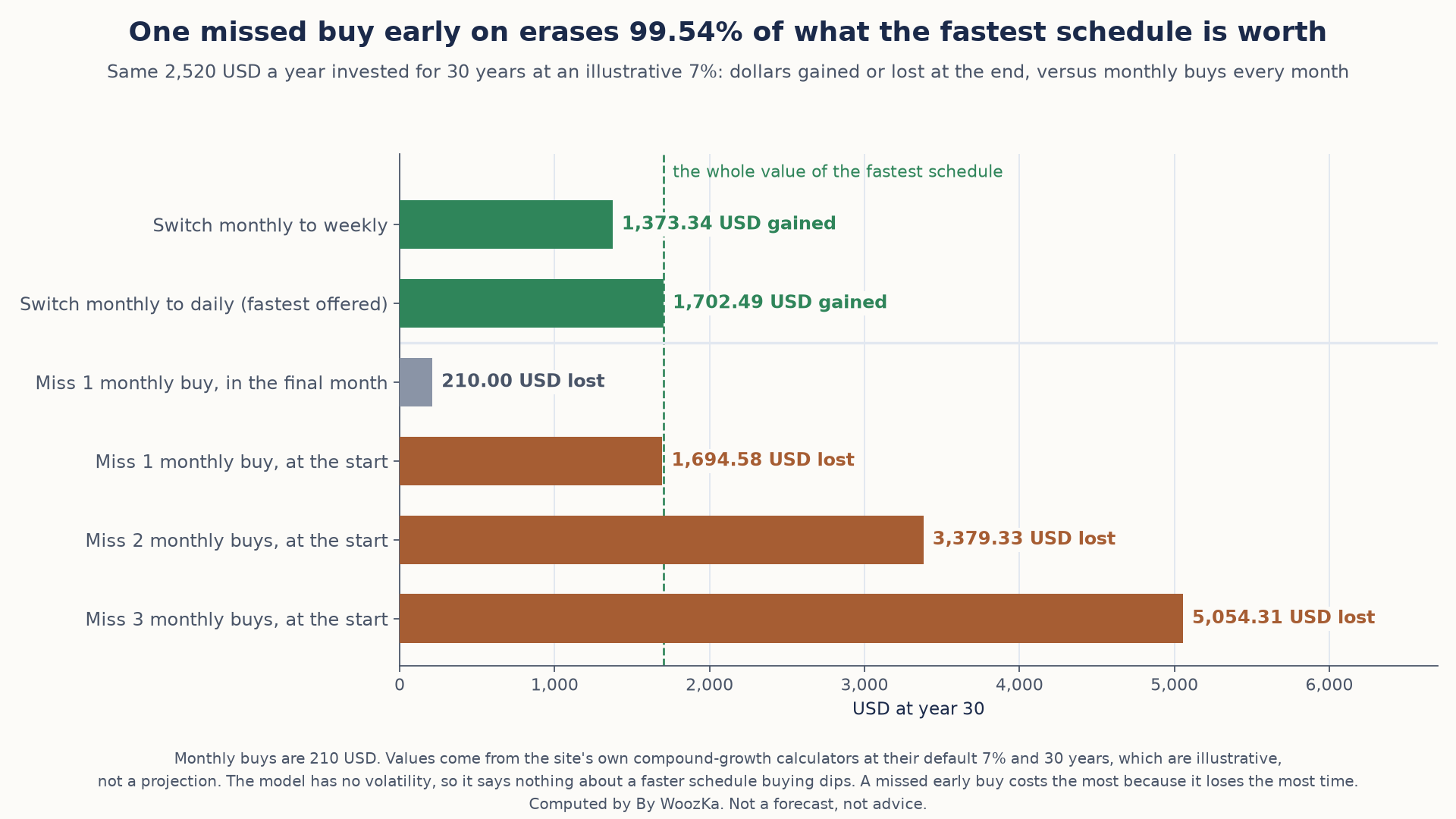
The schedule speed that setup screens advertise is worth about as much as one missed buy early on costs. Two missed months cost roughly twice the entire benefit of the fastest schedule.
What “the Months and Years It Then Runs” Is Worth
The closing claim above is that the setup takes minutes and the value comes from the years it then runs unattended. That is the one sentence in this article with a number behind it that can be printed, so here it is: the same $210 a month, tracked year by year, split into what was contributed and what the contributions earned.
| Year | Contributed | Growth | Growth share |
|---|---|---|---|
| 1 | $2,520 | $82.44 | 3.17% |
| 5 | $12,600 | $2,434.51 | 16.19% |
| 10 | $25,200 | $11,147.81 | 30.67% |
| 15 | $37,800 | $28,762.08 | 43.21% |
| 19 | $47,880 | $51,712.60 | 51.92% |
| 25 | $63,000 | $107,115.06 | 62.97% |
| 30 | $75,600 | $180,593.91 | 70.49% |
Growth does not overtake everything contributed until year 19. Before that the balance is mostly deposits; after it, mostly not. By year 30 the balance is $256,193.91 and growth is 70.49% of it, so slightly more than seven dollars in ten were never deposited by anyone. That is the arithmetic case for the unattended part, and it also explains why the lapse table above bites hardest at the start: the early contributions are the ones with time to become that 70.49%.
All of this can be reproduced in a browser; here is the route. Every figure above was produced by the two calculators this site already ships — computeCompoundDcaSchedule and computeCompound, called directly on their live tool pages — and separate code re-implements both and confirms every published value before reporting. The model compounds at a constant rate and therefore contains no volatility at all: nothing here says anything about a faster schedule buying more dips, which is a separate question this model cannot answer. It isolates one effect only, money arriving sooner on average within the year. The 7% rate and 30-year horizon are the linked calculator’s defaults, chosen so the tables reproduce on the first screen a reader sees, and they are illustrative rather than a projection; 252 trading days is used for the daily schedule because a buy scheduled on a closed day rolls forward, as noted above. Whether dollar-cost averaging beats investing a lump sum is a different question with its own evidence, and it is not touched here. Nothing above recommends a broker, a security, a schedule, or an amount.
The Question That Model Could Not Answer, on a Nasdaq-100 Fund
The paragraph above sets one question aside: whether a faster schedule buys more dips. A constant-rate model cannot answer it, and it matters most for the kind of fund people most often ask to put on autopilot, one tracking the Nasdaq-100, an index whose swings are large enough to make the question real. Setting one up is the same five steps as any other fund, and two of the broker rules above land on it directly: Robinhood’s exclusion of leveraged and inverse products covers the 2× and 3× Nasdaq-100 funds, and at Schwab, where automation covers mutual funds only, the instrument would have to be a Nasdaq-100 index mutual fund whose eligibility shows on the enrollment screen.
So here is the dips question on real prices. The same $210 a month went in through three schedules in every ten-year window that starts in a month from January 2007 to September 2016 — 117 windows, each ending on its last close, each putting in exactly $25,200: $210 on the month’s first trading day, equal amounts on every trading day, and $210 on the month’s last trading day.
| Monthly buy on | Beat daily | Median vs daily | Range vs daily |
|---|---|---|---|
| First trading day | 117 of 117 | +0.52% | +0.18% to +1.07% |
| Last trading day | 0 of 117 | −0.58% | −0.91% to −0.28% |
The daily plan landed between the two monthly plans in every one of the 117 windows, and the gap between the two monthly plans, a median of 1.13%, is about twice either one’s distance from daily. That ordering is not luck, and it is not dip-buying. A daily plan is, by construction, a bundle of smaller monthly plans, one for each trading-day slot in the month, so it cannot buy more dips than the monthly plans it is made of; it averages them. What a faster schedule buys on a Nasdaq-100 fund is not a better price. It is not having to pick a day, and the day matters about twice as much as the schedule. The month-start plan wins here because its money goes in sooner, in a stretch when the index mostly rose; nothing here says that order would hold in a stretch when it did not.
The Same $210 a Month, Started at Each Nasdaq-100 Peak
The question a Nasdaq-100 fund really puts to an automated plan is a different one: will you leave it running? Here is the same $210, bought at each month-end close, started at three high points — the index’s record month-end closes of March 2000 and December 2021, and its highest month-end before the 2008 crash — and run through August 2026.
| Started | Plan’s worst | In the black for good | Index back to start |
|---|---|---|---|
| Mar 2000 | −51.0%, month 31 | Jul 2009 | Feb 2015 |
| Oct 2007 | −32.8%, month 14 | Jul 2009 | Jan 2011 |
| Dec 2021 | −16.7%, month 10 | Mar 2023 | Dec 2023 |
The plan begun in March 2000 hit bottom in its 31st month, worth $3,188 against $6,510 put in. That is the moment an automated plan is most likely to be switched off: the most money in, none of it recovered, and a statement showing half of it gone. It was underwater in 61 of its first 112 months and then in the black for good from July 2009, 9.3 years in, while the index itself took 14.9 years to get back to its March 2000 month-end. The plans begun in 2000 and in 2007 turned for good in the same month. The index column is there to show how long the price took, not who ended with more; whether a lump sum or a schedule comes out ahead is a different question with its own measured answer.
Method and limits, so this can be checked rather than taken on trust. Prices are daily closes of the Nasdaq-100 Index from Nasdaq’s own historical-data service, retrieved September 24, 2026. Nasdaq’s file repeats the prior close on market holidays, which were dropped, and carries a stale stretch from October 28 to November 15, 2002, so that month’s closing level was taken from a second, independent price record, which also matched thirteen other month-ends checked against it. Closes before 2003 are carried to whole index points. The ten-year windows start in 2007 because the daily record before then has gaps. This is the price index, so dividends are left out and every plan value understates what a fund holder who reinvested them had; no fees or taxes are included. The three peaks were chosen after the fact, and the Nasdaq-100 is being asked about partly because it recovered, so none of this is a forecast. No shipped calculator on this site runs historical prices, so there is no tool link here; the arithmetic was computed in code that re-derives and confirms every published figure before reporting. Nothing above recommends a fund, a broker, a schedule, or an amount.
The Bottom Line
Automating your investing is mechanically simple on every major brokerage, but the details genuinely differ: Fidelity and Robinhood support a true $1 automatic recurring buy directly into stocks and ETFs, and Vanguard into its own ETFs, with Robinhood uniquely offering a daily schedule and Vanguard requiring its ETF version to be pre-funded from the settlement account rather than pulled straight from a bank. Schwab is the outlier — its genuine automation, for now, is built around mutual funds rather than individual securities, even though its Stock Slices feature makes manual fractional purchases just as easy as anywhere else. Whichever broker you use, the setup itself takes a few minutes; the value comes from the months and years it then runs without you having to think about it.
Once it’s running, the two questions that matter most are what you’re buying and how you’re weighting the fear and greed rules — both covered in The Autopilot Plan. For a side-by-side of brokerages built specifically around the fractional-share, auto-investing feature set, see the brokerage comparison. For the weekly market read this blog uses to apply the fear and greed rules, subscribe to the newsletter below.
Run it on your own numbers: the three constant-rate tables above came from two shipped tools. The Compound & DCA Growth Schedule produces the year-by-year contributed-versus-growth split and the year-19 crossover — change the amount, the rate or the frequency and the crossover moves with them. The Compound Growth Calculator is what prices a missed buy: run your plan for its full length, run it again for the same length minus the buys you skipped, and the difference is the second table.
Disclaimer: This article is educational content, not financial advice. I am not a licensed financial advisor, and nothing here is a recommendation to buy or sell any security or asset. Investing and trading involve risk, including the possible loss of the money you invest. Do your own research and consider consulting a licensed financial professional before making investment decisions. Read the full Disclaimer.
